Thursday, June 25th 2026

AMD's FSR 4.1 Performance on RDNA 3 Notably Slower than FSR 3.1

AMD recently released FSR 4.1 for its RDNA 3 GPUs, which demonstrated a handy performance increase over native rendering on RDNA 3, but a recent comparison by German outlet, ComputerBase, has revealed that there are noticeable performance regressions when comparing FSR 4.1 to FSR 3.1 on RDNA 3 GPUs. The publication tested FSR 4.1 and FSR 3.1 on the AMD Radeon RX 7900 XTX, RX 7800 XT, and RX 7600, and FSR 4.1 on the Radeon RX 9070 XT. In geometric mean results of nine tested games, the 9070 XT scores an identical frame rate to the RX 7900 XTX in 4K native resolution, but the RDNA 3 flagship scores 52.6 FPS when using FSR 4.1 Quality settings, compared to 56.5 FPS on the 9070 XT—a 7% performance penalty. Looking at FSR 4.1 Performance, the gap grows, with the 7900 XTX serving 65.2 FPS in the test, while the 9070 XT scores 71.9 FPS, making the 7900 XTX 9% slower than the 9070 XT at FSR 4.1 compute.

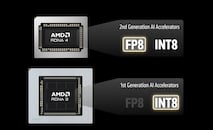
The comparison between FSR 4.1 and FSR 3.1 on RDNA 3 is where it becomes even more interesting, with the geometric mean reflecting an 11% performance penalty for FSR 4.1 in Quality mode and a 14.5% regression in Performance mode. AMD previously explained in an interview with TechPowerUp that there were notable differences between the implementation of FSR 4.1 on RDNA 4 and RDNA 3, specifically that the older hardware uses 8-bit integer (INT8) data, while the RDNA 4 implementation uses the built-in FP8 support in the 2nd-generation AI accelerators in RDNA 4 GPUs. Despite this, AMD claims that it aimed for quality parity across different RDNA generations, which may partially explain the bigger performance penalty on RDNA 3 GPUs. FSR 4.1 support has yet to make it to RDNA 2 GPUs, with official support for the RX 6000-series graphics cards planned for early 2027, so we have yet to see what sort of performance penalty will be incurred there, however, AMD also commented that supporting that older hardware is even more complex, since there are no dedicated AI accelerators. This means RX 6000 GPUs will need to rely on Stream Processors to compute FSR 4.1 upscaling.
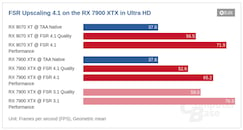
The performance gap is similar in the less premium GPUs, with FSR 4.1 Performance underperforming FSR 3.1 Performance by 9% on the RX 7800 XT and FSR 4.1 Quality coming in with a 7% performance regression. The RX 7600 tells a similar story, showing a 7% difference between FSR 3.1 Quality and FSR 4.1 Quality and a 9% gap between FSR 4.1 and FSR 3.1 in Performance mode.
Source: ComputerBase

189 Comments on AMD's FSR 4.1 Performance on RDNA 3 Notably Slower than FSR 3.1

#1
AntiX3DGlazer
I mean what did we expect? It's a technology made first and foremost with the latest generation in mind.
Posted on Reply
#2
arbiter
So its approx 7-10% slower but think would want to see is side by side image comparison to see if they close to same or was compromise made there.
Posted on Reply
#3
Dr. Dro
So, what is it? Yesterday it was massive performance gains, today it's notably slower?

These latest models are complex, a performance hit is to be expected. Try Render Preset L DLAA on any RTX - it's heavy even for the 5090.

Still doesn't mean that it's not useful or that it was fine for AMD to withhold it for all this time. While I'm happy that gamers get a choice now, it came late, and only because of community pressure. That's not something I agree with.
Posted on Reply
#4
john_
AMD said that if I am not mistaken. They said it will be slower and that was their main excuse for not releasing it officially for older cards. Also the latest DLSS version is slow on RTX 20 and RTX 30 series if I am not mistaken.

Also we have to consider visual quality improvements here. If FSR 4.1 is better in visual quality when in balanced mode compared to FSR 3.1 when in quality mode, then we shouldn't be comparing quality vs quality.
Posted on Reply
#5
wolf
Better Than Native
I mean, I don't think anyone reasonably expected it to perform the same as FSR3... essentially all signs point to it needing more compute time to execute. My question would be, for example, if FSR4 Balanced performs similarly to FSR3 Quality, which looks better? I think I know what I'd bet on.

Similar with DLSS. 1st gen Transformer model is heavier than the final CNN model, 2nd gen Transformer is heavier than the 1st and so on, on any compatible hardware, and the further you go back (and lower tensor throughput and capability) the more the gap widens.

Still a massive win (finally) for RDNA3. Eager to see how RDNA2 fares come 2027, from an academic standpoint mostly, given how old and relatively performant that generation is now and will be by then.
Posted on Reply
#6
Dukenukemx
Doesn't FSR4.1 run slower than FSR3 in everything? It's just less slower on RDNA4.
Posted on Reply
#7
Dr. Dro
DukenukemxDoesn't FSR4.1 run slower than FSR3 in everything? It's just less slower on RDNA4.
FSR 4.x would always run slower on previous generation cards, but I'm fairly sure that if you manage to benchmark the model's execution time, FSR 3.x would probably run faster on the 9070 XT, too. The more complex the neural processing model, the longer it takes to execute, even if more hardware resources are available to do so.

I gotta say, FSR has come a long way from being CAS shader. Previous generation hardware is always, of course, subject to losing even more performance, the scale of which of course subject to the hardware's ML capabilities, or lack thereof (in the case of RDNA 2, specifically).

This is entirely normal and expected - what I'm all for is giving gamers options :)
john_AMD said that if I am not mistaken. They said it will be slower and that was their main excuse for not releasing it officially for older cards. Also the latest DLSS version is slow on RTX 20 and RTX 30 series if I am not mistaken.

Also we have to consider visual quality improvements here. If FSR 4.1 is better in visual quality when in balanced mode compared to FSR 3.1 when in quality mode, then we shouldn't be comparing quality vs quality.
I agree with you, was just mentioning the thread from this Wednesday or so. Think you can find that in the forum's "related threads" footer widget
Posted on Reply
#8
AusWolf
Isn't this the same diagram that we saw when people tested the leaked version months ago?
Posted on Reply
#9
ToTTenTranz
I think the main point here is whether FSR4.1 Performance looks better or worse than FSR3 Quality.

Some people say like it looks better or similar, at least in motion, and that makes it a performance and a quality win for RDNA3 users.

Even if it doesn't, FSR4.1 Balanced should have the same performance impact as FSR3 Quality, and that's at least an image quality win.
Posted on Reply
#10
Spacemarkl
I don't mind. It is faster than native, that is the entire point of upscaling, isn't it? And it looks better than FSR3 even on lower settings. Only when the GPU is not powerful enough anymore to produce enough FPS even with performance settings it might become an issue. But then it's time for a new GPU.
Posted on Reply
#11
RejZoR
I love how for example RTX 3080 has the exact same issue with DLSS 4.5 but it somehow never made into the "news" sections. Sure, it can run DLSS 4.5 too and get similar quality, but at expense of greater performance hit.

How is this news worthy or surprising? Also, on the flip side, due to incredible increase in visual quality of FSR 4.1, you can afford switching from Quality to Performance preset and get better performance with what I can easily say better visual quality than FSR 3.1 Quality.
Posted on Reply
#12
TheGeekn°72
AntiX3DGlazerI mean what did we expect? It's a technology made first and foremost with the latest generation in mind.
it's not "made for the latest generation", it's the latest generation that got the accelerators required to run it, Radeon R&D obsered better results with FP8 models, they got FP8 HW accels on RDNA4, simple as
Dr. DroSo, what is it? Yesterday it was massive performance gains, today it's notably slower?

These latest models are complex, a performance hit is to be expected. Try Render Preset L DLAA on any RTX - it's heavy even for the 5090.
yeah, that kinda tech is finicky, it plays nice or it don't, the thing that matters is if the performance and/or quality achieved is satisfactory

so, is it? only players can tell for themselves
RejZoRI love how for example RTX 3080 has the exact same issue with DLSS 4.5 but it somehow never made into the "news" sections. Sure, it can run DLSS 4.5 too and get similar quality, but at expense of greater performance hit.

How is this news worthy or surprising? Also, on the flip side, due to incredible increase in visual quality of FSR 4.1, you can afford switching from Quality to Performance preset and get better performance with what I can easily say better visual quality than FSR 3.1 Quality.
double standards from the community between the options at hand, always has been, zero surprise there
Posted on Reply
#13
JustBenching
RejZoRI love how for example RTX 3080 has the exact same issue with DLSS 4.5 but it somehow never made into the "news" sections. Sure, it can run DLSS 4.5 too and get similar quality, but at expense of greater performance hit.

How is this news worthy or surprising? Also, on the flip side, due to incredible increase in visual quality of FSR 4.1, you can afford switching from Quality to Performance preset and get better performance with what I can easily say better visual quality than FSR 3.1 Quality.
TheGeekn°72double standards from the community between the options at hand, always has been, zero surprise there
Completely double standards. No negative news about nvidia have ever been posted here. I did a 5 second search and came up empt....oh wait.

AleksandarK in DLSS 5: Gamers Prefer Original Visuals, Many Await Real-World ResultsWhen NVIDIA announced its Deep Learning Super Sampling (DLSS) 5 technology, which the company describes as the first real-time neural rendering technology to bring photorealism to game textures, the r…
Event Horizon in NVIDIA DLSS 5 Gets 84% Dislikes on YouTube as Backlash GrowsAMD is definitely working on their own version of Sloptracing. If they're smart, they'll keep quiet about it until all these glaring issues are resolved.

Ok nevermind, im stupid, silly me.

Whats funny is that both of you complaining about double standards have freaking POSTED in these threads :banghead::banghead:

Complaining about double standards when you are the ones with double standards...
Posted on Reply
#14
arbiter
RejZoRI love how for example RTX 3080 has the exact same issue with DLSS 4.5 but it somehow never made into the "news" sections. Sure, it can run DLSS 4.5 too and get similar quality, but at expense of greater performance hit.

How is this news worthy or surprising? Also, on the flip side, due to incredible increase in visual quality of FSR 4.1, you can afford switching from Quality to Performance preset and get better performance with what I can easily say better visual quality than FSR 3.1 Quality.
JustBenchingCompletely double standards. No negative news about nvidia have ever been posted here. I did a 5 second search and came up empt....oh wait.
Or maybe cause it worked on 3000 and 2000 series cards from day 1. AMD I doubt updated it to work on 7000 series cards cause they wanted it but more they were forced to by unhappy customers. Its less about double standard and more likely it took amd near a year to get around to figuring out how to get it to work on older cards.
Posted on Reply
#15
dgianstefani
TPU Proofreader
arbiterOr maybe cause it worked on 3000 and 2000 series cards from day 1. AMD I doubt updated it to work on 7000 series cards cause they wanted it but more they were forced to by unhappy customers.
Obvious explanation, there was no hesitation releasing the equivalent for older NVIDIA cards at the same time as it was released for the current gen.
Posted on Reply
#16
Vayra86
Of course its not going to net the same performance benefit, we can already observe that quality is inversely proportional to performance from anywhere between Native settings to Quality/Performance setting of any upscaler you deploy. Why would this be different?

Nice clickbait article for nubs I guess
Posted on Reply
#17
TheGeekn°72
JustBenchingOk nevermind, im stupid, silly me.
glad to see you noticed
JustBenchingWhats funny is that both of you complaining about double standards have freaking POSTED in these threads :banghead::banghead:

Complaining about double standards when you are the ones with double standards...
DLSS5 is completely unrelated to the discussion at hand, *THAT* is straight up changing how games look with the AI slopifier 10000 from the leather jacket man

an example of what I was actually referring to: RTX50 drivers are FUCKING SHIT and were from the launch, yet Radeon drivers haven't had significant troubles since last RX6000/early RX7000 and essentially only kept improving but you still have NvidAI glazers telling people "muh Radeon drivers BAD!!!1!!1!" while they are choking on the fumes of burnt power connectors.
Posted on Reply
#18
RejZoR
JustBenchingCompletely double standards. No negative news about nvidia have ever been posted here. I did a 5 second search and came up empt....oh wait.

AleksandarK in DLSS 5: Gamers Prefer Original Visuals, Many Await Real-World ResultsWhen NVIDIA announced its Deep Learning Super Sampling (DLSS) 5 technology, which the company describes as the first real-time neural rendering technology to bring photorealism to game textures, the r…
Event Horizon in NVIDIA DLSS 5 Gets 84% Dislikes on YouTube as Backlash GrowsAMD is definitely working on their own version of Sloptracing. If they're smart, they'll keep quiet about it until all these glaring issues are resolved.

Ok nevermind, im stupid, silly me.

Whats funny is that both of you complaining about double standards have freaking POSTED in these threads :banghead::banghead:

Complaining about double standards when you are the ones with double standards...
Entirely irrelevant. You're quoting some topics about personal opinion on what looks better. None of it touches the fact that RTX 3000 and RTX 2000 series have severe performance penalty when computing DLSS 4.5 yet you need to find that out by digging through NVIDIA docs, there were no sensationalist news about it. It was just always "it works on ALL RTX cards" without any asterisks.
arbiterOr maybe cause it worked on 3000 and 2000 series cards from day 1. AMD I doubt updated it to work on 7000 series cards cause they wanted it but more they were forced to by unhappy customers. Its less about double standard and more likely it took amd near a year to get around to figuring out how to get it to work on older cards.
That's entirely irrelevant as well. The matter at hand here isn't "when it was supported" or "on what graphic cards". It's about performance penalty on cards that don't have all the capabilities to fully utilize upscaler in both performance and visual quality.
Posted on Reply
#19
TheGeekn°72
RejZoRIt was just always "it works on ALL RTX cards" without any asterisks.
just like 5070=4090 lmao
Posted on Reply
#20
unlox
funny how this "news" is presented as if it was something that we discovered now ... we know this since fsr 4 is out .. it is slower than FSR 3, OF COURSE , it's not as if ML had no cost ... OF COURSE the chart doesn't show FSR3.1 on RDNA4 .. of course as it would made that "news" practically irrelevant in this way of presenting things , right ?
once again I ask : is it expected for us to be disappointed when we read news like this ? is it the goal ? should we forget all what we know from reality ? are we supposed to be stupider than we are maybe ? i know marketing thinks like that, so ...
Posted on Reply
#21
ObscureAngelPT
It was expectable.
Still I wouldn't consider a massive loss compared to the 9000 series.

And FSR 4 is notably more demanding than FSR 3 in any card.
The same way that DLSS 4.5 is also way more demanding than DLSS 4 and FSR 4.

And TSR being more demanding than TAA etc etc...
Posted on Reply
#22
dgianstefani
TPU Proofreader
RejZoREntirely irrelevant. You're quoting some topics about personal opinion on what looks better. None of it touches the fact that RTX 3000 and RTX 2000 series have severe performance penalty when computing DLSS 4.5 yet you need to find that out by digging through NVIDIA docs, there were no sensationalist news about it. It was just always "it works on ALL RTX cards" without any asterisks.
It's like 10% slower than the transformer model, hardly severe. Still faster than native, and much faster considering you can reasonably used balanced presets on 4/4.5 instead of quality with the previous DLSS 3 version while still getting a better image. Same thing with FSR 4.

The issue people are having is that why didn't AMD just do the same thing, why did they have to be bullied into it, people would prefer a slightly less performant upscaler that doesn't look like dogs**t.

The article is just to confirm that AMD was in the same position as NVIDIA, they had the option of releasing the newest model for older cards for the same performance penalty, but chose to make excuses about performance instead. There was speculation they were waiting to ensure performance was the same, but that's obviously not the case as we can see now.

I'm also wondering if it wasn't just Steam/Sony/MS XB who developed this/made them do this and the PC version is an afterthought.
Posted on Reply
#23
_roman_
TheGeekn°72yet Radeon drivers haven't had significant troubles since last RX6000/early RX7000 and essentially only kept improving but you still have NvidAI glazers telling people "muh Radeon drivers BAD!!!1!!1!" while they are choking on the fumes of burnt power connectors.
I a nivida 9800m gts, a nivia 660m gtx and because i sold my radeon 6600xt, i had for 3 months a second hand msi? 960 gtx 4gb. After that radeon 6800 non xt, 7800xt and currently 9070 non xt.

the drivers for amd radeon are bad on windows 11 pro and 10 pro. For gnu gentoo linux there exists any software.

To claim amd has no bad drivers get on my nerves.

high ide power consumption was reported and verified by multiple people over the years for radeon 6000. (afaik radeon 5000 also)
My banned user, german text, but code is generic and can be read in any langauge.
high idle power consumption which i fixed myself for w11 pro and gnu gentoo linux for the msi radeon 6800 z trio
www.computerbase.de/forum/threads/info-msi-radeon-6800-z-trio-idle-verbrauch-reduzierung.2145581/
root cause, edid is wrongly parsed for w11 pro and gnu gentoo linux

7800xt got low level hardware features removed, see this forum, linux section post by me. verified by amd software engineer on github. source: github, source different forum, etc. I only verified it as i had hte same hardware and different linux kernel based operating system

asus prime radeon 9070 non xt firmware issues, no post screen
_roman_ in ASUS Prime Radeon RX 9070 OC Edition, AMD, 16GB - GDDR6 Gaming Graphics CardThis is just for information when someone looks for data for this particular grpahic card. 445094 Known Issues: The card does not render the POST Screen, The Power on Self Test Screen. That is annoyin…
Firmware is prodived partly by amd. I doubt ASUS does here a lot or has access to a lot. Just that the card shows a picture after i entered in the dark with no picture the EFI stub LUKS unencrytion passphrase and the linux firmware with amdgpu kenrel module reinitialise the card showed that amd cards can not do the basics. That asus proart monitor was in use with 6600xt, nvidia 960, ryzen 7600x, radeeon 6800 non xt, ryzen 7600x, 7800xt, ryzen 7700x, defictive radeon 9070 non xt from asus, ryzen 7700x, and last now with acer radeon 9070 non xt. Except one defective asus radeon 9070 non xt any other device + several different notebooks worked with that asus proart 350€ monitor.


needs to be verified, checked, past hours my question why amd windows 11 pro latest adrenalin drivers report 3 Watt power consumption vs 9-11 Watt in gnui gentoo linux.

-- RAndom crashes in star wars jedi survivor with powercolor 7800xt hellhound

past months random crashes powercolor 7800xt hellhound w11 pro wiht my last time at portia (epic game store, but exe run in windows explorer offline, no epiic game store).

-- That I need 5 different windows amd gpu drivers since radeon 6600xt days which I bought in the first 2 weeks of release speaks volume. one of 5 windows drivers works, else it is problematic.

Random windows 11 pro crashes of radeon 7800xt. I would have to think much longer to remember why etc and when. But they happen and it is annoying.

I wrote it here in a different topic, linux kernel, etc. only has, when i remember correctly, since ~april 2025, Fan control support for the radeon 7800xt. That was basically close when the 2 year warranty ran out in november 2025. (Feel free to dig up the comment which i wrote on that)

except a bad lact guy from users, amd has 0 - nothing - graphical user interface for the linux userspace. low level sensor access get removed silently.

There are different users here who have issues with amd and windows. the only usable amd gpu driver version is from 12/2025 quite often for microsoft windows for the radeon 7000 cards.

---
---

Of course a different algorithm sometimes needs different cpu instructions and therefore *may* have performance impacts.
Why should another code revision, * FSR 4.1* run faster than * FSR 3.0* . -> my take on this topic.
Posted on Reply
#24
JustBenching
TheGeekn°72glad to see you noticed

DLSS5 is completely unrelated to the discussion at hand, *THAT* is straight up changing how games look with the AI slopifier 10000 from the leather jacket man

an example of what I was actually referring to: RTX50 drivers are FUCKING SHIT and were from the launch, yet Radeon drivers haven't had significant troubles since last RX6000/early RX7000 and essentially only kept improving but you still have NvidAI glazers telling people "muh Radeon drivers BAD!!!1!!1!" while they are choking on the fumes of burnt power connectors.
RDNA 4 drivers have been horrible actually, at least according to the internet / reddit / twitter. Many creators made videos about it, for example no UE4 game with RT could run on RDNA 4 without major stuttering.
Posted on Reply
#25
dyonoctis
RejZoRI love how for example RTX 3080 has the exact same issue with DLSS 4.5 but it somehow never made into the "news" sections. Sure, it can run DLSS 4.5 too and get similar quality, but at expense of greater performance hit.

How is this news worthy or surprising? Also, on the flip side, due to incredible increase in visual quality of FSR 4.1, you can afford switching from Quality to Performance preset and get better performance with what I can easily say better visual quality than FSR 3.1 Quality.
TheGeekn°72it's not "made for the latest generation", it's the latest generation that got the accelerators required to run it, Radeon R&D obsered better results with FP8 models, they got FP8 HW accels on RDNA4, simple as


yeah, that kinda tech is finicky, it plays nice or it don't, the thing that matters is if the performance and/or quality achieved is satisfactory

so, is it? only players can tell for themselves


double standards from the community between the options at hand, always has been, zero surprise there
All I can say is that TPU staff was different back then, IIRC. The impact of the transformer model on older RTX GPUs has been thoroughly tested by various outlets; everybody knew as soon as reviewers could get their hands on the model.

Techspot didn't make news about FSR. Same for tweaktown, 3D guru, OC3D etc...
Posted on Reply
Nov 18th, 2026 09:49 CST change timezone

New Forum Posts

Popular Reviews

TPU on YouTube

Controversial News Posts