Thursday, December 8th 2022

Intel Core i9-13900KS Confirmed with 150W Base Power and 6 GHz Boost Speed
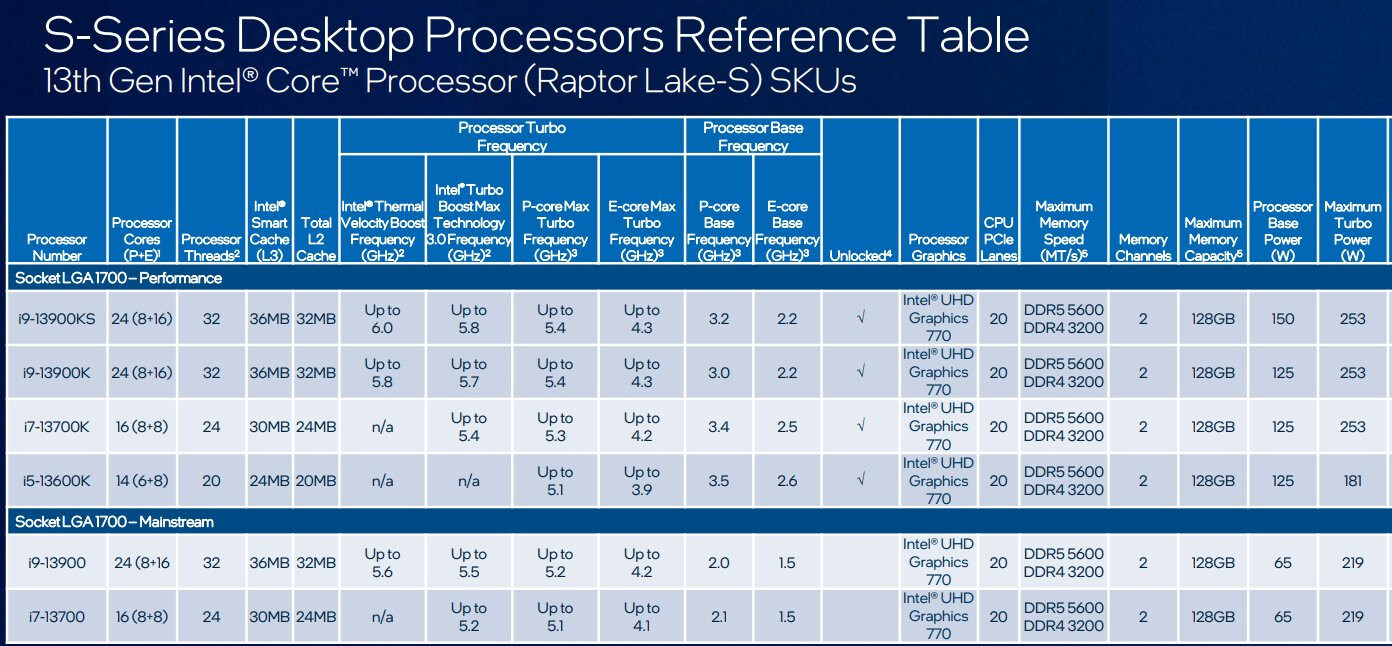
Intel is expanding its 13th Gen Core "Raptor Lake" desktop processor family with a number of new SKUs, led by the new flagship Core i9-13900KS. A leaked company slide confirmed the upper-end SKUs' specs. Led from the top, the new i9-13900KS packs the same 8P+16E (8 performance cores + 16 efficiency cores) configuration as the i9-13900K. It has a slightly higher 3.20 GHz base frequency compared to the 3.00 GHz of the i9-13900K, but boosts all the way up to 6.00 GHz, compared to 5.80 GHz of the i9-13900K. To ensure improved boost frequency residency, Intel bumped up the processor base power value from 125 W to 150 W, while leaving the maximum turbo power value untouched at 253 W.
We also see the specs of the non-K Core i9-13900 and Core i7-13700, which offer the same 8P+16E and 8P+8E core-configs as the i9-13900K and i9-13700K, respectively, but without unlocked multipliers. The i9-13900 ticks at 2.00 GHz with 5.60 GHz maximum turbo frequency, whereas the i7-13700 does 2.10 GHz base, with up to 5.20 GHz boost, compared to 3.40 GHz base and 5.40 GHz boost of the i7-13700K. As "locked" chips both have lower processor base power values of just 65 W, and maximum turbo power values of 219 W. Both these chips could include a cooling solution in the box, which is very likely the Laminar RH1 stock cooler that company includes with the i9-12900 and i9-12700. Intel is expected to announce these chips alongside a large number of 13th Gen Core i5 SKUs on January 3.
Sources:
HXL (Twitter), VideoCardz
We also see the specs of the non-K Core i9-13900 and Core i7-13700, which offer the same 8P+16E and 8P+8E core-configs as the i9-13900K and i9-13700K, respectively, but without unlocked multipliers. The i9-13900 ticks at 2.00 GHz with 5.60 GHz maximum turbo frequency, whereas the i7-13700 does 2.10 GHz base, with up to 5.20 GHz boost, compared to 3.40 GHz base and 5.40 GHz boost of the i7-13700K. As "locked" chips both have lower processor base power values of just 65 W, and maximum turbo power values of 219 W. Both these chips could include a cooling solution in the box, which is very likely the Laminar RH1 stock cooler that company includes with the i9-12900 and i9-12700. Intel is expected to announce these chips alongside a large number of 13th Gen Core i5 SKUs on January 3.
27 Comments on Intel Core i9-13900KS Confirmed with 150W Base Power and 6 GHz Boost Speed
There is a perception it is binned better, but that is simply not confirmed by the spec sheet. The spec sheet is very clear: you need more base TDP at the bottom end of the voltage scale (to feed a baseclock 200mhz), and in the top end Intel has a disclaimer because all frequencies are 'up to'.
So sure, you can win the lottery on a KS. You can also not, and simply waste the money based on perception and high hopes that its actually a better bin. Again: Intel created a spec sheet for this product that allows them to use the exact same bin as a K model.
A Ferrari simply has a higher top speed and acceleration. The KS adds another layer of uncertainty and perceived value on top, that never really has to materialize for Intel to not lie to you.
Its never stupid to bring consumption into discussion at ANY level, imho, and most importantly, it should be in play for those who can afford the top end and live in excess. Its a matter of responsibility. The meal at a luxury restaurant is not a problem. The problem isn't the price of the bun either. The problem is, that effectively the same buns keep creating bigger footprints per user, and it gets pretty silly if you consider those bigger footprints are suffering heavy diminishing returns in effective performance wins. Matter of fact, in the vast majority of use cases you won't ever see them, or is margin of error territory.
For most users of course it's useless and irrelevant, but I guess that's why it's a "special edition"