Monday, January 13th 2025

Intel "Bartlett Lake" Appears as a P/E-Core Hybrid, P-Core Only CPUs Could Soon Follow
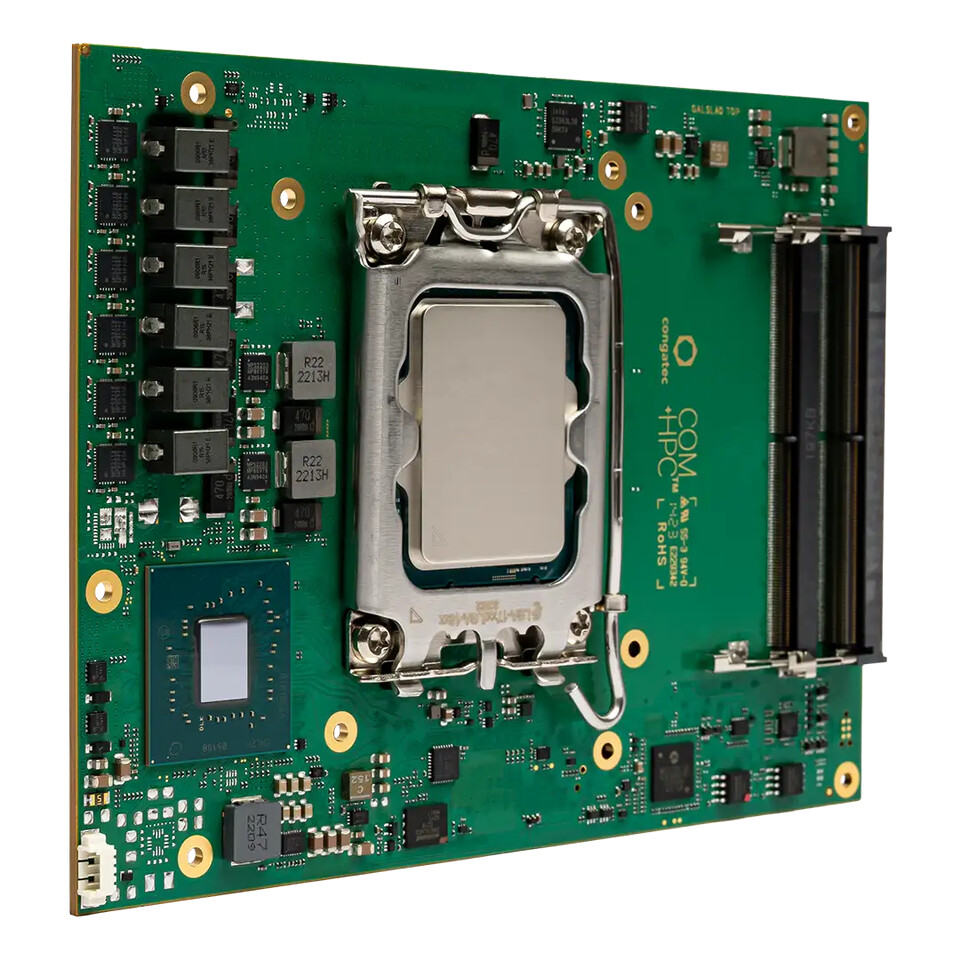
Intel has launched its first wave of Bartlett Lake processors, introducing hybrid-core models specifically designed for embedded systems, with pure performance-core (P-core) variants scheduled to follow later. The initial release, unveiled at CES, showcases the processors through congatec's new COM-HPC modules. The flagship Core 7 251E leads the embedded lineup with 24 cores (8P + 16E) and impressive clock speeds reaching 5.6 GHz boost. Intel claims this processor outperforms the i7-14700 by 6% in single-core and 8% in multi-core benchmarks, despite maintaining a modest 65 W TDP. The series also includes the Core 5 211E with 10 cores (6P + 4E) and the Core 3 201E featuring 4 P-cores. However, the more intriguing development lies ahead.
Earlier sources indicate that Intel plans to release pure P-core variants of Bartlett Lake in Q3 2025, targeting desktop users. These processors will introduce a more traditional approach by replacing E-core clusters with additional P-cores, resulting in configurations of up to 12 P-cores in the upcoming Core 9 series. The pure P-core models will maintain compatibility with existing LGA1700 motherboards, potentially offering an attractive upgrade path for current Intel platform users. The lineup is expected to include 8-core, 10-core, and 12-core variants under the Core 5, 7, and 9 brands respectively, with TDP options ranging from 45 W to 125 W. While the current embedded models focus on specialized applications like medical imaging and edge computing, the future P-core variants seem positioned to appeal to gamers. The processors are expected to utilize Raptor Cove cores, though rumors suggest Intel might consider backporting Lion Cove architecture to the platform.

Sources:
congatec, via Tom's Hardware
Earlier sources indicate that Intel plans to release pure P-core variants of Bartlett Lake in Q3 2025, targeting desktop users. These processors will introduce a more traditional approach by replacing E-core clusters with additional P-cores, resulting in configurations of up to 12 P-cores in the upcoming Core 9 series. The pure P-core models will maintain compatibility with existing LGA1700 motherboards, potentially offering an attractive upgrade path for current Intel platform users. The lineup is expected to include 8-core, 10-core, and 12-core variants under the Core 5, 7, and 9 brands respectively, with TDP options ranging from 45 W to 125 W. While the current embedded models focus on specialized applications like medical imaging and edge computing, the future P-core variants seem positioned to appeal to gamers. The processors are expected to utilize Raptor Cove cores, though rumors suggest Intel might consider backporting Lion Cove architecture to the platform.

84 Comments on Intel "Bartlett Lake" Appears as a P/E-Core Hybrid, P-Core Only CPUs Could Soon Follow
That's its job. en.wikipedia.org/wiki/Operating_system
I'd encourage you to read up a bit on computer architecture too.
With the E-cores removed, there should be no excuse (or justifiable reason) as to why disable this functionality, which is only available on early manufacture (up to around late 2021, earliest weeks of 2022 manufacture, round logo on IHS) 12th Gen CPUs, as long as the E-cores are disabled in BIOS and an old microcode that doesn't hide this functionality is loaded. Some BIOSes support this configuration, but it's not official and it's not guaranteed that your processor supports this, as Intel started to fuse off the hardware bits required to make it work past the date I've mentioned earlier.
Well maybe Sapphire Rapids but even then its latency sucks and all cores are like separated by an ocean even if latency is more consistent between them and the info is scarce on them besides it just being an insanely expensive platform with stupid enterprise overhead detrimental to consumers and gaming besides just cost unlike Broadwell E and prior Intel HEDT.
For AMD forget about it, Even their Threadripper is still 8 cores then more separated by an ocean as they just stack a bunch of 8 core CCDs into one package.
Zen 6 is maybe the hope but info keeps changing and who knows what they will do with AMD being cheap.
Hopefully intel releases 12 P core Bartlett Lake and it is stable and reliable and can clock a little more than 5GHz with Raptor Cove IPC and its stable and does not degrade and I will buy it immediately and sell my 9800X3D. It mayb be a slight downgrade in some gaming scenarios, but when games get more threaded or the few heavily threaded games (Cities SKyline with large populations and cities) the simplicity and extra cores with only mild 5-7% worse IPC will come so in handy and no hybrid or dual CCD scheduling nightmare crap.Way too late but better late than never especially in a world where X86 IPC gains are minimal. Zen 6 seems unknown but even rumors suggest its IPC increase is underwhelming. WIll it finally have the 12 core CCXs or just a rumor? But got to wait 2 friggin years and sick of waiting if it even has it.Maybe and that would make it a hard pass as that is on a mesh arch which sucks bad for gaming with horrible latency.