Tuesday, January 28th 2025

AMD Focused on Delivering RDNA 4 to Desktop, Mobile a Secondary Concern
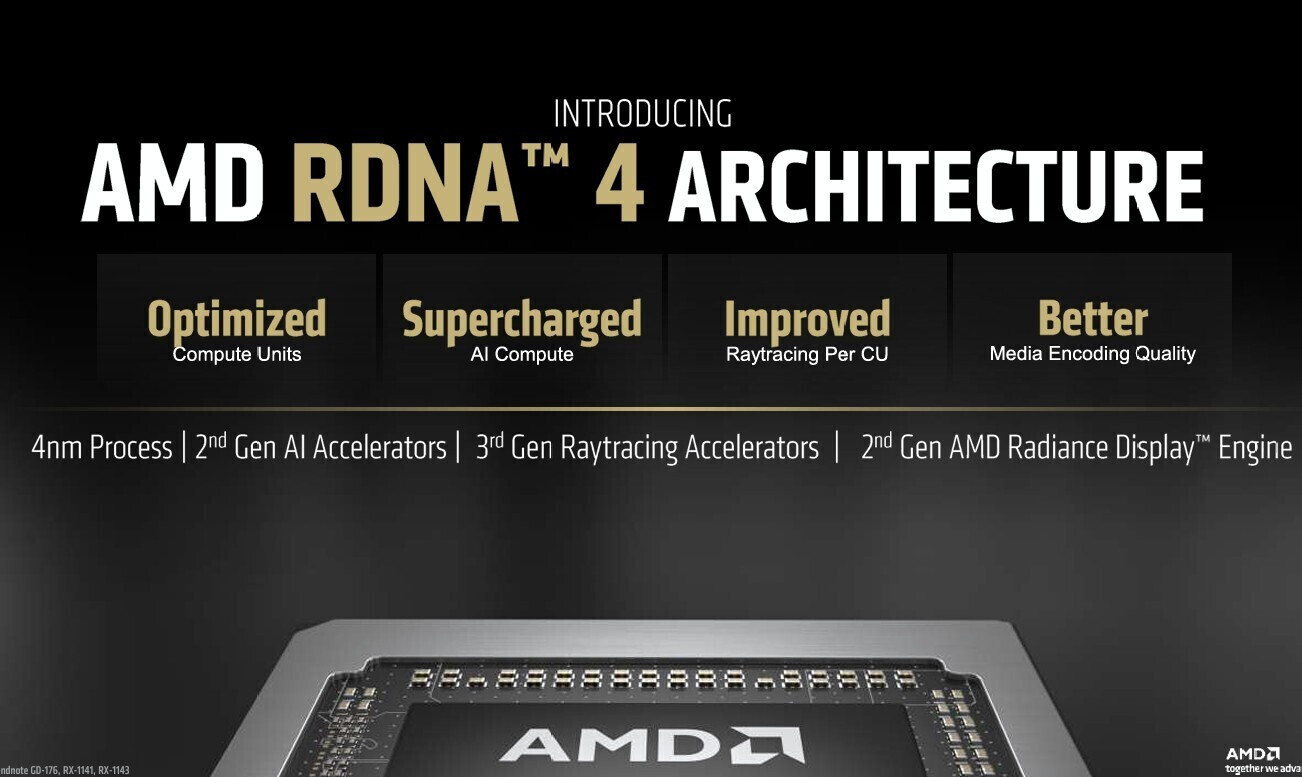
AMD's small portfolio of current-gen (RDNA 3) mobile-oriented Radeon dedicated GPUs pales in comparison to a wide selection of related desktop offerings—a certain demographic of PC gamers have wondered whether the incoming RDNA 4 generation will produce more options for portable platforms. An extensive Notebookcheck article indicates that Team Red is not (immediately) interested in catering to mobile dGPU enthusiasts—the online publication conducted an interview with Ben Conrad, director of product management (client-side). The "Navi Mobile" Radeon RX 7000M range is an uncommon sight on gaming laptops—relative to NVIDIA's wide rollout of dedicated GeForce RTX 4000 Mobile GPUs—normally, higher-end models are present on ultra-expensive specification sheets (paired with "Dragon Range" Ryzen HX CPUs). Industry experts believe that lower-end options are more likely to turn up inside external enclosures.
One of Notebookcheck's questions focused in on this topic—they believe that: "the number of AMD dGPU-based laptop SKUs have been pretty anemic." Their interviewee was ambushed with a query regarding his company's outlook for mobile RDNA 4 options. In response, Conrad stated: "our current graphics strategy is focused on the desktop market with RDNA 4. So, I think you'll see those types of products first in the future. Certainly, RDNA 4 and future graphics technologies will make it into mobile, whether they be on APUs or future products." VideoCardz has read "between-the-lines" and posits that Team Red could skip a generation—UDNA is possibly a better fit for a new wave of laptop dGPUs. A sort-of stopgap has appeared on the horizon—in the shape of AMD's forthcoming "Strix Halo" RDNA 3.5-based integrated solution. The flagship chip's Radeon 8060S iGPU looks promising when compared to a current-gen dGPU, but it will likely struggle when pitted against Team Green's "Blackwell" dedicated mobile platform. Upcoming competition in the APU field will arrive in the form of Intel's "Panther Lake" processors—slated for launch later this year. Its next-gen iGPU is said to utilize the Xe3 "Celestial" architecture.


Sources:
Notebookcheck Article, Tom's Hardware, VideoCardz
One of Notebookcheck's questions focused in on this topic—they believe that: "the number of AMD dGPU-based laptop SKUs have been pretty anemic." Their interviewee was ambushed with a query regarding his company's outlook for mobile RDNA 4 options. In response, Conrad stated: "our current graphics strategy is focused on the desktop market with RDNA 4. So, I think you'll see those types of products first in the future. Certainly, RDNA 4 and future graphics technologies will make it into mobile, whether they be on APUs or future products." VideoCardz has read "between-the-lines" and posits that Team Red could skip a generation—UDNA is possibly a better fit for a new wave of laptop dGPUs. A sort-of stopgap has appeared on the horizon—in the shape of AMD's forthcoming "Strix Halo" RDNA 3.5-based integrated solution. The flagship chip's Radeon 8060S iGPU looks promising when compared to a current-gen dGPU, but it will likely struggle when pitted against Team Green's "Blackwell" dedicated mobile platform. Upcoming competition in the APU field will arrive in the form of Intel's "Panther Lake" processors—slated for launch later this year. Its next-gen iGPU is said to utilize the Xe3 "Celestial" architecture.


29 Comments on AMD Focused on Delivering RDNA 4 to Desktop, Mobile a Secondary Concern
As for iGPUs replacing mobile dGPUs, yes, they have. Look at it in terms of what the chip makers are actually delivering to the OEMs. Intel just cancelled their Battlemage and beyond mobile dGPUs, specifically to focus on bringing Battlemage to laptops through Lunar Lake and are about to unveil their ultimate mobile graphics through Lunar Lake Halo. AMD have done the same with Strix Point and will do the same with Strix Halo, albeit with an inferior RDNA3.5 architecture compared to their soon to launch RDNA4 (which, by the way, no mention of a dGPU RDNA4 for laptops). Point is, there simply won’t be any further efforts from Intel and most likely AMD as well to do things nVidia’s way with mobile dGPUs.
As for the Mac, there’s no denying the M series have always been an incredible feat of engineering. They’re just also, unfortunately, far more restricted in what they can actually run compared to your typical x86 processor. It’s like owning a race car that runs on solar power, but you can only drive it at the race track, playing by Apple’s rules. So, their disruption is ultimately limited to their platform. And if you want that same level of market disruption from any other chipmaker, you’ll have to be ready to accept compromises of a similar calibre.
Also, a max spec MacBook Pro with M4 Max (16/40/16, CPU/GPU/Neural with the 48GB RAM minimum for that chip) starts at $3700, before even getting any storage upgrades. That’s not exactly a disruptive price. But the expense definitely helps with my race car analogy.