Friday, February 28th 2025

12V-2x6 Adapter with Monitoring and Shunt Resistors Appears for NVIDIA's GPUs
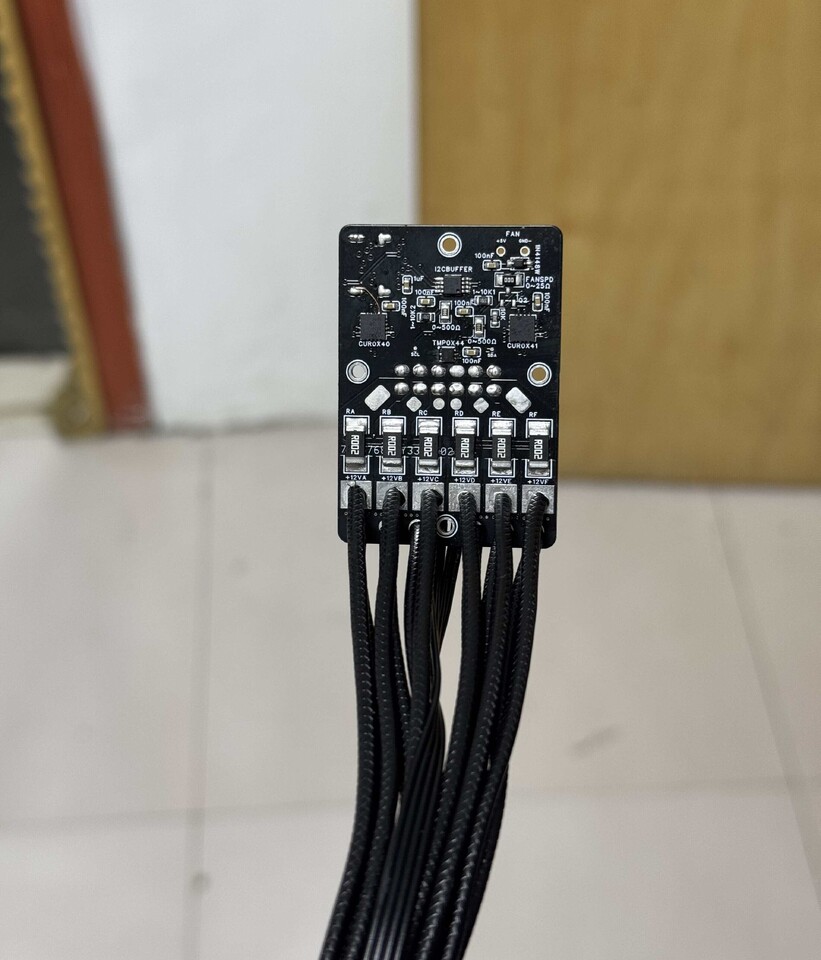
A monitoring adapter prototype for NVIDIA's problematic 12VHPWR/12V-2x6 power connectors has surfaced in Asian markets, potentially offering RTX 5090 owners a stopgap solution amid ongoing concerns about thermal issues and power delivery weaknesses. The prototype features a circuit board with individually routed +12V lines through shunt resistors, enabling precise current measurement across each power line while maintaining ground and sense pin functionality. The adapter incorporates voltage monitoring capabilities and an apparent alarm function designed to trigger during overload conditions. A USB port is present on the board for user-accessible data output to a custom display. Notably, the current design iteration appears to omit temperature monitoring functionality, focusing exclusively on current distribution metrics.
These monitoring solutions merely detect rather than resolve the fundamental design issues reportedly affecting NVIDIA's high-end graphics cards. NVIDIA has maintained silence regarding the reported thermal issues and power supply inconsistencies affecting their flagship GeForce RTX 5090 cards despite growing user concerns about connector safety and performance stability. The emergence of third-party monitoring solutions proves the demand for greater transparency regarding power delivery characteristics, particularly for cards operating at extreme power limits. The RTX 5090, with its factory power limit of 600 W, represents the most power-hungry GPU, getting its massive power through a single 12V-2x6 connector interface.


Sources:
BiliBili, via HardwareLuxx
These monitoring solutions merely detect rather than resolve the fundamental design issues reportedly affecting NVIDIA's high-end graphics cards. NVIDIA has maintained silence regarding the reported thermal issues and power supply inconsistencies affecting their flagship GeForce RTX 5090 cards despite growing user concerns about connector safety and performance stability. The emergence of third-party monitoring solutions proves the demand for greater transparency regarding power delivery characteristics, particularly for cards operating at extreme power limits. The RTX 5090, with its factory power limit of 600 W, represents the most power-hungry GPU, getting its massive power through a single 12V-2x6 connector interface.


35 Comments on 12V-2x6 Adapter with Monitoring and Shunt Resistors Appears for NVIDIA's GPUs
See Nvidia is creating jobs and opportunities for people.
You power supply unit does not have any accuracy on the "measurements" like a true rms multimeter has. Therefore it is not a valid measurement. It's the same as with those cheap 8-15€ Schuko - 230V - WIFI measurement plugs. No accuracy given.
I would only trust a true rms clamp - multimeter in this regard or an oscilloscope with current probes.
www.corsair.com/us/en/p/psu/cp-9020215-na/hxi-series-fully-modular-atx-power-supply-cp-9020215-na#tab-techspecs
that's not much for tech specs.
assets.corsair.com/image/upload/corsairmedia/sys_master/productcontent/49_002614_AA_WW_HXi_Series_QSG_Web.pdf
cwsmgmt.corsair.com/documents/CE-000521AA%20HXi%20Series%20(2020)%20PSU.pdf
I did not expect to see even an accuracy in the first place.
A true RMS multimeter is designed to measure both sinusoidal and non-sinusoidal AC waveforms accurately. It calculates the effective value of an AC waveform, providing precise measurements even in the presence of waveform distortions2. True RMS multimeters are highly accurate and are widely used in various applications, including industrial and commercial settings.
While the Corsair HX1500i provides accurate data for monitoring your PSU's performance, a true RMS multimeter offers a higher level of accuracy for measuring AC waveforms, especially in complex and distorted environments. If you need precise measurements for electrical work, a true RMS multimeter is the better choice."