Tuesday, May 13th 2025

AMD Announces EPYC 4005 "Grado" Zen 5 Server Processors for Socket AM5
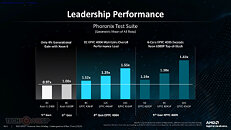
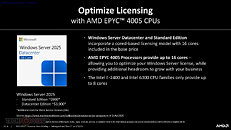
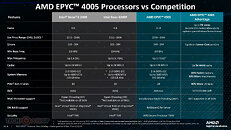
AMD today announced the EPYC 4005 series server processors in the Socket AM5 package, codenamed "Grado." These chips come with core-counts of up to 16-core/32-thread, letting enterprise users optimally utilize their Windows Server 2005 Datacenter Edition 16-core license in dedicated server scenarios. These chips offer superior value to competing Intel Xeon E-2400 series and Intel 6300 series processors that only offer up to 8 P-cores, suboptimally utilizing the 16-core license of Windows Server 2005 Standard- and Datacenter editions.
At the silicon level, "Grado" is essentially identical to the "Granite Ridge" MCM powering the Ryzen 9000 series client desktop processors. The processor has two 4 nm "Zen 5" CCDs, and a 6 nm I/O die. The IOD has ECC memory support unlocked, and memory speeds have been increased to DDR5-5600, compared to DDR5-5200 on the IOD of the previous generation EPYC 4004 "Raphael." The processor supports up to 192 GB of ECC DDR5 memory across a 2-channel (4 sub-channel) memory interface. The "Zen 5" CPU cores are identical in features to "Granite Ridge" client and "Turin" server processors, and up with a full 512-bit data path for the AVX-512 implementation. Processor models range from 6-core/12-thread to 16-core/32-thread.


 The IOD has a similar I/O setup to the Ryzen 9000 "Granite Ridge," with a 2-channel DDR5 memory interface, and a 28-lane PCIe Gen 5 root. It packs the latest generation of AMD Secure Processor (ASP), with a dedicated TrustZone compatible security system, support for hardware-accelerated encryption, memory encryption, TPM 2.0, and TSME.
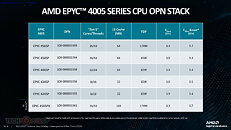
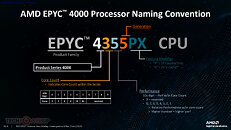
There are six processor models in the EPYC 4005 "Grado" series, the lineup is led by the EPYC 4565P, with a 16-core/32-thread configuration, 64 MB of L3 cache (32 MB per CCD), 4.30 GHz base frequency, up to 5.70 GHz boost, and a TDP of 170 W. The EPYC 4545P has the same 16-core/32-thread configuration, but with tighter clock speeds of 3.00 GHz base, and up to 5.40 GHz boost, with a TDP of just 65 W.
There is also the EPYC 4585PX, a model offered not just for servers, but also compute-intensive workstations. This chip implements 3D V-Cache on one of the two CCDs, and offers a 16-core/32-thread core configuration. The first CCD has 96 MB of L3 cache (64 MB 3D V-Cache + 32 MB on-die), while the second CCD is a regular one with just the 32 MB on-die L3 cache.
Next up, is the EPYC 4465P, a 12-core/24-thread part with a conventional cache structure of 64 MB L3 (32 MB per CCD), 3.40 base frequency, up to 5.40 GHz boost, and a TDP of 65 W. The EPYC 4345P is an 8-core/16-thread part with a single CCD that has 32 MB of L3 cache, clock speeds of 3.80 GHz base and up to 5.50 GHz boost, and a 65 W TDP. Lastly, there's the EPYC 4245P, a 6-core/12-thread part that ticks at 3.90 GHz base, up to 5.40 GHz boost, and comes with 32 MB of L3 cache.
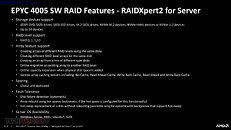
Exclusive to the EPYC 4005 and previous-gen 4004 series, is AMD RAIDXpert2 for Server, a software RAID solution that lets you build RAID volume with up to 14 devices on the platform, spanning SATA and NVMe interfaces. AMD offers driver support for Windows Server, RHEL, Ubuntu, and SLES.
The complete slide-deck follows.








At the silicon level, "Grado" is essentially identical to the "Granite Ridge" MCM powering the Ryzen 9000 series client desktop processors. The processor has two 4 nm "Zen 5" CCDs, and a 6 nm I/O die. The IOD has ECC memory support unlocked, and memory speeds have been increased to DDR5-5600, compared to DDR5-5200 on the IOD of the previous generation EPYC 4004 "Raphael." The processor supports up to 192 GB of ECC DDR5 memory across a 2-channel (4 sub-channel) memory interface. The "Zen 5" CPU cores are identical in features to "Granite Ridge" client and "Turin" server processors, and up with a full 512-bit data path for the AVX-512 implementation. Processor models range from 6-core/12-thread to 16-core/32-thread.


There are six processor models in the EPYC 4005 "Grado" series, the lineup is led by the EPYC 4565P, with a 16-core/32-thread configuration, 64 MB of L3 cache (32 MB per CCD), 4.30 GHz base frequency, up to 5.70 GHz boost, and a TDP of 170 W. The EPYC 4545P has the same 16-core/32-thread configuration, but with tighter clock speeds of 3.00 GHz base, and up to 5.40 GHz boost, with a TDP of just 65 W.
There is also the EPYC 4585PX, a model offered not just for servers, but also compute-intensive workstations. This chip implements 3D V-Cache on one of the two CCDs, and offers a 16-core/32-thread core configuration. The first CCD has 96 MB of L3 cache (64 MB 3D V-Cache + 32 MB on-die), while the second CCD is a regular one with just the 32 MB on-die L3 cache.
Next up, is the EPYC 4465P, a 12-core/24-thread part with a conventional cache structure of 64 MB L3 (32 MB per CCD), 3.40 base frequency, up to 5.40 GHz boost, and a TDP of 65 W. The EPYC 4345P is an 8-core/16-thread part with a single CCD that has 32 MB of L3 cache, clock speeds of 3.80 GHz base and up to 5.50 GHz boost, and a 65 W TDP. Lastly, there's the EPYC 4245P, a 6-core/12-thread part that ticks at 3.90 GHz base, up to 5.40 GHz boost, and comes with 32 MB of L3 cache.
Exclusive to the EPYC 4005 and previous-gen 4004 series, is AMD RAIDXpert2 for Server, a software RAID solution that lets you build RAID volume with up to 14 devices on the platform, spanning SATA and NVMe interfaces. AMD offers driver support for Windows Server, RHEL, Ubuntu, and SLES.
The complete slide-deck follows.


16 Comments on AMD Announces EPYC 4005 "Grado" Zen 5 Server Processors for Socket AM5
Good processors on good silicon.
ok, good.
I believe a regular Ryzen on such Epyc mobo should provide similar features, and such Epyc cpu on a regular consumer mobo won't be providing any of the fancy stuff you mentioned. But that's just me guessing, I never tried it/have seen anyone trying it out.
www.asrockrack.com/general/productdetail.asp?Model=EPYC4000D4U#Specifications
I checked a random example, the Asus ProArt X870E board, thinking it's a good candidate for Epyc compatibility ... and yet only Ryzens are on the list. The very short list of Epyc 4004-compatible AM5 boards (including the one you linked to) is here:
geizhals.eu/?cat=mbam5&xf=16791_EPYC4004
As an example from your own link, the B650 does support those Epyc CPUs, but its x670e counterpart does not:
www.asus.com/motherboards-components/motherboards/proart/proart-b650-creator/helpdesk_qvl_cpu?model2Name=ProArt-B650-CREATOR
www.asus.com/motherboards-components/motherboards/proart/proart-x670e-creator-wifi/helpdesk_qvl_cpu?model2Name=ProArt-X670E-CREATOR-WIFI
Even though both have the same BIOS/AGESA version and whatnot. Still, not guaranteed, as you said, but very likely to work.
But I hope there are other motherboards, that are also easier to get in the EU that will support this Epyc processor. I'm looking for a server motherboard (aka with built-in management interface etc.) using AMD EPYC 4585PX.