Monday, August 4th 2025
Bolt Graphics' Zeus GPU: Dev Kits Arrive 2026 for Gaming, HPC, and CAD
When Bolt Graphics made its appearance early this year, it was quite a shock to see a new entrant in the already very competitive consumer/prosumer GPU market. However, Bolt promises that its Zeus GPU is an entirely different beast, focused on areas such as path tracing in games, CAD workloads, HPC simulations, and film/TV. Its Zeos GPU is a unique design too, with expandable memory. There is a 32/64/128 GB soldered memory capacity, with 2x or 4x DDR5 SO-DIMM slots, supporting up to 384 GB of memory. In addition to regular video outputs, the Zeus GPU features a 400 GbE QSFP-DD port for advanced networking on render/simulation farms, allowing thousands of interconnected GPUs that bypass a NIC. Bolt Graphics notes that the developer kits are on track to arrive in 2026, with mass production set for 2027.
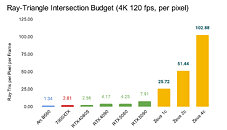
When it comes to gaming performance, Bolt uses consumer-grade GPUs such as NVIDIA GeForce RTX 5090 for comparison. Until now, developers have often had to compromise on visual quality to meet their frame-rate targets when using real-time ray tracing and path tracing. With Zeus, they no longer have to choose between speed and fidelity, delivering full-quality 4K path-traced graphics at a smooth 120 FPS with at least 25 samples per pixel. On the compute side, Zeus excels in heavy scientific and engineering tasks, achieving up to 20 FP64 TeraFLOPS while consuming less than 400 W. It tackles electromagnetic-wave simulations a staggering 300 times faster than the B200, without accuracy downgrade. We are yet to see if the Zeus will live up to its hype, so first dev kits will uncover a lot about it next year.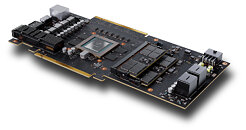
Source:
Bolt Graphics
When it comes to gaming performance, Bolt uses consumer-grade GPUs such as NVIDIA GeForce RTX 5090 for comparison. Until now, developers have often had to compromise on visual quality to meet their frame-rate targets when using real-time ray tracing and path tracing. With Zeus, they no longer have to choose between speed and fidelity, delivering full-quality 4K path-traced graphics at a smooth 120 FPS with at least 25 samples per pixel. On the compute side, Zeus excels in heavy scientific and engineering tasks, achieving up to 20 FP64 TeraFLOPS while consuming less than 400 W. It tackles electromagnetic-wave simulations a staggering 300 times faster than the B200, without accuracy downgrade. We are yet to see if the Zeus will live up to its hype, so first dev kits will uncover a lot about it next year.


23 Comments on Bolt Graphics' Zeus GPU: Dev Kits Arrive 2026 for Gaming, HPC, and CAD
EDIT
But I love their comparison on the website:
withwhen ray traced graphics are so computationally expensive, you're not getting that price or that wattage even if this was somehow feasible. There's a matrix to follow:If a product is fast and cheap, it's not good
If a product is good and fast, it's not cheap
If a product is cheap and good, it's not fast
You can't have all three
Yes it gives us hope but its never gonna materialize.
PS "You can't have all three"
There was a joke in Greece about a political party and it's voters.
Like which one is good and fast but not cheap? I mean that means that product would have to be borderline perfect.... I dont think such a thing exists.
Unless we are going to get pretty subjective here in which case the matrix is kinda pointless.
25.72 x 2 = 51.44 x 2 = 102.88
Really?
Sure, it'll be priced high like hell at first, but if it can come down in cost, it'd be a fun card to play with, esp. with the upgradable RAM.
I hope it spanks the competition and also no DLSS maybe pure rendering.
Long story short you ain't gonna play games on these any time soon despite the "one trillion billion gigaflop rays per femtosecond" claims. Interesting product as a compute accelerator though, if it ever makes it to market.
With the Intel Nvidia Partnership, I think the timing is great. And for console wars the timing isn't good, as PC is still leading the gaming platform in terms of power. I always wanted to see the end of PC master race for gaming. Personally, I always thought AMD or Intel even Apple would have taken the console market and said, we are going to release this one product, that dominates the gaming industry. Putting the best tech into a console, then working on desktops, severs and tablets in the meantime. Plus, the landscape of a television is larger than a PC case, so there's a space for it, discreet and quiet market that I've haven't seen get much better in terms of smart features. But instead, we see VR and that's not interesting to me. We see Steam making moves, though that's again just a PC lite for gaming. Where's the new competition going? A space that's still here, still making progress and improvements.
I guess we'll see. Maybe it's a thing, maybe it wasn't to begin with. Though they need to make a mark, in something that they can say "We did that", change something we use every day and that'll be the popularity they need to take on these competitors.
- Barry Ruff
Director of Graphics Engineering
Bolt Graphics
21 Sept 2023 - Bolt Graphics IP has been in development since 2014, the same year the initial seed money of around ~$138K
Patent #US20230410403A1 filed 2022, Granted in 2025.
> 5nm prototype chips started shipping to Early Access customers in 2024 Bolt Graphics CEO explained that sampling of prototype SoC's began late 2024.
"Performance is measured by counting the time it takes for GPUs to render scenes of varying complexity. The Nvidia GPUs are benchmarked using Blender Cycles & Optix, while the Amd GPUs are using Cycles & HIP. Bolt Zeus is benchmarked using Glowstick."
"Houdini, Maya, 3ds max, and Nuke provide support for Hydra delegates. Glowstick is already integrated inside USDView as a Hydra delegate, and we are working on porting that to the tools listed above. SketchUp, Unreal Engine, Blender, Revit, and many other content creation tools use tool-specific plugin interfaces to integrate other renderers. Glowstick will be available as installable plugins for those tools."
nVidia recently developed CUDA to run on RISC-V architecture, this allows the Zues Prototype to compute on this software foundation.
" In order to test and improve the effectiveness of our path tracing hardware, we needed to build a testbench that path traced renders. Initially, we used it internally to produce renders to compare against existing renderers like Arnold, Iray, and Cycles. We decided to productize this renderer, and named it Glowstick.
Glowstick is our in-development path tracer that is co-designed with Zeus hardware. It will be included at no cost with Zeus GPUs."
APOLLO FP64 SOLUTION
- On GPUs, potentially higher FP32/FP64 performance trades off with extremely limited memory capacity, complex host-device programming model, far away network and storage interfaces. FDTD3D, for example, supports Cuda GPUs. FDTD solvers like Ansys Lumerical that support both CPU and GPU backends typically limit the functionality of the GPU backend. Basic functionality like per-timestep outputs and movie monitors are not present. This drives users back to CPU solvers.
- Other FDTD solvers like Meep, Lumerical, and Tidy3D require the user to post-process outputs and generate videos for visualization. As the other solvers require the simulation to complete prior to generating the visualization, the value of the visualization decreases.
- Bolt Graphics Early Access Program WiKi that includes code and benchmark methodolgy information...
The video below shows a demo of Apollo, highlighting the live viewer:
Thankyou for your attention to this important matter.