Tuesday, March 10th 2026

NVIDIA Announces RTX Mega Geometry Implementation in Witcher 4, Path Tracing for 007 First Light

NVIDIA at the 2026 GDC announced the first implementation of RTX Mega Geometry. Announced alongside its GeForce RTX 50-series "Blackwell" generation, Mega Geometry is a technology that seeks to significantly increase geometric complexity of objects or surfaces with ray tracing elements. A distant analogue of Mega Textures, Mega Geometry leverages nested triangle clusters to reduce video memory footprint as well as the hardware cost of ray intersection. The RT cores in "Blackwell" GPUs have hardware-level readiness for Mega Geometry.

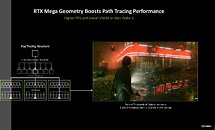
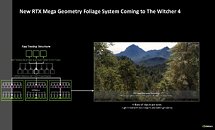
At GDC, NVIDIA showed us two distinct examples of Mega Geometry, the first one is "Alan Wake 2," where it is shown boosting Path Tracing performance, with tens of thousands of ray traced objects on the scene with a 5-20% frame rate improvement versus conventional ray tracing methods, and a 300 MB video memory footprint reduction from the nested triangle clusters model. Next up, is a demonstration of Mega Geometry foliage system in the upcoming "The Witcher 4" title. A pre-release demo (not indicative of actual gameplay) shows Mega Geometry render a forest with thousands of trees with millions objects on the scene, each with its own unique animation. Besides cluster triangles, the scene also implements Opacity Micromaps that NVIDIA introduced with RTX 40-series "Ada."
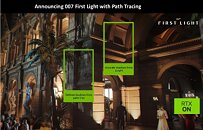

Next up, NVIDIA announced that the upcoming "007 First Light," inbound for May 27th, implements Path Tracing for a significant uplift in realism from accurate shadows. This technology is also implemented with "Control Resonant," the hotly anticipated sequel to "Control," one of the first games to implement ray tracing.
Add your own comment

49 Comments on NVIDIA Announces RTX Mega Geometry Implementation in Witcher 4, Path Tracing for 007 First Light

#1
shuffy_losys
I hope NVIDIA or someone who's using this puts out a technical blurb of some sort about how this works.
Posted on Reply
#2
RejZoR
Oh great, more proprietary bullshit that will make "non MEGA RTX" visuals intentionally nerfed and look like ass on purpose just to make their crap look better. Have seen that nonsense countless times done by NVIDIA. PhysX being one of the worst offenders of all times.
Posted on Reply
#3
Hyderz
Interesting.. this rtx mega geometry.. by the sounds of it, it is bypassing traditional ray tracing methods. Improving fps, uses less vram and improving visual quality... lets hope there isnt much artifacting...

Also by the looks of it, should improve games running on Unreal Engine 5
Posted on Reply
#4
BoxCutter
Finally reflections on cars and palm trees casting shadows, graphics technology made possible solely due to pathtracing, thank you nVidia, what would we be doing without you. What a time to be alive.
Is this like an actual thing? This reminds me when I first saw "neural rendering" promo. I thought that was a parody, still do.
Posted on Reply
#5
_roman_
maybe some guys should have a 9 to 5 job and see maybe subways and cars on the road. real life cars never look like that. i think it was inspired by a mercedes but the reflections are nonsense. fake shadow left and fake reflections on the right

on a second view point, the road looks unrealistic, etc.
the plastics from the side mirrors are also wrong. painted plastic behaves differently as those shown pure injection molding ones.
tyres are lacking the writings, and the thread

the front lamp units of the car are also not realistic. the cap between the front lamps and the metal hood is wrong, the spacing to the bumber and side metall cover is also unrealistic.

a higher contrast does not imply light was calculated correctly. especially in a foggy environment like the picture implies. on a sunny days we would see different colours.
Posted on Reply
#6
shuffy_losys
_roman_maybe some guys should have a 9 to 5 job and see maybe subways and cars on the road. real life cars never look like that.
Then share some pictures of your own so we know how it's supposed to look like
Posted on Reply
#7
BoxCutter
shuffy_losysThen share some pictures of your own so we know how it's supposed to look like
All I can tell you is that it looks like something out of a 2004 game. The performance stuff seems more interesting, but these things out of context don't mean anything.
Posted on Reply
#8
GodisanAtheist
BoxCutterFinally reflections on cars and palm trees casting shadows, graphics technology made possible solely due to pathtracing, thank you nVidia, what would we be doing without you. What a time to be alive.
Is this like an actual thing? This reminds me when I first saw "neural rendering" promo. I thought that was a parody, still do.
- Yeah I'm really confused by these screenshots. All of this stuff was approximately possible with raster, and the whole point of "RTX" Ray Tracing was accurate lighting.

Now AMD seems to have caught up more or less in Ray Tracing... so I guess its time to reinvent the marketing wheel with Path Tracing and give us the same shit we've had for 10+ years but now at 30 FPS 1080P with DLSS Performance or something.
Posted on Reply
#9
RejZoR
GodisanAtheist- Yeah I'm really confused by these screenshots. All of this stuff was approximately possible with raster, and the whole point of "RTX" Ray Tracing was accurate lighting.

Now AMD seems to have caught up more or less in Ray Tracing... so I guess its time to reinvent the marketing wheel with Path Tracing and give us the same shit we've had for 10+ years but now at 30 FPS 1080P with DLSS Performance or something.
Pretty much. Remember how RTX ON was all the rage for most basic reflections that most people were unable to differentiate from good screen space reflections. Or worse, games that have ray tracing but for some reason still use screen space reflections even when RT is enabled. So they now need to sell us RT is so 2010, Path Tracing is the real deal. Weren't they saying RT was the real deal too? Which is it?

Also I see examples of stupid intentional nerfing of "legacy" visuals to make Path Tracing look better. Like, come on, I've seen better portrayal of metal on a car in Need for Speed 3: Hot Pursuit over 25 years ago and somehow NVIDIA is showcasing a "no RTX ON" example of a car absolutely and entirely devoid of ANY specular effects. Even when my real car is dirty as dog rolling in a puddle and it still has reflective surfaces. But here it's absolutely matte just so that "Path Traced" looks better. ?!
Posted on Reply
#10
_roman_
too much light - from the right side


even that has too much light with the given computer pictures i critised above
Note: hopefully not anyone will get upset when i post their cars with blurred licensee plate

not every paint is reflective

that still has too much light when compared with teh computer picture. where is no light there can not be any reflections.


I do not have any pictures when it is foggy with cars. maybe a few days per year in the best case.

Note: i do not want to pick anything which can be traced back to myself. area, my own car, my own village, my car in my garage etc.
Posted on Reply
#11
sam_86314


This one annoys me. It looks like crap, and I'm sure the performance impact is insane.

Yeah, let's use path tracing to do this! It's not like screen-space reflections can do the exact same thing for a fraction of the resources or anything.

BeamNG.drive uses more old-school reflections (no ray tracing), and it looks so much better in my opinion.

Posted on Reply
#12
nguyen
Nice, Path Tracing coming to more games. Let hope the new update let 12GB VRAM GPUs owners (4070/5070) experience the full Path Tracing, right now Path Tracing is only for 16GB VRAM GPUs and above.
Posted on Reply
#13
Steevo
Looks more like the first image.
Posted on Reply
#14
Prima.Vera


This is bad an unrealistic on so many levels. First, the scene looks very cloudy and foggy meaning the reflections are more realistic in the 1st pic, and 2nd, that bs overly unrealistic ray tracing render, can be done with absolutely zero performance loss, identically, using raster rendering with screen-space reflections.
Not for the laziness of the developers...
Posted on Reply
#15
cinemaware
This thread is a nostalgic throwback to times when I couldn't afford a card that could do RT with reasonable framerates. I also used to think that it's all probably nonsense, and in many cases it was back then.

The problem is that was really a long time ago, and things have moved on. People who think that it's ok to judge this tech from screenshots clearly haven't really witnessed it in action. Properly implemented RT can totally transform the look of a game but it's really hard to show in static pictures.
Posted on Reply
#16
Dr. Dro
shuffy_losysI hope NVIDIA or someone who's using this puts out a technical blurb of some sort about how this works.
They have. It's documented in the Blackwell architecture whitepaper. Mega Geometry is essentially a marketing name for ray tracing of cluster-level structures. It was backported to all GeForce RTX cards as far back as Turing, but Blackwell's RT cores are especially optimized for this type of work:
Zorah features nearly half a billion triangles per scene, over 30,000 materials, over 2,000 particle lights and 1,500 textures to enable complex architecture and lighting to be visualized at cinematic quality.
RejZoROh great, more proprietary bullshit that will make "non MEGA RTX" visuals intentionally nerfed and look like ass on purpose just to make their crap look better. Have seen that nonsense countless times done by NVIDIA. PhysX being one of the worst offenders of all times.
Mhm, seems a little crazy, remember to connect your tin foil hat to ground while you wait for AMD to develop their implementation or, if required, a competing solution. When you made a conscious choice to purchase a 9070 XT, you signed up to ride on the red team's economy wagon.

Which should suit you just fine, after all, I thought none of you cared about raytraced graphics anyways.
Posted on Reply
#17
cinemaware
Dr. DroWhich should suit you just fine, after all, I thought none of you cared about raytraced graphics anyways.
Not to mention that in 98% cases it's optional. So all the crying about the performance hit really is of the crocodile sort.
Posted on Reply
#18
_roman_
cinemawarePeople who think that it's ok to judge this tech from screenshots clearly haven't really witnessed it in action.
maybe the amd gpu implementation is broken for the radeon 7800xt in star wars jedi survivor, avatar pandora and control.

i criticise the wrong physics in my viewpoint. if you like it, why not

-- i do get the feeling, hard to proof that subnautica on latest amd w11 pro gpu driver update, which i installed a few days ago, suddenly renders some extra fog in the initial scene when you start a new game / new run. i do this quite often, start a new game and try to get my base up than quiet. next time i play I start fresh. there may be the possibility that amd graphic cards render games wrongly or let's phrase it more friendly, render games differently.
Posted on Reply
#19
Vayra86
_roman_maybe some guys should have a 9 to 5 job and see maybe subways and cars on the road. real life cars never look like that. i think it was inspired by a mercedes but the reflections are nonsense. fake shadow left and fake reflections on the right

on a second view point, the road looks unrealistic, etc.
the plastics from the side mirrors are also wrong. painted plastic behaves differently as those shown pure injection molding ones.
tyres are lacking the writings, and the thread

the front lamp units of the car are also not realistic. the cap between the front lamps and the metal hood is wrong, the spacing to the bumber and side metall cover is also unrealistic.

a higher contrast does not imply light was calculated correctly. especially in a foggy environment like the picture implies. on a sunny days we would see different colours.
Anyone claiming RT lighting is more realistic has been drowning in the green kool-aid since Turing. Not in the least because you can reach identical imagery with rasterized lighting. It just takes effort, and effort has been taken in numerous games. We can place various DX11 games next to this and every time conclude the DX11 image has more clarity, visual fidelity and also achieves realistic lighting, at less than half the performance footprint.

I haven't seen a single RT infused game actually being or giving off a more realistic immersive feel. If anything it looks more artificial than real. Far too polished, still full of inaccuracies and just plainly wrong effects, and overall just not fit for the use case. But sure, you can look at reflections in places that shouldn't have them now. Weeee

And you get all of that while nuking your performance and energy bill for lower FPS than a raster image.

The question is how much of a lemming one chooses to be, but man, the stupidity knows no bounds it seems. 'RTX on'... herp derp
Dr. DroI thought none of you cared about raytraced graphics anyways.
Correct. The demand is entirely an Nvidia construct, and most people don't even make the explicit choice to jump on said bandwagon. The vast majority will turn RT features off to get the performance they want, or even just by default because it isn't a better image at all.

RTX 'on' will live as long as Nvidia keeps using it as a marketing tool. Everywhere else, it will be relegated to the sidelines as developers are far too busy actually making games, which is, in the end, what gaming is about. Graphics are just a tool, not a goal.
Posted on Reply
#20
dyonoctis
RejZoROh great, more proprietary bullshit that will make "non MEGA RTX" visuals intentionally nerfed and look like ass on purpose just to make their crap look better. Have seen that nonsense countless times done by NVIDIA. PhysX being one of the worst offenders of all times.
It's part of the neural rendering thing that Microsoft enabled when they added support for cooperative vectors in DX12. AMD got something similar coming up
www.techpowerup.com/341494/amd-dense-geometry-format-dgf-aims-to-increase-visual-detail-with-future-gpus
gpuopen.com/learn/animating-geometry-with-amd-dgf/
AMD's technology is similar in function although different in form to Mega Geometry introduced by NVIDIA with its "Blackwell" graphics architecture. Team Green defines Mega Geometry as squarely focussed on increasing the geometry of ray traced objects through a hierarchical model of storing geometry data. DGF has a broader application spanning raster and ray traced objects. The paper also deals with the hardware stack of DGF. Apparently, none of AMD's current architectures provide hardware acceleration for it, and the technology is being developed for a future architecture, such as "RDNA 5," or UDNA. On GPUs without hardware support, the DGF stack can be executed on shaders, however this comes with a small performance cost, which is worth the effort compared to rendering all that added geometry without DGF using conventional raster 3D methods.
Vayra86Anyone claiming RT lighting is more realistic has been drowning in the green kool-aid since Turing. Not in the least because you can reach identical imagery with rasterized lighting. It just takes effort, and effort has been taken in numerous games. We can place various DX11 games next to this and every time conclude the DX11 image has more clarity, visual fidelity and also achieves realistic lighting, at less than half the performance footprint.

I haven't seen a single RT infused game actually being or giving off a more realistic immersive feel. If anything it looks more artificial than real. Far too polished, still full of inaccuracies and just plainly wrong effects, and overall just not fit for the use case. But sure, you can look at reflections in places that shouldn't have them now. Weeee

And you get all of that while nuking your performance and energy bill for lower FPS than a raster image.

The question is how much of a lemming one chooses to be, but man, the stupidity knows no bounds it seems. 'RTX on'... herp derp


Correct. The demand is entirely an Nvidia construct, and most people don't even make the explicit choice to jump on said bandwagon. The vast majority will turn RT features off to get the performance they want, or even just by default because it isn't a better image at all.

RTX 'on' will live as long as Nvidia keeps using it as a marketing tool. Everywhere else, it will be relegated to the sidelines as developers are far too busy actually making games, which is, in the end, what gaming is about. Graphics are just a tool, not a goal.
I mean, in that case, it's PT, it's physically based, so it's supposed to be more accurate*. Raster will look a bit odd to a moderately trained eye. Once you start to look at the fine details, the illusion of raster starts to show its limits. On a purely technical level, it's not the endgame of graphics.
But granted, games can't use enough samples to really end that debate. The PT in games is low-res and reconstructed. And we've known that artefact can appear, it's something that both Nvidia and AMD are working on.

PT has been the holy grail of CG long before Nvidia even cared. The principle behind the tech has been proven for over 20 years.

RTRT/RTPT is what isn't quite there yet. I said that before, and I will say it again: there's a point where a Real Time CG artist's interest will start to diverge from a gamer's interest. Especially if that artist is going after realism. One side wants good enough and money-friendly graphics, the other one wants to hunt the holy grail.

And crysis also made shareholders believe that everyone must have that wow factor on technical prowess.
Posted on Reply
#21
Apocalypsee
I'm sorry this is just sad, rasterization already reached this kind of quality eons ago. Look at Radeon 9700 car paint demo that looks great and released way back in 2003. Seriously, when I read Mega Geometry all I read is geometry instancing.

Talking about accurate shadows but...
Posted on Reply
#22
Chomiq
ApocalypseeI'm sorry this is just sad, rasterization already reached this kind of quality eons ago. Look at Radeon 9700 car paint demo that looks great and released way back in 2003. Seriously, when I read Mega Geometry all I read is geometry instancing.

Talking about accurate shadows but...
That's CA simulation. Nothing to do with RTX.
Posted on Reply
#23
Vayra86
dyonoctisPT has been the holy grail of CG long before Nvidia even cared. The principle behind the tech has been proven for over 20 years.

RTRT/RTPT is what isn't quite there yet. I said that before, and I will say it again: there's a point where a Real Time CG artist's interest will start to diverge from a gamer's interest. Especially if that artist is going after realism. One side wants good enough and money-friendly graphics, the other one wants to hunt the holy grail.

And crysis also made shareholders believe that everyone must have that wow factor on technical prowess.
But we're not playing CG. I really don't care in the slightest; I'm playing games, graphics are just relevant to show me what's going on so I can play said game. Frankly, I don't give a rat's ass how it looks, and I've seen my share of games at this point, from CGA to the current tech. Can I spot the differences? Absolutely. Just like I can directly spot the uncanny valley problem of more recent graphics, the vaseline effect of TAA, or the numerous artifacts in upscalers, but at least the shadows and lighting are physically accurate. Physically accurate still won't mean 'a realistic image' though, you need far more than lighting for that, and raster graphics already showed us this is possible just fine. You mention Crysis.... I mean, put your average Crysis 3 sequence next to a recent game and then take into account graphics ~ performance. We haven't moved forward at all from there - we've regressed in a BIG way. It gets even worse if you factor in the amount of interactivity Crysis' world/engine offers on top. Not a single UE5 game comes near. I really don't care that I can now walk up to a breadcrumb and see its... lo and behold... almost an actual breadcrumb visually. Nothing is really being done with the added detail either - because its really not a gameplay element or a system, its just a fancy layer UE5 devs can add with a few clicks. Easy money for the screenshot-based sale - it has nothing to do with gaming.

The only thing driving RT here is Nvidia that wants to sell GPUs. Still. Where's the industry movement outside of Nvidia's garden? A garden that, I might add, the main promoter is abandoning quietly with ever worse quality and higher priced product? Are people seriously believing that there's light at the end of a tunnel that's slowly getting flooded with water? Are we really, collectively, this stupid? Wow. Just wow.

Don't drown in the new abbreviations that need to keep getting made up to somehow portray an illusion of progress. RT isn't progress. Its devolution. You can cook your perfect lighting ahead of time, lose a sliver of dynamic capability, and have 3x the performance showing the exact same thing. Its just that simple.

And yeah like you say, if the Real Time CG's artist's priorities shift to their own focus of interest, I don't think that's in service of gaming either. The artist works in service of the game. We all know what's driving this: games are supposed to become fast food joints. You McDrive a title, play it for a few hours, and move on to the next one. Consume consume consume... So they use a toolkit that delivers them results quickly, and they optimize their own workflow at the expense of your and my hardware.

I have no other conclusion to draw wrt this tech. Its an empty shell with damaging consequences.
Posted on Reply
#24
Shtb
Your bets - where will 9070XT end up compared to 5000 series?

Level of 5070? Or even 5060Ti?

And again, can we expect a significant, significant improvement in optimization for Radeon after... 1 year?
When Nvidia's GW-NDA ends.
Or will they have a new agreement with CDPR for a longer period?
Posted on Reply
#25
Dr. Dro
Vayra86Correct. The demand is entirely an Nvidia construct, and most people don't even make the explicit choice to jump on said bandwagon. The vast majority will turn RT features off to get the performance they want, or even just by default because it isn't a better image at all.

RTX 'on' will live as long as Nvidia keeps using it as a marketing tool. Everywhere else, it will be relegated to the sidelines as developers are far too busy actually making games, which is, in the end, what gaming is about. Graphics are just a tool, not a goal.
Then there's no reason to complain about AMD cards being unable or inept at doing certainly things. Especially new graphics techniques such as this.
Posted on Reply
Add your own comment
Nov 11th, 2026 23:39 CST change timezone

New Forum Posts

Popular Reviews

TPU on YouTube

Controversial News Posts