Tuesday, March 10th 2026

NVIDIA Announces RTX Mega Geometry Implementation in Witcher 4, Path Tracing for 007 First Light
NVIDIA at the 2026 GDC announced the first implementation of RTX Mega Geometry. Announced alongside its GeForce RTX 50-series "Blackwell" generation, Mega Geometry is a technology that seeks to significantly increase geometric complexity of objects or surfaces with ray tracing elements. A distant analogue of Mega Textures, Mega Geometry leverages nested triangle clusters to reduce video memory footprint as well as the hardware cost of ray intersection. The RT cores in "Blackwell" GPUs have hardware-level readiness for Mega Geometry.
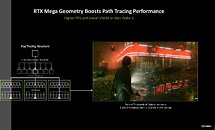
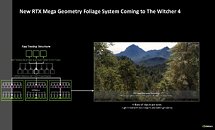
At GDC, NVIDIA showed us two distinct examples of Mega Geometry, the first one is "Alan Wake 2," where it is shown boosting Path Tracing performance, with tens of thousands of ray traced objects on the scene with a 5-20% frame rate improvement versus conventional ray tracing methods, and a 300 MB video memory footprint reduction from the nested triangle clusters model. Next up, is a demonstration of Mega Geometry foliage system in the upcoming "The Witcher 4" title. A pre-release demo (not indicative of actual gameplay) shows Mega Geometry render a forest with thousands of trees with millions objects on the scene, each with its own unique animation. Besides cluster triangles, the scene also implements Opacity Micromaps that NVIDIA introduced with RTX 40-series "Ada."

 Next up, NVIDIA announced that the upcoming "007 First Light," inbound for May 27th, implements Path Tracing for a significant uplift in realism from accurate shadows. This technology is also implemented with "Control Resonant," the hotly anticipated sequel to "Control," one of the first games to implement ray tracing.
At GDC, NVIDIA showed us two distinct examples of Mega Geometry, the first one is "Alan Wake 2," where it is shown boosting Path Tracing performance, with tens of thousands of ray traced objects on the scene with a 5-20% frame rate improvement versus conventional ray tracing methods, and a 300 MB video memory footprint reduction from the nested triangle clusters model. Next up, is a demonstration of Mega Geometry foliage system in the upcoming "The Witcher 4" title. A pre-release demo (not indicative of actual gameplay) shows Mega Geometry render a forest with thousands of trees with millions objects on the scene, each with its own unique animation. Besides cluster triangles, the scene also implements Opacity Micromaps that NVIDIA introduced with RTX 40-series "Ada."


49 Comments on NVIDIA Announces RTX Mega Geometry Implementation in Witcher 4, Path Tracing for 007 First Light
amd hardly fixes any bugs and drop gpu generations one after another. long term bugs are never fixed.
the only argument to buy amd or intel or nvidia is just performance per dollar. drivers are bad, long term support is bad and various issues with various manufacturers over the generations.
when you fancy those screenshots go for nvidia. just information based evaluation. than the purchase price should also not matter.
those technical topics are interesting. i personally do not see any progress. i belong in the camp game fun and game mechanics over pure fancy graphics without proper game mechanics.
-- back to your question. pure marketing wise nvidia cards will be on top massive when you favour those new nvidia features. nothing wrong to like those features, use those features and like your nvidia card.
Other than that, I agree with all the critics on this thread. This is an extremely bad example and any artist with more than half a brain wouldn't have even bothered saving this render, let alone publish it.
Path Tracing is coming to Pragmata, 007 First Light, Tides of Annihilation, Witcher 4, etc...looks like the future of gaming look bright (thank to Path Tracing :roll:)
arstechnica.com/gaming/2015/05/amd-says-nvidias-gameworks-completely-sabotaged-witcher-3-performance/
11 years in the future, has this changed? Hint: it hasn't. It literally hasn't, open your GPU-Z, see DirectX 11 tab, and you'll be greeted by a fat "No"
"Why is our market share 5% and still on a downward trend? :("
I "care about gaming" as much as the next poster here, but this is raging against nothing. The RT / PT tech can be transformative for visual fidelity, and we're no longer talking about some silly reflections in a puddle. If you can't see it you're either obstinate or doing something wrong with your hardware (or, like many base it just on watching some pics on a website).
And there's no evidence that all the processing power that goes into that optional thing could be used for something else. If so, then I have yet to see it, it doesn't seem like devs are falling over themselves to make cities with every building enterable, turbo boost the geometry, or some such.
It is not a valid reason to write the advancement of technology off entirely, especially if the reasoning behind it is merely fear of missing out.
If I really into this FOMO thing I would be using 5090 right about now. I only use ray tracing to see what it offered, and for the visual it gives just doesn't justify the performance reduction. It's not a conspiracy that nvidia been slowing down for gaming, Blackwell Super releases have been cancelled, and they focused more on AI than ever.
Others follow the herd and tell the world around them they're pioneering a new tech while in fact they're just maniacally following the marketing from a certain company ;) They're all over it: every driver, patch, piece of content that contains it, it gets carefully analyzed and omg its different! Must be better! We've seen the discussion about upscaler, RT methods etc ad infinitum: its NEVER about gaming or the actual game, its about the pixels. Since DLSS1 we've seen the same promotors (like you) carefully analyzing the thing. Its not gaming, it literally has nothing to do with it. You're tweaking the image. There is no question the focus here is different from what most people do when they're gaming. And that's fine. But it ain't about gaming.
I'm a gamer, not a pixel analyst. Its really simple, I've not been convinced yet this is something I'm actually missing out on. I don't miss a thing. The games are completely skippable, the cost is too high, and the visual improvement is always accompanied with major drawbacks.
Its just a shit deal and the market being cornered doesn't help its adoption either, because the price is not only performance cost, but actual $$$. Its just not worth it; the economy doesn't check out, and the proof is in the pudding if you look at the GPU market and performance relative to graphical prowess.Exactly.
We've ground to a halt instead. Even the GPUs barely get more powerful, but the same promotors of RT are still saying all is well, we'll get there! Soon!
I remember similar voices saying 'crypto will get to something better than speculative goods!' 'Soon!'
Some people never learn.Ah yes, if DF says its better you sheep along. What's new? I'm glad you're clearly having fun about your own comment though. Or are you laughing at yourself?But of course it is - if its not economically sound, humanity tends to either not do it, or creates a system to make it economically sound. VR is a great example, happening live and ongoing. It will probably keep struggling for a while longer while it diminishes entirely, or finds its purpose in some niche market.
I haven't seen economically sound yet. I do see humans getting forced to admit to the former, and its pretty clear gaming nor RT will be successful riding on a tiny bunch of happy few that promote RT. The technology's success rides completely on its ability to drive down cost, not just for developer workflows, but for the gamer too.
Sure you like FPS more than accurate lightings, but you are not the only audience that game studio target. Game studio will make sure that their games will cater to all gamers, so there you have games without RT, with RT and Path Tracing.
If you think that game studio should cater to you only, then you have main character syndrome LOL. Oh if you think that Nvidia should double the performance every 2 year, maybe you should have doubled your salary every 2 years too? was it impossible on your side?
To be completely fair there are other ways for stronger chips and the contrast between the best cpu for example of a data center compared to the best consumer cpu is HUGE. Go back in time a see how close they were like in the core 2 duo/core 2 quad era vs the best xeons at the time.
GPU cost too much? According to whose perspective though, all data I have seen like Steam Hardware Survey and Jon Peddie Research show people are buying Nvidia GPU just fine.
Anyways even PS5 let you choose between RT @ 30FPS or upscaled No RT @ 120FPS, they give you the choice between visuals/FPS, ain't that a good thing ;).
If you want to complain about slow progress, you are pointing at the wrong company though, look at Intel and AMD with their CPU and Radeon Team
You don't see the broader side of things, especially with UE5 based games it plays poorly because most game devs take the shortest route on optimizing their game. Just go watch Threat Interactive videos they explain in great detail what's the problem with modern games.
The only person who have main character syndrome is you. I mentioned regarding performance of games and transistor budget whats the relation to my salary? Out of ideas how to counteract my point? With how games is made nowadays I wanted to spend less and less on computer hardware and move on to better hobby which I already did.
I'm a gamer too. But I'm also a tech enthusiast and I love to see the advances in technology that makes games possible.
I can't even call myself an "analyst". Of my favorite games one still runs on FSR 2, the other on DLSS 3.7 (and can't be upgraded due to anti-tamper) and 3 of the other most top played games for me don't support upscalers at all.
Stop discussing each other.
Be civil in posting and follow the Guidelines when posting.
With RE9 and Pragmata, Capcom has made Path Tracing available to gamers. It's obvious that all the rasterization fakery using Path Tracing as reference does not come close to the actual Path Tracing.
To the naysayers, better visuals don't come for free, it will cost money, either with a more expensive GPU or more expensive game (game cost more with longer development time = higher price)
Which brings me to my own conclusion on this: NVIDIA's push for real-time ray tracing is orthogonal to the main concern, which is diversity of games. As far as I can tell, NVIDIA GPUs are still mostly CUDA cores, with RT and tensor cores a small portion of each chip. They didn't become incapable of playing raster-only games, nor did AMD/Intel GPUs suddenly cease to exist. There's nothing stopping any given developer from making a high-quality, raster-only gameplay-focused experience.
Rather than decrying the very existence of RTRT technology, I think we should be advocating for developers to continue to make games across the entire fidelity and performance spectra. I, for one, have enjoyed quite a few games at the extremes of those.
In addition, this only covers direct and global illumination. This does nothing for object-cast shadows and other optical phenomena like reflections. Shadows are always going to be a pain point because all of them require essentially re-rendering the scene from every light source that casts a shadow (and you want light sources to cast shadows, right?). With reflections, we've had cube maps, but that only works with static scenery. There's screen-space reflections, but when it fails (and it fails a lot), it becomes a distraction. Earlier real time reflections (like rear view mirrors in racing games) require re-rendering the scene, often with reduced image quality so the performance hit isn't as high.
In any case, raster rendering's goal has always been to get as close to ray tracing as possible, because ray tracing is considered the ground truth. But raster rendering has to cheat a lot, and at some point, the level of effort it takes to cheat is going to cost as much as doing the actual work.
One thing that ray tracing provides the graphics side of things is that it takes away the complexities of dynamic lighting entirely. There's a lot of things you have to worry about when you do dynamic lighting in raster rendering to avoid tanking performance, the biggest one is giving dynamic lights an unrealistically short range for certain things like shadow rendering. Raster rendering's performance cost is how many objects and how many lights there are, which means the more complex you make the scene, the more it'll cost to render it (duh). Ray tracing's only cost is how many rays you want to cast. It doesn't matter how many things are in the game world.
Also I find it a little unfair to dismiss real time ray tracing because a bunch of tech around it keeps popping up. It's effectively eight year old tech. Lighting from raster rendering has had at least 30 years of refinements. And boy howdy, if you think all this stuff popping up about ray tracing is bad, maybe you should have a look at how the sauce is made for a modern, raster rendered game.
They fork the expense over to your and my GPU price, and as a consequence, its availability... and eventually everyone's shooting themselves in the foot. The games run like shit, gamers get disgruntled and Nvidia gets rich.
That is all this is. It doesn't look radically different, it doesn't do things we couldn't do before. It just automates a workflow with the promise of improved accuracy, but comes at an immense performance cost.
Its remarkably similar to the slop you get when you let AI do your coding. It's functional, but in no way a high quality thing that was clearly spent time and attention on. It feels like a McDonalds burger. You'll eat it and it won't come back out directly, but its an empty shell and you're hungry after an hour again. But hey, it was cheap to make, so there's more budget left to spend on... stuff you'll never see.Take a moment to think of why that hasn't happened yet when clearly the technology is available and all it is supposed to take is a bit of effort. We're over 8 years into this RT bullshit. When is this 'happening' in your mind? If it were, it should have by now.
As for 'developers' own claims on DOOM... consider that is Bethesda you're talking about, the company of pathological liar Todd Howard and stuck in limbo for about a decade now, as they got bought up, and has been running an ID Engine that has always had all kinds of dynamic capabilities without the use of RT. Its complete and utter bullshit you can't get dynamic capability without RT. We've always had it - even UT99 had realtime reflective surfaces already, dynamic lighting, etc. Multiple older consoles have been showing us all of that, too. There's nothing new here.