Monday, June 8th 2026

Intel Socket LGA1954 for "Nova Lake" Pictured in the Flesh, Confirms 2L ILM Design
Here is the first picture of Intel's next-generation desktop Socket LGA1954. We had only seen concept renders of the socket, until now. A successor to the current LGA1851, LGA1954 will seat Core Ultra "Nova Lake" desktop processors that introduce significantly higher CPU core counts and cache sizes to the desktop platform, dialing up compute power available to the segment. A key design change with LGA1954 over LGA1851 is its 2-lever ILM (independent loading mechanism), similar to Intel's HEDT and server sockets. Also, LGA1954 appears to be more squarish than rectangular, which is probably how Intel achieved the higher pin counts. The 2L ILM design allows for a more uniform retention of the ILM brace against the processor package.
Despite the significant change in socket design, LGA1954 is expected to retain cooler compatibility with the current LGA1851 and previous LGA1700, which means your CPU coolers purchased way back in 2021 could be reused for the next-generation processors. This is similar to how AMD managed to retain cooler compatibility between sockets AM4 and AM5, which are fundamentally different socket types—one is a PGA ZIF socket, the other is an LGA. We could expect a long string of leaks leading up its debut. There could be some limitations—the retention module of the cooler should apply at least 35 lbs (15.8 kg) of load.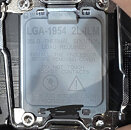
Source:
LC Tech Leaks (Twitter)
Despite the significant change in socket design, LGA1954 is expected to retain cooler compatibility with the current LGA1851 and previous LGA1700, which means your CPU coolers purchased way back in 2021 could be reused for the next-generation processors. This is similar to how AMD managed to retain cooler compatibility between sockets AM4 and AM5, which are fundamentally different socket types—one is a PGA ZIF socket, the other is an LGA. We could expect a long string of leaks leading up its debut. There could be some limitations—the retention module of the cooler should apply at least 35 lbs (15.8 kg) of load.

26 Comments on Intel Socket LGA1954 for "Nova Lake" Pictured in the Flesh, Confirms 2L ILM Design
From Wikipedia: "Leviathan is often an embodiment of chaos, threatening to eat the damned when their lives are over"
I'm not sure I want my CPU to be doing that...we've had enough Spectres in our CPUs already...Yes but I can think of a few of reasons not to:
- It would add extra cost with immediate benefit...and I imagine they are going to try and keep the costs down to maximise the profit as much as possible which is harder to do in the current climate
- It would break the compatibility with existing coolers
- It would limit the flexibility of choice for motherboard makers (like how we don't see any Threadripper ITX builds...)
- It might increase the amount of EMC/noise the CPU is subject to so would require careful consideration as to treat the unused pins (hold at ground/high impedance/etc) (i.e., it might effect stability)
- It would reduce their opportunity to sell you a nice shiny new motherboard setup in a couple of years time.
Hopefully this will land when prices are good and I can look at using it in my next PC for a complete re-build...otherwise I'll just be upgrading the CPU in my current one...From what I know, the next Intel's Sandy Bridge moment will come only when they come with Rentable Units and Unified Cores, so skip Nova Lake.
No.
Per MLID leaks Nova Lake and Razer Lake will still have P+E.
For desktop Hammer Lake (the third and last LGA1954 arch) will bring unified cores and HT.
Why not just use a contact frame? Wouldn't it be better and cheaper for manufacture?
I expect a breakthrough even bigger than Sandy Bridge, so if you're smart then skip the coming bollocks that Intel wants to sell you.
I'll probably buy one and be happy. 🤷♂️
I discussed and checked several times that topic with others. intel drops and changes always avx 10.2. for myself i came to teh conclusion after reading intel spec paper with avx 10.2 from different dated specification, that is a hoax and not fully specified. intel dropped several times some stuff. i can not take it serious anymore. changing stuff after a year, several years does not make it a proper specification. avx512 is well specified and it works in the field. code is written for it and it is already in use.
Well, maybe this was the reason for Intel's stagnation?
After all, people always bought their stuff without ever expecting something better.
P.S: Nvidia's Spark SoC, or whatever its name is, is delusional in the same way as everything else that is not like Apple Silicon that has the full non-partitioned UMA.
Itanium failed, transmeta failed and bulldozer nearly killed AMD.
keeping cores on a processor a single variant is the best way forward.
software optimisation would take many years and it won't be worth it for most tasks anyway.
After thinking about it, I would say that Nova Lake is a missed opportunity.
Yes even if it wins, it's still a missed opportunity.
Here's why:
The flagship will have a large number of cores thus it will have some workstation-esque potential, at least in some regards, of course product segmentation will ensure it doesn't encroach (too much?) on hardcore workstation territory.
But nevertheless the connectivity and expansion potential (using a Z990) is shaping up to be pretty impressive.
And compared to the preceding CPUs it seems like it would be on a next level.
The memory config is the biggest weakness in my view.
Dual channel with 8000 MT/s (UDIMM) rating is quite unbalanced.
Even for mid-2025 market conditions. If we assume CUDIMM it's basically a mortgage fest.
What Nova Lake would have needed is triple channel. Paired with a much lower frequency rating. Sounding too vintage for your ass?
The advantages are:
- more capacity, one can have 3x 24 GB or 3x 32GB modules meaning a rather large (for mainstream builds) RAM buffer with single rank and moderate voltage;
- some cost cutting for mobo makers if Intel would enforce the use of 3 DIMM slots only for the ATX boards, the other 3 are useless anyway for the vast majority of users; the extra room by omitting one DIMM could allow easier placement of some headers or extra features like Debug LED display etc.;
- more bandwidth using lower frequency (and thus cheaper RAM).
The disadvantages are:
- more complex IMC, however some benefits would be running the RAM at lower frequency and moderate voltage which would be less stressful overall;
- more expensive RAM to start a build (as you need 3x16 at a minimum), it having lower frequency makes it cheaper in that regard, but validating a 3 module kit is more expensive also buying 3 modules instead of 2 means the end cost would be higher, but you would be getting 50% more capacity and more bandwidth than dual-channel thus the price per GB for the whole kit could in fact be similar to a high speed dual channel one (even more if the triple channel is UDIMM and the dual channel is CUDIMM) so basically proportionally more for the larger capacity but you still end up with more bandwidth;
- the necessity for E-ATX boards to get 6 DIMMs for the users that want to populate them all for very high capacity builds, not really a drawback as they have big money anyway since they can afford so much RAM.
Thinking outside the box is the key to winning in this day and age. Everyone insisting on dual channel (for the consumer market) is not thinking outside the box. Because keeping dual channel means speed has to go up to compensate for the bandwidth needs, way up!
Even if a triple channel Nova Lake would encroach a bit on workstation territory beating AMD decisively is worth it. I don't know if Intel feels the same way but I expect them to.
Next year the RAM situation won't be (much) better by the looks of it, so the proposition of a strong consumer platform that needs high speed expensive RAM to get the best out of it doesn't sound like a great deal. Also going for the flagship (or the one below it) means capacity is also required, so high capacity and high speed RAM sounds like wallet extermination.
Going triple channel with lower frequency rating would have given Intel more time to develop a stronger IMC for Razer Lake, and they could have postponed the high speed RAM for that arch. After all the rumor mill says the core count stays the same with Razer Lake, so it's sort of a polishing the turd buying time type of arch until the Hammer (Lake) drops bringing revolutionary changes.
With that said, even if I'm moderately optimistic for Nova Lake, even if it wins I still feel that triple channel would have been the sucker punch that would have turned Intel into a crowd favorite over night. Nobody would have expected that feature, neither AMD nor consumers.
Prove me wrong peeps!