Thursday, July 23rd 2026

AMD Instinct MI400 Series and Helios Rack Debut: CDNA 5 Goes 2 nm, Plus ROCm.ai and "Gorgon Halo"
AMD used its Advancing AI 2026 keynote today to launch the Instinct MI400 Series, its next-generation data-center GPU family, alongside the Helios rack-scale solution and the CDNA 5 architecture that underpins both. CDNA 5 is AMD's first GPU architecture to reach the 2 nm node, with the flagship Instinct MI455X carrying 320 billion transistors across a multi-chiplet package and 432 GB of HBM4. This is a data-center compute architecture, not a Radeon gaming architecture, though some of the design choices in CDNA 5 point to where AMD's future unified gaming/compute architecture could be headed.
The MI400 Series splits into two parts: the Instinct MI455X for frontier AI and AI-factory deployments, and the Instinct MI430X for sovereign AI and HPC. Together with the Helios rack, 6th Gen EPYC "Venice" CPUs and AMD Pensando networking, they form AMD's open answer to NVIDIA's Vera Rubin NVL72. This post also covers the new ROCm.ai software stack and AMD's "Gorgon Halo" client teaser.


 Instinct MI455X: CDNA 5 on 2 nm
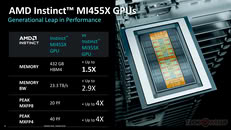
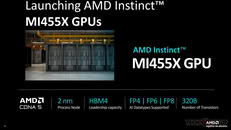
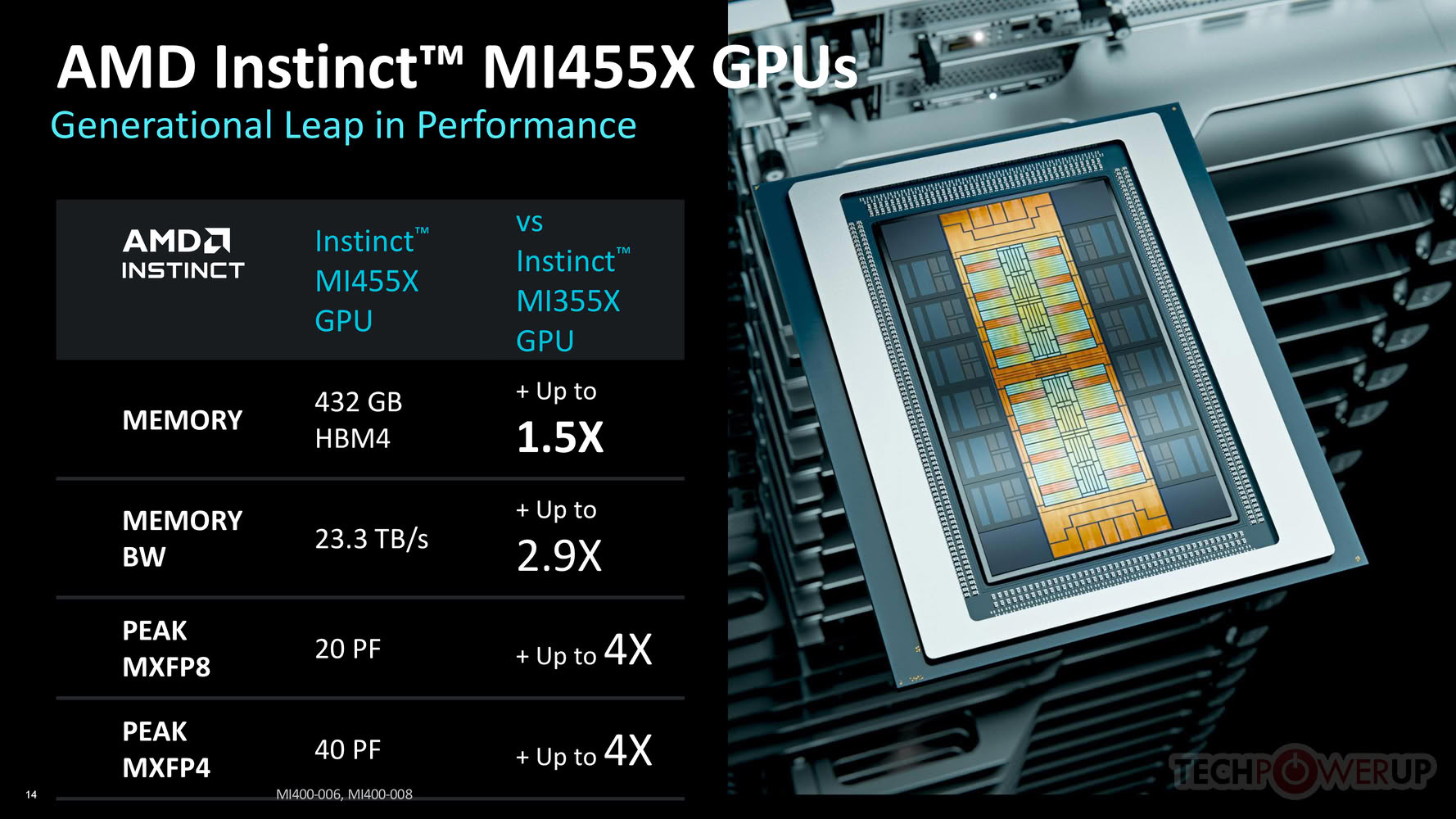
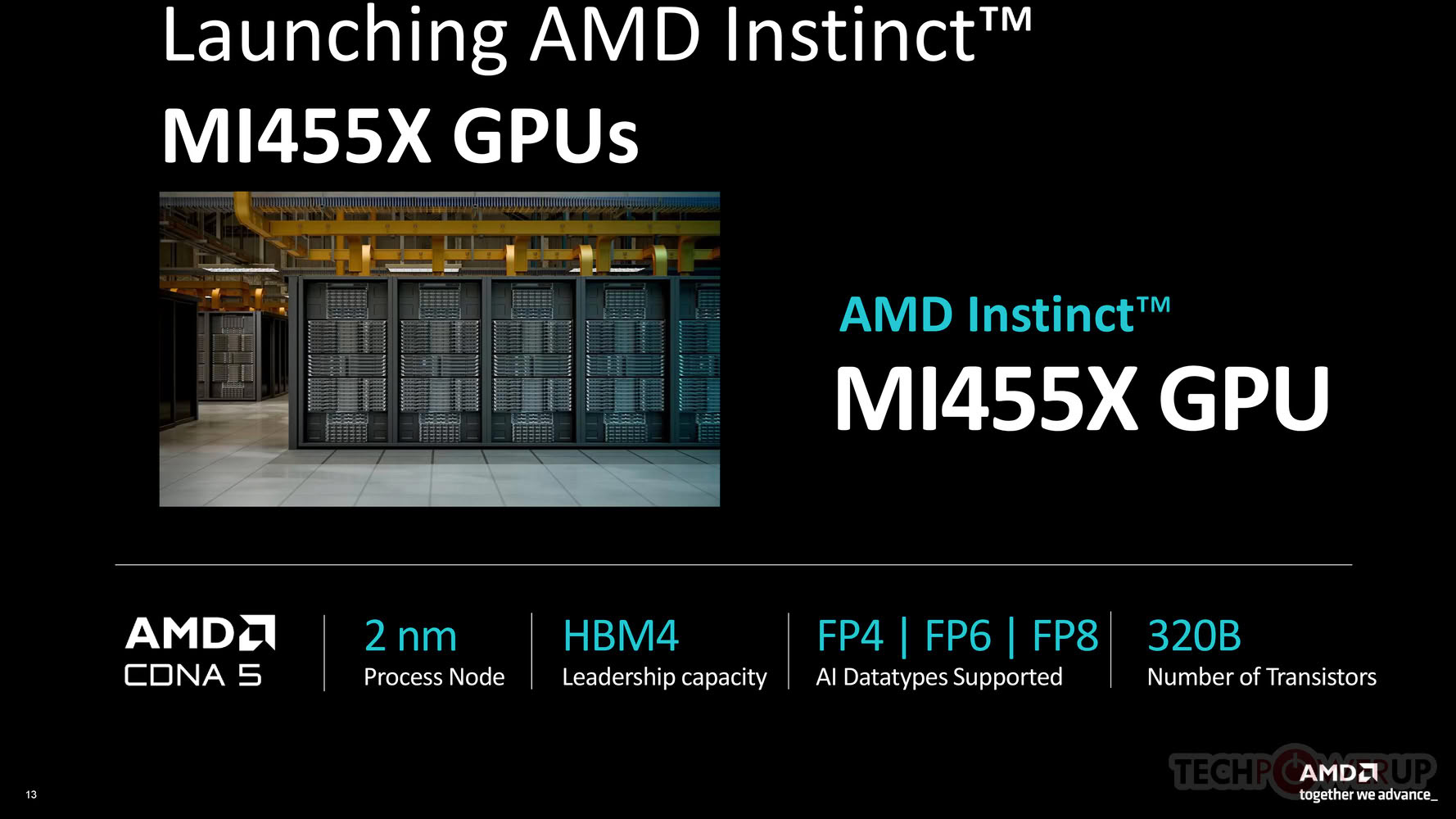
The MI455X is AMD's first GPU designed from the ground up for rack-scale deployment. AMD moves the compute (XCD) chiplets to TSMC's N2 process—2 nm gate-all-around—while the FCD and MID chiplets use the N3P (3 nm FinFET) process. The package integrates 8 XCD, 2 IOD and 2 FCD dies alongside 12 stacks of HBM4, for a total of 320 billion transistors. Key specs:
 CDNA 5 Architecture Choices
AMD attributes the MI455X's efficiency gains to a broad set of architectural changes: larger caches, multicast memory operations, Tensor Data Mover enhancements, Wave32 execution, HBM4 memory, and the UALoE scale-up fabric—all aimed at reducing data movement and overhead per unit of useful work. The whole design is oriented around the 72-GPU shared-memory pod (see Helios below), rather than the traditional 8-GPU node, which is a first for AMD Instinct.
Not a Gaming Architecture
CDNA is AMD's data-center compute line; RDNA remains the gaming graphics architecture (the current Radeon parts are RDNA 4, and there is no consumer Radeon news at this event). However, AMD has publicly stated it intends to converge CDNA and RDNA into a single unified architecture ("UDNA") in the future—so CDNA 5's choices are a useful tell. The most eye-catching is Wave32 execution: a 32-wide wavefront model that has been an RDNA hallmark, now appearing in CDNA. AMD's continued investment in block-scaled low-precision data types (MXFP4/FP6/FP8) is also relevant, since on-GPU low-precision AI math is exactly what future gaming GPUs will lean on for upscaling, frame generation and on-device AI. Add the maturing chiplet packaging and the move to 2 nm, and CDNA 5 shows the building blocks a future unified gaming/compute architecture would inherit. None of this makes CDNA 5 a gaming part, but it's a clear look at the common technology base.
Instinct MI430X: Sovereign AI and HPC
The MI430X targets sovereign AI, national infrastructure, research institutions and leadership-class HPC, where numerical accuracy matters. AMD quotes up to 288 TFLOPS of hardware-based FP64 performance for scientific computing, deployed in traditional mesh-based HPC topologies rather than the Helios rack. It shares the MI400 Series' HBM4 memory, advanced security (secure boot, encrypted GPU-to-GPU links) and open ROCm software foundation.

 AMD Helios: The Rack-Scale Solution
Helios is AMD's open, validated rack-scale blueprint: 72 MI455X GPUs across 18 open-rack, four-GPU compute trays, paired with EPYC 9006 SP7 "Venice" CPUs and AMD Pensando networking. Per rack, AMD quotes:
ROCm.ai: AI-Native Software Stack
Alongside the hardware, AMD announced ROCm.ai, an AI-native developer experience that bundles several pieces:
"Gorgon Halo" and the Ryzen AI Mini-PC Successor
For readers watching the client side, AMD teased "Gorgon Halo," the successor to its Strix Halo / Ryzen AI MAX platform—the silicon behind the current wave of compact AI mini-PC "boxes." AMD says it extends unified memory from 128 GB up to 192 GB and pushes local model support from 200B up to 300B parameters, letting these desktop-class systems run cloud-scale models locally. AMD also referenced its next-gen Ryzen AI 400 mobile series, deepened its Hugging Face partnership (native "Halo" support plus a year of Hugging Face Pro bundled with every Halo box), and a Cisco partnership for secured deskside AI. It shows how AMD's AI data-center technology is trickling down into prosumer and enthusiast desktops.
The MI400 Series splits into two parts: the Instinct MI455X for frontier AI and AI-factory deployments, and the Instinct MI430X for sovereign AI and HPC. Together with the Helios rack, 6th Gen EPYC "Venice" CPUs and AMD Pensando networking, they form AMD's open answer to NVIDIA's Vera Rubin NVL72. This post also covers the new ROCm.ai software stack and AMD's "Gorgon Halo" client teaser.


The MI455X is AMD's first GPU designed from the ground up for rack-scale deployment. AMD moves the compute (XCD) chiplets to TSMC's N2 process—2 nm gate-all-around—while the FCD and MID chiplets use the N3P (3 nm FinFET) process. The package integrates 8 XCD, 2 IOD and 2 FCD dies alongside 12 stacks of HBM4, for a total of 320 billion transistors. Key specs:
- Memory: 432 GB HBM4 at 23.3 TB/s of bandwidth
- Compute: 20 PF peak MXFP8, 40 PF peak MXFP4; supports FP4, FP6 and FP8 datatypes
- Host interface: PCI-Express 6.0 x16, running the AMD Infinity Fabric protocol to deliver 256 GB/s of bidirectional, hardware-coherent bandwidth to a paired EPYC "Venice" CPU
AMD attributes the MI455X's efficiency gains to a broad set of architectural changes: larger caches, multicast memory operations, Tensor Data Mover enhancements, Wave32 execution, HBM4 memory, and the UALoE scale-up fabric—all aimed at reducing data movement and overhead per unit of useful work. The whole design is oriented around the 72-GPU shared-memory pod (see Helios below), rather than the traditional 8-GPU node, which is a first for AMD Instinct.
Not a Gaming Architecture
CDNA is AMD's data-center compute line; RDNA remains the gaming graphics architecture (the current Radeon parts are RDNA 4, and there is no consumer Radeon news at this event). However, AMD has publicly stated it intends to converge CDNA and RDNA into a single unified architecture ("UDNA") in the future—so CDNA 5's choices are a useful tell. The most eye-catching is Wave32 execution: a 32-wide wavefront model that has been an RDNA hallmark, now appearing in CDNA. AMD's continued investment in block-scaled low-precision data types (MXFP4/FP6/FP8) is also relevant, since on-GPU low-precision AI math is exactly what future gaming GPUs will lean on for upscaling, frame generation and on-device AI. Add the maturing chiplet packaging and the move to 2 nm, and CDNA 5 shows the building blocks a future unified gaming/compute architecture would inherit. None of this makes CDNA 5 a gaming part, but it's a clear look at the common technology base.
Instinct MI430X: Sovereign AI and HPC
The MI430X targets sovereign AI, national infrastructure, research institutions and leadership-class HPC, where numerical accuracy matters. AMD quotes up to 288 TFLOPS of hardware-based FP64 performance for scientific computing, deployed in traditional mesh-based HPC topologies rather than the Helios rack. It shares the MI400 Series' HBM4 memory, advanced security (secure boot, encrypted GPU-to-GPU links) and open ROCm software foundation.
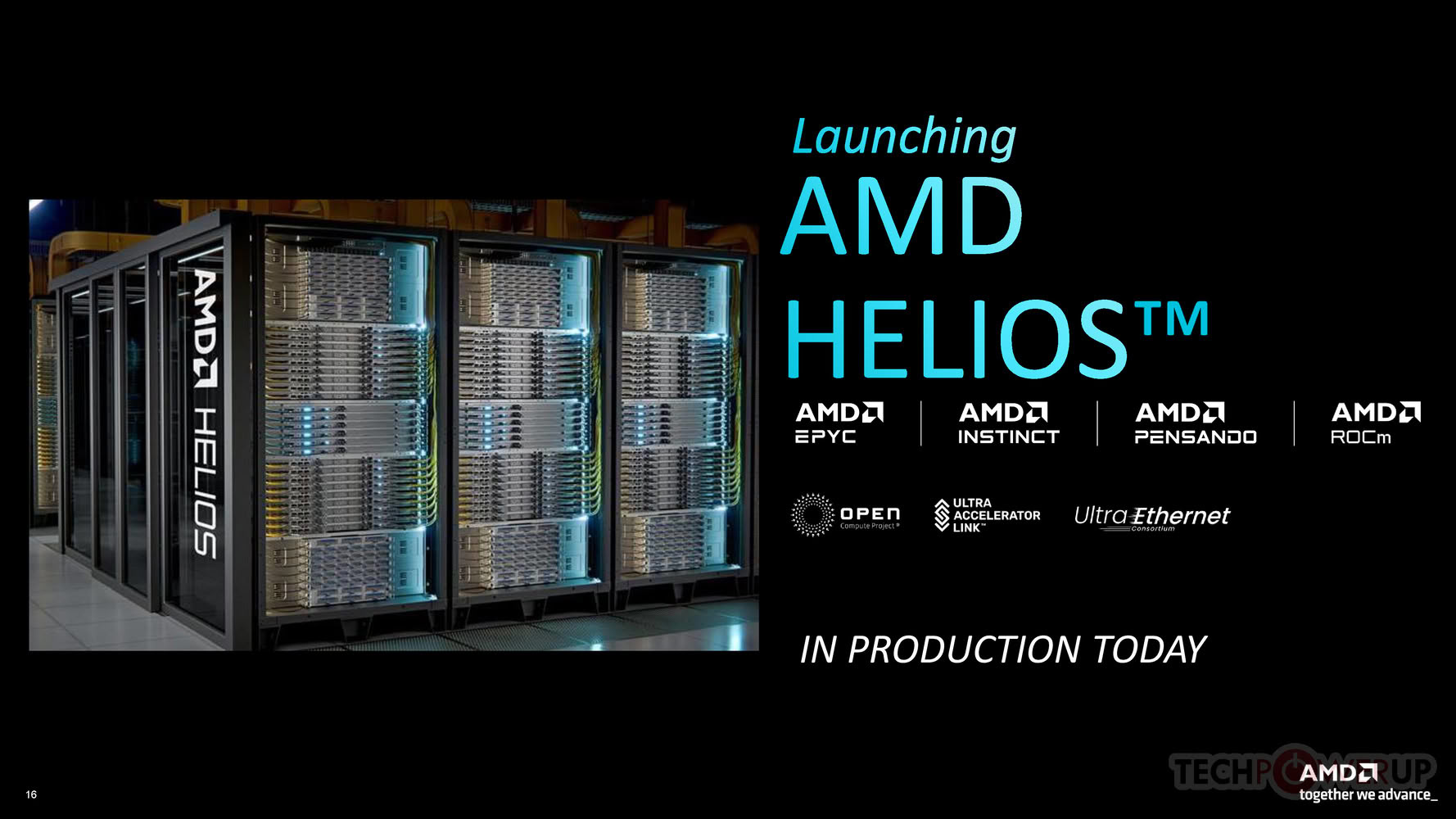
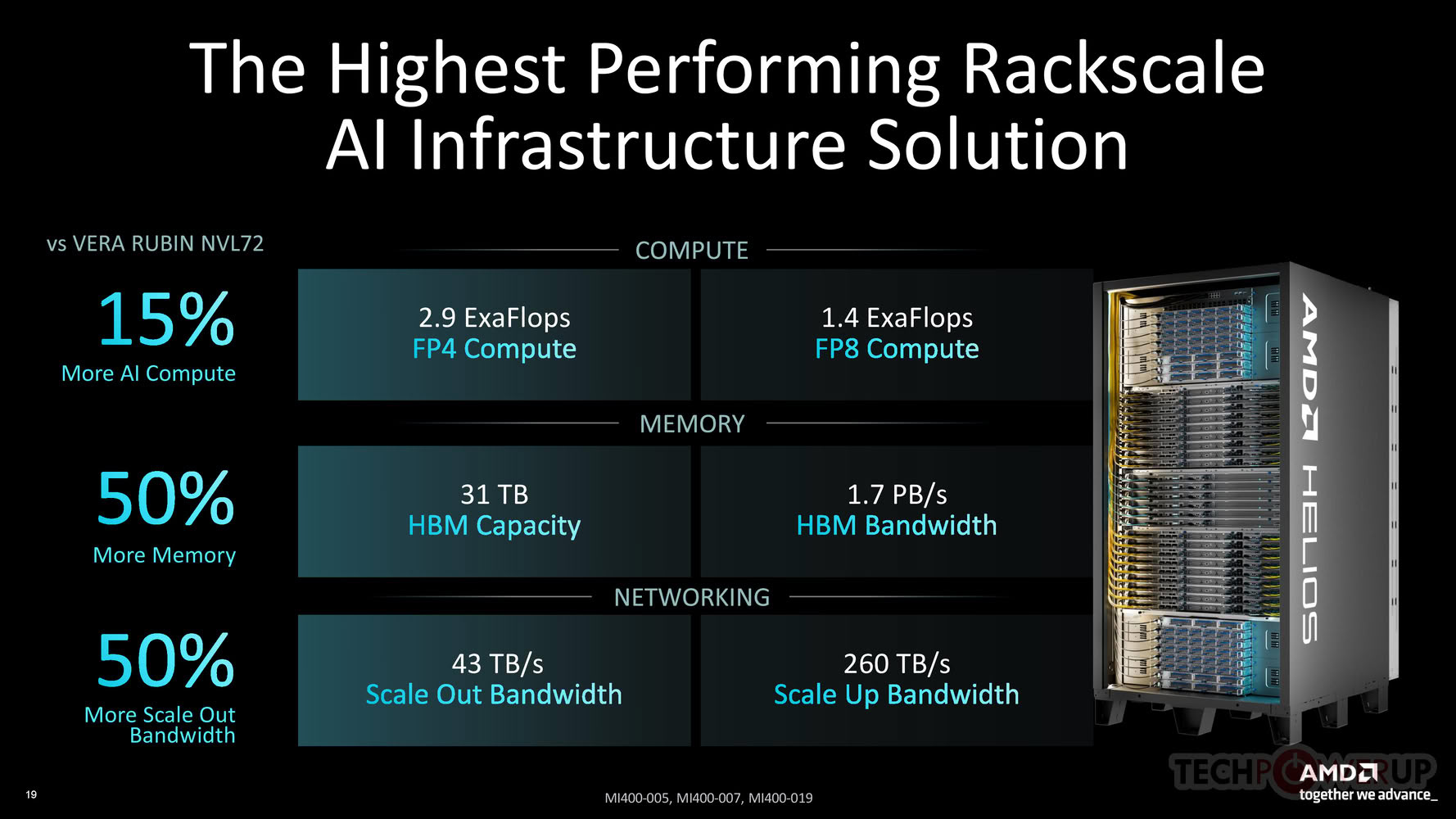
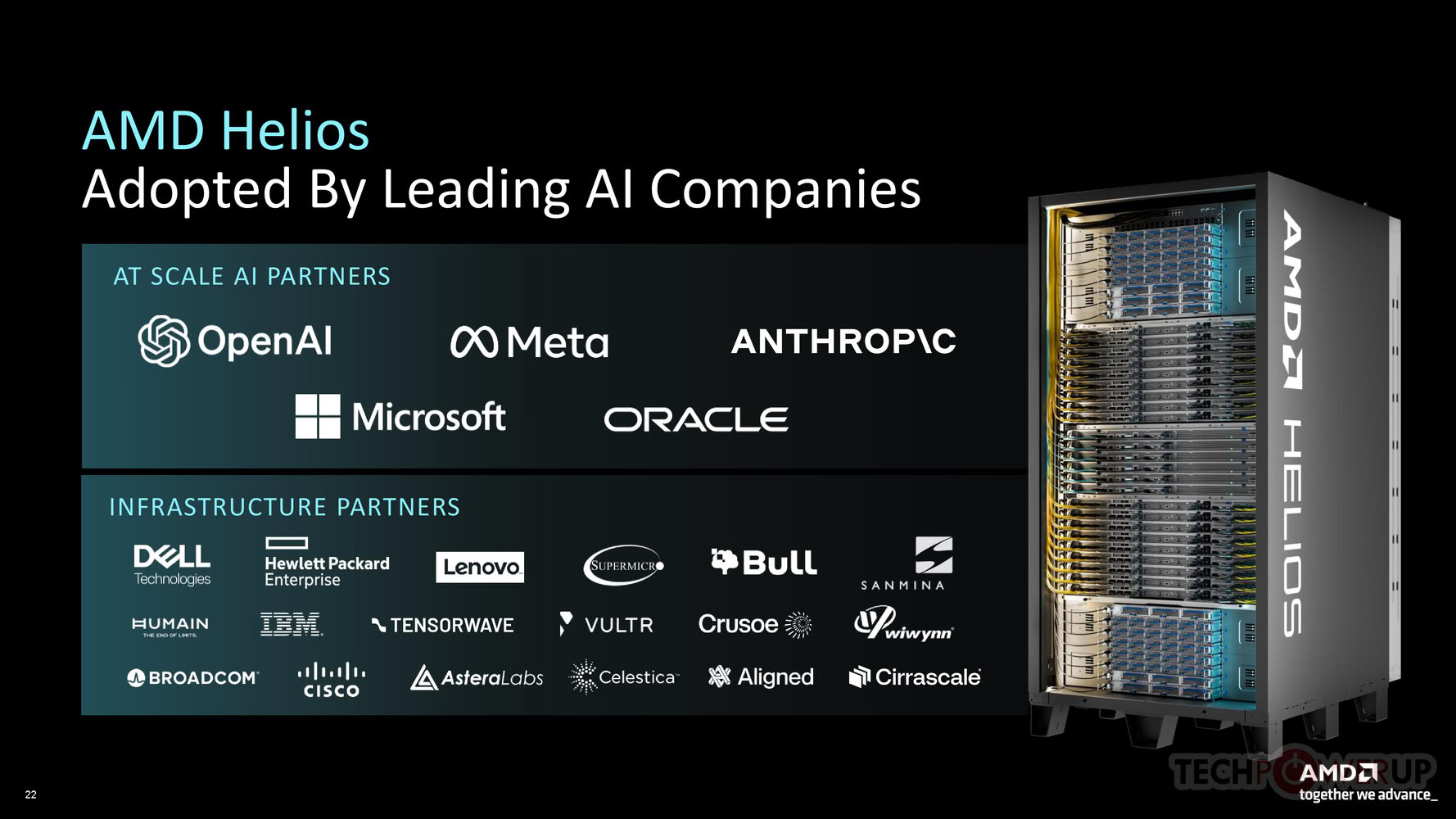
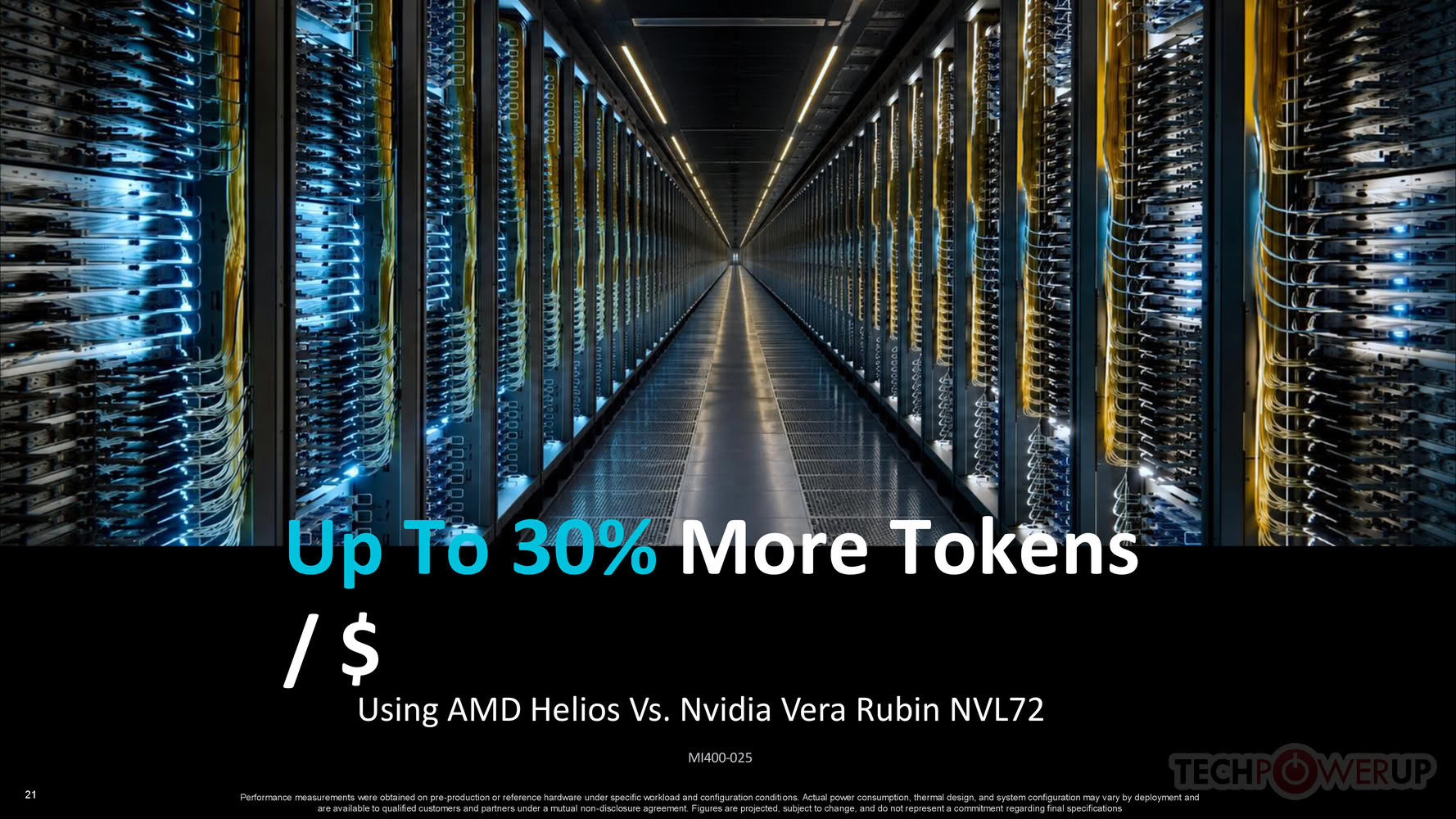
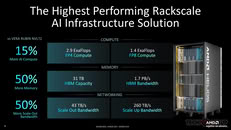
Helios is AMD's open, validated rack-scale blueprint: 72 MI455X GPUs across 18 open-rack, four-GPU compute trays, paired with EPYC 9006 SP7 "Venice" CPUs and AMD Pensando networking. Per rack, AMD quotes:
- 2.9 ExaFLOPS peak FP4 and 1.4 ExaFLOPS peak FP8
- 31 TB of HBM4 capacity and 1.7 PB/s of memory bandwidth
- 260 TB/s scale-up bandwidth (via UALink over Ethernet, "UALoE") and 43 TB/s scale-out bandwidth
ROCm.ai: AI-Native Software Stack
Alongside the hardware, AMD announced ROCm.ai, an AI-native developer experience that bundles several pieces:
- ROCm CLI—a unified command-line experience for installing, validating, serving and troubleshooting AI workloads, including air-gapped deployments.
- AMD Skills—AMD-authored expertise plugged directly into leading AI coding assistants, specifically Claude, Cursor, Codex and Gemini, so developers get AMD-specific guidance instead of generic answers.
- Hyperloom—a new open-source agentic system that automates end-to-end inference optimization (profiling, kernel rewriting, validation) with no human in the loop, doing in hours what AMD says previously took weeks.
- FlyDSL—a Pythonic domain-specific language for writing GPU kernels, aimed at giving Python developers low-level-class performance without hand-writing GPU code.
"Gorgon Halo" and the Ryzen AI Mini-PC Successor
For readers watching the client side, AMD teased "Gorgon Halo," the successor to its Strix Halo / Ryzen AI MAX platform—the silicon behind the current wave of compact AI mini-PC "boxes." AMD says it extends unified memory from 128 GB up to 192 GB and pushes local model support from 200B up to 300B parameters, letting these desktop-class systems run cloud-scale models locally. AMD also referenced its next-gen Ryzen AI 400 mobile series, deepened its Hugging Face partnership (native "Halo" support plus a year of Hugging Face Pro bundled with every Halo box), and a Cisco partnership for secured deskside AI. It shows how AMD's AI data-center technology is trickling down into prosumer and enthusiast desktops.
3 Comments on AMD Instinct MI400 Series and Helios Rack Debut: CDNA 5 Goes 2 nm, Plus ROCm.ai and "Gorgon Halo"