Monday, September 14th 2026

Silkland Announces H96, World's First Certified Ultra96 HDMI Cable Series

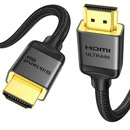
Silkland, the certification-first connectivity brand, today announced the Silkland H96, the world's first Certified Ultra96 HDMI cable series available to consumers. Both debut models—the 2 m S2705 and 3 m S2707, featuring aluminium-alloy housings and double-braided nylon jackets—are available for purchase today at silklandtech.com, starting at $32.99. Additional lengths will follow.

Every unit carries the official Ultra96 certification label. Buyers can scan the package QR code to confirm its brand, model and certified length on the official HDMI website.

A multi-length first
The Ultra96 program is HDMI LA's most rigorous cable certification ever, requiring each model to pass testing at an HDMI Forum Authorized Testing Center at every specific length.

At 96 Gbps, signal integrity becomes harder to maintain as length grows—so launching with two individually certified lengths on day one is an engineering achievement as much as a market first.

Double the bandwidth of HDMI 2.1
The H96 supports uncompressed 4K@240 Hz and 8K@60 Hz at full 4:4:4 chroma. With DSC, it supports up to 4K@480 Hz, 8K@240 Hz and 16K@60 Hz.

It also supports HDMI 2.2's Latency Indication Protocol (LIP) for precise audio-video sync, plus VRR, ALLM, QMS and eARC. The H96 is backward-compatible with current 48 Gbps HDMI 2.1 devices and ready for 96 Gbps HDMI 2.2 devices expected from 2027.
"Every new HDMI generation starts with the same question: is it certified—and can I actually buy it?" said Vincent, CEO of Silkland. "Today the answer to both is yes. The H96 isn't a 'coming soon' page—it's certified, labeled, and on sale today. Scan it yourself."
The launch extends Silkland's track record of certification firsts, including the first VESA-certified 2 m DP80 cable and the first USB-IF-certified 1.5 m USB4 80 Gbps cable on Amazon.
Source: Silkland
Add your own comment

17 Comments on Silkland Announces H96, World's First Certified Ultra96 HDMI Cable Series

#1
MikOnTopGG
Okay, 96Gbps, but, to be honest, what is the use of these cables? I mean, we have DP which already has plenty bandwidth.
Posted on Reply
#2
LabRat 891
MikOnTopGGOkay, 96Gbps, but, to be honest, what is the use of these cables? I mean, we have DP which already has plenty bandwidth.
Companies refuse to implement DisplayPort 2.1 UHBR20/DP80 for whatever reason. Most DP2.1 displays are UHBR10 or UHBR13.5 at best.
While I genuinely think DisplayPort is plainly superior to HDMI in all regards- With Linux finally getting full HDMI2.1 and VRR support, HDMI has solidly 'won' (for the time being). 😥
Posted on Reply
#3
TheLostSwede
News Editor
MikOnTopGGOkay, 96Gbps, but, to be honest, what is the use of these cables? I mean, we have DP which already has plenty bandwidth.
Same point as 80 Gbps DP cables today. Nothing seems to use either, yet.
Posted on Reply
#4
MikOnTopGG
LabRat 891Companies refuse to implement DisplayPort 2.1 UHBR20/DP80 for whatever reason. Most DP2.1 displays are UHBR10 or UHBR13.5 at best.
While I genuinely think DisplayPort is plainly superior to HDMI in all regards- With Linux finally getting full HDMI2.1 and VRR support, HDMI has solidly 'won' (for the time being). 😥
Yeah
TheLostSwedeSame point as 80 Gbps DP cables today. Nothing seems to use either, yet.
So why are they getting produced? Future Proofing?
Posted on Reply
#5
TheLostSwede
News Editor
MikOnTopGGYeah

So why are they getting produced? Future Proofing?
It's as the press release says, for HDMI 2.2, which I'm at least not aware of any product that supports. The standard was only released in June 2025.
Posted on Reply
#6
MikOnTopGG
TheLostSwedeIt's as the press release says, for HDMI 2.2, which I'm at least not aware of any product that supports. The standard was only ratified in June 2025.
Yeah, I guess.
Posted on Reply
#7
LabRat 891
MikOnTopGGSo why are they getting produced? Future Proofing?
A. HDMI 2.1 users that demand a certified quality and 'overkill' cable.
[VRR/FreeSync/Gsync and DSC are extremely sensitive signal integrity, dropped or repeated frames cause jarring dimming, flickering, and/or stuttering]

B. There's a very good chance that 2027-2028> Game Consoles and 8K displays will utilize HDMI 2.2. [So, "Yes."]
Posted on Reply
#8
Wye
Great, I can use them to connect the non-existing HDMI 2.2 GPU to the non-existing HDMI 2.2 monitor.

Or play jump rope?
Posted on Reply
#9
AsRock
TPU addict
TheLostSwedeIt's as the press release says, for HDMI 2.2, which I'm at least not aware of any product that supports. The standard was only released in June 2025.
And by time you find out it if works or not it be too late, milk that cow and over charge.
Posted on Reply
#10
Godrilla
Hopefully this chicken can lay some hdmi 2.2 compatible eggs in the form of video cards and displays and or foreshadow that they might be closer than initially anticipated.
Posted on Reply
#11
Tek-Check
MikOnTopGGOkay, 96Gbps, but, to be honest, what is the use of these cables? I mean, we have DP which already has plenty bandwidth.
The whole premium consumer electronics ecosystem will start moving to HDMI 2.2 ports from next year, including new 4K TVs, gaming consoles, GPUs, some monitors, possibly some AVRs, etc. It's the same like the transition to HDMI 2.1 in 2020. New 4K/240Hz TVs will certainly need it. It's all about higher refresh displays asking for more bandwidth.

Just make sure you disable ACR data over HDMI as much as possible...
Posted on Reply
#12
ISSEnterprise
MikOnTopGGOkay, 96Gbps, but, to be honest, what is the use of these cables? I mean, we have DP which already has plenty bandwidth.
You can see TVs never have the DP and its' size offer the big screen experience which currently monitors cannot give. For some hardware manufacturers, although they have to pay for license fees, but the HDMI group can offer technical solutions while DP cannot. For gaming, there are gaming consoles which only have HDMI and some gamers prefer using PC to play on big screen TVs.
Posted on Reply
#13
Grimling
LabRat 891Companies refuse to implement DisplayPort 2.1 UHBR20/DP80 for whatever reason. Most DP2.1 displays are UHBR10 or UHBR13.5 at best.
The reason is most of the time:
1. To save Cost
2. The bandwidth the Monitor requires does not need the full UHBR20 version.
Posted on Reply
#14
Dr. Dro
MikOnTopGGOkay, 96Gbps, but, to be honest, what is the use of these cables? I mean, we have DP which already has plenty bandwidth.
Currently none, there are no GPUs or otherwise any devices that support HDMI Ultra96. Might be supported on Rubin, might not, the architecture has been finished for some time. Same for RDNA 5, though I'd actually wager chances that it works on it are actually higher.

DP80 support is dodgy as is - Nvidia RTX 50 series or Radeon Pro with RDNA 3 or 4 architecture. AMD actually had DP80 first (Ada/40 series only does DP1.4 HBR3), but elected for market segmentation and disabled it on gaming cards.
Posted on Reply
#15
MikOnTopGG
Dr. DroCurrently none, there are no GPUs or otherwise any devices that support HDMI Ultra96. Might be supported on Rubin, might not, the architecture has been finished for some time. Same for RDNA 5, though I'd actually wager chances that it works on it are actually higher.

DP80 support is dodgy as is - Nvidia RTX 50 series or Radeon Pro with RDNA 3 or 4 architecture. AMD actually had DP80 first (Ada/40 series only does DP1.4 HBR3), but elected for market segmentation and disabled it on gaming cards.
Right, so maybe they are future Proofing. I will stick to DP, don't know about you.
Posted on Reply
#16
Dr. Dro
MikOnTopGGRight, so maybe they are future Proofing. I will stick to DP, don't know about you.
I use an OLED TV, so HDMI for me :)

The DP vs. HDMI feud is stupid anyway, both work and HDMI caught up technologically, there's no benefit to either. Use what your device requires.
Posted on Reply
#17
MikOnTopGG
Dr. DroI use an OLED TV, so HDMI for me :)

The DP vs. HDMI feud is stupid anyway, both work and HDMI caught up technologically, there's no benefit to either. Use what your device requires.
Yeah, exactly. This is also why they keep HDMI on the GPU's. Not only for the high bandwidth monitors, but also for the tv's.
Posted on Reply
Add your own comment
Nov 17th, 2026 13:14 CST change timezone

New Forum Posts

Popular Reviews

TPU on YouTube

Controversial News Posts