Monday, October 26th 2026

Unreal Engine 5.8 Gets Advanced Shader Delivery for Less In-Game Stuttering
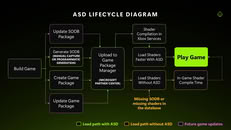
Epic Games is finally addressing one of the biggest issues with its game engine: in-game stuttering. Thanks to the latest version of Unreal Engine, version 5.8, this problem is becoming a thing of the past. The engine now incorporates Microsoft's DirectX Advanced Shader Delivery (ASD) for pre-compiled game shaders, moving shader compilation off the player's device. This change reduces the power and CPU time spent on compiling shaders. The company packages shader data into a State Object Database (SODB) and uses cloud-based compilation to convert that data into a Precompiled Shader Database (PSDB). This database can be shipped alongside the game, allowing it to find ready-to-use shaders on the first run. As a result, game developers will be able to provide pre-compiled shaders, speeding up game loading times and reducing any shader-induced stuttering during gameplay.
Once these pre-compiled shaders are downloaded onto the device, they will be simply invoked when playing the game, leaving Unreal Engine with easy access to shaders for seamless loading. As one of the most demanding game engines, Unreal Engine in its version 5.x is already computationally intensive and requires powerful graphics cards for optimal results. However, even with powerful GPUs, in-game stuttering can occur if a game's shaders aren't properly compiled and loaded. Using ASD will finally resolve this issue for good, provided game developers choose to support it.
 For example, NVIDIA has recently launched its ASD support with the GeForce 621.01 WHQL Game Ready drivers, while AMD's RDNA 1, RDNA 2, RDNA 3, RDNA 3.5, and RDNA 4 GPU generations, as well as Qualcomm Snapdragon X2 Series with Adreno integrated graphics, already support ASD. This month, Microsoft also to extended ASD to Intel Arc B-Series, which includes B570, B580, Intel Core Ultra Series 2, and Intel Core Ultra Series 3.
Source:
Epic Games
Once these pre-compiled shaders are downloaded onto the device, they will be simply invoked when playing the game, leaving Unreal Engine with easy access to shaders for seamless loading. As one of the most demanding game engines, Unreal Engine in its version 5.x is already computationally intensive and requires powerful graphics cards for optimal results. However, even with powerful GPUs, in-game stuttering can occur if a game's shaders aren't properly compiled and loaded. Using ASD will finally resolve this issue for good, provided game developers choose to support it.


13 Comments on Unreal Engine 5.8 Gets Advanced Shader Delivery for Less In-Game Stuttering
I guess what I'm asking is.. how are pre-compiled shaders going to reduce stutter vs shaders compiled one-time and stored locally?
And this looks like it's for Xbox only. Nobody would accept MS gatekeeping a compiled shader database for every UE game.
There is bit of jittery here and there and i now use a program called SCSkiller which recompiles shaders, also there are shaders that didnt really compile properly... after using the scskiller the gameplay is night and day.. also i have been able to crank up the settings and it is buttery smooth.
There is still some traversal stutters, doesnt fully eliminate those but it is far more enjoyable with SCSkiller...
[EDIT] Nevermind, it's an XBOX thing? The article sounds like a PC thing but the flowchart indicates XBOX?No, it is a PC thing. wccftech.com/unreal-engine-5-8-adds-microsoft-advanced-shader-delivery-support-potentially-addressing-one-of-ue5s-biggest-pc-gaming-problems-shader-compilation-stutter/
So I'm still wondering how pre-compiled shaders from a storefront/launcher package are better than compiled shaders done locally (apart from saving 5-10 minutes of CPU time every time you update drivers/card). How is this going to reduce stutter? It's just doing the same thing?
Also seems like it will only support the latest driver generation (which I never use).
Apparently won't replace local shader compilation unless I'm misunderstanding:
Not at all costs, mind you. However, if the required steps to get from Crysis Warhead to a Star Trek Holodeck are shader compilations, I would absolutely accept the time loss of local - which just gets more efficient with community efforts - regardless of what purrdy baubles people demand.
I accept we have to go through Nuclear Missiles to get to Fusion Reactors. Remember to duck and cover though!And these are the community efforts I'm talking about. We just solve stuff. That more people can't use search engines is the precursor needed for someone to make a better search engine.
Graphics will be fine.
We didn't get to Path Tracing by stopping at Tessellation. (Nor could we stop if we wanted to, because that wouldn't be human.)
"Better" is a value judgment to be decided later, and will always be subjective.
If you're willing to do an experiment, use Steam to download the Demo of Final Fantasy Resonance (6GB), and watch the background video at the Main Menu. Wouldn't it be cool if some modder could use DLSS5 to bring that level of 2.5 pixel clarity to an emulated Super Mario World 2 Yoshi's Island, alongside performance improvements that then get swiped by an indie studio and snuck into Windows 12?
A man can dream. It is all a Man can do.You're preaching to the choir, but this is chicken vs egg.
Can the art direction on something that doesn't exist yet be improved if the thing doesn't exist yet to practice on?
I want the 4D Quantum Tesseract Dick On Table model to be developed, so we can get better at doing cool art with it.