News Posts matching #CPU

Return to Keyword Browsing

Thermaltake Launches Jing Silent CPU Cooler

Thermaltake, leading DIY thermal solutions brand, launch their latest CPU air-cooler specifically developed for silent operation while maintaining a maximum of cooling efficiency, the Thermaltake Jing. Its name is derived from the Chinese, representing "Silence" and carrying with it the concepts of comfort, excellence and exquisiteness. The universal socket support makes it compatible to all computer processors currently available on the market. With a maximum cooling capacity of up to 200W and an almost un-audible noise level of 16 dBA at a fan speed of 800 RPM, the Jing CPU cooler is the ideal solution for noise sensitive users expecting uncompromising performance.

Unlike traditional up-side-down air flow designs, the Jing utilizes a tower side-flow design to optimize cooling performance. To attain maximum cooling performance, Thermaltake's Jing adopts 5 Φ6mm high-efficiency heat-pipes conducting heat from the Nickel coated mirror base directly into the cooling tower which is made of 41 0.5 mm thick specially designed aluminum fins to increase the overall thermal dissipation area. The two preinstalled extra silent 120 mm VR fans can be manually adjusted between 800RPM and 1300RPM according to differing user needs. Through their inhale-exhaust reverse fan design a greater airflow is achieved resulting in enhanced thermal performance.

Intel Atom Processors Further Expand to Storage Appliances for Homes, Small Busineses

Backed by industry support of the Intel Atom processor optimized for networked storage appliances for the home and small business, Intel Corporation has added two new Intel Atom processors to further boost the company's focus on the platform.

Since Intel's initial foray in this area in March, leading storage manufacturers, including Acer, Cisco, LaCie, LG Electronics, NETGEAR, QNAP, Super Micro, Synology and Thecus have announced products based on the energy-efficient Intel Atom processor platform.

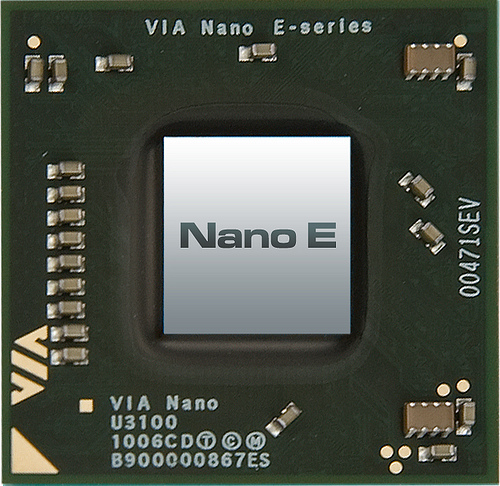
VIA Unveils Nano E-Series Processors, Readies Embedded Industry for Next-Gen 64-bit

VIA Technologies, Inc, a leading innovator of power efficient x86 processor platforms, today announced the VIA Nano E-Series processor, bringing native 64-bit software support, virtualization capabilities and extended longevity support to embedded markets.

The move to 64-bit software architecture is an essential transition for the future of the embedded industry. Forthcoming operating systems such as Windows Embedded Standard 7 will be able to leverage a 64-bit software eco system that provides up to double the amount of data a CPU can process per clock cycle. This translates in to greater ease in manipulating large data sets and an overall performance boost compared to non-native 64-bit architectures.

NVIDIA CUDA Emulator for every PC

NVIDIA's CUDA GPU compute API could be making its way to practically every PC, with an NVIDIA GPU in place, or not. A chinese freelance developer has coded a means to get CUDA work as a middleware on OpenCL. This move lets CUDA work on ATI Radeon GPUs that support OpenCL, as well as x86 CPUs, since OpenCL specs allow the API to run on CPUs for development purposes. The implications of these are many:
  • Letting CUDA-accelerated software such as Badaboom make use of ATI GPUs
  • Letting PhysX run on ATI GPUs as PhysX middleware uses CUDA for GPU acceleration
  • Possibly better scaling of PhysX on multi-core CPUs (over OpenCL), as the regular PhysX CPU acceleration is infamous for bad multi-core scaling in performance
The software works as a translation layer, exchanging calls between CUDA and OpenCL or the CPU if OpenCL is not available. It comes in the form of a loader application that injects itself into the executing process. To get PhysX to run, one needs to install older versions of PhysX System Software (version 8.09.04 WHQL being the latest) from its standalone installer (installs PhysX libraries without looking for NVIDIA GPUs).

DOWNLOAD: CUDA Emulator Loader

Zotac Readies Five New ZBOX Series Nettops

Zotac is working on five new MAG nettops under its ZBOX series. Each of these "anywhere PCs" measure 18.8 (L) x 18.8 (W) x 4.4 (D) cm, and offer enough power for basic computing. The five new models are based on a variety of nettop platforms. As standard features, these have 160 GB HDDs, SDHC card reader, USB 2.0 and eSATA, Gigabit Ethernet and WiFi. Zotac's new nettops will debut next month. Specifications and expected price of each of these are as follows:
  • HD-ID11 model - 1.66 GHz Atom 510 dual-core CPU / 1GB of RAM / Next-gen ION (GT218 GPU with 512MB dedicated memory) / $255
  • HD-ND21 model - 1.3 GHz Processor SU4100 dual-core CPU /2GB of RAM / ION (first-gen) / $300
  • HD-ND02 model - 1.6 GHz Atom 330 dual-core CPU / 2GB of RAM (DDR3) / ION (first-gen) / $217
  • HD-AD01 model - 1.5 GHz Athlon X2 Neo L325 dual-core CPU / 2GB of RAM / ATI Radeon HD 3200 / $242.

New Cases, Coolers and 3D Displays From Zalman

Zalman is actually in a local hotel suite, showing off some very interesting products. They are showcasing their 3D monitor in the 21.5 inch variant with FullHD resolution. A 24 inch version can also be had, while a 27 inch LCD and a 32 inch 3D TV LCD are also in planning. We also got a good look at their upcoming VGA coolers for ATI and NVIDIA cards. Due to the different placement of GPU cores, there are now two different coolers with the same general structure. We were told, that the final NVIDIA version will be green, while the red variant is final and will be intended for ATI products.

Scythe Readies Susano and Yasya Cu CPU Coolers

Scythe showed off prototypes of two of its creations for the season, the Scythe Susano and Yasya Cu CPU coolers. The Susano is one of Scythe's biggest CPU coolers. Its vast aluminum fin array covers the entire upper half of the average ATX motherboard. Its design involves a heatsink-turned CPU block, from which six copper heat pipes pass. These heat pipes convey heat to a large, roughly-square aluiminum fin array on which are latched four 120 mm fans. These blow air through the aluminum fin block, and onto several parts of the motherboard, including memory, northbridge and CPU VRM. The Yasya Cu is a slightly more in tune with the times. It is a copper-based variant of the Yasya CPU cooler. It uses the tried and tested tower design, and makes use of copper fins with a turbulent shape. Heat is conveyed to these fins using six copper heat pipes. Scythe did not give out a release date for these coolers.

AMD Slated to Receive 56 Million CAD Grant from Ontario Government

AMD today announced that it has entered into a Memorandum of Understanding with the Ontario Ministry of Economic Development and Trade, under which the Ministry will award a five-year grant of $56.4 million CAD ($52.8M USD) to AMD Canada under Ontario's Next Generation of Jobs Fund. The grant is expected to fund R&D activities by AMD's Markham-based engineers in the development of its upcoming AMD Fusion family of processors, related software infrastructure and integrated computing platforms. Ontario expects to make its initial investment of $11.2 million CAD to AMD upon signing the formal agreement, with periodic payments occurring thereafter throughout the grant period.

In turn, AMD will commit to substantially invest in AMD Fusion processor-related R&D activities in Markham, and retain and create hundreds of high-value R&D jobs during the grant time frame. AMD also plans to increase collaborative activities with local universities.

Cool IT Systems Introduces New Line of CPU and GPU Coolers

CoolIT System has a bunch of new CPU and GPU coolers. They are showing a full range of new coolers for the CPU, starting with the ECO A.L.C. which now places the pump right into the cooling base, increasing compatibility with cases. The unit has an MSRP of $74.99 and should be available now. The next step up is the Vantage A.L.C, which incorporates a display and all the electronics on the CPU bracket. The LCD is a programmable 84x48 pixel screen with a dynamic, custom color backlight and 2.4 GHz wireless communication module. Two buttons on the Vantage module provides a user interface for optimizing all chassis fan speeds, RGB case lighting, LCD Backlight color along with monitoring and alarm triggers. The Vantage also features the so called ESP (Extra Sensory Peripherals) wireless technology which enables the cooler to be controlled and monitored through CoolIT's Maestro software and USB wireless controller.

On the GPU cooling front, we got a good look at the OMNI A.L.C. This unit has the same wireless system and features interchangable plates between the water block and GPU. This means that you can simply exchange the this plate when upgrading your graphics card.

New NVIDIA Tegra Processor Powers The Tablet Revolution

NVIDIA today launched its Next Generation Tegra, the world's first processor for the mobile web, specifically designed for the high-resolution needs of tablets. Consumers have been waiting for a truly portable, high-resolution, no-compromise Internet experience. NVIDIA's new Tegra processor delivers that by combining lightning-quick browsing, streaming 1080p video and Adobe Flash Player 10.1 acceleration with an immersive 3D user interface and days of battery life.

"Without question, 2010 is going to be year of the tablet," said Tim Bajarin, President, Creative Strategies, Inc. "The new NVIDIA Tegra processor has a unique feature set critical for tablets -- fast web browsing with fully rendered pages, uncompromised graphics, snappy user interface and HD video - all with the battery life we've only seen with cell phones."

EVGA Dual LGA-1366 Motherboard Pictured

The recently surfaced high-end dual socket LGA-1366 motherboard is pictured in full, without its cooling assembly. The picture reveals quite a bit about EVGA's new monstrosity. To begin with, the motherboard is neither ATX, nor EATX in the truest sense. Like the recently announced X58 Classified 4-way SLI which was based on the "XL-ATX" form-factor, this motherboard seems to be 13.58 inches (344.93 mm) long, and about as wide as EATX (330 mm, 13 inches), or maybe a little more.

Each LGA-1366 socket is wired to six DDR3 DIMM slots for triple-channel memory, and is powered by an 8-phase digital-PWM circuit. Each socket further has a 3-phase power circuit for its DIMM slots. The CPU VRM for each socket takes input from an 8-pin ATX, and what appears to be a 6-pin +12V (PCI-E?) connector. The motherboard further takes power from a 6-pin PCI-E power connector apart from the usual 24-pin ATX power connector. Some of these inputs may be redundant and needed only for additional electrical stability to support competitive overclocking.

Intel Announces Next-Generation Atom Platform

Intel Corporation announced new Intel Atom processors today that feature integrated graphics built directly into the CPU, enabling improved performance and smaller, more energy-efficient designs in a new generation of netbooks and Atom-based entry level desktop PCs. Major OEMs have committed to having systems on the new Intel Atom processors and a new companion chipset available within the next few weeks.

The newest Intel Atom platform for netbooks consists of a new Intel Atom processor, the N450, and a new low-power Intel NM10 Express Chipset. For entry level desktop PCs, it consists of either the Intel Atom processor D410 or the dual core D510, also paired with the Intel NM10 Express Chipset. The Intel Atom processor was designed from the ground up for small devices and low power, and remains Intel's smallest chip, built on the company's 45nm high-k metal gate manufacturing process. The overall package, including chipset, just got smaller due to the increasing integration and 45nm manufacturing, which means smaller, more compact system designs, lower costs for OEMs and improved performance.

VIA Introduces New VIA Nano 3000 Series Processors

VIA Technologies, Inc, a leading innovator of power efficient x86 processor platforms, today introduced its new VIA Nano 3000 Series processors, bringing enhanced digital media performance and lower power consumption to Windows 7 thin and light notebook and all-in-one desktop PC markets.

Based on the 64-bit superscalar 'Isaiah' architecture, VIA Nano 3000 Series processors deliver the most compelling thin and light notebook computing experience with their rich HD entertainment capabilities, including support for flawless playback of high bit-rate 1080p HD video, as well as low power consumption resulting in longer battery life.

Sharkoon Announces Silent Eagle C92 and C120 CPU Cooler

Sharkoon introduces two all new high-performance, and quiet, Tower-coolers for the AMD- and Intel-processors. The Sharkoon Silent Eagle CPU cooler options are the Model C92 with a 92mm fan and Model C120 with a 120mm fan. Both provide four U-equalizing 8mm cooling heat pipes and premium aluminium fins for efficient heat dissipation. This is further strengthened by the Direct-Touch-Technology: The heat pipes rest directly on the processor, so that the heat is released directly without having to detour through an extra plate to the cooling fans.

Sharkoon's popular Silent Eagle models utilize an innovative Golf ball surface texture application. The round dimples on the rotor blades minimize air turbulence and provides a boost in air output at the same rotational speed and noise emission. The fans are equipped with a 4-pin PMW connector to automatically regulate over the provided mainboard. The 92mm fan of the C92 model rotates between 350 to 1600 r/min, with a maximum sound volume of 24,8 dB(A) and motion air flow up to 72,9 m³/h. The heat sink, including fan, measures 120 x 92 x 77 mm (H x W x D) and weighs 550 g. The 120mm fan of the larger C120 model rotates between 359 to 1200 r/min and conveys a sound volume under full load of 20 dB(A) with a motion air flow of 83 m³/h. The C120 measures 157 x 125 x 86 (H x W x D) and weighs 755 g.

Intel IGPs Use Murky Optimisations for 3DMark Vantage

Apart from being the industry's leading 3D graphics benchmark application, 3DMark has had a long history of 3D graphics hardware manufacturers cheating with their hardware using application-specific optimisations against Futuremark's guidelines to boost 3DMark scores. Often, this is done by drivers detecting the 3DMark executable, and downgrading image quality, so the graphics processor has to handle lesser amount of processing load from the application, and end up with a higher performance score. Time and again, similar application-specific optimisations have tarnished 3DMark's credibility as an industry-wide benchmark.

This time around, it's neither of the two graphics giants in the news for the wrong reasons, it's Intel. Although the company has a wide consumer base of integrated graphics, perhaps the discerning media user / very-casual gamer finds it best to opt for integrated graphics (IGP) solutions from NVIDIA or AMD. Such choices rely upon reviews evaluating the IGPs performance at accelerating video (where it's common knowledge that Intel's IGPs rely heavily on the CPU for smooth video playback, while competing IGPs fare better at hardware-acceleration), synthetic and real-world 3D benchmarks, among other application-specific tests.

Zalman Rolls out CNPS-10X Flex CPU Cooler

Traditionally, a specialists in aluminum/copper fin 'ring' type CPU coolers, Zalman maintained a performance leadership till aluminum fin tower type CPU coolers took over as the better performing design. Zalman was forced to keep up with the trend, which it did with the introduction of its CNPS-10X series coolers, namely CNPS-10X Quiet, and CNPS-10X Extreme. The third one in the series, which Zalman recently made available to European stores, is the CNPS-10X Flex. This is basically a tower-type heatsink that uses a block of 56 aluminum fins (some of which are anodized black), to which heat is conveyed by five copper heat-pipes. While it does not include a fan of its own, it gives you the flexibility of using your own 120 mm fan, and allows for two fans in all. The retention module supplied supports all current CPU sockets, including LGA-1366, LGA-1156, LGA-775, and AM3/AM2+/AM2. Priced at €40, it is €10 cheaper than the CNPS-10X Quiet, enough price difference to allow you to buy a decent-quality 120 mm fan of your choice, be it performance-oriented, or quiet.

NVIDIA Collaborates With Microsoft On High Performance GPU Computing

NVIDIA today announced work with Microsoft to promote NVIDIA Tesla graphics processing units (GPUs) for high performance parallel computing using the Windows HPC Server 2008 operating system.

"The coupling of GPUs and CPUs illustrates the enormous power and opportunity of multicore co-processing," said Dan Reed, corporate vice president of Extreme Computing at Microsoft. "NVIDIA's work with Microsoft and the Windows HPC Server platform, is helping enable scientists and researchers in many fields achieve supercomputer performance on diverse applications."

NVIDIA Research developed several GPU-enabled applications on the Windows HPC Server 2008 platform, such as a ray tracing application that can be used for advanced photo-realistic modeling of automobiles. Related to this, NVIDIA worked with Microsoft Research to install a large Tesla GPU computing cluster and is studying applications that are optimized for the GPU.

oZone3D.Net PhysX FluidMark v1.1.0 Benchmark Released

Nearly a year since its first release, the creators of FurMark have released a new version of their Physx based FluidMark, which like Furmark can be used as either a stress test or benchmarking tool. FluidMark is designed to run in hardware mode for all CUDA ready NVIDIA cards, which includes the 8, 9 and 200 series of graphics cards. For all others the program runs in software mode, which can be forced even if your system has one of the above mentioned cards. The creators say in software mode, the tool "is an excellent CPU benchmark." The latest graphics drivers and Physx version 9.09.0428 is recommended to be installed prior to running this. For more information and to download go here

FluidMark 1.1.0 changelog:
  • New: simple color point rendering mode (press the R key in stability test).
  • New: use the code base than FurMark.
  • New: command line parameter (/no_sph) to disable SPH fluid simulation method.
  • Change: compiled with NVIDIA PhysX SDK 2.8.1.
  • Bugfix: minors bugs fixed

Zalman CNPS9900-NT Closing In

Having released the 120 mm copper monstrosity, the CNPS9900, Zalman is looking to give the NVIDIA-branded CNPS9700-NT an update, only this time, there's no NVIDIA branding to be seen. The CNPS9900-NT is decked with nickel-plated copper, which gives it the chrome appearance. Between the two copper-fin blocks, is nested a 120 mm green LED lit fan, which gives the same illumination as the older NT versions of Zalman's coolers. It measures 94 x 131 x 152 mm (LxWxH), and weighs in at 730 g. The fan spins at speeds between 1000 and 2000 rpm. The cooler supports all current CPU socket types, including LGA-1366, LGA-1156, LGA-775, and AM3/AM2(+). It packs a tube of the company's ZM-STG2 thermal compound. When released in Europe, it is expected to sell for 70 EUR.

GELID Launches the Slim Silence AM2/LGA775 - 1U Slim ITX Heatpipe CPU Cooler

Thermal Solutions specialist GELID Solutions adds a 28mm high 1U Slim ITX heatpipe CPU Cooler with PWM fan to its popular line of Silent CPU coolers.

With a compact heatsink design for Mini ITX, Micro ATX, ATX, HTPC, Panel PC, Car PC and 1U server the "Slim Silence" is equipped with a high performance heatpipe and a silent fan. The high performance heatpipe ensures a fast and efficient heat transfer from core to aluminium fins. The frameless silent fan includes a ball bearing and a GELID intelligent PWM (Pulse Width Modulation) control which ensures a silent operation at low CPU temperature and accelerates the fan speed when necessary.

AMD Plans Massive 45 nm Transition, New CPUs Announced

Industry observer DigiTimes, citing anonymous sources, today reported that AMD is planning to move production of its desktop processors to 45 nm node process by the third quarter of this year.
AMD plans to move production of its desktop CPUs to its 45nm node process in the third quarter, helping to reduce costs, according to sources at motherboard makers.
Currently, only AMD's quad-core Phenom II X4 800 and 900 series (Deneb) and triple-core Phenom II X3 700 series (Heka) CPUs are manufactured under a 45nm process. The company plans to move its dual-core Phenom II X2 500 series (Callisto) and Athlon II X2 200 series to 45nm in June, and quad-core Athlon II X4 600 series and triple-core Athlon II X3 400 series (Rana) in September, the sources noted.
The chipmaker also plans to launch several CPUs during the period between the end of the second quarter and the third quarter. The dual-core Phenom II X2 550 and 545 will launch at the end of the second quarter, and the quad-core Phenom II X4 945 (95W) and 8xx (95W), triple-core Phenom II X3 7xx (95W), quad-core Athlon II X4 630 and 620, triple-core Athlon II X3 435 and 425, and dual-core Athlon II X2 250, 245 and 240 will launch in the third.
AMD also plans to launch 10 low-power consumption CPUs including the Phenom II X4 905e, Phenom II X3 705e and Athlon II X4 605e.

ASUS Announces ROG Crosshair III Formula, Set Your Sights on Blazing Benchmarks

ASUS, the world's leading producer of motherboards, today put world record-breaking power into the hands of AMD Phenom II users with the launch of the ROG (Republic of Gamers) Crosshair III Formula. Based on the AMD Socket AM3 platform, the Crosshair III Formula harnesses its full complement of ROG-exclusive features and technologies to unleash the full overclocking potential of Phenom II processors-enabling budget-conscious enthusiasts and gamers to enjoy extreme levels of performance at an affordable mid-price point.

Fujitsu Develops the Fastest CPU in the World

10 years after they last held this title, Fujitsu have now snatched the status from previous record holder Intel, by developing a CPU (Central Processing Unit) capable of 128 billion calculations per second. Codenamed Venus, the chip is said to be able to calculate 2.5 times faster than the previous fastest CPU and using miniaturization technology, Fujitsu have managed to double the number of central circuits integrated onto a chip measuring about 2cm from four to eight. Venus is also said to consume only a third of the electricity compared to current levels.
Tens of thousands of these new chips are set to be used in a next-generation supercomputer for an Institute of Physical and Chemical Science which will go into operation at the end of fiscal 2010. It has also been said that should the Venus come to be used in devices such as personal computers and digital electronic appliances, it could lead to the development of equipment such as portable simultaneous interpretation devices and automated driving devices for cars.

AMD SSE5 Gets an Instruction-Set Expansion, Coins XOP (eXtended Operations)

AMD kept up with the SIMD processing standards Intel set by licensing its popular CPU instruction sets such as MMX, SSE, SSE2, and SSE3. The three were used as is by AMD, except for that AMD chose not to conform completely with Supplemental SSE3, SSE4 and its revisions (SSE4.1, SSE4.2). The company devised the SSE4A instruction set to feature with its K10 micro-architecture. SSE4A is a lighter version that features LZCNT (Leading Zero Count), POPCNT (bit population count), EXTRQ/INSERTQ and MOVNTSD/MOVNTSS (Scalar streaming store instructions). What's more, the company even decided back in 2007 that it would come up with SSE5, that then Intel sought to leave development with AMD.

In due course of time, Intel started development of AVX (Advanced Vector eXtensions) that enhances processing of FPU-intensive workloads. AMD gained interest in this technology, and is looking to make it compatible with the originally-conceived SSE5. The instructions that remain as part of the superset that doesn't include AVX is now referred to by AMD as XOP (eXtended OPerations). In addition to this, AMD will include FMA4 (Floating point vector Multiply-Accumulate). The new instruction sets make it to AMD's next-generation Bulldozer micro-architecture slated for 2011. Meanwhile, Intel's AVX makes it to the Sandy Bridge micro-architecture slated for 2010~11. AMD published the Programmer's Manual document on 128-Bit and 256-Bit XOP, FMA4 and CVT16 Instructions, which can be read here (PDF).

Not all AMD Processors Support 'XP Mode' in Windows 7

A new feature of Microsoft's Windows 7 operating system that created a stir is its "XP mode" feature, where the operating system provides the user with a sandbox Windows XP desktop environment, complete with all its features, and application support. What makes the feature even more interesting that documents, settings, and XP-affine applications installed in the environment could be seamlessly integrated with the host Windows 7 environment.

It turns out now that the feature explicitly requires hardware-level virtualization support. AMD and Intel, both have their proprietary virtualization features, although the two chose to make it available only to a few CPU models. Generally, entry-level desktop/mobile CPUs don't carry the feature. For consumer client desktop variants of Windows 7, the "XP mode" feature would require AMD-V feature by the processor. Currently all processors by AMD support this, except those from the Sempron series, according to an AMD spokesperson. For enterprise variants of the OS, Microsoft Enterprise Desktop Virtualization (MED-V) MED-V 2.0 builds on top of Windows Virtual PC and provides centralized management of Windows XP Mode. MED-V is a virtualization management platform. It will be made available within 90 days of the commercial availability of Windows 7.
Return to Keyword Browsing
Nov 11th, 2026 07:05 CST change timezone

New Forum Posts

Popular Reviews

TPU on YouTube

Controversial News Posts