News Posts matching #DRAM

Return to Keyword Browsing

Elpida Starts Shipments of 4 Gbit Wide-IO LPDDR3 Memory Chips

Elpida Memory, Inc., the world's third largest Dynamic Random Access Memory manufacturer, today announced that it has begun sample shipments of 4-gigabit Wide IO Mobile RAM and 4-gigabit DDR3 Mobile RAM (LPDDR3).

Wide IO Mobile RAM is a next-generation mobile memory chip that provides solutions to opposing needs for faster speed and lower power consumption. The rising performance of smartphones and tablet devices in recent years has led to demand for faster DRAMs (DRAMs with greater data transfer rates), but in turn this has generated concerns about increases in system power consumption.

The solution is that Wide IO Mobile RAM expands the I/O width by using x512-bit, a data width that is more than 10 times larger than the width for existing DRAMs, which enables a data transfer rate of 12.8 gigabytes per second (GB/s) per chip while operating at a low speed of 200MHz. The reduced DRAM speed results in approximately 50% less power consumption compared with DDR2 Mobile RAM (LPDDR2), currently the leading DRAM choice for mobile devices, configured at the same transfer rate.

Buffalo Unveils New 8 GB Memory Modules

Buffalo Japan unveiled new 8 GB memory modules in the 204-pin SO-DIMM and standard 240-pin DIMM form-factors. These modules pack 8 GB capacity, and stick to JEDEC DDR3-1333 MHz standards. Featured in the D3N1333 series, these modules 1024M x 64bit DIMM configuration. They achieve 1333 MHz speeds with CAS latency of 9T and DRAM voltage of 1.5V. The Buffalo Tools software comes bundled with these modules. The two are priced at 26,670 JPY, around US $341.6.

Micron Technology, Inc., Reports Results for the First Quarter of Fiscal 2012

Micron Technology, Inc., today announced results of operations for its first quarter of fiscal 2012, which ended December 1, 2011. For the first quarter, the company had a net loss attributable to Micron shareholders of $187 million, or $0.19 per diluted share, on net sales of $2.1 billion. The results for the first quarter of fiscal 2012 compare to a net loss of $135 million, or $0.14 per diluted share, on net sales of $2.1 billion for the fourth quarter of fiscal 2011, and net income of $155 million, or $0.15 per diluted share, on net sales of $2.3 billion for the first quarter of fiscal 2011.

The company's consolidated gross margin remained at 15 percent for the first quarter of fiscal 2012. Improvements in NAND Flash margins were offset by declines in DRAM. Revenue from sales of NAND Flash products was 6 percent higher in the first quarter of fiscal 2012 compared to the fourth quarter of fiscal 2011 due to an 18 percent increase in sales volume partially offset by a 10 percent decrease in average selling prices. Revenue from sales of DRAM products was essentially unchanged in the first quarter of fiscal 2012 compared to the previous quarter, as a 14 percent increase sales volume was offset by a 12 percent decrease in average selling prices. Sales of NOR Flash products were approximately 14 percent of total net sales for the first quarter of fiscal 2012.

DRAM Prices to Rebound

Prepare for your RAM to cost you a little bit more early next year! According to the chairman and CEO Simon Chen for Taiwan-based memory module maker Adata Technology the previous cuts in DRAM production will begin to take effect in early January thus effecting the consumers bottom line. He is quoted as saying, "The rebound is mainly because cuts in DRAM output will begin to take effect, PC makers will replenish DRAM inventories and so will buyers on the spot market in January.' He also said, 'PC makers are expected to hike inventory level from two weeks to one month."

Mr. Chen went on to say, "The popularity of Ultrabook PCs will reduce demand for DRAM, but total demand for DRAM will not decrease because of large potential demand for server DRAM arising from fast growth in cloud computing-based applications. However, large demand for Ultrabook PCs will take off when prices fall to US$599 and they are equipped with Microsoft Windows 8." In tough economic times this is a bitter pill to swallow but to be expected given the laws of supply and demand.

DDR4 May Use 3D Stacking Technology

Micron Technology, one of the biggest DRAM companies, has announced that it's working the JEDEC standards organization for computer memory, to standardize a new DRAM interface and die-stacking technology called three-dimensional stacking, or 3DS, which may be incorporated into the upcoming DDR4 standard. X-bit labs has a nice summary of how 3DS works:
The idea behind 3DS is to use specially designed and manufactured master-and-slave DRAM die, with only the master die interfacing with the external memory controller. 3DS technology uses optimized DRAM die, single DLL per stack, reduced active logic, single shared external I/O, improved timing, and reduced load to the external world. This combination of features can improve timing, bus speeds, and signal integrity while lowering both power consumption and system overhead for next-generation modules, according to Micron.

Kingston HyperX Beats Three World Records

Kingston Technology Europe Ltd, an affiliate of Kingston Technology Company Inc., the independent world leader in memory products, today announced that the Romanian overclocking team, Lab501 achieved three new world records with the world's fastest dual channel memory kit, the Kingston HyperX KHX2544C9D3T1FK2/2GX, during a live overclocking session.

The three new records for RAM modules were set on the 3rd of December 2011, by Matei "Matose" Mihatoiu, Tudor "Monstru" Badica and Razvan "Micutzu" Fatu, the three Romanian overclocking champions from the world renowned Lab501 team. The records were achieved in an overclocking event organized in the eMAG showroom in Bucharest, Romania, in front of approximately 100 overclocking enthusiasts and two local TV crews.

KINGMAX Introduces UI-03 Paperclip Flash Drives

KINGMAX, a world renowned leading brand of DRAM and flash memory, announced the KINGMAX latest model UI-03 in the urban series. What would surprise you when you choose a USB drive? Whenever a new style of flash drives comes to the marketplace, of course we look for speed, capacity and the latest technology, but nowadays we also consider its added values, and where added value is concerned, for most people, it is a case of whether it is attachable or waterproof.

KINGMAX latest model UI-03 in the urban series, which really has got the "wow" factor! What is unique is its "paper-clip" design hook, making the UI-03 not simply a storage drive but also a handy USB drive that can also be used to attach pieces of paper together. It can even be attached to your collar as a discrete pendant.

Super Talent Introduces Quad-Channel, Quad Rank DDR3 RDIMMs

Super Talent Technology, a leading manufacturer of NAND flash storage solutions, today announces a new line of 1333 MHz, quad rank registered DDR3 RDIMM modules for servers. Today's new motherboards that support the new 16 core processors, now require a new type of RDIMMs, quad-channel DDR3. On the heels of their single and dual rank RDIMMs, Super Talent is pleased to announce a new Quad-Rank Module for those who require even more DRAM capacity.

At 8 GB per module, today's servers can now support a maximum of 128 GB of RAM. These modules have passed vigorous testing using the new AMD Interlagos compatible motherboards and even support fully loaded configurations at speeds up to 1066 MHz. If you're deploying a new server and have been looking for RDIMMs to deliver maximum performance and capacity, you owe it to yourself to call SuperTalent. Products available and shipping now. Part Number: W13RC8G8x - 8GB RDIMM Module.

R&D: IBM's Racetrack Memory, Data Storage At Superfast DRAM Speeds

Racetrack memory, is a new type of magnetic memory that has magnetic domains "racing" along tiny nanometer sized wires, giving performance similar to conventional DRAM. Invented by IBM Fellow, Stuart Parkin, it has been in development since about 2004, with a working prototype having now been unveiled containing 256 "racetrack" cells, each containing a single wire. The technology works by sending very fast electric pulses down these wires, measured in nanoseconds, which transmit very fast moving magnetic domains which are then read by a magnetic head either as a one or a zero, depending on their direction. IBM said in a statement: "This breakthrough could lead to a new type of data-centric computing that allows massive amounts of stored information to be accessed in less than a billionth of a second."

IBM to Produce Micron's HMC in Debut of First Commercial, 3D Chip-Making Capability

IBM (NYSE: IBM) and Micron Technology, Inc. announced today that Micron will begin production of a new memory device built using the first commercial CMOS manufacturing technology to employ through-silicon vias (TSVs). IBM's advanced TSV chip-making process enables Micron's Hybrid Memory Cube (HMC) to achieve speeds 15 times faster than today's technology.

Micron's Hybrid Memory Cube features a stack of individual chips connected by vertical pipelines or "vias," shown above. IBM's new 3-D manufacturing technology, used to connect the 3D micro structure, will be the foundation for commercial production of the new memory cube.

IBM will present the details of its TSV manufacturing breakthrough at the IEEE International Electron Devices Meeting on December 5 in Washington, DC.

A-Data Launches Waterproof and Shock-Resistant USB 3.0 Flash Drives

ADATA Technology, a leading manufacturer of high-performance DRAM modules and NAND Flash application products, has launched a new USB 3.0 Flash drive, the S107. The S107 offers a new approach to shock-resistant designs and SuperSpeed USB 3.0 interfaces, with a sporty outlook and dynamic design to satisfy the needs of active consumers who want to express their own personal style.

Targeting the modern crowd with an on-the-go and mobile lifestyle, the S107 combines a sporty modern look with military grade shockproof and water-resistant construction. The S107 drive exterior is constructed of a unique silicone rubber, providing excellent reliability, making it ideal for traveling and excursions. Users need not worry about data loss from accidental drops or spills, which can cause irreparable damage in conventional storage devices.

AMD Teams Up With Patriot And VisionTek To Take Radeon DDR3 Memory To Retail Channel

In August, we got a first glimpse of AMD Radeon-branded DDR3 memory modules sold at select stores in Japan. At the time, AMD denied plans of directly selling AMD-branded memory to customers, and that it was determining if the sale of AMD Radeon-branded memory through channel partners is a viable opportunity. Today there is concrete evidence that AMD wants to go directly to customers with their DDR3 memory products, and has partnered with two well known companies in its effort.

Presenting a more polished AMD memory module lineup. The first ones (pictured in the link above) looked not much more than bare, generic-looking DDR3 modules with Radeon logo stickers. The new ones look better designed for customers, since good product design pays heavily in the retail channel. The new modules use black colored PCBs, metal heatspreaders, and red colored full-length stickers. A confirmation that these products are headed to the retail channel is the box. OEMs don't buy memory modules in boxes, they buy them in trays. AMD has a nice-looking product box design with a carbon-fiber pattern and appropriate branding.

Raspberry Pi: the Upcoming $25 1080p-Capable ARM-Based Hobby Computer

Yes, you heard that right, when completed, the Raspberry Pi foundation will be selling a credit card sized computer running Linux that can plug into your television and play H.264 1080p30 videos. Raspberry Pi is the somewhat cheekily-named UK registered charity which has been set up to design and build a very low cost computer that is targeted for use in computer science lessons in schools, to "put the fun back into learning computing." Why, was it ever not fun?! However, such a simple and cheap general purpose gadget has the potential for many other uses than the classroom, as the world is full of inventive tech-minded people that can tinker with something like this and build innovative projects with them, perhaps by using several of these together.

The product will come in two configurations, a $25 Model A with 128 MB SDRAM & $35 Model B with 256 MB SDRAM and both will come with the same 700 MHz Broadcom BCM2835 media processor featuring an ARM11 (ARM1176JZF-S) core, Broadcom GPU core, DSP core and support for Package-on-Package (PoP) RAM. We expect that in this day and age, most people will go for the 256 MB model, which is still a very small amount of RAM. For those that want to get the most out if this device, the website - www.raspberrypi.org - has a forum and a wiki with tons of technical details on the device, including benchmarks and links to many other news stories & blogs about the product. There's even a shop, although at the moment, it's only selling keyboard stickers of the foundation's logo.

KINGMAX Announces New PD09 and UD09 USB 3.0 Flash Drives

As the demand of high speed data transmission is increasing, KINGMAX, a world renowned leading brand of DRAM and flash memory, has launched two stylish metallic look UD-09 USB 3.0 flash drives at the same time, to cater to users who pursue comprehensive high speed data transmission equipment.

On the whole, the speed of new UD-09 is twice that of typical USB 2.0 drive, and the grey and piano black with stylish shinning plating in the middle adds to the excitement of UD-09. The new entry-level PD-09 projects simplicity in style with pink and mist grey to choose from, and scratch resistant design makes PD-09 the most durable. Capacities of 4GB, 8GB, 16GB, and 32GB are now available.

Corsair Announces Full Line of Quad Channel DRAM Kits

Corsair, a worldwide designer and supplier of high-performance components to the PC gaming hardware market, today announced several new quad channel DDR3 memory kits optimized for motherboards using the Intel Core i7 processor family for Socket LGA-2011.

After announcing the world's first high-performance quad channel 32GB memory kit in October, Corsair is following up with the addition of three new quad channel memory kits. Like all Dominator memory kits, the new kits are assembled with tightly screened DRAM and include Corsair's DHX+ heatsink patented technology. All Dominator quad channel kits support Intel's latest XMP 1.3 profiles for easy performance tuning.

Exceleram Unveils 32 GB Quad-Channel DDR3 Memory Kit for Sandy Bridge-E

German memory maker Exceleram is among the first to release quad-channel DDR3 memory kits, in time for Intel's Core i7 "Sandy Bridge-E" processor platform. Sandy Bridge-E processors pack a massive four-channel DDR3 integrated memory controller, and require at least four DDR3 modules to perform optimally. The kit released by Exceleram features in its "Grand" series, and totals 32 GB in size, spread across four 8 GB modules. These modules run at DDR3-1333 MHz speed, with timings of 9-9-9-24, and DRAM voltage of 1.5V. Exceleram did not give out pricing details, but you should be able to buy one of these in time for your big fat Sandy Bridge-E build.

A-Data Intros 8 GB Premier DDR3 Modules

A month after debuting its Premier line of mainstream DDR3 memory modules, A-Data released new high-density 8 GB modules in the series. Available in both desktop UDIMM and notebook SO-DIMM form-factors, A-Data's new modules operate at PC3-10700 (DDR3-1333 MHz) speeds with CAS latency of 9T, and DRAM voltage of 1.5V. The new modules make use of 4 gigabit memory chips made possible in the mainstream segment by advancements in silicon fab processes. Unfortunately, the pricing isn't quite "mainstream" yet. One of these 8 GB Premier modules by A-Data could set you back by €159.90. They are backed by limited lifetime warranty.

Gigabyte Shows Off 3D Power Technology for Upcoming Motherboards

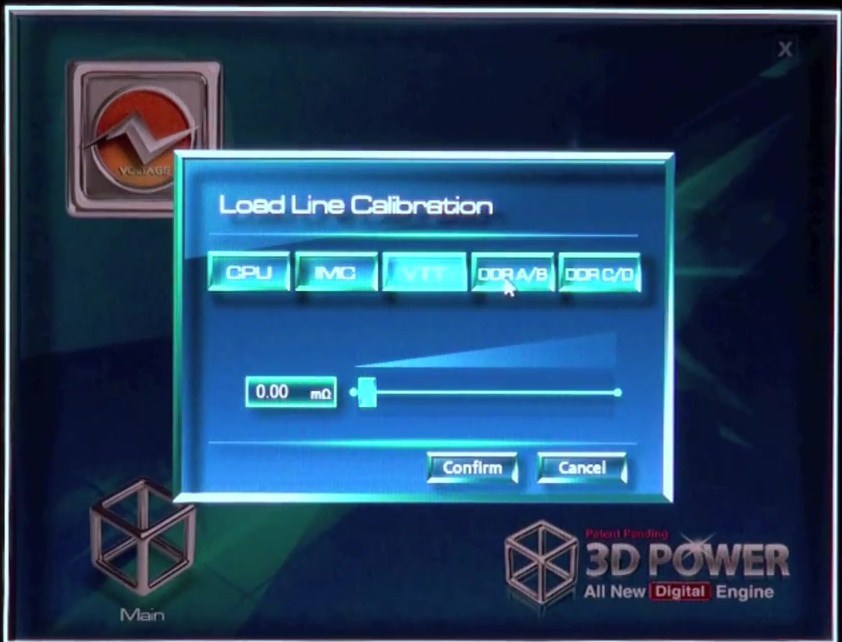
Last week we got a glimpse of Gigabyte's new 3D BIOS technology, a UEFI setup program with an innovative and functional user interface built into Gigabyte's upcoming X79 motherboards. Today Gigabyte released a new video detailing another such innovation, called 3D Power. This program gives you total and unrestricted control over the three main dimensions of your motherboard's power delivery: voltages, PWM frequency, and phase control. Gigabyte announced that all its upcoming X79 motherboards will feature PWM (pulse width modulation) CPU power design, backed by highly capable PWM controllers that give you a plethora of things you can tweak.

To begin with, the 3D Power application starts up with a cube that has the icons of the three main elements. Clicking on "voltage" gives you control over voltage-related settings in three main pages, turbo voltage response, load line calibration (active V-droop control), and active over-voltage protection. Load line calibration allows you to fine-tune the extant of V-droop correction over a variety of power domains, such as CPU, VTT, IMC, and DRAM.

Micron Introduces New 64 GB DDR3 LRDIMM Module

Micron Technology, Inc., today announced a new portfolio of load reduced dual-inline memory modules (LRDIMMs) featuring a 64GB offering. In addition to the standard densities of 8GB, 16GB and 32GB, which are sampling in high volume to several customers, Micron is introducing a 64GB LRDIMM to meet the ever-growing density requirements of servers.

Micron continues its memory market leadership with modules that provide 50 percent higher memory capacity and a performance increase of 33 percent for server applications. Resulting improvements to system scalability can significantly enhance cloud computing, high-performance computing, Web servers, transactional databases, and data analytics while reducing power needs by nearly 10 percent per DIMM slot compared to standard modules.

G.Skill RipjawsZ Quad-Channel DDR3 Kits for Sandy Bridge-E Leaked

Motherboard vendors aren't the only ones getting ready for the big launch of Intel's new high-end desktop (HEDT) platform - Sandy Bridge-E, the ecosystem also consists of memory and cooling products vendors - more importantly, memory. Intel Sandy Bridge-E processors pack an integrated memory controller with a massive 256-bit bus width. To put it into perspective, if a motherboard is populated with four DDR3-1333 MHz modules, the system memory bandwidth would be a staggering 42,600 MB/s. Like everyone, G.Skill is expected to have memory kits with four DDR3 memory modules. It is likely that these kits consisting of four matched modules will be referred to as "quad-channel". Around this time, the company will have a new lineup, RipjawsZ.

RipjawsZ will make use of a new, slightly taller than standard heatspreader design, and will be available in at least two color options - black and red. Some of the kits will consist of just modules, while some will also pack Turbulence II air-coolers that use two fans. In all there are two basic types of modules: ZL, ZH; among these ZH provides the best timings for the frequencies it offers. These modules will be available in a variety of speeds: DDR3-1333, DDR3-1600, DDR3-1866, DDR3-2133, and DDR3-2400. Modules with speeds of up to DDR3-1866 make do with 1.5V DRAM voltage, DDR3-2133 needs 1.60V, while some higher speed modules need up to 1.65V. These kits are available in a variety of capacities - 8 GB (4 x 2 GB), 16 GB (4 x 4 GB), 32 GB (4 x 8 GB), and 64 GB (probably 8 x 8 GB). These modules will be Intel eXtreme Memory Profile (XMP) revision 1.3 compliant.

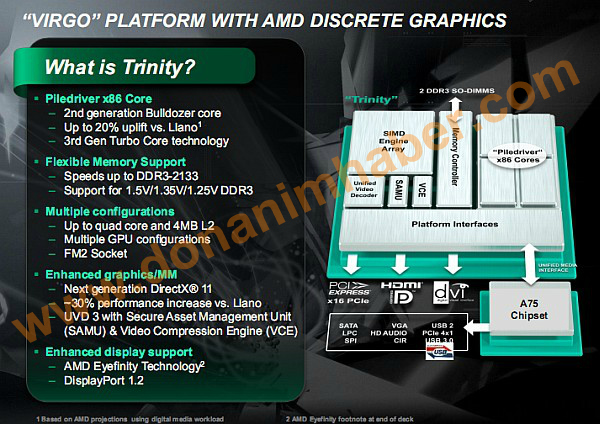
AMD Trinity Detailed Further, Compatible with A75 Chipset

AMD detailed its upcoming "Virgo" PC platform that consists of next-generation "Trinity" APU (accelerated processing unit), and current-generation AMD A75 "Hudson-D" chipset. A notable revelation here is that the next-gen APUs will be compatible with AMD A75, although it will be designed for a new socket called FM2. It remains to be seen if FM1 and FM2 are pin-compatible.

"Trinity" packs four x86-64 cores based on the next-generation "Piledriver" architecture, arranged in two Piledriver modules. A module is a closely-knit group of two cores, with certain shared and dedicated resources. Each Piledriver module has 2 MB of L2 cache shared between the two cores. In all, Trinity, with its two modules, has 4 MB of L2 cache without any L3 cache.

OCZ Announces Indilinx Everest-powered Octane SATA SSD Family

OCZ Technology Group, Inc., a leading provider of high-performance solid-state drives (SSDs), today launched the Indilinx Everest-based Octane SATA 3.0 and SATA 2.0 SSD series, striking the ideal balance between capacity, physical size, and speed. In addition to being the world's first SSD to achieve up to a 1TB capacity in a compact 2.5 inch format, OCZ's Octane SSD series combines high-speed data transfer rates with record-breaking access times to provide a superior user experience and improved application performance.

"OCZ has reached an important milestone in the development of its own controller technology," said James E. Bagley, Senior Analyst with Storage Strategies NOW. "The high sustained performance, even with compressed files, the rapid boot feature and high access speeds using SATA 3.0 protocol puts their controller technology in the major league."
"Until now SSDs have been tailored for specific applications, forcing users into a product which maximizes performance for a narrow band of applications, but is significantly lacking in others," said Ryan Petersen, CEO of OCZ Technology. "The Octane Series solves this problem by providing the highest level of performance across varied workloads including mixed file sizes and mixed compressible and uncompressible data, all while nearly doubling NAND flash endurance."

ADATA USB 3.0 Goes Full Swing, Breaks through Performance Limits

ADATA Technology, a leading manufacturer of high-performance DRAM modules and NAND Flash application products, has launched a full range of USB 3.0 products. This USB 3.0 product lineup from ADATA offers a comprehensive range of styles, all of which incorporate new heights of performance excellence, leading consumers to experience the new era of USB 3.0 whirlwind speed.

After ADATA announced the different functionality and high performance USB 3.0 hard drive solutions SH14 & SH12, the constant pursuit for high quality, high efficiency, and the differing needs of consumers has spurred the company to re-launch its USB 3.0 flash drive line. This first new launch includes three models of ADATA USB 3.0 Flash drive: the N005 Pro, the first choice for those looking for professional performance, and the performance and value entries S102 Pro and C103. The N005 Pro and S102 Pro are advanced versions offering professional performance and improved overall speed, more than twice that of previous models.

Corsair Announces World's First High-Performance Quad Channel 32GB Memory Kit

Corsair, a worldwide designer and supplier of high-performance components to the PC gaming hardware market, today announced the world's first high-performance quad channel Dominator 32GB DDR3 memory kit.

The Dominator 32GB Quad Channel kit (part number CMT32GX3M4X1866C9) consists of four rigorously-screened 8GB DDR3 DRAM modules with Corsair's patented DHX+ heatsinks. It operates at 1.5V and is designed to run at 1866MHz, with 9-10-9-27 C9 timing. Corsair has compatibility tested the new 32GB Quad Channel kit with upcoming quad channel platforms as well as current dual channel platforms.

ADATA Launches Premier Pro Series DRAM Modules

ADATA Technology, a leading manufacturer of high-performance DRAM modules and NAND Flash application products, today announced the launch of its new Premier Pro DRAM modules.

The Premier Pro DRAM modules are designed for IT professionals who need to deliver rock-solid quality computer systems to their customers. The quality of ADATA Premier Pro modules are enhanced in two aspects. First, the modules are engineered for long term reliability. "When memory devices are not reliably engineered," said Ukyo Jeong, Vice President of DRAM product engineering at ADATA, "there is very high chance that the memory module will fail within the first year of usage." He continued: "a 1.6 to 3.2% rate of system failure due to problems with DRAM is not acceptable for IT professionals, and this is the typical failure range when a DRAM module uses components that are not subjected to burn-in process."
Return to Keyword Browsing
Nov 16th, 2026 15:45 CST change timezone

New Forum Posts

Popular Reviews

TPU on YouTube

Controversial News Posts