News Posts matching #ESS

Return to Keyword Browsing

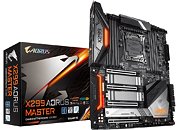
GIGABYTE Intros X299 Aorus Master Motherboard

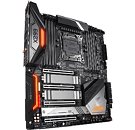
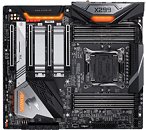
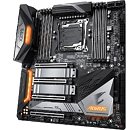
GIGABYTE today announced its almost-flagship socket LGA2066 motherboard, the X299 Aorus Master. The Master brand-extension, if you'll recall, is positioned just a notch below the flagship Aorus Xtreme, which makes this board a successor to the X299 Aorus Gaming 7. The X299 Aorus Gaming 9 and Designare-EX remain the company's flagship LGA2066 products, until they're succeeded by a new Aorus Xtreme product. There's still plenty to go around with the new X299 Aorus Master, beginning with its updated design scheme that's in sync with the company's latest Z390 motherboard lineup. It ships with out-of-the-box support for Core X 9000-series processors. The board is wider than ATX, although not quite E-ATX. It draws power from a combination of 24-pin ATX, two 8-pin EPS, and an optional 6-pin PCIe power. A 12-phase VRM powers the CPU, cooled by a 2-stage heatsink. Expansion slots include four PCI-Express 3.0 x16 (x16/NC/x16/NC or x16/NC/x8/x8 or x8/x8/x8/x8). The DIMM and PCIe slots feature metal reinforcement.

Storage connectivity on the GIGABYTE X299 Aorus Master includes three M.2 slots with PCI-Express 3.0 x4 wiring, each with heatsinks; and eight SATA 6 Gbps ports. Networking includes a 2.5 GbE wired interface driven by Realtek Dragon 8125AG controller, a 1 GbE driven by Intel i219-V controller, and 802.11 ac + Bluetooth 5 interface driven by Intel 9260 WLAN card. USB connectivity includes four USB 3.1 gen 2 ports (two on the rear panel including a type-C, two by header), driven by a combination of ASMedia ASM1142 controller and the X299 PCH. The onboard audio solution is quite something. An ESS Sabre 9218 DAC (130 dBA SNR!) drives the main front + headphones channel with Ti Burr Brown OPA2111KP OPAMPs and WIMA capacitors; while a 120 dBA SNR Realtek ALC1220VB pulls the remaining channels. Manually-switchable dual-BIOS, 7-segment POST code readout, USB flash-back, and a boatload of other overclocker-friendly features complete the board. Expect it to be priced around USD $399.
ASUS Intros ROG Strix Fusion 500 Gaming Headset

ASUS introduced the Republic of Gamers (ROG) Strix Fusion 500 gaming headset, a step up from the Strix Fusion 300 the company launched last September. The headset essentially retains the design of the Fusion 300, but steps it up with gold-metallic body panels around the cans, RGB multi-color LED diffusers replacing the red LED accents, which you can control via ASUS Aura Sync RGB software; and under the hood enhancements.

The headset uses a higher quality ESS Sabre 9018 DAC combined with ESS 9601 amplifier. The DAC has a high SNR, and puts out 24-bit/96 kHz audio. The enhanced audio setup is mated with 50 mm ASUS Essence drivers, and improvements made to the passive acoustic dampening material around your ears. ASUS included game-specific virtual-7.1 surround DSPs with this headset. Available now, the ASUS ROG Strix Fusion is priced at USD $179.99, about $50 pricier than the Fusion 300.

Zorloo Announces Their Second-Generation Portable USB-DAC

Zorloo is pleased to introduce its second-generation portable USB-DAC product, ZuperDAC-S, today. It builds on its wildly praised ZuperDAC to enable computers or mobile phones an unprecedented HiFi music experience. Today, computers and mobile phones are powerful enough to handle different audio protocols. However, the last but most critical step in the entire digital-to-analog conversion process, i.e. turning musical data 0 and 1 into audible sound waves, always sucks. Constrained by the limitation of this internal conversion process, audio may also have to be re-sampled to fit the pipeline.

Bypassing the internal conversion with ZuperDAC-S drastically improves sound quality to a new level. It supports up to 192kHz sampling frequency and 24-bit depth, which eliminates unnecessary sample rate and bit depth conversion. The music output from ZuperDAC-S is exactly what was recorded. ZuperDAC-S uses the ESS Sabre 9018 audiodac and delivers a stunning 120dB SNR and 0.0005% THD+N performance. It delivers a balanced, clear and articulated sound in a wide soundstage. The integrated headphone amplifier output can connect directly to headphones, or go through the amplifier systems.

GIGABYTE Introduces Z370 Motherboards for 8th Gen Core

GIGABYTE TECHNOLOGY Co. Ltd, a leading manufacturer of motherboards and graphics cards, has unveiled the new GIGABYTE Z370 AORUS motherboards based on the Intel Z370 chipset. These supercharged motherboards are equipped with a server-grade digital power design which fully support 8th generation Intel Core processors. Performance tuned, the Z370 AORUS Motherboards are compatible with memory modules rated for 4133MHz. With unique features like an ESS Sabre DAC, Smart Fan 5 and RGB Fusion, there's no doubt why gamers turn to AORUS for the ultimate gaming motherboard.

"Following Intel's release of the Z370 chipset platform, GIGABYTE has designed a new, groundbreaking motherboard," said Vincent Liu, Senior Associate Vice President of GIGABYTE's Motherboard Business Unit. "GIGABYTE Z370 AORUS motherboards are designed for gamers who value powerful, yet highly durable motherboards. With our new digital power design, not only will Z370 AORUS motherboards unleash the power of the 8th generation Intel Core processors' they will easily fulfill gamers' demands."

GIGABYTE Aorus Z370 Motherboard Series Pictured

Here are some of the first pictures of GIGABYTE's Aorus branded Z370 series motherboards. The lineup begins with the Aorus Z370 Gaming 3 and Aorus Z370 Gaming K3. These two boards are nearly identical to each other, and differ with only their onboard gigabit Ethernet controller, with the Gaming K3 featuring the latest Killer E2500 controller, while the Gaming 3 features Intel i219-V. Both boards feature just the one PCI-Express 3.0 x16 slot wired to the CPU, with the second slot being electrical x4 and wired to the PCH. GIGABYTE has been traditionally generous with its onboard audio solutions, and these boards are no exception. You get a Realtek ALC1220 (120 dBA SNR) CODEC strapped to a single headphones amp circuit, ground-layer isolation, and audio-grade capacitors.

Moving slightly up the ladder is the Aorus Z370 Ultra Gaming, pictured below. You get a similar CPU VRM implementation to the Gaming K3, but with two PCI-Express 3.0 x16 slots (x8/x8 with both populated) wired to the CPU, for multi-GPU setups. You also get a stylish I/O shroud. Positioned above the Ultra Gaming, is the Aorus Z370 Gaming 5. This board features a stronger CPU VRM, three M.2 slots as opposed to two on the Ultra Gaming, a higher grade onboard audio with a high-grade OPAMP, more USB 3.1 ports, 802.11 ac + Bluetooth WLAN; and a full-length I/O shroud. Leading the pack (for now) is the Aorus Z370 Gaming 7. Positioned further above the Gaming 5, this board features the highest-grade onboard audio solution from GIGABYTE, with an ESS Sabre AMP; M.2 SSD heatsinks, two gigabit Ethernet interfaces (Intel + Killer), and reinforcement braces around even more slots. These boards are expected to launch on the 5th of October, 2017.

Creative Announces Sound BlasterX AE-5 Audiophile-grade Gaming Sound Card

Creative Technology Ltd today announced at E3 2017 the latest addition to its Sound BlasterX Pro-Gaming Series, the Sound BlasterX AE-5. E3 is the world's premier event for computer, video and mobile games and related products, making it the perfect place to debut the next era of PC audio.

The sound card features the world's best gaming headphone amplifier for PCs. The Sound BlasterX AE-5 delivers the ultimate audio performance with the full force of a 122 dB 32-bit / 384 kHz ESS Sabre DAC, a kick-ass custom-designed 600Ω discrete headphone amp, audiophile-grade components, and proprietary Sound Blaster audio enhancement technologies.

ASUS Announces STRIX Series Sound Cards

ASUS today announced Strix Raid DLX, Strix Raid Pro, and Strix Soar, gaming sound cards that deliver sensational, high-definition 192kHz/24-bit audio, 7.1-channel surround-sound, and Perfect Voice noise-cancellation technology for incredible gaming experiences.

Strix Raid DLX is a premium soundcard built with high-end components to satisfy gamers who demand the ultimate audio performance. Strix Raid DLX features an ESS SABRE9016 digital-to-analog converter (DAC) - the world's highest performance 32-bit and 24-bit audio DAC - to deliver rich, immersive, and clear sound with an incredible 124dB signal-to-noise ratio (SNR). Designed for enthusiast gamers, Strix Raid Pro and Strix Soar come with the high-performance ESS SABRE9006A DAC for pure, full-sounding audio with an impressive 116dB signal-to-noise ratio (SNR). Low-dropout (LDO) regulators and Hi-Fi-grade Nichicon FineGold, Nichicon Muse, and German WIMA capacitors ensure optimized power delivery.

MSI Selects ESS SABRE HiFi Audio DAC for Gaming Notebooks

ESS Technology today announced that MSI, the leading gaming notebook manufacturer and innovator, has selected ESS Technology's SABRE HiFi Audio DAC for the first notebooks featuring Intel's latest sixth generation Intel Core i7 Skylake processors. Targeted at hardcore gamers, these hotly anticipated MSI notebooks will be available through MSI e-Commerce channels on September 1, 2015.

"MSI is thrilled to work with a technology leader like ESS on the most innovative gaming notebooks we have ever introduced," said Eric Kuo, Vice President of Global Sales & Marketing with MSI. "The entire SABRE brand is revered by audiophiles around the world as the pinnacle of audio excellence. It's the perfect choice for our hardcore gamers who look for the best features and the best systems to deliver an unparalleled gameplay experience."

MSI Unleashes the X99A GODLIKE Gaming Motherboard

MSI, world leading in motherboard technology, announces the most powerful X99 gaming solution, the X99A GODLIKE GAMING motherboard. Featuring Killer DoubleShot-X3 Pro, Turbo M.2 connectivity, 2X Faster USB 3.1 Type-A and Type-C and a whole new gaming oriented LED feature, MYSTIC LIGHT, the X99A GODLIKE GAMING is the most powerful motherboard to serve you in battle.

The X99A GODLIKE GAMING is world's first RGB LED motherboard, supporting more than 2000 colors and many style presets such as breathing, flashing and waving. Make your build look on fire or cold as ice. You are in control. Simply select any of the colors from the palette to suit the systems' design. Just change it to another one using the easy to use Mystic Light APP available on PC, phone and tablet, and make your PC look & feel brand new! With 2048 different colors and 7 different LED modes, the Mystic Light provides infinite possibilities for gamers to personalize their gaming rig.

MSI X99-GODLIKE Gaming Audio Boost 3 Pro Solution Has Some Serious Chops

The past two generations of motherboards saw the onboard HD audio finally get a quality leap it deserved, as motherboard makers addressed the shortcomings of onboard audio in dealing with heavy gaming and audiophone headsets. We've seen things like a 115 dBA SNR CODEC by Realtek (ALC-1150), ground-layer isolation, de-pop circuits, audio-grade electrolytic capacitors, and headphones amps become essentials for today's high-end motherboard onboard audio solutions. It looks like MSI is trying to push that envelope even further with Audio Boost 3 Pro, a new onboard audio solution making its debut with the X99-GODLIKE Gaming, which could also feature on some upcoming high-end LGA1151 motherboards by the company.

To begin with, the solution consists of two separate DACs. An ESS Sabre 124 dBA SNR chip handles the front-out and headphones out channels; while a Realtek ALC1150 (115 dBA SNR) handles other analog channels in a 7.1-channel setup. The way this works is that the Realtek chip is wired to the HDA channel of the PCH, while offloading select channel D/A conversion to the Sabre chip. Further downstream to this chip is a 600Ω headphones amplifier chip by TI. Even the other analog channels have amplifier circuits. Signal loss is prevented by Nichicon Muse electrolytic capacitors. The CODEC and DAC are capped by an inner EMI shield, and the board's outer metal shroud; and is isolated from the ground-layer of the rest of the board. This solution also features Nahimic, a sound quality enhancing DSP used in the defense and aerospace industries. All analog jacks feature gold-plating. Digital outputs include optical TOSLINK. Unrelated to the audio solution, the X99-GODLIKE also features a special USB port meant for headsets, that has additional electrical stabilizers.
Return to Keyword Browsing
Nov 11th, 2026 17:59 CST change timezone

New Forum Posts

Popular Reviews

TPU on YouTube

Controversial News Posts