News Posts matching #GIMP

Return to Keyword Browsing

KDE Begins Drafting AI Guidelines: "Don't Be a Meat Proxy"

Despite the immense popularity of LLMs and AI coding agents in software development, the open-source community seems to be quite divided on the topic at times. On the one hand, you have projects like GIMP banning AI from its codebase entirely, while other projects, like Nobara Linux and Omarchy, are very much all-in on AI coding. There is, however, a middle ground, like the Linux Kernel project, which allows AI-assisted and -generated code in the codebase, but all code requires human review and a proper merge request write-up that demonstrates an understanding of the actual code submitted. This appears to be where KDE Plasma will land as a project, if the recent proposed KDE LLM guidelines are anything to go by.

The draft of KDE's LLM guidelines was submitted for discussion by project lead, Nate Graham, and it outlines rules that effectively summarized by the golden rule: "Don't be lazy." In the KDE LLM guidelines discussion post, the proposed draft explains that "contributions with obvious and lazy LLM usage may be ignored or closed," and that "nobody should know if you use an LLM," because the output should be indistinguishable from what you could produce yourself without an LLM. It also places rules on AI-generated text, forbidding AI-generated text for merge requests, commit messages, or replying to a question or comment. The current draft also seeks to prevent additional work being placed on maintainers by limiting vibe-coded changes to that maintainers are expected to clean up and implement—an issue faced by Godot maintainers not long ago.

Qualcomm AI Hub Introduced at MWC 2024

Qualcomm Technologies, Inc. unveiled its latest advancements in artificial intelligence (AI) at Mobile World Congress (MWC) Barcelona. From the new Qualcomm AI Hub, to cutting-edge research breakthroughs and a display of commercial AI-enabled devices, Qualcomm Technologies is empowering developers and revolutionizing user experiences across a wide range of devices powered by Snapdragon and Qualcomm platforms.

"With Snapdragon 8 Gen 3 for smartphones and Snapdragon X Elite for PCs, we sparked commercialization of on-device AI at scale. Now with the Qualcomm AI Hub, we will empower developers to fully harness the potential of these cutting-edge technologies and create captivating AI-enabled apps," said Durga Malladi, senior vice president and general manager, technology planning and edge solutions, Qualcomm Technologies, Inc. "The Qualcomm AI Hub provides developers with a comprehensive AI model library to quickly and easily integrate pre-optimized AI models into their applications, leading to faster, more reliable and private user experiences."

AMD Ryzen 7 8700G AI Performance Enhanced by Overclocked DDR5 Memory

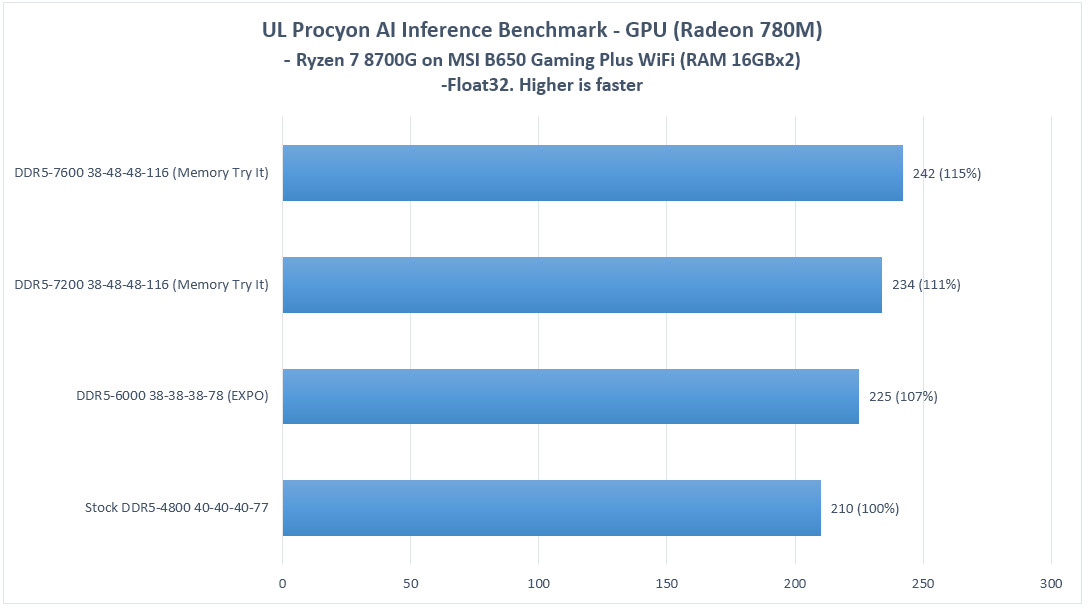
We already know about AMD Ryzen 7 8700G APU's enjoyment of overclocked memory—early reviews demonstrated the graphical benefits granted by fiddling with "iGPU engine clock and the processor's memory frequency." While gamers can enjoy a boosted integrated graphics solution that is comparable in performance 1080p stakes to a discrete Radeon RX 6500 XT GPU, AI enthusiasts are eager to experiment with the "Hawk Point" pat's Radeon 780M IGP and Neural Processing Unit (NPU)—the first generation Ryzen XDNA inference engine can unleash up to 16 AI TOPs. One individual, chi11eddog, posted their findings through social media channels earlier today, coinciding with the official launch of Ryzen 8000G processors. The initial set of results concentrated on the Radeon 780M aspect; NPU-centric data may arrive at a later date.

They performed quick tests on AMD's freshly released Ryzen 7 8700G desktop processor, combined with an MSI B650 Gaming Plus WiFi motherboard and two sticks of 16 GB DDR5-4800 memory. The MSI exclusive "Memory Try It" feature was deployed further up in the tables—this assisted in achieving and gauging several "higher system RAM frequency" settings. Here is chi11eddog's succinct interpretation of benchmark results: "7600 MT/s is 15% faster than 4800 MT/s in UL Procyon AI Inference Benchmark and 4% faster in GIMP with Stable Diffusion." The processor's default memory state is capable of producing 210 Float32 TOPs, according to chi11eddog's inference chart. The 6000 MT/s setting produces a 7% improvement over baseline, while 7200 MT/s drives proceedings to 11%—the flagship APU's Radeon 780M iGPU appears to be quite dependent on bandwidth. Their GIMP w/ Stable Diffusion benchmarks also taxed the integrated RDNA 3 graphics solution—again, it was deemed to be fairly bandwidth hungry.

GIMP 2.4 Released

GIMP (an abbreviation for GNU Image Manipulation Program) has been updated from version 2.2 to 2.4 almost three years after the release of 2.2. The free software, which is seen by many as a lightweight alternative to more advanced image editing software such as Adobe Photoshop, now features improvements such as a refreshed user interface, scalable brushes, better selection tools, a foreground select tool, an align tool, new menus, improved zoom, extended file format support and various other digital photography improvements including color management and red eye removal. GIMP 2.4 is available for Windows, Mac and Linux, and can be downloaded via this page.
Return to Keyword Browsing
Nov 13th, 2026 10:41 PST change timezone

New Forum Posts

Popular Reviews

TPU on YouTube

Controversial News Posts