
News Posts matching #HWMonitor

Return to Keyword Browsing

HWMonitor v1.65 Brings Back Hotspot Reading for NVIDIA RTX 50 Series

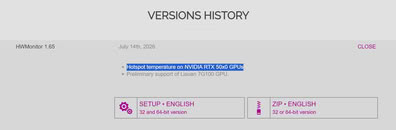
CPUID has just released HWMonitor version 1.65, which reintroduces the previously abandoned hotspot temperature reading for NVIDIA's GeForce RTX 50 series "Blackwell" GPU. When NVIDIA originally launched its "Blackwell" GPU lineup, the company removed the ability for popular utilities like GPU-Z and HWMonitor to access hotspot sensor data, even though the sensor was present on the die. We initially thought it was impossible to access this data again without using NVIDIA's internal tool, Modular Diagnostic Software (MODS), which is not publicly available. However, the latest HWMonitor update has restored this capability. Although we are unsure how the update accomplishes this without public API exposure, which NVIDIA restricted with the RTX 50 series, the software reportedly bypasses this limitation and successfully performs a normal hotspot reading.

An extreme overclocker known as "Madness" on X has already tested the latest HWMonitor version 1.65 on a shunt-modded and water-cooled RTX 5090 GPU, which is drawing over 900 W from the wall. Under the water block, the GPU's hotspot sensor measures around 68°C, while the normal temperature reporting shows a delta of about 17°C, indicating that the reported GPU temperature is around 51°C. Although this delta between the overall GPU die temperature and hotspot temperature isn't ideal, it provides overclockers with more detailed information about their GPUs.
Security PSA: Popular Tools CPU-Z and HWMonitor Were Briefly Compromised

Popular PC DIY enthusiast tools like CPU-Z and HWMonitor were briefly compromised during the night between April 9 and April 10. This left anyone who downloaded these tools from the CPUID website vulnerable to malware they thought was a normal software tool. What actually happened was that multiple users on Reddit noticed their downloads from CPUID for both CPU-Z and HWMonitor were flagged multiple times by Windows Defender for security concerns. During that night, users attempting to download these popular utilities found the website pointing to a different host where the modified .exe files were stored. After realizing what was happening, users started removing these compromised .exe files and waited for CPUID to issue a statement. One of the owners of CPUID published a statement on X, explaining that attackers had replaced the original download links with malware-infected file links, resulting in a widespread security vulnerability. Thankfully the website is now back up and safe to resume downloads.
Hi,
Investigations are still ongoing, but it appears that a secondary feature (basically a side API) was compromised for approximately six hours between April 9 and April 10, causing the main website to randomly display malicious links (our signed original files were not compromised). The breach was found and has since been fixed. Sorry for the inconvenience. I did my best to fix that mess as soon as possible :-/
Sam.

Intel "Panther Lake" Naming Scheme Confirmed with Core Ultra X9/X7/X5 SKUs

Last week, Intel finally revealed details about the much-anticipated "Panther Lake" processors. Our in-depth analysis covers all the specifics. However, one missing piece was the official naming scheme that Intel plans to use. Previous rumors suggested that the new naming scheme would include the X moniker to denote the top SKUs. Today, this has been confirmed by the developers of HWMonitor, a tool used for monitoring key system health sensors such as voltages, temperatures, power, currents, fan speeds, utilization, and clock speeds. They verified that the Panther Lake Core Ultra family will feature X9, X7, and X5 SKUs. These processors will include a larger Xe GPU tile with up to 12 Xe3 cores, the fastest memory subsystem, and a CPU structure consisting of four P-cores, eight E-cores, and four LPE-cores.
Below, you can check out the Core Ultra X9/X7/X5 SKUs, now confirmed by the HWMonitor update:

Burning Saga Continues, This Time it's an AMD Ryzen 7 9800X3D CPU

A new case of catastrophic CPU failure has emerged involving AMD's Ryzen 7 9800X3D processor, marking the latest in a series of reported incidents within the last few days involving high-performance GPUs and CPUs. The failure occurred during routine use when a system equipped with the 9800X3D and an ASRock Nova X870E motherboard suddenly shut down, resulting in visible thermal damage to both components. The incident is particularly noteworthy as the system operated under stock settings, with only AMD EXPO memory optimization enabled. The affected user, who has two decades of PC building experience, reported that the system had been operational for approximately 20 days before the failure, with no temperature anomalies recorded through HWMonitor during its operation.

The hardware was running the ASRock BIOS version 3.16. This case differs significantly from the previous AMD Ryzen 7 9800X3D failure, where user error during installation was identified as the primary cause, with the user force-installing the CPU in the socket. The timing of the failure—during a low-intensity workload of streaming video content—further complicates the investigation into root causes. While isolated cases of hardware failure are not uncommon in the PC component market, this case may be the first one caused entirely by the CPU/motherboard combination, not user error. The user also faces uncertainty regarding warranty coverage, as the CPU and motherboard were purchased separately from different retailers. We hope the warranty case goes well, and the user gets a replacement!

HWMonitor v1.52 Ready for Intel Raptor Lake Refresh SKUs

The latest version (1.52) of the HWMonitor application is prepared in advance for a wide variety of incoming PC hardware products—most notably Intel's Raptor Lake Refresh desktop processors. The release notes mention specific SKUs including: Core i5-14600K/KF (14 cores), i7-14700K/KF (20 cores) and i9-14900K/KF (24 cores)—these CPUs have emerged across a number of recent leaks. We expect Team Blue to present these models, in an official capacity, to the world at their Innovation 2023 event (starting September 19).

Non-specific Core 3,5 & 7, plus Core Ultra 5, 7 & 9 series CPUs are also mentioned in the patch notes, pointing to a mixed bag of (i.e very confusing) 14th Generation products comprised of Raptor Lake Refresh (possibly mobile variants) as well as Meteor Lake ranges lined up for "preliminary" support within HWMonitor v1.52. AMD's already announced Radeon (Navi 32) RX 7800 XT and RX 7700 XT GPUs have also been added to the app's compatibility roster.
Return to Keyword Browsing
Nov 15th, 2026 09:35 CST change timezone

New Forum Posts

Popular Reviews

TPU on YouTube

Controversial News Posts

