Tuesday, October 14th 2025

Intel "Panther Lake" Naming Scheme Confirmed with Core Ultra X9/X7/X5 SKUs
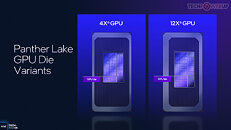
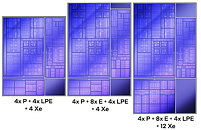
Last week, Intel finally revealed details about the much-anticipated "Panther Lake" processors. Our in-depth analysis covers all the specifics. However, one missing piece was the official naming scheme that Intel plans to use. Previous rumors suggested that the new naming scheme would include the X moniker to denote the top SKUs. Today, this has been confirmed by the developers of HWMonitor, a tool used for monitoring key system health sensors such as voltages, temperatures, power, currents, fan speeds, utilization, and clock speeds. They verified that the Panther Lake Core Ultra family will feature X9, X7, and X5 SKUs. These processors will include a larger Xe GPU tile with up to 12 Xe3 cores, the fastest memory subsystem, and a CPU structure consisting of four P-cores, eight E-cores, and four LPE-cores.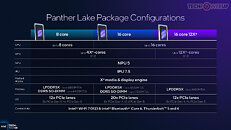
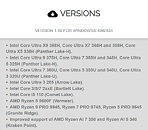 Below, you can check out the Core Ultra X9/X7/X5 SKUs, now confirmed by the HWMonitor update:
Sources:
HWMonitor, via VideoCardz


- Core Ultra X9 388H: 4 P-Cores, 8 E-Cores, 4 LPE-Cores, 12 Xe3 Cores
- Core Ultra X7 368H: 4 P-Cores, 8 E-Cores, 4 LPE-Cores, 12 Xe3 Cores
- Core Ultra X7 358H: 4 P-Cores, 8 E-Cores, 4 LPE-Cores, 12 Xe3 Cores
- Core Ultra X5 338H: 4 P-Cores, 4 E-Cores, 4 LPE-Cores, 10 Xe3 Cores
- Core Ultra 9 375H: 4 P-Cores, 8 E-Cores, 4 LPE-Cores, 4 Xe3 Cores
- Core Ultra 7 355H: 4 P-Cores, 8 E-Cores, 4 LPE-Cores, 4 Xe3 Cores
- Core Ultra 7 345H: 4 P-Cores, 8 E-Cores, 4 LPE-Cores, 4 Xe3 Cores
- Core Ultra 5 325H: 4 P-Cores, 4 E-Cores, 4 LPE-Cores, 4 Xe3 Cores
- Core Ultra 7 360U: 4 P-Cores, 0 E-Cores, 4 LPE-Cores, 4 Xe3 Cores
- Core Ultra 5 350U: 4 P-Cores, 0 E-Cores, 4 LPE-Cores, 4 Xe3 Cores
- Core Ultra 5 340U: 4 P-Cores, 0 E-Cores, 4 LPE-Cores, 4 Xe3 Cores
- Core Ultra 3 320U: 2 P-Cores, 0 E-Cores, 4 LPE-Cores, 4 Xe3 Cores
22 Comments on Intel "Panther Lake" Naming Scheme Confirmed with Core Ultra X9/X7/X5 SKUs
Intel is so lost, you gotta love the fact that in 2025 they are actually still pushing hard on their quad core strategy. 4x P is the basis with a bunch of bullshit cores next to it because the 4 P cores are so far past expiry date, they desperately need help. Now with LPE cores to the rescue, because if you mix the monikers together, that's obviously bettererrer! Such technology leadership
When it comes to their mobile linup, that's not new, even in their dominating era, Intel sold low power core i7 who only had a higher frequency compared to the core i5. Here's a table showing the low-power Sandy Bridge lineup. As you can see,not curbstomping AMD isn't a requirement in order for Intel to have a fairly confusing product stack. It's always been like that, you only notice it now because they talk more about the laptop CPUs, when that was largely ignored by most tech outlets (besides the likes of notebookcheck)
Not to mention, there's another competitor who's only using 4 big cores, and a bunch of small cores
Arrow Lake and Meteor Lake also have this advantage. Meteor Lake has slow cores but Arrow Lake-H on mobile has done very well in reviews. Panther Lake has better LPE cores so I think it'll often feel more responsive. But Arrow Lake had 14 cores on the ring bus and L3 cache, so in productivity work Panther Lake has to rely on newer cores to make up for lost count.
Qualcomm's next chip apparently has 12+6 cores and uses TSMC N3X for the CPU and N3P for the GPU, which sounds like a huge upgrade for Qualcomm. It probably still has separated core clusters but it sounds to me like it'll be Panther Lake's most capable competition in the near term.
Placing the x86 cores, iGPU, PCIe controller, and memory controller on the same die would yield a significant performance gain, as communication latency between these components would be significantly reduced.
AMD (and Intel too) home CPUs should be made like this:
As long as Intel doesn't abandon this E-cores and LP-cores scheme, I think it will continue to sell very little in the domestic market (desktop PCs).
Any news on Bartlett Lake-S?
And yes its great Apple has a custom built M4 for their custom built solutions, but I don't think that comparison is doing anyone in x86 favors if we dive into it.
This is what 2025 mobile chips look like with the x86 company that hasn't stalled for 10 years. Some actual choice.
Panther lake got a lot of SKUs, but it only covers thin and light, and unlike Ryzen AI 300, you won't find them in Gaming laptops (just like Lunar lake). Ryzen AI 7 350 up to Ryzen AI 9 HX 375 will be competing with Arrow lake refresh. That 54w max TDP far exceed panther lake power limits. You can find Ryzen 9 HX370 laptop with a 5080 in them!
And AMD is starting to do the same, with their "new" mobile CPUs that are using an older arch. You forgot to show the Ryzen 2xx series that launched in 2025 based on zen 4, with a Ryzen 9 that shouldn't be a Ryzen 9. It's supposed to less high-end than series 3xx, but kind of not at the same time? There's a big overlap in terms of price and overall specs of the laptops equipped with them. It's just that the one with ryzen 200 should be a bit faster in MT? But Ryzen 300 better at AI stuff? The poor generational leap between zen4 and zen5 makes the comparison a bit odd. The Ryzen 7 260 is within a margin of error from the Ryzen AI 7 350.
And I still remember the absolute clusterfuck that mobile 7xxx and 8xxx was, where you needed a notice to understand what you actually bought, with that series including Zen2, Zen 3 and Zen4 CPUs. At least they clean that up a bit by using a different series.
I remember when you just had to choose between a Ryzen U or a Ryzen H. Simpler times.
AMD and Apple seem to be on the forefront of new technology now. More core show more promise. Less cores show you company wants out of the CPU market.
You know what Intel should do, If I was running Intel I would Drop the whole Core Processor Name completely.
I would also drop the stupud i3 i5 i7 i9 BS
Bring back the Pentium Name, Call it the Pentium X for desktop and Pentium XM for mobile.
Pentium X would only see a name like X4 for 4 cores X8 8 cores X16 for 16 cores and maybe a X32 for 32 core desktop monster.
E cores would be removed completely. LPC Cores maybe a coprocessors to the major P cores only.
If I base it on claims regarding Clearwater forest, we're talking +17% IPC vs Skymont used in Lunar Lake and Arrow Lake. And here's the thing - Lunar Lake's Skymont cores were head and shoulders above Crestmont to start with, and Crestmont was double digit higher than Gracemont (from Alder / Raptor). Given how important Clearwater Forest is, it makes sense that Intel would put a lot of effort here.
It's no longer correct to say these e-cores have an IPC ~ Skylake. Overall these perform in the IPC range of a Zen 3 core.
Hence, I doubt that the core-counting thought process being used here is going to apply.
P and E designs will converge into one type of core, gradually, over 2-3 generations. The result will more closely resemble E than P. We'll also see some form of clustering (clusters of 2 cores sharing L2?), at least in CPUs with a ring bus, to limit the number of bus stops.
At this the two other kittens imagined what would have happened if similar politics led to a heterogeneous mix of Pentium 4 and M processors back in 2007. Then the M would not have been enhanced to make the Core microarchitecture and there'd be no need to discuss Intel today.
In my opinion it's time to bring NetBurst back, brand it as EPL and create a Dog Lake CPU with a mixture of EPL, P, E and LPE cores. This is because scheduling tasks between P and E is no more difficult than when there are four types of cores.
The fact that intel still smacks AMD in battery life on laptops indicates there is a good strategy here. That and Intel easily beating AMD in productivity tasks again. Arrow lake was surprisingly good there.
Those LPE cores are why Lunar Lake was pushing 20 hours of battery life out of laptops, on par with Apple's ARM designs, while AMD machines are still hovering around 6-7 hours.AMD is the only major CPU maker sticking to the unfiied core approach. Even then, they have the "c" cores.
Apple, Qualcomm, and even Intel via lunar lake have shown how powerful the multidesign cores can be. The BIG.little approach has been the norm in mobile devices for well over a decade and Apple and intel have normalized it on desktops and laptops. Only servers remain with the all big approach.
The main reason is local AI. Arrow Lake just spanks everything doing text inference and AI image and video generation.
And these benchmarks were done using DDR5-6000. AI ramps almost linearly with memory speed (see last chart), so with a rig setup for low-cost local AI using fast DDR5 the spanking is way way worse than the first two review charts indicate. Take the 1st two and add another 22% to the performance when running DDR5-8200.
In practice though, you are right, but that's not the marketing story and it doubly confirms how weird Intel's CPU strategy really is.