News Posts matching #Leak

Return to Keyword Browsing

Leak Suggests Next-Gen Xbox Planned for 2028, AMD Zen 6 & RDNA 5 Considered

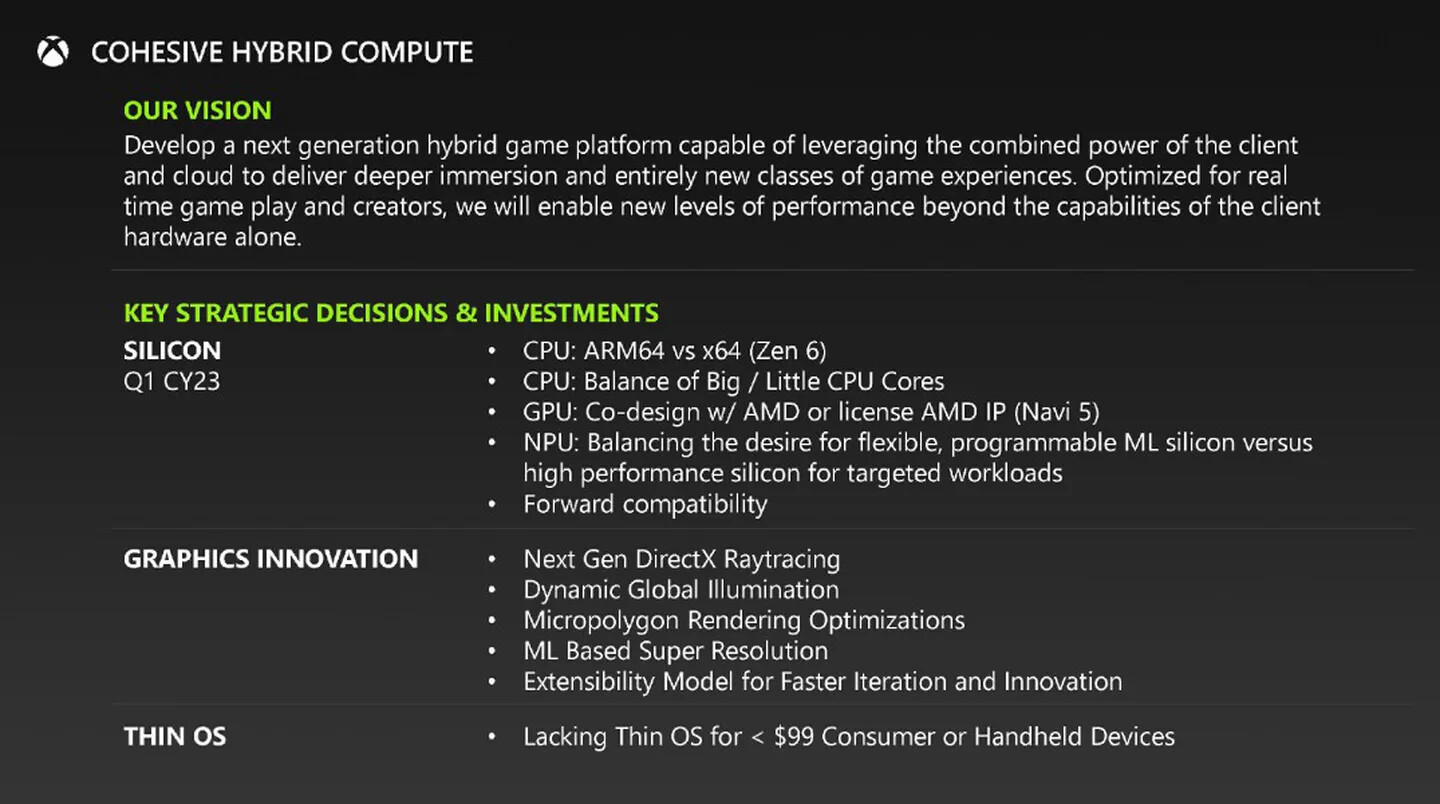
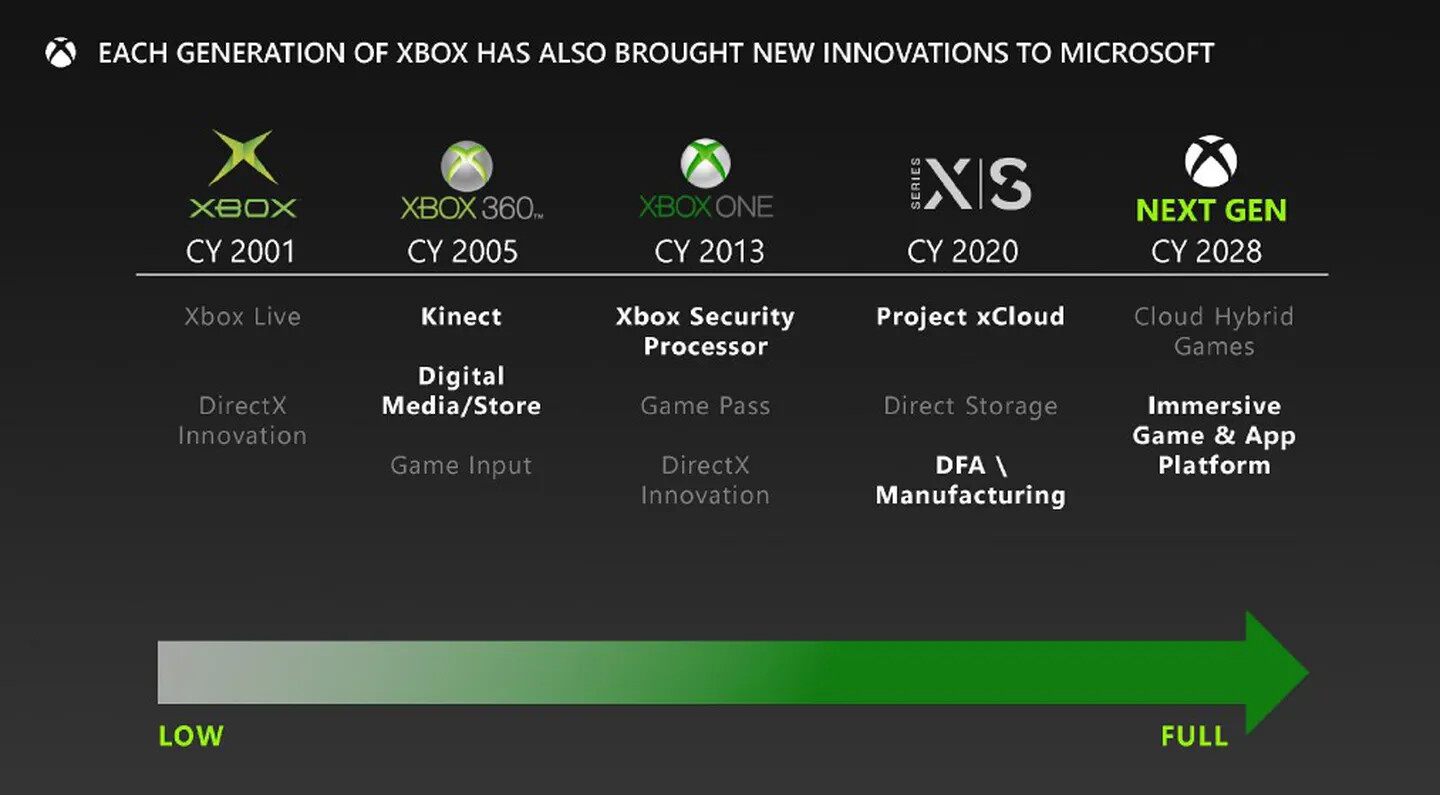
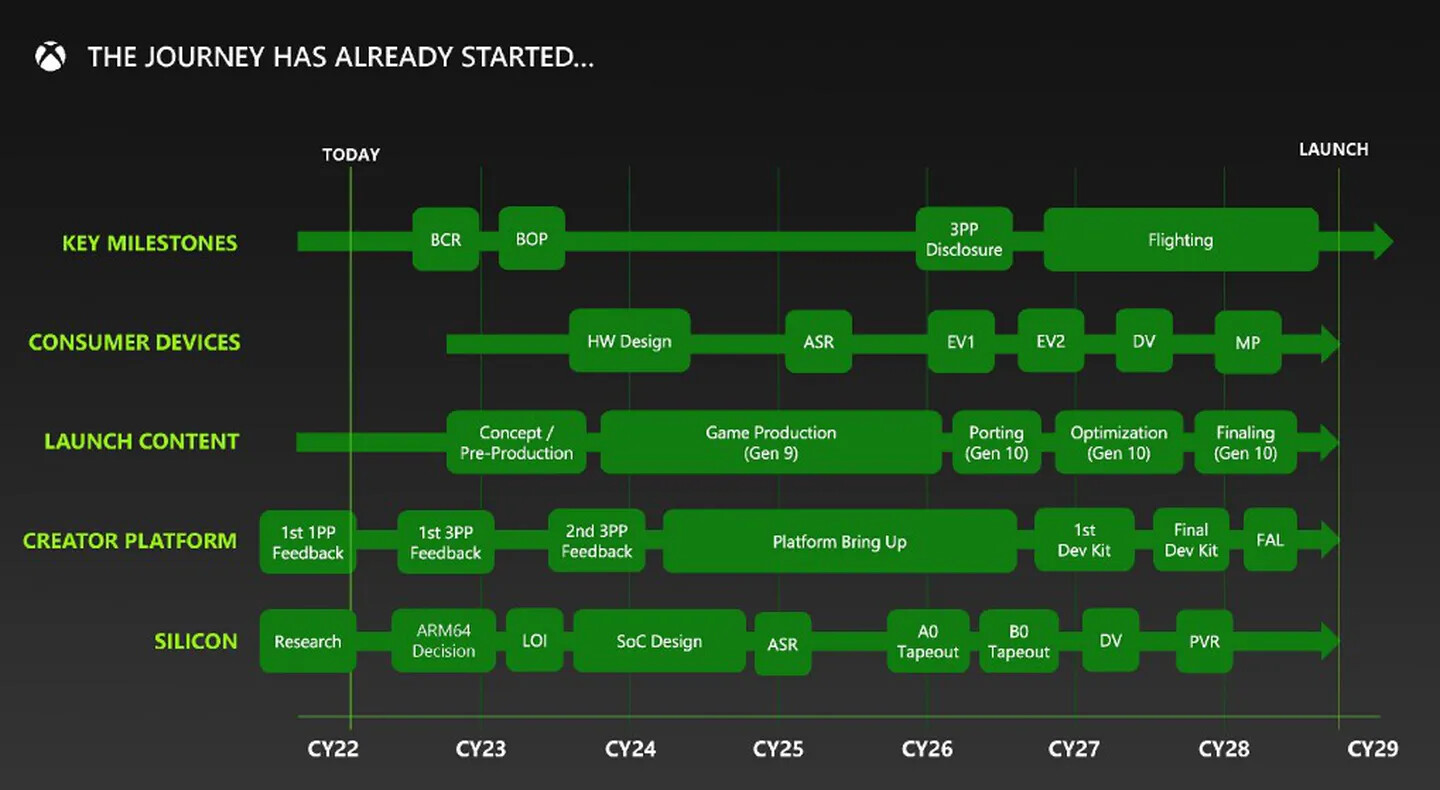
A comprehensive leak of documents—from a FTC versus Microsoft case—has exposed short and long-term plans in the world of Xbox. It seems that a relatively mild refresh of current generation Xbox Series X and S is lined up for the second half of 2024, but presentation material (dated April 2022) also reaches far into the future with strategies for next-gen gaming hardware. The bigwigs at Xbox were projecting a "full convergence" of their proprietary "xCloud" gaming platform and physical console hardware to deliver "cloud hybrid games" for 2028—schemes and priorities could have shifted in the interim, given various legal challenges and takeover bids.

One of the slides points to Microsoft getting the technical nitty-gritty sorted by CY2023—with two main options presented for consideration: a licensed ARM 64 design or a "Zen 6-based" AMD 64 processor. The next-gen Xbox's GPU aspect could incorporate a Navi 5 design (RDNA 5)—weighing up either a co-operation with AMD, or an IP license of said graphics architecture. VideoCardz theorizes that: "the latter option seems more likely if the ARM 64 chip is chosen over the Zen 6 APU." A key goal in this area seems to be an implementation of "Next-Gen DirectX Ray tracing" and "ML-based Super Resolutions" features. A Neural Processing Unit (NPU) is marked as a key provision for the 2028 console—granting some nice-to-have perks including: latency compensation, frame rate interpolation and various enrichments of the user experience.

Bungie Reportedly Using Unreal Engine 5 for Secret Multiplayer IP

Inside sources have claimed that Bungie is working on a third project—codename: Gummy Bears—alongside Destiny 2 (their bread and butter IP) and the still mysterious Marathon reboot. Several media outlets keep close tabs on activity at the Sony Interactive Entertainment-owned studio—"Gummy Bears" is believed to be a "light-hearted" and "colorful" alternative to the other multiplayer experiences in Bungie's stable. Paul Tassi (writing for Forbes) believes that Bungie's "Matter" concept is synonymous with "Gummy Bears"—past job adverts have outlined a "team-based action game" that takes: "inspiration from fighting games, platformers, MOBAs, life sims, and frog-type games, wrapped up in a lighthearted, comedic world."

TheGamePost has chosen to follow up on their previously leaked summertime information with another major claim—multiple sources have alleged that Epic's Unreal Engine forms the technical foundation of "Gummy Bears," a team-based combat title with isometric gameplay. Switching to an outside toolset would be quite an unusual move for Bungie—the veteran development house has relied on its (extremely mature) Tiger Engine for more than a decade. One insider placed emphasis on the new IP being built in Unreal Engine 5 for current-gen platforms. PlayStation-specialist site Insider Gaming has contacted Sony for comment on the situation, and conducted a quick investigation: "As far as the accuracy of this report, Insider Game has yet to verify it with its independent sources. However, a quick look at Bungie's career page shows a job listing for an "Unannounced Project" where the required skills include the ability to code in C++. This is the programming language used for Unreal Engine."

Xbox Series X & S Refresh Roadmap Leaked

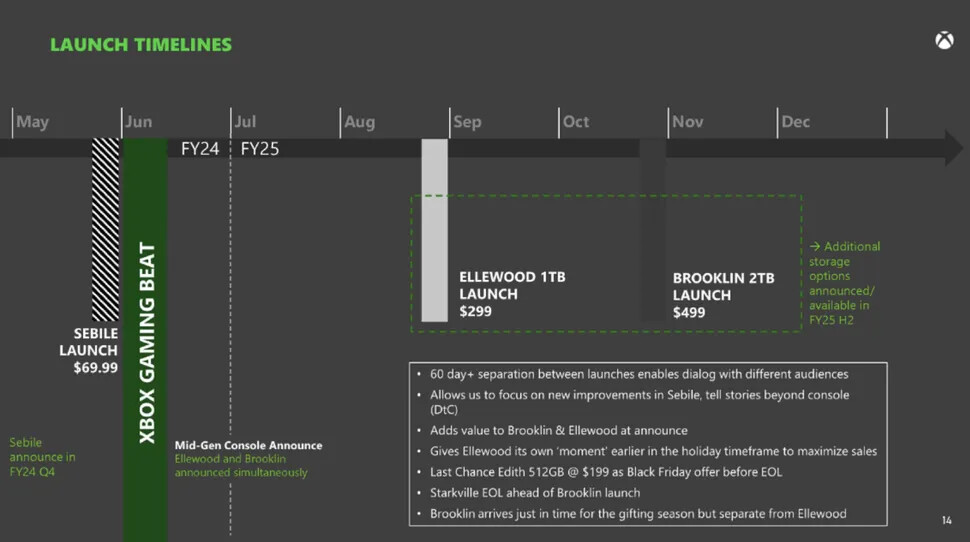
A hefty information dump—originating from documents relating to a Microsoft vs. FTC legal case—has revealed plans (dated April 2022) for an upcoming refresh of current generation Xbox Series X and S consoles. Microsoft Gaming's head honcho, Phil Spencer, dismissed the need for a mid-gen refresh of the more powerful model—his summertime 2023 declaration came after the rumor mill coughed up speculative details of Sony working on a more potent PlayStation 5. The leaked roadmap and slides points to a refreshed Xbox Series X console lined up for launch in October 2024. The new cylindrical design is codenamed "Brooklin" and features an all-digital entertainment scheme—internal upgrades include a 2 TB SSD, plus support for Wi-Fi 6E and Bluetooth 5.2. An "improved sustainability story" suggests that the refresh will consume less power.

A 6 nm die shrink of the current Xbox Series X "Scarlett" APU with Zen 2/RDNA2 setup is reportedly in the cards. It seems that Microsoft is not preparing something that could compete with a theoretical "PlayStation 5 Pro." The leaked roadmap states that Brooklin's projected MSRP is $499—so no price hike over the original. The refreshed Xbox Series S—codenamed "Ellewood"—retains the existing Series S aesthetic, along with its entry-level $299 price tag. Microsoft's roadmap has it launching earlier than "Brooklin"—August 2024. Internal storage is set at 1 TB, and an updated southbridge grants support for Wi-Fi 6E and Bluetooth 5.2. A low-power standby mode is said to consume only 20% of the current gen model's sleepy intake. The 2022 roadmap also mentions a refreshed "Sebile" Xbox controller, with the aim to get it launched by May 2024, so several months before the projected arrival of revised X and S consoles.

AMD Threadripper Pro 7000 Presentation Slides Leaked

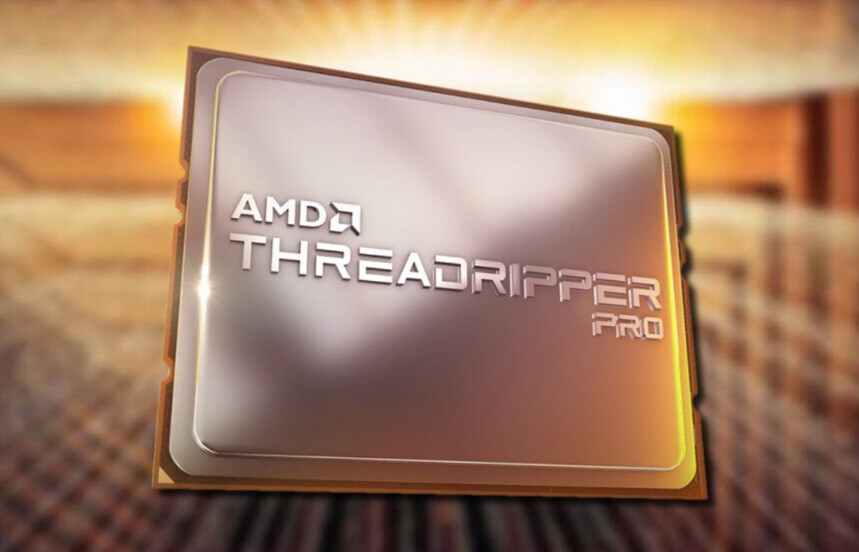
A trio of allegedly official presentation slides appeared on X yesterday, posted by Underfox3—the leaker stopped short of revealing the origin of this material. They simply commented: "AMD Threadripper Pro is coming...🔥." The next generation HEDT processor family is expected to arrive in the fall, and the opening slide pretty much confirms this launch window (starting September 22—autumnal equinox). There has been a noticeable uptick in Zen 4 "Storm Peak" 7000-series pre-release units appearing online lately—so the timing seems plausible. Text segments do not mention the 7000-series in specifics, but an IHS render visible on the second slide looks somewhat similar—in shape—to a grey market-listed Threadripper Pro 7985WX. VideoCardz has compiled various leaked SKUs into a chart (see below).

A very general claim is made on the second slide—boasting a 20% performance increase over their Threadripper Pro 5000 series—but detailed information (prowess in single or multi-core tests) or in-depth benchmark results are not included. VideoCardz surmises from an interpretation of the third slide—noting: "support for 96 cores, marking a 50% boost over the TR PRO 5000 series. This suggests that the 20% improvement likely pertains to the single-core Zen 4 boost." The final slide also shows said 96-core Threadripper Pro processor tipped against Intel's Xeon W9-3495X CPU (a 56-core Sapphire Rapids candidate)—the former is said to produce 75% more renders per day. Per frame completion time is 657 second versus 1125 seconds (respectively).

AMD Threadripper Pro 7985WX Pops Up on Grey Market

Activity on the next-gen Ryzen Threadripper front has ramped up over the past week—we previously witnessed a fairly comprehensive spec leak of Pro 7995WX and 7975WX processors last week, thanks to Dell Precision Tower workstations getting tested out in SiSoftware's Sandra suite. Pre-release "Zen 4" HEDT hardware seems to be out in the wild—YuuKi_AnS has posted a photo of an allegedly SP6 socket-ready AMD Ryzen Threadripper Pro 7985WX CPU.

This sample is apparently for up for sale on an unspecified online marketplace, advertised as having a TDP rating of 350 W. An AMD OPN core code reads: "100-00000454," although the photographed unit lacks any external "Threadripper" branding. The seller describes the for-sale processor as possessing "minor signs of use" as evidenced by scuffs and marks, but it is said to be fully functional and no repairs are required to get it in operational mode. The screen grab does not include any details about pricing or location.

Intel Core i5-14600K Benchmarked

An Intel Core i5-14600K processor has been benchmarked roughly a month before its expected rollout at retail—previous leaks have this particular model placed as the most wallet friendly offering within a range of 14th Gen Core "Raptor Lake Refresh" CPUs. A total of six SKUs, with K and KF variants, are anticipated to launch on October 17. An official unveiling of new processor product lineups is scheduled for tomorrow at Team Blue's Innovation event. China's ECSM has managed to acquire an engineering sample (ES) of the aforementioned i5-14600K model, and put it through the proverbial ringer in Cinebench R23, Cinebench 2024, and CPU-Z. The brief report did not disclose any details regarding exact testbench conditions, so some of the results could be less than reliable/accurate.

ECSM's screenshot from CPU-Z re-confirms the Core i5-14600K's already leaked specs—six high-performance Raptor Cove cores running at a 3.50 GHz base clock, going up to 5.30 GHz (a 200 MHz gain over its predecessor: Core i5-13600K). Eight efficiency-oriented Gracemont cores running up to 4.0 GHz—100 MHz more than on the predecessor. The Core i5-14600K and i5-13600K share the same designations of 24 MB L3 cache and 125 W PBP—the leaked engineering sample was shown to have a core voltage of 1.2 V. The previous gen CPU operates on 1.14 V. ECSM noted that CPU package power consumption reached 160 W, and: "currently, the burn-in voltage is still quite out of control, especially for the two 8P models, both of which are at 1.4 V+. However, there is still a lot of room for manual voltage reduction."

Apple A17 Pro SoC Within Reach of Intel i9-13900K in Single-Core Performance

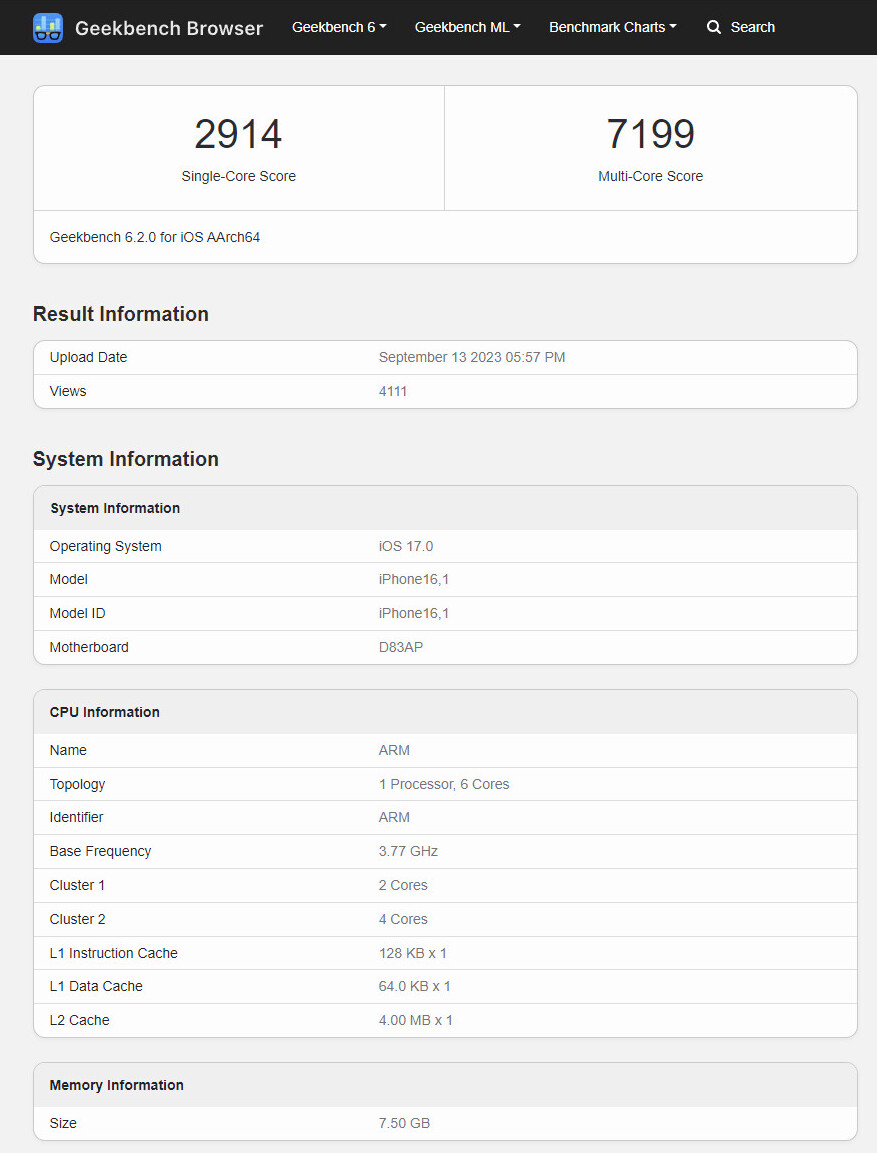
An Apple "iPhone16,1" was put through the Geekbench 6.2 gauntlet earlier this week—according to database info this pre-retail sample was running a build of iOS 17.0 (currently in preview) and its logic board goes under the "D83AP" moniker. It is interesting to see a unit hitting the test phase only a day after the unveiling of Apple's iPhone 15 Pro and Max models—the freshly benched candidate seems to house an A17 Pro system-on-chip. The American tech giant has set lofty goals for said flagship SoC, since it is "the industry's first 3-nanometer chip. Continuing Apple's leadership in smartphone silicon, A17 Pro brings improvements to the entire chip, including the biggest GPU redesign in Apple's history. The new CPU is up to 10 percent faster with microarchitectural and design improvements, and the Neural Engine is now up to 2x faster."

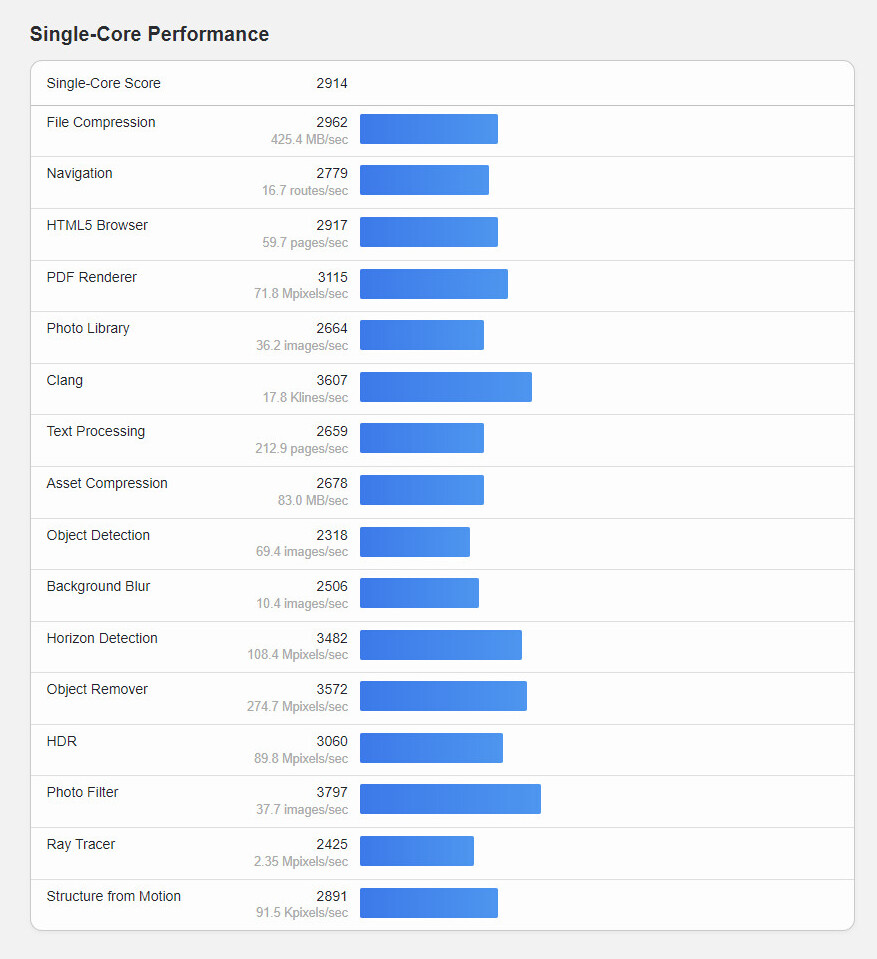
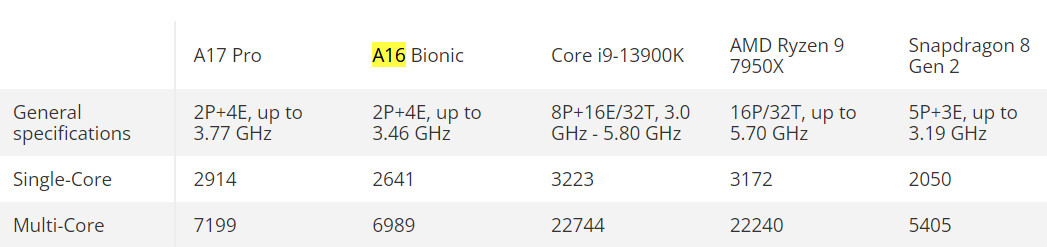
Tech news sites have pored over the leaked unit's Geekbench 6.2 scores—its A17 Pro chipset (TSMC N3) surpasses the previous generation A16 Bionic (TSMC N4) by 10% in single-core stakes. Apple revealed this performance uplift during this week's iPhone "Wonderlust" event, so the result is not at all surprising. The multi-score improvement is a mere ~3%, suggesting that only minor tweaks have been made to the underlying microarchitecture. The A17 Pro beats Qualcomm's Snapdragon 8 Gen 2 in both categories—2914 vs. 2050 (SC) and 7199 vs. 5405 (MC) respectively. Spring time leaks indicated that the "A17 Bionic" was able to keep up with high-end Intel and AMD desktop CPUs in terms of single-core performance—the latest Geekbench 6.2 entry semi-confirms those claims. The A17 Pro's single-threaded performance is within 10% of Intel Core i9-13900K and Ryzen 9 7950X processors. Naturally, Apple's plucky mobile chip cannot put up a fight in the multi-core arena, additionally Tom's Hardware notes another catch: "A17 Pro operates at 3.75 GHz, according to the benchmark, whereas its mighty competitors work at about 5.80 GHz and 6.0 GHz, respectively."

PC-Canada Listings Reveal 14th Gen Core i9-14900K, i7-14700K & i5-14600K CPU Prices

PC-Canada's online store has been updated with several pages of Intel 14th Gen Core/Raptor Lake Refresh processors—this is yet another example of an embargo busting mistake. Telemart Ukraine revealed a small total of six SKUs around late August, but pricing was not included on their placeholder product pages back then. Our friends in Canada have removed all relevant retail information from public view, but momomo_us and a handful of hardware news sites have preserved these details. We get another look at previously leaked model names in K and KF guises, with some "initial" pricing—subject to change by Team Blue decree—starting at $415.99 CAD for the Core i5-14600KF, and topping out with the Core i9-14900K at $833.99 CAD.

Analysis of these "early" prices reveals a slightly smaller than expected hike over charges for the previous generation. VideoCardz has eyeballed the numbers: "A quick comparison with the current pricing of the 13th Gen Core series reveals that these initial prices are surprisingly not as high as one might have anticipated, with an average increase of only 4% or a range of 2% to 7%." Check out their diagram below. The Raptor Lake Refresh K and KF-series desktop lineup is expected to launch on October 17 (according to previous leaks)—Intel's upcoming Innovation Event kicks off next week, where an official unveiling is set to take place.

Microsoft Surface Laptop Studio 2 & Laptop Go 3 Leaked

Microsoft has scheduled a special product announcement event for next week—Germany's WinFuture has likely spoiled all mystery ahead of time by revealing two next generation Surface devices. It was already speculated that Microsoft would exhibit a bunch of new portable Windows PCs at the upcoming September 21 New York City-based shindig, but this week's leak treats us to photos and initial specifications for the Laptop Studio 2 and Laptop Go 3. The former retains its predecessor's 14.4-inch 3:2 format display, with a 2400×1600 resolution and 120 Hz refresh rate. Under-the-hood improvements for the Surface Laptop Studio 2 include a jump up to 13th Gen Intel Core Raptor Lake CPUs (from 11th Gen Tiger Lake)—WinFuture reckons that two options are lined up: Core i7-13700H and and Core i7-13800H. The Surface Laptop Studio 2's discrete graphics solution is speculated to be a mobile NVIDIA GeForce RTX 4050 or RTX 4060 GPU.

A base model could rely on an iGPU based on Intel Iris Xe graphics architecture. 64 GB of LPDDR5X memory is believed to exist with some configurations, which is a nice upgrade (albeit probably a very pricey option) over the previous generation's 16 or 32 GB RAM offerings. The leaked photos indicate that a Micro-SD slot and USB Type-A connector are new additions for 2023's model. The WinFuture article presents some prices—€2249 (~$2400) for the basic iGPU model, mid-tier with RTX 4050: €2729 (~$2915), and €3199 (~$3415) for an almost top flight model sporting 32 GB RAM and RTX 4060. The Surface Laptop Go 3, meanwhile, looks a little less exciting—it is said to get a CPU bump up to Intel Core i5-1135G and Core i5-1235U processors. Otherwise it looks largely similar to its previous-gen sibling. The leak did not include images of a reported Surface Go 4, but WinFuture expects it to be presented next week, powered by an Intel N200 SoC.

Horizon Forbidden West PC Version "Imminent" According to Leaker

IMDA, Singapore's rating board, has evaluated a new version of Horizon Forbidden West—a website entry for an upcoming "Complete Edition" on the PlayStation 5 platform was uncovered late last week. This information was removed at a later date since, but several media outlets have preserved crucial details. Horizon Forbidden West Complete Edition is M18 rated in that part of the world, thanks to gory content and sexual themes. IMDA's extended classification blurb implies that the base campaign as well as this year's Burning Shores DLC will be bundled together in a new package.

Dealabs leaker billbil-kun believes that a PC version is lined up for "imminent" release on Steam and the Epic Games Store—they cannot confirm an exact launch date, but it could arrive within a month based on potentially accurate data leaks. Sony tends to keep its flagship titles exclusive to PlayStation systems for 18 months—the base Horizon Forbidden West game arrived on PlayStation 4 and 5 last February...so the timing is about right for a converted edition to arrive PC-side. A State of Play presentation is scheduled for later today—billbil-kun recommends that folks check it out, given recent insights posted by Giant Bomb's Jeff Grubb.

AMD Ryzen Threadripper Pro 7995WX & 7975WX Specs Leaked

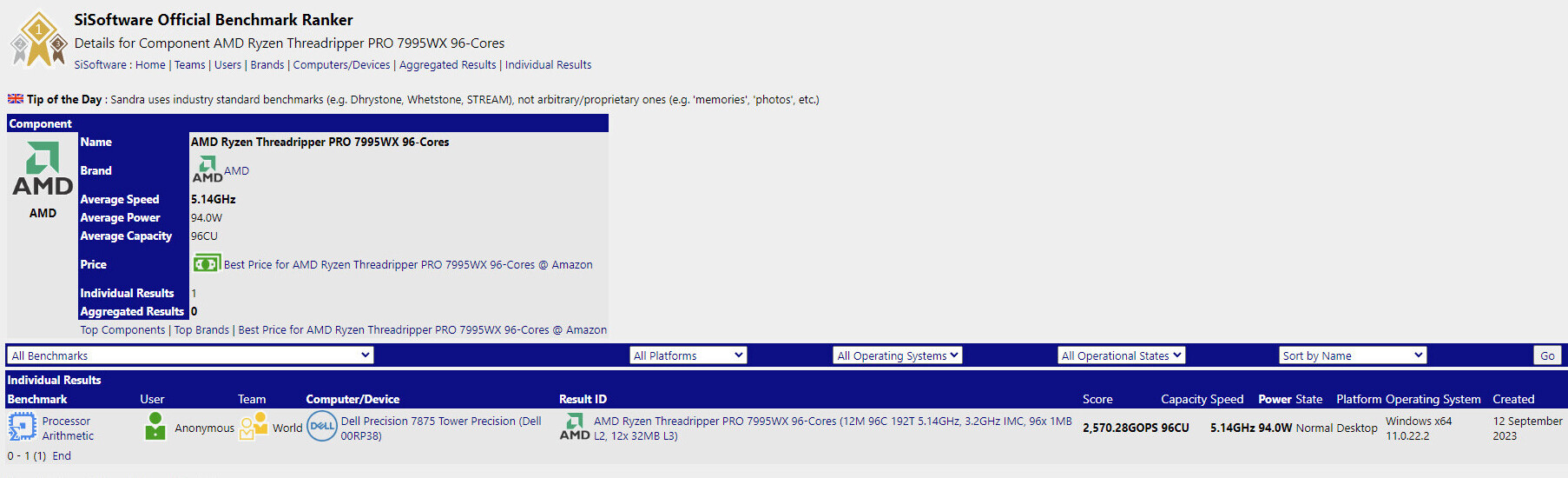
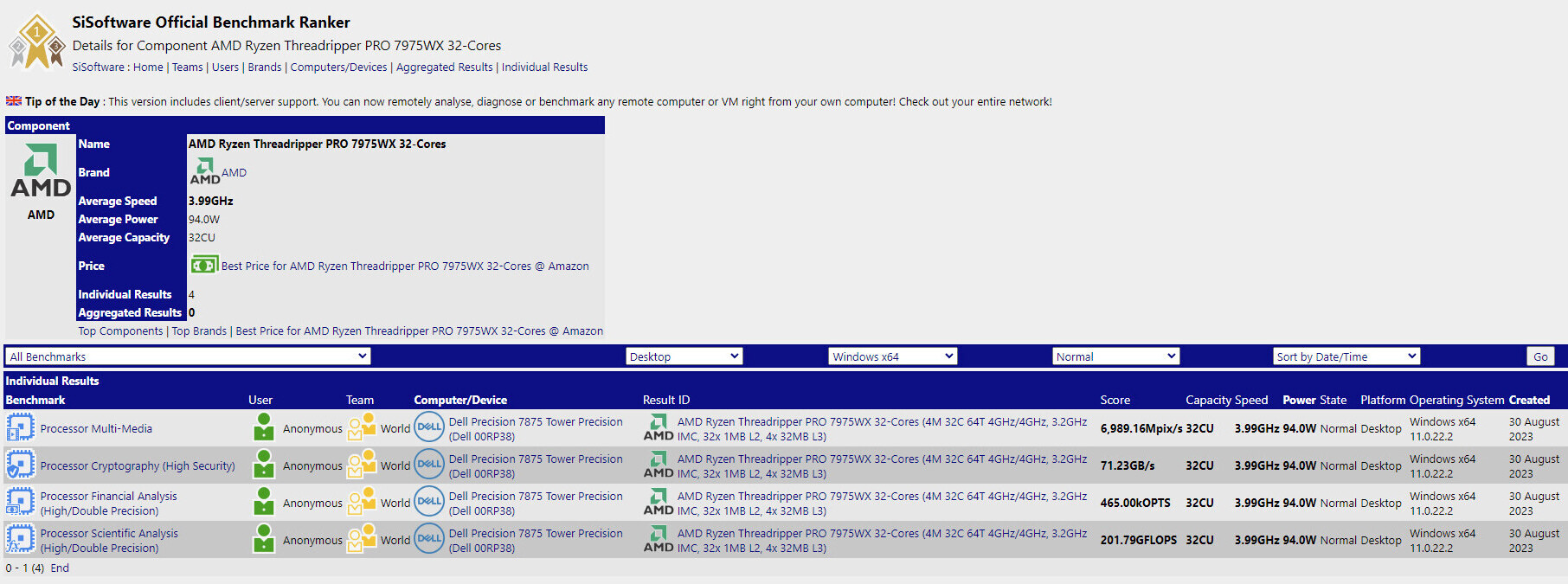
A pair of Dell Precision workstations have been tested in SiSoftware's Sandra benchmark suite—database entries for the 7875 Tower (Dell 00RP38) and 7875 Tower (Dell 00RP38) reveal specifications of next generation AMD Ryzen Threadripper Pro CPUs. The 32 core 7975WX model was outed a couple of weeks ago, but the Sandra benchmark database has been updated with additional scores. Its newly leaked sibling is getting a lot of attention—the recently benchmarked 7995WX sample appears to possess 96 Zen 4 cores, and 192 threads (via SMT) with a 5.14 GHz maximum single-core boost clock. Tom's Hardware is intrigued by benchmark data showing that the CPU has: "a 3.2 GHz all-core turbo frequency."

There are 12 CCDs onboard, with a combined total of 384 MB of L3 cache (each CCD has access to 32 MB of L3)—therefore Wccftech believes that "this chip is based on the Genoa SP5 die and will adopt the top 8-channel and SP5 socket platform. The chip also features 96 MB of L2 cache and the top clock speed was reported at 5.14 GHz." The repeat benched Ryzen Threadripper Pro 7975WX CPU is slightly less exciting—with 32 Zen 4 cores, 64 threads, 128 MB of L3 cache, and 32 MB of L2 cache. According to older information, this model is believed to have a TDP rating of 350 W and apparent clock speeds peaking at 4.0 GHz—Wccftech reckons that this frequency reflects an all-core boost. They have produced a bunch of comparative performance charts and further analysis—well worth checking out.

Intel Core i9-14900KF Geekbenched in v6.2

OneRaichu has conducted a series of Geekbench 6.2 tests on an Intel Core i9-14900KF CPU, very likely a preview sample—his results have arrived for public viewing in the form of three new database entries. The hardware enthusiast (and sometimes leaker) is expected to produce a full review of said flagship Raptor Lake Refresh processor. His evaluation arrives roughly a week after leaked Intel Core i9-14900K processors appearing online, via benchmark results produced in Geekbench 6.1 and CPU-Z. The KF variant is missing an integrated GPU, while its K sibling is likely endowed with a bog standard Intel UHD Graphics 700-series iGPU.

The database entries reveal single-core scores starting at 3322 and going up to 3347 points. Multi-core scores span from 22895 through to 23051 points. A Geekbench 5 result is thrown in for good measure, with achievements of 2412 points in single-core, and 26972 points in multi-core performance. OneRaichu's test build utilized an ASRock Z790 Taichi motherboard and 32 GB of DDR5-7000 memory, his OS of choice appears to be Microsoft Windows 11 (non-Pro) 64-bit. VideoCardz has crunched the numbers: "preliminary benchmarks suggest that the Core i9-14900KF outperforms the i9-13900K by approximately 5-6% in multi-threaded tests and a minimum 12% improvement in single-core performance."

ASUS Registers a Boatload of Radeon RX 7800 XT & RX 7700 XT SKUs

ASUS has registered an unprecedented number of AMD Radeon RX 7000-series mid-range graphics card SKUs with the Eurasian Economic Commission (EEC)—we were somewhat impressed with PowerColor's new SKU count, as reported on TPU two days ago, but Team ASUS shrugs that off with ease. 64 new models based on Radeon RX 7800 XT and RX 7700 XT GPUs have been lodged with the EEC—it should be noted that some of these are unlikely to reach final market form. VideoCardz points out that ASUS has a track record of favoring NVIDIA silicon in terms of offering multiple models across budget, mid level and premium tiers: "ASUS has never released such a large number of cards for a single SKU. Their plans for Radeon models are notably more modest compared to their GeForce RTX 40 counterparts, and some of the listed SKUs are rarely used for AMD GPUs."

ASUS decided to keep things simple with its launch day selection of Radeon RX 7800 XT and RX 7700 XT cards—arriving in TUF Gaming form, with black or white color options. Their latest EEC registration provides an early insight into potential plans for an extensive expansion of Navi 32 GPU-based card models—with additional TUF Gaming options, as well as ROG Strix, Dual, and ProArt SKUs. ASUS has historically adhered to a tradition of picking black shroud designs for its ProArt card series, but the EEC info dump reveals white variants.

Intel Core Ultra 7 1002H Spotted on Geekbench, Meteor Lake Sample Hits 5.0 GHz Max. Clock

Pre-release Meteor Lake silicon has popped up again thanks to an Intel Corporation Client Platform getting submitted for evaluation through Geekbench 6.1.0. The latest database entry—discovered by Benchleaks—presents yet another Core Ultra 100H mobile CPU series engineering sample. This new candidate could end up being named "Core Ultra 165H" once it hits retail in finalized form. Team Blue seems to be playing around with its naming/identifying schemes ahead of an official unveiling—we hope to see something sensible presented at this month's Innovation event.

The tested Meteor Lake Client Platform featured a Core Ultra 7 1002H CPU mounted on an MTL-P LP5x T4 RVP board, with access to 12 GB of memory. Clock speeds of 3.4 GHz (base) and 4.988 GHz are mentioned on the Geekbench Browser page. A 6 P-Core and 10 E-Core configuration aligns this evaluated sample with the previously leaked Core Ultra 7 165H SKU. It achieved a single-core score of 2439 points in Geekbench 6.1, placing it above previously submitted Meteor Lake samples. The multi-core tally comes in at 12668, which trails slightly behind other compiled scores.

PowerColor Registers Radeon RX 7600 XT 10 GB & 12 GB Cards

PowerColor has registered a significant number of AMD Radeon RX 7000-series SKUs with the Eurasian Economic Commission (EEC)—these enrollments are seemingly always a good source of pre-launch information. Naturally, the ever reliable harukaze5719 has reported on this latest filing. The most interesting new SKUs within this leak appear to be Radeon RX 7600 XT graphics cards lined up in Hellhound and Fighter flavors—perhaps an early hint of Team Red prepping different versions of existing RDNA 3 GPUs. Scott Herkelman, AMD's senior vice president, stated last month that no new RX 7000-series ASICs were in the pipeline. The already released Radeon RX 7600 8 GB GPU is the sole entry within its lower end gaming segment for the current generation.

Technical information is not included with EEC filings, so we can only speculate about the choice of Navi 3x GPU with these leaked XT variants. VideoCardz has questioned the slightly peculiar allocations of 10 GB and 12 GB VRAM specs: "(raising) questions about AMD's choice of GPU architecture. One possibility is that they are using the Navi 33 with unusual 96-bit and 80-bit memory configurations, although this seems counterintuitive as it would result in lower memory bandwidth compared to the RX 7600. The Navi 33 GPU is typically limited to a 128-bit memory interface." Alternatively, they also propose that a "heavily cut-down Navi 32 GPU" could exist that "grants 192/160-bit memory." SKUs based on AMD's unreleased Radeon RX 6750 Golden Rabbit Edition (GRE) GPU are also visible within PowerColor's registration, also sporting 10 GB and 12 GB video memory configurations. Additionally, the Taiwanese graphics card specialist appears to be preparing a couple of white and SAKURA edition Radeon RX 7800 XT and 7700 XT cards.

NVIDIA GeForce RTX 3090 SUPER Founders Edition Pops Up on Taobao

An unreleased NVIDIA GeForce RTX 3090 SUPER Founders Edition graphics card was last spotted just over a year ago. A fortunate member of the Chinese NGA discussion board provided a close-up shot of a shroud bearing "super." A new leak gives us a full view of the RTX 3090 SUPER FE with prominent branding—KittyYYuko declared: "WTF, I have indeed heard of this leak before" upon posting this discovery to social media.

According to ITHome, the example from last year appeared to be a publicly released variant of "an unpackaged GeForce RTX 3090 Ti," and the latest finding seems to be identical. A seller, tbNick_dn86z, has created an entry for his GeForce RTX 3090 SUPER Founders Edition card with a value of 9999 RMB (~$1370) on Xianyu (Taobao's second hand market)—it is advertised as being "original and not modified, with a pure black casing." When confronted about identifying any apparent differences between the SUPER and officially launched Ti version, tbNick_dn86z confirmed that they are largely the same (minus external branding)—a matching device ID is shared across both variants.

Leak Suggests AMD 6th Gen EPYC "Venice" CPUs Linked to New SP7 Socket

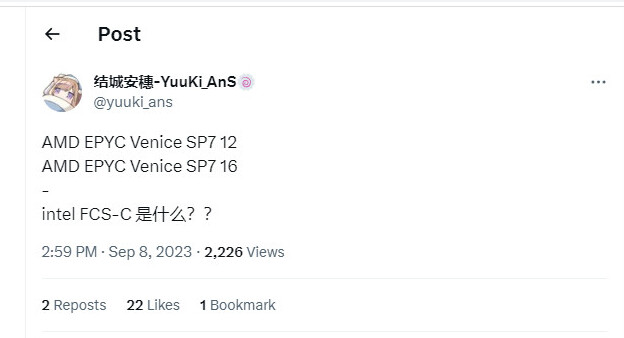
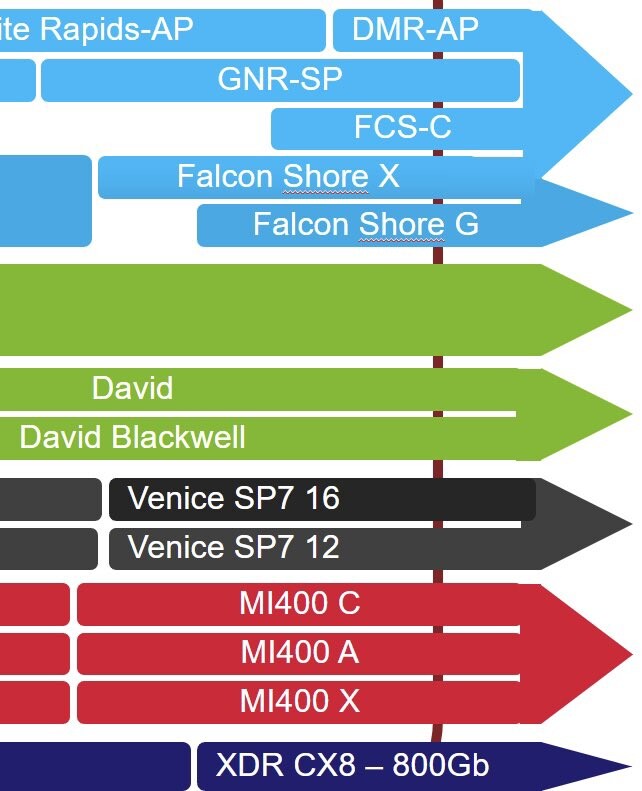
Hardware leaker, YuuKi_AnS, has briefly turned their attention away from all things Team Blue—their latest leak points to upcoming server-grade processors chez AMD. A Zen 6 core-based 9006 EPYC CPU series, codenamed "Venice," is expected to arrive within two to three years along with an all-new SP7 socket—this information seems to have been sourced from an unnamed server manufacturer's product roadmap. A partial view of said slide also reveals forthcoming equipment powered by Intel "Falcon Shore" and NVIDIA "Blackwell" GPU technologies.

As reported a couple of months ago, older insider info has AMD using "Weisshorn" as an in-house moniker for Zen 6 "Morpheus" architecture, destined for Venice CPUs—alleged to form part of a 2025/2026 EPYC lineup. YuuKi_AnS proposes that these will utilize either 12-channel or 16-channel DDR5 memory configurations—thus providing plenty of bandwidth across hundreds of Zen cores. Altogether very handy for cloud, enterprise, and HPC workloads—industry experts reckon that 384-core counts are feasible on single packages. Naturally, a Team Red timeline dictates that Zen 5 "Nirvana" is due before Zen 6 "Morpheus," so EPYC 9005 "Turin(-X)" and 8005 "Turin-Dense" lineups are (allegedly) up for a 2024-ish launch window on SP5 (LGA-6096) and SP6 (LGA 4094) socket types.

Intel Demos 6th Gen Xeon Scalable CPUs, Core Counts Leaked

Intel's advanced packaging prowess demonstration took place this week—attendees were able to get an early-ish look at Team Blue's sixth Generation Xeon Scalable "Sapphire Rapids" processors. This multi-tile datacenter-oriented CPU family is projected to hit the market within the first half of 2024, but reports suggest that key enterprise clients have recently received evaluation samples. Coincidentally, renowned hardware leaker—Yuuki_AnS—has managed to source more information from industry insiders. This follows their complete blowout of more mainstream Raptor Lake Refresh desktop SKUs.

The leaked slide presents a bunch of evaluation sample "Granite Rapids-SP" XCC and "Sierra Forest" HCC SKUs. Intel has not officially published core counts for these upcoming "Avenue City" platform product lines. According to their official marketing blurb: "Intel Xeon processors with P-cores (Granite Rapids) are optimized to deliver the lowest total cost of ownership (TCO) for high-core performance-sensitive workloads and general-purpose compute workloads. Today, Xeon enables better AI performance than any other CPU, and Granite Rapids will further enhance AI performance. Built-in accelerators give an additional boost to targeted workloads for even greater performance and efficiency."

Nintendo "Switch 2" Reportedly Showcased at Private Gamescom Event

In the weeks leading up to Gamescom 2023 all sorts of Nintendo-related rumors started to spew forth—the boldest being a public unveiling of their much anticipated Switch successor during the conference segment. This did not transpire—of course—with Nintendo choosing to showcase existing games and hardware on the trade fair floor in Germany. Post-event murmurs proposed another highly unlikely circumstance—claims posted to social media and on forums pointed to a top secret demo session of "Switch 2" hardware occurring "behind closed doors" at Gamescom, with an elite set of development teams in attendance. These rumblings were largely dismissed due to unsubstantiated information coming from less than reliable sources.

Eurogamer and Video Games Chronicles (VGC) reached out to their cadre of industry insiders to find out more—newly published articles seem to align with recent leaks. The former understands that: "Developer presentations for Switch 2 took place behind closed doors, with partners shown tech demos of how well the system is designed to run. One Switch 2 demo is a souped up version of Switch launch title Zelda: Breath of the Wild, designed to hit the Switch 2's beefier target specs. (To be clear, though - this is just a tech demo. There's no suggestion the game will be re-released." An insider familiar with the games industry in Spain alleged, a few months ago, that Switch 2 development kits had been delivered to a notable local development partner.

Intel 14th Gen Raptor Lake Refresh Full Lineup Leaks Out

Six Intel 14th Gen Core Raptor Lake-S Refresh SKUs were prematurely listed by an e-tailer late last month, with the already leaked Core i9-14900K CPU model popping up again (a week later) via CPU-Z and Geekbench tests. This higher end K and KF product lineup is expected to launch at some point next month—according to the rumor mill. Team Blue could be preparing cheaper non-K models for an unveiling at CES 2024, but a leaker has decided to spoil the fun way in advance. YuuKi_AnS uploaded an allegedly extremely comprehensive list of 14th Gen SKUs, complete with full specifications to their X/Twitter handle. This grants an early glimpse of lowly Intel 300 and 300T models—both featuring a 2P+0E core configuration—these appear to be modern successors to (now retired) Pentium Gold and Celeron branded budget-friendly processor families.

It should be noted that the leaked slide (dated September 5) states that everything sitting within the table is a qualification sample (QS), therefore these chips are subject to change due to their pre-production nature. Parts of the table look a bit iffy—support for DDR5 memory varies across the range, while EEC memory support is also very inconsistent. Intel seems to be sticking with the usual set of three different die designs for desktop Raptor Lake Refresh CPUs—Tom's Hardware points out that: "the B0 die (8P-16E) powers SKUs from the Core i5-14600 and up, while the C0 (8P+8E) die targets models from Core i5-14400 to Core i5-14500T. On the contrary, the H0 (6P+0E) die, which is the lowest of the trio, will be inside the Intel 300 to Core i3-14100T chips."

Official AMD Radeon RX 7800 XT & RX 7700 XT Performance Figures Leaked

Argentina's HD Tecnología site has obtained and published AMD's official data outlining the performance prowess of the soon-to-be released Radeon RX 7800 XT & RX 7700 XT GPUs, when stacked up against their closest rivals—NVIDIA GeForce RTX 4060 Ti 16 GB and RTX 4070 12 GB. Team Red could have "cherry-picked" some of this information, and presented resultant performance charts during the grand unveiling of their mid-range RDNA 3 cards at last month's Gamescom press event. HD Tecnología claims that the fuzzy batch of screengrabs were obtained from an official review guide, they chose to not share pages containing precise details of system specifications. An embargo imposed on media outlets is set to be lifted tomorrow, which coincides with the launch of AMD's Navi 32-based contenders.

The test system was running games within a DirectX 12 environment, possibly at maximum settings—general hardware specs included an non-specific AMD Ryzen 7000-series CPU coupled with DDR5 memory on unidentified AM5 motherboard. VideoCardz's abbreviated analysis of the numbers stated: "In summary, without ray tracing, the Radeon RX 7800 XT outperforms the GeForce RTX 4070 by almost 7% on average, while with ray tracing enabled, it maintains a slight 0.5% lead. Conversely, the RX 7700 XT exhibits 16% higher performance over the RTX 4060 Ti 16 GB. However, the presence of ray tracing can tip the scales slightly in NVIDIA's favor, resulting in an 8.5% lead over the AMD GPU."

Intel Core i9-14900K Tested in Geekbench & CPU-Z

An alleged Intel Core i9-14900K engineering sample CPU was tested out recently in CPU-Z, with results leaked onto the internet earlier this week—courtesy of wnxod—978 points in single-core and 18117.5 points in multi-core. This particular sample of the flagship Raptor Lake Refresh processor managed to surpass its predecessors quite handily—with 9.7% SC/8.4% MC gains over the i9-13900K (Raptor Lake), and an uplift of 19.4% SC/59% MC over the i9-12900K (Alder Lake). Thanks to the i9-14900K's Thermal Velocity Boost (TVB) capability, it is able to hit a maximum 6.0 GHz clock speed (with P-cores) on 1.385 volts according to the leaked CPU-Z info.

Another example was put through the ringer via Geekbench 6.1.0 on Microsoft Windows 11 Pro 64-bit. The database entry popped up this morning, and several PC hardware news outlets were quick to pounce on the figures. In terms of single core performance, the benched Core i9-14900K achieved a score of 3121—blowing past a previous record holder—3089 set by a Core i9-13900KS CPU. Intel's 14th generation contender looks to be the fastest single-threaded chip out there, despite a less than optimal test system configuration—16 GB of DDR5-4800 memory on a Biostar Z790A-Silver mainboard, with Windows running a balanced power plan. The Core i9-14900K's multi-core score lagged behind its main rival—19032 versus 21678 (respectively). It would be nice to witness some nicer test builds materialize as we get closer to Intel's Innovation September event, and the rumored launch of K-series Raptor Lake Refresh processors around late October.

AsRock TRX50 Workstation Board Registered - AMD Threadripper 7000 Arriving Soon?

AMD's Zen 4 high-end desktop (HEDT) family could be closing in on a launch window—AsRock's European office has registered a number of motherboards with the EEC, and KOMACHI_ENSAKA spotted a model sporting a TRX50 chipset sitting in the middle of mainstream gaming Lightning and Riptide offerings. The "TRX50 WS" seems to be the first sighting of an AMD Threadripper 7000 "Storm Peak" series workstation board. TRX50 is presumably the logical successor to Team Red's existing TRX40 platform—the latter supports third generation (Zen 3) Ryzen Threadripper 5000 "Chagall" processors. AMD has not publicly published any details regarding next-gen Threadripper and Threadripper Pro product lineups, but several leaks have pointed to the new HEDT platform arriving within the second half of 2023.

A mid-August Geekbench database entry outed the AMD Ryzen Threadripper PRO 7995WX—this 96 core/192 thread CPU scored 2095 points in single-core tests, and 81408 multi-core points—these results have it positioned as one of the fastest processors submitted to Geekbench. The test system was running Geekbench v5.5 for Linux (Ubuntu 22.04 LTS). It is speculated that four (or more) models could be released with differing core counts: 16, 32, 64 and 96—please refer to the VideoCardz authored chart (below). Past rumors have SP5 and SP6 socket types linked to the "Storm Peak" family, with the introduction of DDR5 memory standard to Threadripper.

AMD Ryzen 8000 "Strix Point" APU Leak Points to 16 RDNA 3.5 CUs

PerformanceDatabases has uncovered details relating to an alleged engineering sample of AMD's Ryzen 8000 "Strix Point" APU—likely insider sourced CPU-Z screengrabs from early last month revealed that the upcoming Zen 5-based laptop chip (in their words): "is built on a 4 nm Process and features the Big.Little CPU architecture with 4 Performance Cores and 8 Efficiency Cores. Both the P and E-Cores support hyper-threading. On the P-Core and E-Core, the L1 Data cache is 48 KB, while the L1 instruction cache is 32 KB. Each P Core boasts 1 MB of cache, and with E-Cores, it looks like there are 4 in a group, sharing 1 MB of L2 Cache. This setup is quite similar to Intel's design. Keep in mind, it's still in the engineering sample (ES) stage, so there's more to come. We'll keep you posted on any further updates!"

Another "AMD Strix - Internal GPU" example emerged late last week, this time in the form of a leaked HWInfo64 screen grab with some information completely covered up—the visible parts seems to point to this "Strix Point" APU featuring a core configuration as seen in the earlier leak, along with 1024 unified shaders. We can presume that the sampled Zen 5-based mobile APU possessing 16 RDNA 3.5 compute units (16 × 64 = 1024). Other details include a 45 W TDP rating, and the socket type being FP8 (as utilized by current Ryzen 7040U and 7040H(S) mobile SoCs). The 512 MB GDDR6 memory configuration is very likely an error—according to HWInfo64, the tested system was fitted with 32 GB of LPDDR5 memory. "Strix Point" looks to be the logical successor (in 2024) to AMD's current "Phoenix" lineup of mobile processors, as featured in gaming handhelds and laptops. PC hardware enthusiasts are expressing excitement about the upcoming APU series wielding impressive iGPU performance, with the potential to rival modern discrete mobile solutions.

Reports Suggest AMD Ending Production of Navi 23 GPU

ITHome has picked up on interesting retail activity in China, where AMD Radeon RX 6650 XT graphics cards are deeply discounted. This seems to correspond to a possible discontinuation of Team Red's Navi 23 XT GPU—a Board Channel source stated: "AMD factory has stopped production of a certain GPU. At the present time, shipments from all AIB brands have stopped with inventory being cleared. AMD has stopped production for the Radeon RX 6650 XT, and nearly all brands will have their inventory cleared by the end of September." Board partners in China appear to running sales promotions, with cards reduced from an original MSRP of 3099 RMB ($425) down to as low as 1739 RMB (~$240), although these adjusted prices are mostly hovering around the 2000 RMB (~$275) mark.

AMD recently declared that its Radeon RX 7000 desktop lineup is now complete, following the unveiling of mid-range RX 7800 XT and RX 7700 XT cards at last week's Gamescom trade fair in Cologne, Germany. Their low-to-mid tier Radeon RX 7600 card, based on the Navi 33 XL GPU, is the sole successor to multiple RDNA 2 predecessors (RX 6600, 6600 XT & 6650 XT). AMD and its board partners are likely prioritizing larger scale RDNA 3 production, so the latest batch of GPU industry insider information is not all that surprising. Tom's Hardware points out that: "there is hardly any point for AMD to continue production of Navi 23. The company's RDNA 3-based Navi 33 GPU integrates 13.3 billion transistors, has 2048 SPs, and performs better than its direct predecessor. Meanwhile, it has a smaller die size (204 mm² vs 237 mm²) and is made on TSMC's N6 process technology (as opposed to N7 in the case of Navi 23), so it may well be cheaper to produce."
Return to Keyword Browsing
Nov 24th, 2026 04:10 CST change timezone

New Forum Posts

Popular Reviews

TPU on YouTube

Controversial News Posts