News Posts matching #Leak

Return to Keyword Browsing

Lenovo Legion Go Handheld Major Details Leaked - Powered by AMD Ryzen Z1 Extreme APU

Lenovo's Legion Go handheld gaming system was uncovered by Windows Report over a week ago following a series of minor leaks emerging throughout the summer. Key points of discovery included an AMD Ryzen Z1 APU, detachable Joy-Con-esque controllers and Windows 11 being the operating system of choice. The news site has today divulged even more details, thanks to a trusted anonymous source sending in an official product press release. It seems that Lenovo is planning to unveil the Go and matching accessories (AR glasses & headphones) at next month's IFA 2023 trade fair in Berlin. The handheld gaming device could launch in early October, with the base model starting at $799 (MSRP).

According to the leaked document, Lenovo's Legion Go is specced with an 8.8 inch, 2560 x 1600 pixel 144 Hz refresh rate IPS LCD touchscreen display—its maximum brightness is allegedly rated at 500 nits. AMD's Ryzen Z1 Extreme APU—that debuted with the ASUS ROG Ally—appears to run the show. The leak also indicates that 16 GB of LPDDR5X-7500 memory is soldered to the Go's mainboard, alongside a user-replaceable PCIe 4.0 NVMe M.2 2242 SSD. The document infers that Lenovo is prepping variants with 256 GB, 512 GB, and 1 TB SSD storage configurations.

AMD Ryzen 8000 "Granite Ridge" Desktop CPUs Could Utilize Same IO Die as Ryzen 7000

AMD is aiming to launch its Ryzen 8000 desktop CPUs, codenamed "Granite Ridge," at some point next year. The next generation Zen 5 core microarchitecture is expected to arrive alongside (Navi) RDNA 3.5 iGPU cores according to the last batch of Team Red product roadmaps. Today, hardware tipsters Olrak29_ and Kepler_L2 have made claims on social media that part of the Ryzen 7000 CPU legacy will continue with the succeeding desktop processor lineup—we already know that Granite Ridge will exist as a Socket AM5 package, but today's leak proposes that these next-gen chips are lined up to utilize the same IO die as sported by AMD's current Zen 4 desktop family.

These new rumors suggest that the "reused" Ryzen 7000 IOD (I/O Die) chiplet will grant the familiar allocation of 28 PCIe Gen 5 lanes, memory controllers, USB functions, plus RDNA 2 iGPU cores. Wccftech points out that: "...interestingly, AMD lists the Ryzen 7000 "desktop" CPUs with Navi 3.0 support whereas the Radeon 710M iGPU in fact is based on the RDNA 2 graphics core. The next-gen lineup was mentioned to support the newest RDNA 3.5 GPU core which will be coming to the Strix APU family next year but that isn't the case either." The article proposes that "RDNA 3.5 GPU cores on the AM5 platform" could arrive with the advent of upcoming Ryzen APUs—namely 6 nm Rembrandt (6000G) and 4 nm Phoenix (7000G) desktop solutions.

Intel 14th Gen Raptor Lake Refresh K-Series CPUs Listed by Retailer

Intel 14th Gen Core CPU series leaks continue to emerge this week—MSI let slip an NDA slide during a livestream a few days ago, and now a retail outlet in the Ukraine has listed six Raptor Lake-S Refresh SKUs on its online store, as spotted by the ever watchful momomo_us. The placeholder product pages that have popped up on Telemart seemingly provide us with yet another look at SKU names, basic specifications, cache sizes, as well as maximum clock speeds. These appear to reaffirm information gleaned from previous leaks regarding 14th generation K and KF models.

Intel's Innovation 2023 event is set to take place on September 19 to 20—where Team Blue is expected to make a big presentation on Raptor Lake Refresh processor ranges (as well as Meteor Lake), so it is somewhat surprising to see retail listings appear well in advance of next month's official announcements, and the anticipated 14th Gen Core K-series product launch in October.

AMD Radeon PRO W7600 GPU Spotted in Geekbench Database

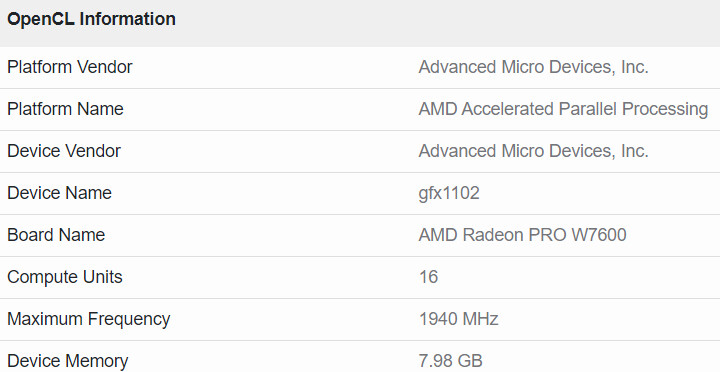
An interesting system popped up on Geekbench Browser early this morning—on initial inspection the evaluated high-end PC was sporting hardware of 2021-vintage, but its graphics card was observed as an outlier. The Intel Core i9-12900K (Alder Lake-S) CPU was sitting on an MSI MPG Z690 Carbon WiFi mainboard, with 64 GB of DDR5 SDRAM (3990 MT/s). The benchmarked computer was running Microsoft Windows 11 Pro (64-bit) on a power saver (economizador) plan. According to the entry's OpenCL information section we are looking at an attached GPU device called "GFX1102 ID," the board name is revealed to be "AMD Radeon PRO W7600" with 8 GB of VRAM. This lower-end alternative to existing (RDNA 3) Radeon Pro models—W7900 (48 GB) and W7800 (32 GB)—could be nearing a public launch.

This information aligns the workstation-oriented card with AMD's Navi 33 GPU—the same GFX1102 designation appears within TPU's database entry (look at the Shader ISA (GFX11.0) graphics feature). VideoCardz reckons that the leaked Radeon PRO W7600 is closely related to AMD's mobile Radeon RX 7700/7600 series—based on Navi 33, due to their matching IDs. Their report proposed: "Based on this data, the GPU is expected to have a clock speed of 1940 MHz. Comparatively, this is 310 MHz lower than the Radeon RX 7600 gaming model, which refers to its Game Clock of 2250 MHz. The Compute Unit field refers to "Workgroup Processor/WGP" cluster, so the card features 32 Compute Units or 2048 Stream Processors, the same configuration as the RX 7600. The card is listed with 8 GB of memory, but it remains uncertain whether this model will support ECC (error correction), a feature found in the W7900/W7800 models. It's important to note that the W6600 did not utilize this type of memory."

Leaker Claims No Liquid Metal Cooling for PlayStation 5 Refresh

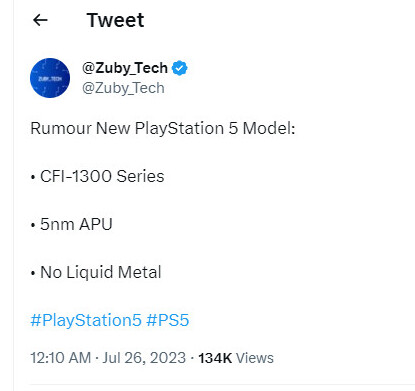
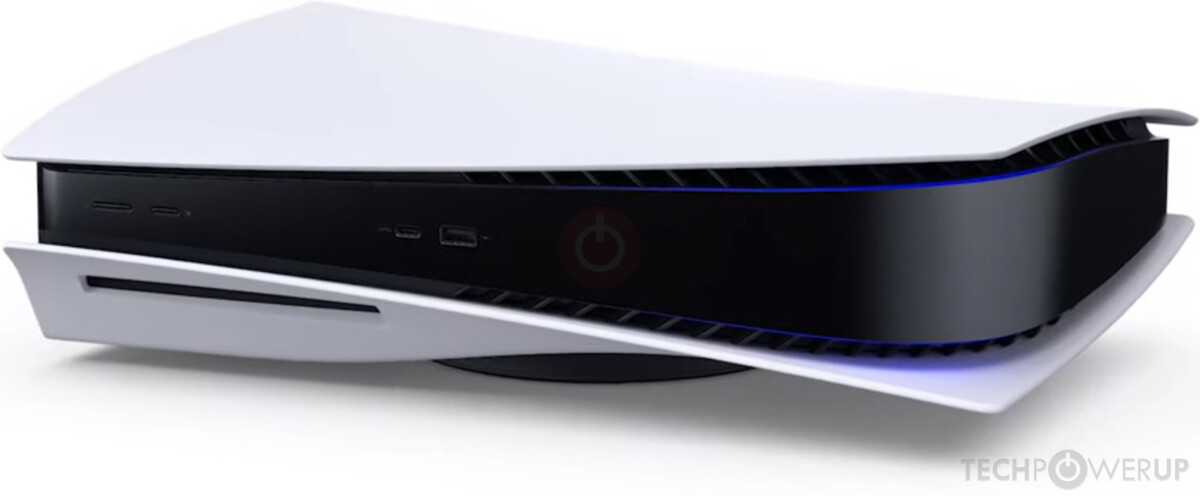
PlayStation 5-related rumors have been flowing over the past week—Zuby_Tech was reportedly the main source responsible for leaking out Project Q footage, but the tipster has turned to his attention to an alleged new version of the host system. Yesterday's tweet makes reference to a refreshed PlayStation 5 model—the "CFI-1300 series"—with a revised 5 nm APU. The late-2020 launch model (CFI-1200) sported a 7 nm chipset, while 2022's die shrink granted the CFI-1202 series with a 6 nm SoC.

The tipster thinks that Sony will be dropping the PS5's liquid metal cooling system for its next iteration, thanks to a central 5 nm part offering greater efficiency and reduced thermal output. Previous reports have predicted that this refreshed "modular model" is marked for a late 2023 release window. Sony has been running a summer price reduction campaign—could this marketing incentive be clearing the way—i.e selling off older stock—in anticipation of the refreshed model's arrival? "CFI-1300" should not be confused with the heavily rumored PlayStation 5 Pro variant—Insider Gaming's Tom Henderson has reiterated multiple times that this major hardware upgrade is still a long way off from launching.

AMD Radeon RX 7900 GRE Could be Introduced at ChinaJoy 2023 Conference

AMD's Chinese office has announced that company representatives will be present at this year's ChinaJoy event—their Weibo social media account confirmed that: "from July 28th to July 31st, 2023, in Hall E6 of Shanghai New International Expo Center, super hardcore and mega cool AMD hardware will be on the scene, bringing you a fast and fun gaming experience. We are looking forward to meeting you!" ITHome thinks that the timing of this announcement points to a possible official unveiling of the Radeon RX 7900 GRE (Golden Rabbit Edition) on the showroom floor.

The publication has cited a tip provided by the one and only momomo_us—the Chinese market exclusive Golden Rabbit Edition will be released tomorrow, which lines up with ChinaJoy 2023's kick off time. Recent leaks have revealed that the 84 Compute Units + 16 GB configured graphics card is a new SKU, sitting below the RX 7900 XT in Team Red's Radeon RDNA 3 hierarchy. It seems to be "built on the mysterious Navi 31 + Navi 32 hybrid GPU." Additionally, ITHome reports that AMD has partnered up with ASUS, and will be exhibiting ROG Moba 7 Plus series laptops (sporting Ryzen Dragon Range APUs) at the Shanghai event.

Apple's 15-inch MacBook Air Unit Sales Reportedly Lower than Expected

Apple introduced its 15-inch MacBook Air at June's WWDC23 event—the giant multinational technology had taken feedback from its customer base, and followed through by rolling out a larger version of the existing M2-based 13-inch model. That appeasement could be a wasted effort, given the latest rumors emerging from Asia. DigiTimes has gathered information from sources within Apple's supply chain—they claim that "the 15-inch MacBook Air...reportedly didn't meet customer demand expectations. There are even calls for the supply chain to put shipments on hold."

The 15-inch MacBook Air's shipment volume for July is reportedly 50% short of the company's original projection, with a broad downturn in the global notebook market factoring in as a reason for sluggish sales. The model's $1299 starting price appears to be quite reasonable at first glance, but the entry point only gives you a spec consisting of non-upgradable 8 GB (unified) RAM and 256 GB solid state storage. A discerning buyer is semi-forced to shell out closer to $2000 for a more competitive configuration, comparable to the closest Window 11 slimline laptops. The high asking prices, on top of a mixed reception around launch time have done the 15-inch MacBook Air few favors. Apple enthusiasts are probably saving up and waiting for the arrival of upcoming M3 chipset-equipped models. DigiTimes reckons that an "upcoming announcement" regarding a next-gen MacBook Pro is due very soon.

Machenike Reportedly Exhibited Next Generation Intel Core-based Systems at Bilibili World

According to a short article released by ITHome, Machenike, a popular Chinese PC hardware company displayed several interesting Intel CPU-based systems at the Bilibili World exhibition (in Shanghai). The manufacturer confirmed (to the reporter) that their next generation hardware will be hitting the market within the next three months, which coincides with the rumored launch of Intel 14th Gen Core Raptor Lake-Refresh desktop K-series SKUs.

Exhibited material implied that Machenike's upcoming PCs—arriving in the form of a "LIGHT-05" desktop tower, mini models and laptops—could be among the first batch of systems to support PCIe Gen 5 storage (as standard). Potential buyers could be attracted to next-gen machines offering access to faster NVMe SSD, on top of rumored higher core counts provided by the Raptor Lake Refresh. ITHome believes that a number of the mini-PCs at Machenike's booth were already running on Raptor Lake Refresh or (Core rebrand) Meteor Lake processors.

Call of Duty: Modern Warfare III Branding Spotted on Leaked Monster Energy Drink Tie-in

Activision is reportedly putting Call of Duty: Modern Warfare 3 through its paces as an alpha test, and is struggling with the containment of leaks. DCMA takedowns have done little to stop the flow, and the publisher has started teasing the much anticipated 2023 CoD release. Licensing partners seem to be taking a lax attitude with regards to NDAs—new Monster Energy promotional material has been photographed in the wild. Revised energy drink brand packaging features a prominent series character—Captain Price—with the Call of Duty: Modern Warfare III logo emblazoned atop the famous protagonist.

Monster Energy has a documented history of offering XP and accessory codes as part of video game tie-in offers, so that legacy is all but confirmed for continuation with this year's alleged mainline CoD entry. Sledgehammer Games is reportedly the main development house working on CoD:MWIII, and various news outlets have claimed that a November launch window is being targeted by the game's publisher. Activision has taken a good humored approach when dealing with the latest leak—their @CallofDuty social media account's response stated: "Whew. Mondays. Anyone have an energy drink they can spare?"

Insider Claims PlayStation 5 Pro Targeting 8K "Performance Mode" & Accelerated Ray Tracing

Insider Gaming's Tom Henderson has picked up some interesting insider knowledge about the long rumored PlayStation 5 Pro gaming console—his (side hustle) Key to Gaming article theorizes that a project codenamed "Trinity" has been in-progress since early 2022. Sony is apparently sticking to its tradition of using Matrix themed codenames for internal hardware projects—PlayStation 4 Pro was referred to as "Neo," and PlayStation VR's alias was "Morpheus." His inside sources claim that Sony has been showing off Trinity prototype units to game development studios, with refreshed dev kits lined up for the "majority" of interested parties by November 2023.

Henderson's sources provided scant info about Trinity's specs and performance goals: "Although the Pro's specs were difficult to pin down, (admittedly) due to my lack of technological prowess, sources have stated that Trinity with have 30 WGP and 18000mts memory. As for the consoles performance targets and as to be expected, the PlayStation 5 Pro will be targeting improved and consistent FPS at 4K resolution, a new "performance mode" for 8K resolution, and accelerated ray tracing. Whether or not a PlayStation 5 Pro console is desired enough in the current market remains to be seen, but as of writing, the PlayStation 5 Pro is in development and is targeting a November 2024 release date." The leaked information has been interpreted several ways by different outlets—mostly focusing on the improved AMD RDNA-powered GPU. I have included Zuba_Tech's updated spec sheet (see below), which seems to be a bit on the fanciful side of things (proposing 72 CUs). Others have theorized that the revised GPU could offer twice the performance of the base PS5 model's Oberon RDNA 2-based GPU (36 CUs).

AMD Expected to Increase Microcode Size for Future Processor Technologies

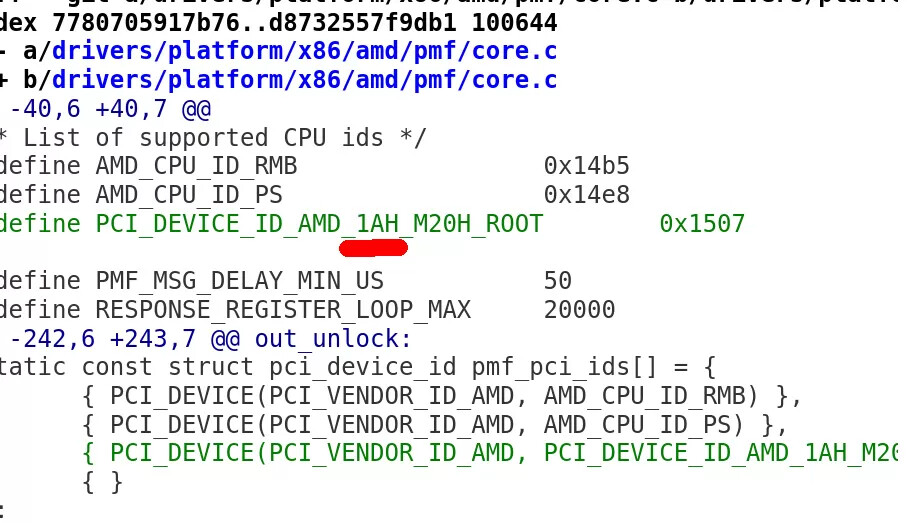
Phoronix has recently uncovered an intriguing Linux update, with kernel improvements being prepared to handle greater microcode payloads—they believe that "future AMD CPUs will be getting larger microcode patches." The timing could suggest that upcoming Zen 5 processors will be likely candidates to meet new requirements: "Right now the Linux kernel has a maximum microcode patch size for AMD CPUs that is three times the kernel's page size (typically 4K). But with a patch (published on July 20) that will "increase substantially" to eight times the page size. The increase is intentionally quite a magnitude larger in order to avoid future patches further having to bump the patch size limit in later generations." Earlier this month, some GitHub entries demonstrated that AMD engineers had patched Linux 6.5 with updates for "Family 26" (1Ah) CPU enablement," which Phoronix believes to be for next-gen platforms (Zen 5): "It's also not elaborated on why the CPU microcode size will be increasing. In any event the simple patch to bump the AMD CPU microcode limit is now out for review. It's also marked for back-porting to existing stable kernel versions."

Intel Arc A580 GPU Reportedly Appears in GFXBench Database

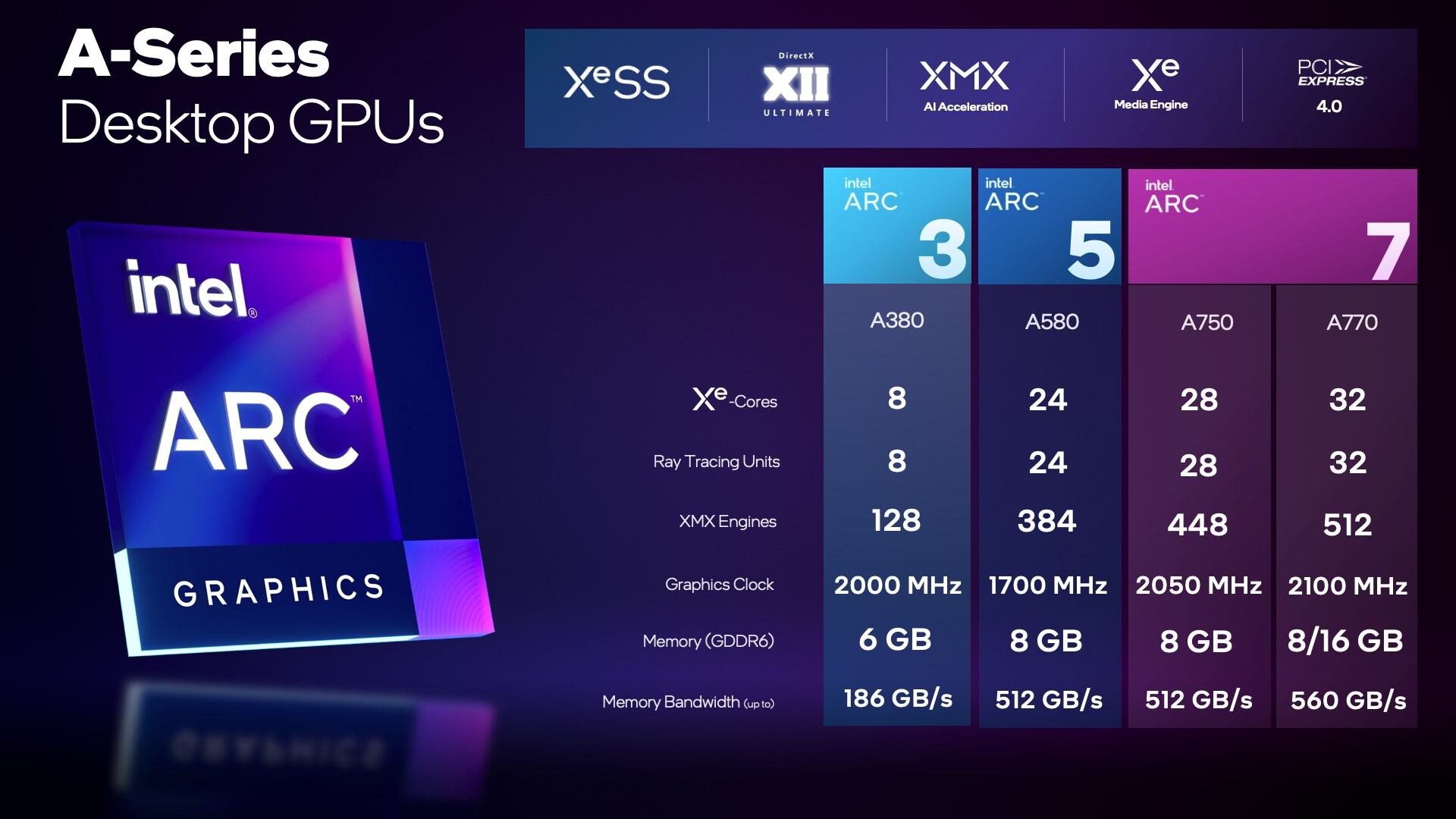
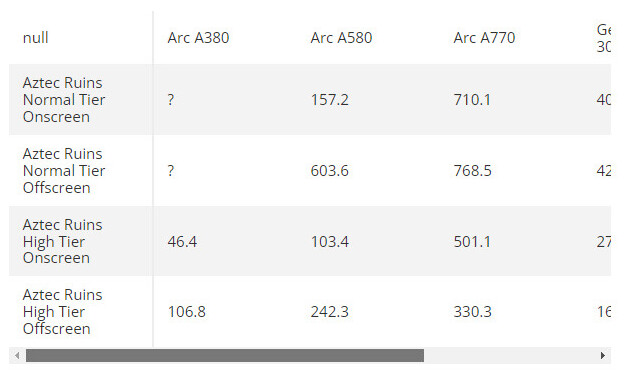
The Intel Arc A580 GPU was revealed alongside its Alchemist siblings—A380 A750 and A770—last year, but remains the only one out of that lineup to not have reached the retail market. Things have been quiet on the Intel Arc 5-series "Advanced Gaming" front for a while now—TechPowerUp's GPU-Z utility was updated with support for the A580 last September, and an evaluation sample was benched in Ashes of the Singularity a month prior to that. A supposed sample Intel Arc A580 was recently tested via a Vulkan-based renderer in GFXBench 5.0, perhaps not the best platform to gauge PC performance on.

Has an owner of a rare curiosity unit chosen to bench the unreleased GPU, or is a manufacturer evaluating a sample with a very delayed product launch in mind? The test results are not all that impressive, with the A580 performing poorly compared to the range-topping Arc A770 (placed in Intel's "high performance gaming" tier), although it does much better than the A380 (not a big boast). The likely prototype nature of the evaluated card or immature state of drivers could be to blame for shortcomings in GFXBench 5.0.

AMD Ryzen 9 7945HX3D Outed by ASUS ROG Laptop Specs

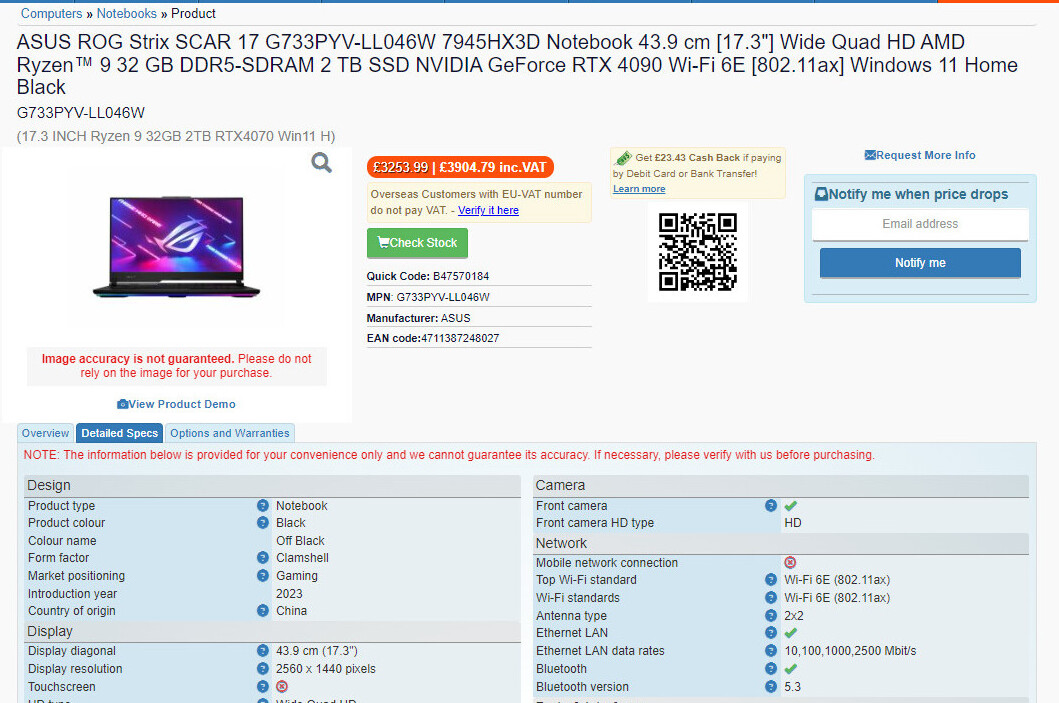
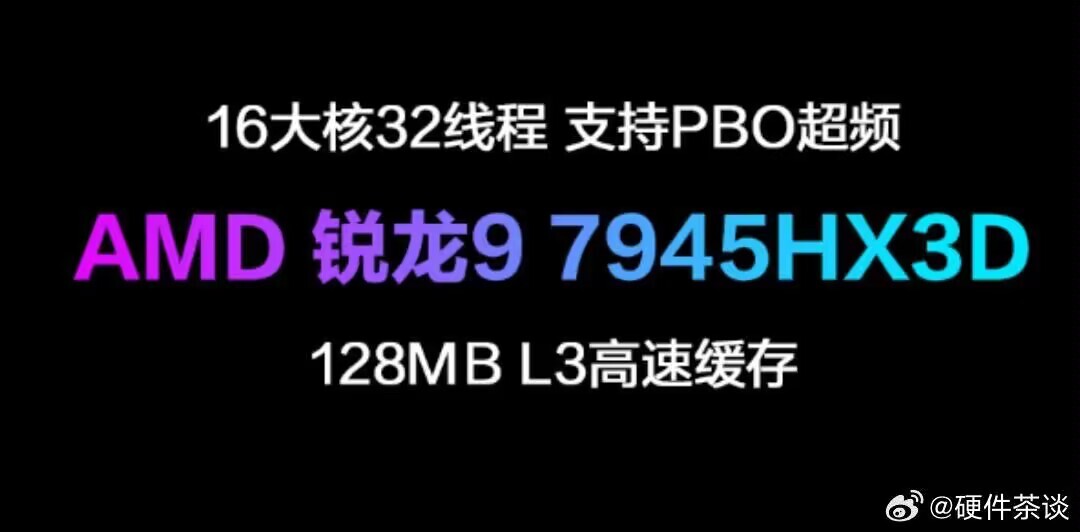
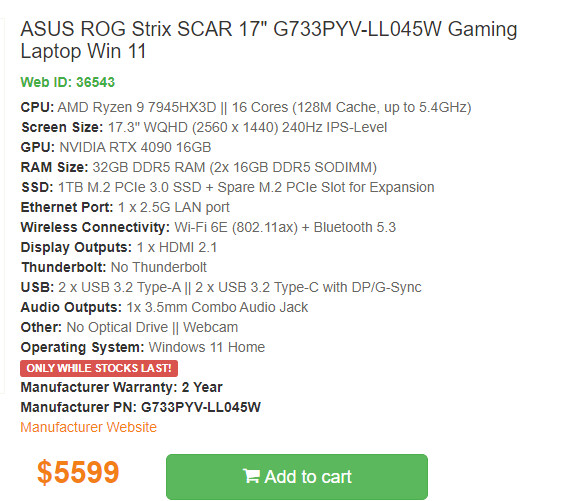
Tipsters have noticed that ASUS is preparing a new high-end laptop with an unannounced AMD processor—the upcoming ROG Strix SCAR 17-inch model (G733PYV-LL046W,) will apparently sport a Ryzen 9 7945HX3D APU (with 128 MB of L3 cache). The inclusion of "X3D" in the processor's name has generated a lot of interest, given that Team Red's 3D V-Cache technology has existed mainly within mainstream desktop-oriented Ryzen 7000 and 5000 processor lineups. This leaked dual-CCD APU is probably being lined up to take on upper-echelon Intel Raptor Lake-HX processors, as well as refreshed variants.

The leak indicates that this APU will likely sit at the top of the Zen 4-based Dragon Range-H lineup—being a 5.4 GHz max. boost clock, 16-core/32-thread CPU, with a configurable TDP (between 55 W and 75 W) and Radeon 610M iGPU. The host ASUS ROG Strix SCAR 17 laptop is no slouch thanks to some very generous hardware specifications, including a mobile NVIDIA RTX 4090 GPU, 32 GB of DDR5 memory, 2 TB SSD, and a 17.3" 240 Hz IPS display. Listed at 5599 AUD (~$3800) on Computer Alliance, or £3904.79 (~$5000) chez Lamba-Tek, you would expect the best possible performance for those prices. The two online retailers have not confirmed any concrete release dates for the high-end ASUS laptop.

Leaked Footage Shows Sony Project Q Handheld Running Android OS

A significant Sony Project Q leak has revealed an alleged prototype running on an undisclosed version of the Android operating system—the remote play-oriented handheld device was first revealed in late May's PlayStation showcase, but Sony's games division has so far kept stum about the Q's means of operation. Zuby_Tech has (prematurely) pulled back the curtain by uploading various images and video footage of a working unit.

A very simple version of Android seems to be displayed on the device's 8-inch 1080p LCD screen (a protective film is still attached), with a prominent QR code featured on its home window. The streaming device has the potential to be quite flexible, in terms of functionality, thanks to Sony's apparent wise choice of operating system selection. Zuby_Tech also took the time to open up their sample unit—without the screen in place, there appears to be not much going on inside there. Previous rumors have the Project Q accessory costing somewhere in the $200-300 region, with a battery life of 3-4 hours—this could be a tough one to market and sell, even to the most ardent of PlayStation platform supporters.

Leak Suggests Radeon RX 7800 XT & RX 7700 XT GPUs Scheduled for September Launch

As we get closer to a possible late summer/early autumn release window for mid-range AMD Radeon RX 7000-series gaming graphics cards, more leaks have emerged from sources in Asia. Benchlife believes that "in addition to Radeon RX 7900 GRE, AMD and its AIB partners are also preparing two Navi 32 chip graphics cards such as Radeon RX 7800 XT and Radeon RX 7700 XT, which are expected to be available in early September." Previous leaks have indicated that a September launch is planned, albeit with the RX 7800 XT SKU being based on a heavily modified Navi 31 GPU.

Two non-XT units have recently emerged via leaked benchmark results, so there could be a good number of options lined up for a third quarter 2023 launch. Jon Peddle Research (JPR) has added their two cents, by reconfirming that Team Red could be showcasing mid-range models at a late summer trade fair: "AMD is rumored to announce two new 7000-series AIBs at Gamescom in late August. The leaks suggest that AMD is behind NVIDIA in terms of AIBs and has open slots in its SKU lineup. The leaked benchmark data (see below) indicates that the RX 7800 and RX 7700 may compete with the RTX 4070 and RTX 4060 Ti, respectively." JPR proposes that AMD is preparing at least two mid-range models for launch, although this could increase to five. If a mysterious fifth candidate does exist outside of the oft mentioned RX 7700, RX 7700 XT, RX 7800 and RX 7800 XT SKUs, where would it be placed in the hierarchy? We can exclude the RX 7900 16 GB GRE GPU since it seems to be a Chinese market exclusive, with performance estimated to be just below RX 7900 XT standards.

Semiconductor Bosses Discussed China Trade Restrictions with US Government

According to various news sources, CEOs from Intel, NVIDIA and Qualcomm have been holding meetings with representatives of the US government—with the topic of discussion reportedly being the escalation of semiconductor import restrictions placed on China. AMD was notably absent from Monday's proceedings, due to Dr. Lisa Su attending to business matters in Taiwan. Commerce Secretary Gina Raimondo, National Economic Council director Lael Brainard and National Security Council director Jake Sullivan were alleged to have met with industry leaders.

Chipmakers have expressed worry about new restrictions coming into effect within the next couple of week—the latest negotiations could have touched on some sort of provision for leading silicon manufacturers. The US government believes that by limiting China's access to cutting-edge technology, it will bolster national security interests—with the Chinese military not being able to develop competitive defense systems. The Semiconductor Industry Association stated on Monday that: "overly broad, ambiguous and at times unilateral restrictions risk diminishing the US semiconductor industry's competitiveness, disrupting supply chains, causing significant market uncertainty and prompting continued escalatory retaliation by China." Intel, NVIDIA and Qualcomm did not provide any comments to press outlets following the conclusion of their meetings with senior government officials. It is speculated that Qualcomm is set to lose the most trade following the implementation of stricter rules—Bloomberg proposes that 60% of the firm's business revenue comes from Chinese territories.

Intel Alder Lake-N50 SoC Outed by Geekbench Test

A new entry has appeared on the Geekbench Browser database—very early this morning—apparently pointing to the lowest model sitting within the ranks of Intel's Alder Lake-N CPU series. According to leaked Geekbench 6.1 test results, as spotted by Benchleaks, the evaluated system was running on an "Intel N50" processor. This truly entry-point 6 W TDP SoC seems to feature two Gracemont efficiency cores with a 997 MHz base clock and a boost capability of 3.4 GHz. You are not getting any hyper-threading here. The integrated GPU is reported to sport 16 Execution Units—the more powerful N200, Core i3-N305 and Core i3-N300 Alder Lake-N siblings have double that count (32 EUs).

The benchmarked N50 system achieved overall scores of 1054 (single core) and 1388 (multi-threaded). Geekbench Browser states that the tested build had 8 GB of RAM (single channel), with the OS being Microsoft Windows 10 IoT Enterprise LTSC (64-bit) on a balanced power plan. VideoCardz was somewhat impressed with the plucky 6 W TDP chip offering comparable performance to decade old CPUs, albeit with a much lower power draw. The N50's single core result positions it closer to Intel fourth Gen Core Haswell mobile processors or first generation Ryzen CPUs, but the multi-core score is a bit of letdown—perhaps comparable to Intel Core 2 and AMD FX series models.

DMCA Strikes Point to Modern Warfare III Being the next Call of Duty Title

A flurry of DMCA take down notices, on Activision's part, have brought even more attention to an alleged Call of Duty internal alpha test. Leakers have been talking about Modern Warfare III being the likely candidate for a new CoD release this year, following a planned premium expansion for MW II morphing into a full-fledged sequel. Activision has been busy scrubbing the internet clean of screenshots sourced from the alleged "Hailström" test build, but issued copyright strike messages contain references to the next entry in the series. Targeted tipsters have been warned about activity that has resulted in: "leaked content from unreleased video game Call of Duty: Modern Warfare 3" appearing on social media and other gaming community hubs.

The publisher has semi-acknowledged that the cat is out of the bag, and yesterday addressed the fan base with a simple query: "Let's get this out of the way...Should MW II Operators, Weapons and Bundles carry forward into Call of Duty 2023?" This official tweet was shared by the Sledgehammer Games account—this Activision-owned studio is rumored to be the primary development house working on Modern Warfare III, with other Call of Duty-oriented outfits providing additional support. Call of Duty: Vanguard (2021) was Sledgehammer's third fully developed entry in the blockbuster (and highly contested) series.

Leaked AMD Radeon RX 7700 & RX 7800 GPU Benchmarks Emerge

A set of intriguing 3DMark Time Spy benchmark results have been released by hardware leaker All_The_Watts!!—these are alleged to have been produced by prototype Radeon RX 7700 and Radeon RX 7800 graphics cards (rumored to be based on variants of the Navi 32 GPU). The current RDNA 3 lineup of mainstream GPUs is severely lacking in middle ground representation, but Team Red is reported to be working on a number of models to fill in the gap. We expect a number of leaks to emerge as we get closer to a rumored product reveal scheduled for late August (to coincide with Gamescon).

The recently released 3DMark Time Spy scores reveal that the alleged Radeon RX 7700 candidate scored 15,465 points, while the RX 7800 achieved 18,197 points—both running on an unspecified test system. The results (refer to the Tom's Hardware-produced chart placed below) are not going to generate a lot of excitement at this stage when compared to predecessors and some of the competition—evaluation samples are not really expected to be optimized to a great degree. We hope to see finalized products with decent drivers putting in a good appearance and performing better later on this year.

Intel 14th Gen Core K-series Specs Leaked

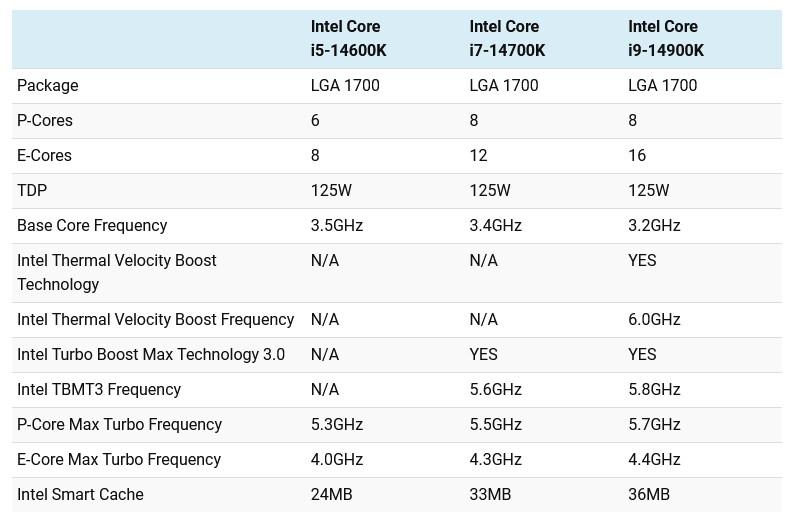
Benchlife claims to have obtained full specifications of Intel's upcoming 14th Gen Core series—the site kicked things off by releasing details of a trio of Raptor Lake Refresh K-series SKUs earlier today. Insiders have seemingly divulged fairly comprehensive specs for i9-14900K, i7-14700K, and i5-14600K desktop CPUs. The expected lineup-wide implementation of greater clock speeds (+200 MHz) is present on these examples according to the leaked info—i9-14900K is reportedly capable of boosting up to 6.0 GHz (via Thermal Velocity tech), while its Core i7 and Core i5 siblings are said to be hitting 5.6 GHz and 5.3 GHz (respectively).

The Core i7-14700K seems to be the only rumored model to receive a core count increase—the listed 8P+12E configuration is decked out with more Gracemont efficiency cores when compared to the 13th Gen equivalent's makeup (i7-13700K, 8P+8E). This grants a slightly increased pool of Intel's "Smart Cache"—33 MB instead of the previous gen model's 30 MB. These 125 W TDP "K" SKUs are expected to arrive mid-October alongside "KF" models (lacking iGPUs). The 65-W non-K lineup could be presented at the next CES, and launched in January 2024.

AMD Reportedly Prepping Special Radeon RX 7900 GRE Model for Chinese Market

A reference to an unreleased Radeon RX 7900 GRE GPU specced with 16 GB of VRAM appeared on distributed computing platforms last month. The unusual GRE acronym was a little bit puzzling, but ITHome has recently discovered that this could be the successor to an older GME (Golden Mouse Edition) card. AMD's Radeon RX 590 GME design was released back in March of 2020 to celebrate the year of the Rat or Mouse.

The Chinese zodiac sign for 2023 is the rabbit, hence AMD preparing a Golden Rabbit Edition (GRE) for that territory. ITHome proposes that this Radeon RX 7900 non-XT model could field a cut-down version of Team Red's Navi 31 GPU—with its Compute Unit count possibly reduced slightly below the standard 84 CUs, while an allocation of 16 GB of GDDR6 video memory gets coupled to a 256-bit interface (down from the XT's 20 GB and 320-bit). The short report does not provide any release date information or detailed specifications/features, but we can assume that the GRE is highly likely to arrive within the year it is intended to commemorate.

Sparkle Embracing Arc A380 & A310 GPUs with Low-Profile GENIE Series

Sparkle presented a pair of custom Intel Arc A380 and A310 cards[/url] at last month's Computex expo—reaffirming its commitment to presenting the full lineup of Arc GPUs. It is now reported that these "Industrial Low-Profile" cooled units will form the company's "GENIE" series. Sparkle's triple-fan TITAN series is comprised of Arc A770 and A750 GPUs, while the dual-fan ORC is formed solely of an A750. ELF is a single fan design A380 card.

The aforementioned GENIE models are both one slot designs with single fans and a low profile shrouds that only covers part of the PCB (comparable to the reference card). The A380 unit offers 8 Xe-Cores with 6 GB GDDR6 96-bit memory, while the lesser A310 gets 6 Xe-Cores and 4 GB of GDDR6 64-bit memory. The leaked presentation slide does not show any release date information, but reasonably final looking hardware making an appearance at Computex 2023 suggests that the GENIE series is not too far off from reaching retail.

AMD Ryzen 8000 "Strix Point" APUs Referenced in GPU LLVM Backend

As reported by Phoronix—references to GFX1150 & GFX1151 targets have been added to the AMDGPU LLVM backend/compiler, which seems to indicate that these are upcoming AMD APU models. AMD engineers have made to reference to GFX1150 as "Strix1" (full codename: Strix Point) in the past according to several sites, but the recent leak has GFX1151 mentioned for the first time.

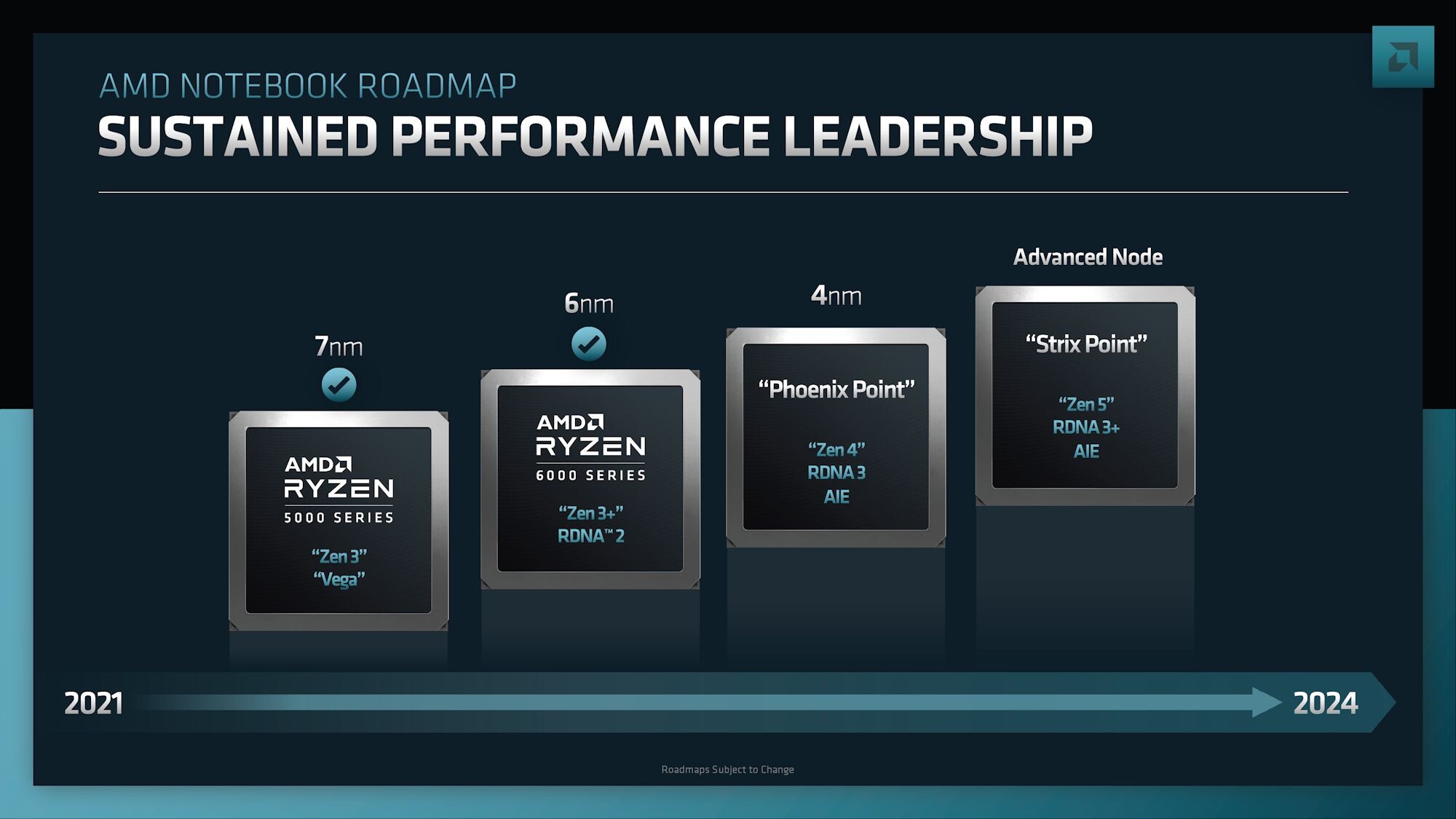
Previous reports suggest that Team Red could be developing two Strix/Zen 5/RDNA 3.5 APUs with AI engine enhancements for laptops—a discovery of two separate GFX targets suggests that we are likely looking at different 12-core and 16-core models. The former is said to be a monolithic design with a TDP going up to 54 W. The 16-core "Strix Halo" (also known as "Starlak") is a very different type of product with leaks suggesting that it will have a maximum TDP of 120 W, and be based on a chiplet design. Zen 5 processor products are expected to arrive in the second half of 2024—with Granite Ridge filling in the desktop platform segment.

Ratchet & Clank: Rift Apart PC Spec Requirements Published

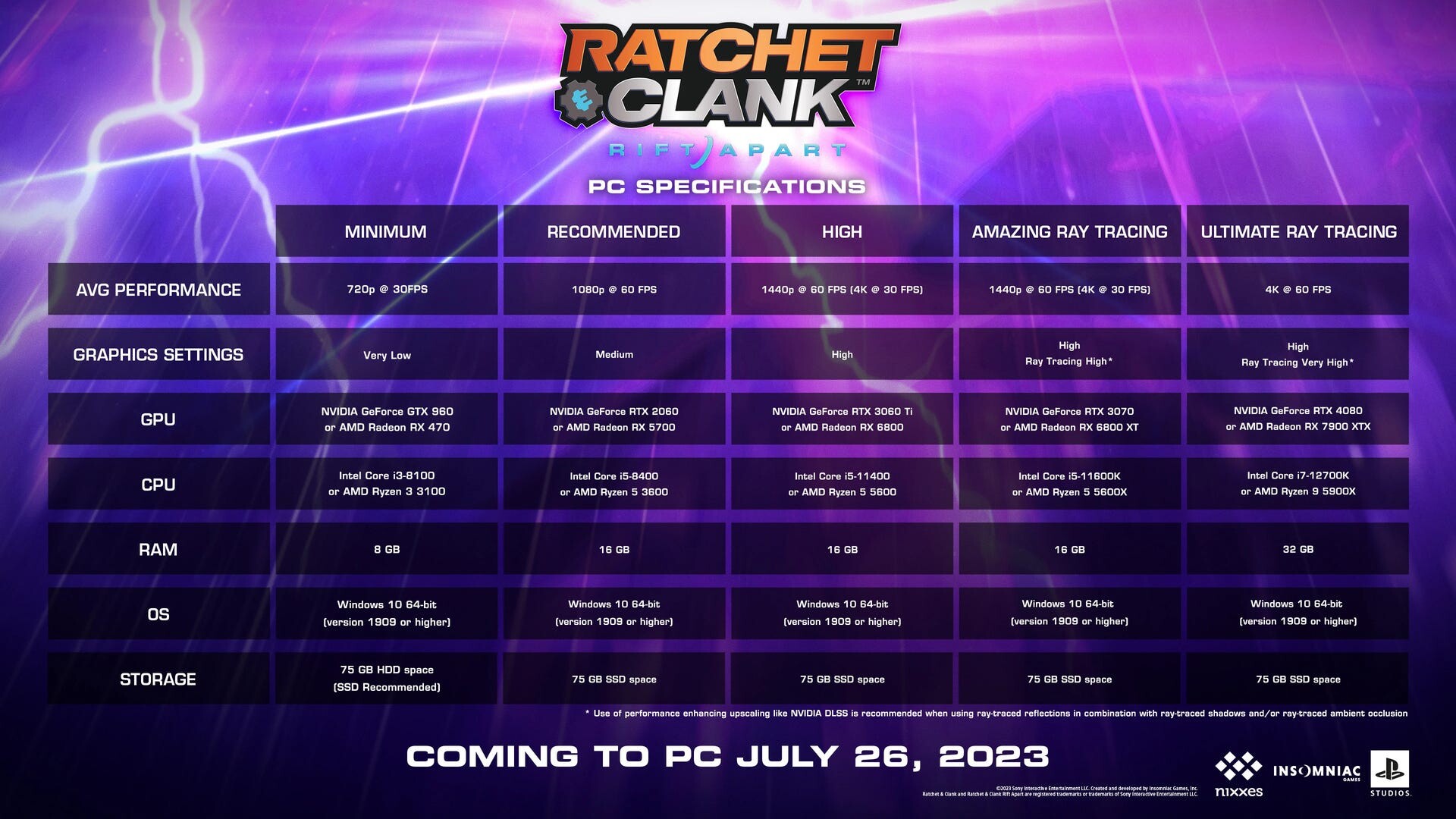
Nixxes and Insomniac yesterday published their official PC specification requirements for the Ratchet & Clank: Rift Apart port (arriving on July 26). The announcement was made via a post on the game's Steam store page, but the two teams decided to remove it soon after (perhaps the information was released too early). Several news sites were quick enough to note that the PC version of Ratchet & Clank: Rift will be the first DirectStorage 1.2 game with support for GPU decompression. Senior Lead Programmer Richard van der Laan stated (in the now deleted update): DirectStorage ensures quick loading times and GPU decompression is used at high graphics settings to stream assets in the background while playing. Traditionally, this decompression is handled by the CPU, but at a certain point there is an advantage to letting the GPU handle this, as this enables a higher bandwidth for streaming assets from storage to the graphics card. We use this to quickly load high-quality textures and environments with a high level of detail.

His colleague, Principal Programmer Alex Bartholomeus, also chipped in with: "For Ratchet & Clank: Rift Apart on PC, we added adaptive streaming based on live measurement of the available hardware bandwidth. This allows us to tailor the texture streaming strategy for the best possible texture streaming on any configuration." The most surprising aspect gleaned from the PC specification sheet is the minimum performance requirement (720p @ 30 FPS) of a hard disk drive (HDD) acting as the main storage device, although they would prefer that you go with a more modern storage option. A solid-state drive (SSD) is deemed necessary for the "Recommended" tier at 1080p/60 FPS. This is quite amusing considering that Insomniac's creative director, Marcus Smith, once said (in an official PlayStation showcase video) that Ratchet and Clank: Rift Apart's dimensional rift hopping "would not have been possible without the Solid State Drive of the PlayStation 5."

Intel Raptor Lake Refresh Basic Specs Leaked

YouTuber RedGamingTech has put together a list of leaked Intel 14th Gen Core SKUs—they claim that this information was compiled from various tipsters and inside sources. Raptor Lake Refresh is perhaps not a very exciting prospect—i.e. a mild upgrade—for current owners of 13th Gen Core CPUs on the LGA 1700 platform, but upcoming mid-range SKUs could offer a nice performance uplift for those still on 12th Gen silicon (or older) thanks to higher core counts. According to RedGamingTech's list, the refreshed Core i7 series (14700, -K &-F) sports 20 cores and 28 threads, while Core i5 14600 SKUs are rumored to feature 16 cores and 24 threads. Prospective budget-conscious customers are likely to be enthused by Core i3 SKUs getting a refresh with new 6-core/12-thread configs.
Return to Keyword Browsing
Nov 24th, 2026 04:02 CST change timezone

New Forum Posts

Popular Reviews

TPU on YouTube

Controversial News Posts