News Posts matching #MacBook Pro

Return to Keyword Browsing

Global OLED Notebook Shipments Forecast to Grow Over 40% YoY in 2027

Apple's newly unveiled MacBook Pro with PROLED XDR Display marks a significant milestone in the evolution of MacBook display technology and user experience, becoming the first model in the lineup to feature a tandem OLED touchscreen. TrendForce estimates that shipments of the new model will reach 1.2-1.5 million units in 2027. Apple's entry into the OLED notebook market is also providing fresh impetus for panel makers to accelerate the development of advanced display technologies.

However, TrendForce notes that the new MacBook Pro's premium starting price of US$2,899 for the 14-inch model, coupled with its initial availability alongside existing Mini-LED models, could temper near-term replacement demand.


Apple Unveils MacBook Pro With PROLED XDR Display and Touch for the First Time on Mac

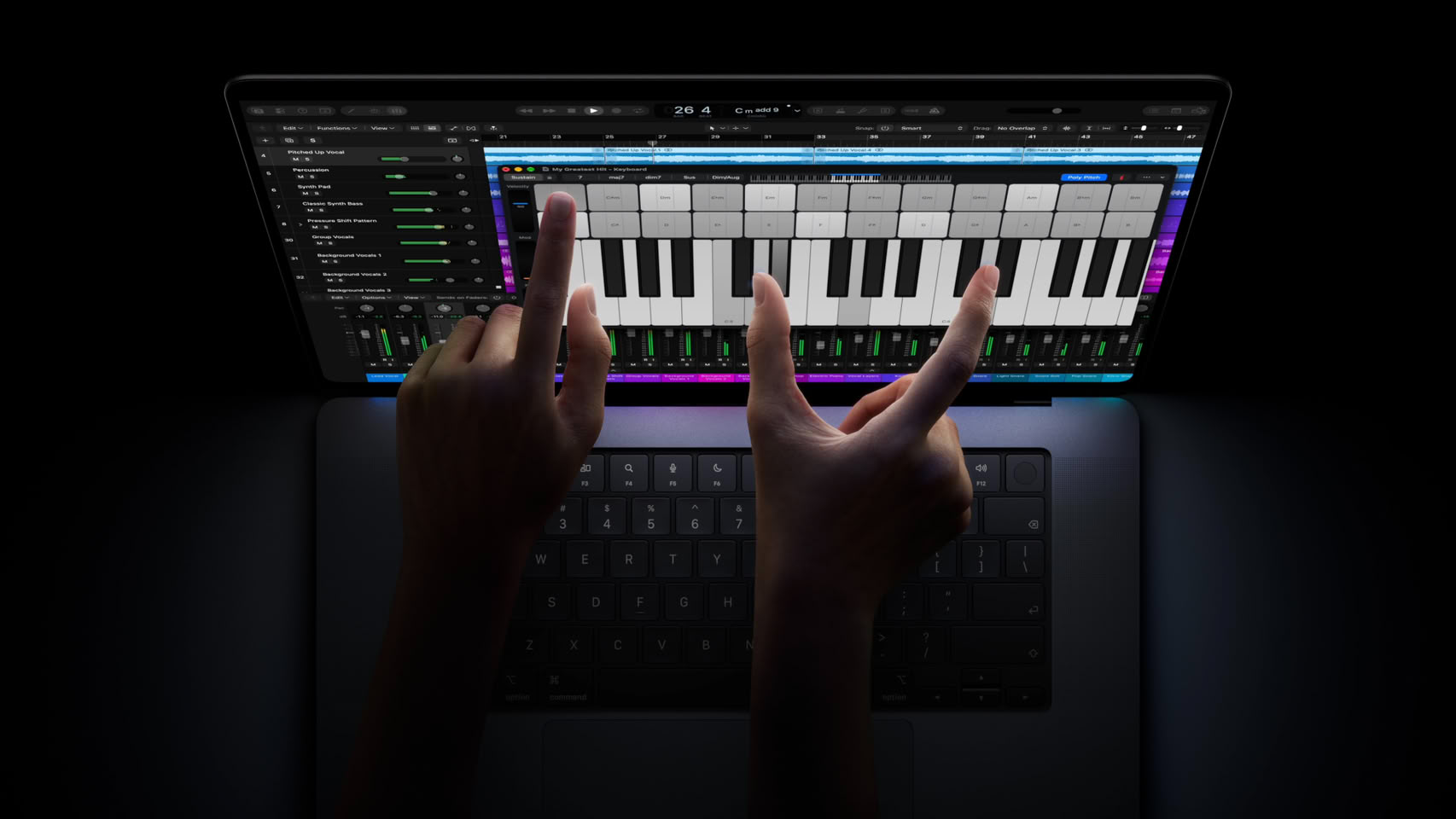
Apple today introduced the all-new MacBook Pro with PROLED XDR Display, featuring breakthrough tandem OLED technology that delivers game-changing front-of-screen performance. Available in 14- and 16-inch models, MacBook Pro with PROLED XDR Display offers a visual experience unlike any other, transforming pro workflows with up to 2000 nits peak HDR and SDR brightness, an industry-leading 10,000,000:1 contrast ratio for exceptional detail, a 120 Hz variable refresh rate, and a wider color gamut covering both P3 and Adobe RGB for brilliant colors. The new MacBook Pro also introduces intuitive Touch capabilities on the Mac for the first time, opening up a whole new dimension for pros to interact with their content, from manipulating 3D models to playing musical instruments onscreen.

The Dynamic Island now comes to Mac, serving as the home for Spotlight, Live Activities, and Siri AI. And with up to 24 hours of battery life in thinner and much lighter 3- and 4-pound designs, MacBook Pro is more portable than ever, empowering pros to take their work wherever inspiration strikes. Featuring M5 Pro and M5 Max, Apple's most powerful chips ever built for a pro laptop, along with up to 128 GB of unified memory and now up to 16 TB of blazing-fast storage, the new MacBook Pro delivers speed and capability for the most demanding workflows. An enhanced six-speaker sound system now provides 50 percent deeper bass and remarkable sound clarity for even more immersive audio. And Thunderbolt 5 and a wide array of connectivity, a 12MP Center Stage camera, studio-quality mics, and the power of macOS 27 with Apple Intelligence and Siri AI complete the MacBook Pro experience. It is available to pre-order starting today, October 28, with availability beginning Friday, November 6.

Apple Introduces the New 14-inch MacBook Pro with M6

Apple today announced the new 14-inch MacBook Pro with M6, delivering even more performance, powerful on-device AI capabilities, and faster connectivity for college students, business users, creators, and more. M6 features an advanced 12-core CPU with the world's fastest CPU core, so everything from productivity tasks to more demanding pro workflows feels incredibly fast and responsive. The 12-core GPU delivers up to 30 percent faster graphics and up to 25 percent faster AI workloads when compared to M5, making the 14-inch MacBook Pro with M6 a compelling value for users who need serious power.

For those upgrading from M1, the performance gains are even more significant, with up to 11x faster graphics and up to 13x faster AI performance. With additional Neural Accelerators in the GPU and a Dual 16-core Neural Engine, M6 turns MacBook Pro into an even more powerful platform for AI—from taking advantage of Siri AI and Apple Intelligence features across apps and macOS to running LLMs locally, all while preserving user privacy. In addition, the 14-inch MacBook Pro features Wi-Fi 7 and Bluetooth 6, while superfast storage makes working with large files, exporting projects, and running demanding AI workflows fly. And with phenomenal battery life of up to 24 hours, it delivers the same remarkable performance whether plugged in or on battery, so users can work, create, and pursue their passions from anywhere.

Apple's Touchscreen MacBook Pro and New OLED iPad Mini Launching in Late October

It has previously been rumored that Apple is planning to launch a new MacBook Pro with a touchscreen OLED panel, ostensibly as a range-topping model that would slot in above the current-gen MacBook Pros. Now, a report by Bloomberg claims that the touchscreen MacBook Pro will launch alongside a new OLED iPad Mini on October 27 or close to that date.

A beta version of macOS 27.2 previously showed up substantiating the rumors that Apple is launching a touchscreen MacBook Pro, with new long-press animations being implemented in the Dock UI for tooltips. It's said that the two new devices will launch alongside a 14-inch M6 MacBook Pro and M6 iMac.

Apple to Skip M6 Pro and M6 Max, Jumps to M7 Series

Apple has reportedly canceled its M6 Pro and M6 Max processors, according to a recent note from Bloomberg's Apple insider Mark Gurman. Behind the scenes, there is a significant shift in Apple's silicon rollout strategy. The company is postponing the launch of its higher-end M6 SoC variants, like the M6 Pro and M6 Max, and is instead moving directly to the M7 processor family. Currently, Apple is testing the M6 SoC in the base MacBook Pro model, with many improvements in CPU microarchitecture and NPU performance for local AI processing. Reportedly, memory is also being upgraded for higher bandwidth, now targeting around 200 GB/s, up from 123 GB/s in the current base M5 SoC. The integrated GPU will see a 20% increase in core count, featuring 12 GPU cores in the M6, which will be a noticeable improvement from the current 10-core configuration in the M5.

Regarding the more powerful versions of the M6, such as the M6 Pro and M6 Max, this will be the first generation of Apple M-Series chips to lack the Pro and Max versions, as these will appear in the next-generation M7 series coming next year. Apple is planning a complete overhaul of the SoCs to bring major performance increases for on-device AI processing, which will first appear with the M7 SoCs. Next year's base M7 processor is expected to arrive in the first half of 2027 and will also upgrade memory bandwidth to about 240 GB/s. As a reminder, this is supposed to be the first Intel-manufactured Apple Silicon design, utilizing 18A-P node. The M7 Pro and M7 Max will arrive in late 2027 with much higher bandwidth and performance. An M7 Ultra version will follow in 2028 for Mac Studio.

Apple Increases Prices Amid Rising NAND Flash and DRAM Costs

Apple temporarily halted its online store today to implement a pricing update, bringing the store back online shortly after the changes were made. Even a leading consumer electronics company like Apple, known for having one of the best component supply chains in the world, couldn't ignore the impact of NAND Flash and DRAM price changes. As a result, the company has adjusted the prices of all products containing these components, reflecting an upward trend. Starting with its most affordable Mac option, the MacBook Neo, the price has increased from $599 to $699 for the base configuration. This pricing does not include the student discount, which has become more stringent. Apple now requires student verification for college students and other forms of verification for educational staff to access these discounts.

The average increase in today's price hike is $246.67. The most significant change is seen in the Mac Studio powered by the M3 Ultra SoC, which is now priced at $5,299, a $1,300 increase from its original $3,999 price. On the other end of the spectrum, the HomePod mini has experienced a $30 increase, going from $99 to $129. You can view the entire pricing update, compiled by MacRumors, below. Additionally, the 256 GB version of the Mac mini is back in stock, now priced at $799, up from its previous listing of $599. No price changes have been applied to any iPhone, Apple Watch, AirPods, Studio Display, and accessories.
All price changes follow.

Apple Taps Intel 18A-P Node for M7 MacBook Chip, 14A Node for iPhone

According to the sell-side equity research firm GF Securities, Apple is set to utilize both Intel's 18A-P and 14A nodes for its product lineups. As previously reported, the company will employ Intel's advanced 18A-P node for the M7 SoCs that power MacBook Air and entry-level MacBook Pro laptops. Intel's investment in the development and manufacturing ramp of the 14A node will also be beneficial, as Apple plans to use the 14A node for producing A21 SoCs for iPhones. The 18A-P node is ideal for Apple's laptop SoCs, providing a balance between efficiency and speed. It offers a 9% performance increase at the same power level or achieves 18% power savings at the same performance level compared to the standard 18A node, resulting in laptops with good frequency and low power usage. With Apple moving away from TSMC's 3 nm node in the current M5 SoC, the improvements will be significant and are expected to be realized by 2027.

For the A21 iPhone SoCs, Apple will use Intel's advanced 14A node, which promises a generational leap in density, frequency, and power savings. Apple's primary goal is to employ a more advanced node for mobile devices, with plans to have these chips ready by 2028. As this is anticipated to begin in about two years, Apple will likely wait for the final 14A PDK before starting trial production. It remains uncertain whether the company will manufacture its A21 Pro SoC at TSMC and leave the regular version to Intel. However, Apple is gradually diversifying its supply chain with more silicon manufacturers. With advanced packaging, Intel can compete with TSMC in many areas, and we are eager to see the outcomes of this competition.

Apple Set to Become Third-Biggest Laptop Maker This Year

Apple is reportedly set to become the third-largest laptop vendor by the end of 2026, according to market research firm Sigmaintell. Their projections indicate that Apple-made laptops will surpass the industry staple Dell, securing the third spot. This is a remarkable achievement for Apple, which will capture significant unit sales with its newly released, affordable MacBook Neo. According to the market research, the largest vendor by unit sales in 2026 is expected to be Lenovo with 43 million units, followed by HP with 39 million units. Apple is anticipated to sell 28 million MacBooks that year, an impressive number considering the firm sold about 23 million MacBooks in 2025.

The latest MacBook Neo is projected to sell around 10 million units, while the remaining 18 million units are expected to come from the MacBook Air and MacBook Pro 14/16 variants. With its current product portfolio, Apple covers a wide range of market segments, from the entry-level $599 MacBook Neo (or $499 with a student discount) to mid-range offerings like the thin and light MacBook Air, and high-end options for professionals with the MacBook Pro lineup. By catering to every segment from entry-level to high-end, Apple enhances its market visibility and provides users with options to fit their budgets.

End of an Era: macOS 27 Drops Support for Intel-Based Macs

Apple is making its latest macOS 26 release the last official operating system that will run on Intel-powered Macs. This means that starting with next year's macOS 27 release, new operating system updates will be available only on the M-Series of Apple Silicon. For macOS 26, codenamed "Tahoe," several Intel-based Macs will still support this latest release. These include the 2019 Mac Pro, 2019 MacBook Pro 16-inch, 2020 MacBook Pro 13-inch, and the 2020 release of the 27-inch iMac. These models will receive the latest macOS "Tahoe" operating system support this year, while next year's macOS 27 will officially end the rollout for Intel-based Macs. This marks the end of an era for Intel-based Macs and represents the Hackintosh community's final efforts to get this operating system on non-Apple PCs.

The transition to Apple Silicon officially began in late 2020 with the introduction of the M1 SoC—Apple's first custom silicon processor that features an in-house developed CPU, GPU, and much of the surrounding IP that make up an SoC. This initiated a series of M-Series designs over the years, with the current latest being the M5 generation, led by the M5 Pro and M5 Max. The Cupertino giant has been creating custom silicon for years with its A-Series of smartphone SoCs, but only recently started a special line for Macs. The company even offers the A18 Pro-based MacBook Neo, incorporating some smartphone silicon into a $599 Mac computer for basic PC work.

Apple Prepares New MacBook Ultra with OLED Touchscreen and Dynamic Island

Apple could name its upcoming laptop MacBook "Ultra" as the ultimate portable Mac from the Cupertino-based giant. According to Mark Gurman in the latest PowerOn newsletter, Apple is giving the MacBook a long-rumored "Ultra" overhaul, this time as an addition to the existing MacBook lineup, not as a product replacement. This model is expected to be Apple's first MacBook with an OLED touchscreen and a dynamic island instead of the traditional notch found on today's MacBook displays. It will sit above the new M5 Pro and M5 Max-powered MacBook Pro 14 and MacBook Pro 16, making Apple's new Mac lineup one of the most diverse in the company's history, especially with the recent launch of the MacBook Neo.

While March was reserved for the regular MacBook Pro devices, Apple is scheduling its MacBook Ultra overhaul for the end of this year, when we are also likely to see new chips powering the ultimate design. Pricing is expected to increase as well, as we have historically seen Apple introduce a price premium whenever a new OLED panel was installed on a device, similar to when the iPad received an OLED upgrade. These MacBook Ultra devices are codenamed K114 and K116 and are breaking with Apple's design philosophy, which has been critical of touchscreen devices for years. Apple's legendary co-founder Steve Jobs once called the touchscreen laptop experience "ergonomically terrible," but the competitive landscape has changed significantly over the past few years. To stay competitive, Apple is adapting to these industry changes slowly but surely. Interestingly, Gurman is not certain that Apple will definitely call it MacBook Ultra, it could also retain some Pro model naming, with clear differentiators for this model to sit at the top of the MacBook line.

Apple M5 Pro and M5 Max Debut New "M-Core" Tier and SoIC 2.5D Packaging

Apple today launched its most advanced silicon design yet with the introduction of the M5 Pro and M5 Max processors for MacBook Pro laptops. These new SoCs feature an 18-core CPU with six new "super cores" and 12 performance cores. The main difference between the M5 Pro and M5 Max lies in the size of the integrated GPU and the maximum memory capacity that Apple can equip these SoCs with. With these two SoCs, Apple has added another core tier to its lineup. In the M5 Pro/Max SoCs, a new tier called "M-core" has been introduced, which sits between the Super Core and Efficiency Core. What used to be performance and efficiency cores in the regular M5 have been renamed. Essentially, Apple renamed the performance core to super core and introduced an M-core tier that sits between the super core and efficiency core. Interestingly, the efficiency core is completely absent from the new SoCs, resulting in a combination of performance and middle-class cores, which will enhance the performance of these processors. In this context, the regular M5 SoC has four super cores and six efficiency cores.

Inside these new SoCs, the six super cores run at 4.61 GHz, while the M-cores run at 4.38 GHz. The M-core is a 7-wide out-of-order execution CPU that has roughly 70% of the P-core performance with slightly lower power usage. This new core tier is expected to boost the multithreaded performance of the M5 Pro/Max processors by up to 20%, according to some preliminary estimates found on Chinese Baidu forums. For the M5 Pro, Apple has included 16 MB of cache for the super cores, 16 MB of cache for the M-cores, and 24 MB of memory cache. The memory choice is LPDDR5X, which runs at 9,600 MT/s and offers up to 64 GB of capacity. In the M5 Max, the core cache remains the same, but the memory cache is increased to 48 MB, and the memory capacity is upgraded to a configuration of up to 128 GB. Both SoCs feature GPU cores that run at 1.62 GHz, with the M5 Pro having a 20-core iGPU and the M5 Max having a 40-core iGPU.

Apple Unveils New Studio Display and All-New Studio Display XDR

Apple today announced a new family of displays engineered to pair beautifully with Mac and meet the needs of everyone, from everyday users to the world's top pros. The new Studio Display features a 12MP Center Stage camera, now with improved image quality and support for Desk View; a studio-quality three-microphone array; and an immersive six-speaker sound system with Spatial Audio. It also now includes powerful Thunderbolt 5 connectivity, providing more downstream connectivity for high-speed accessories or daisy-chaining displays.

The all-new Studio Display XDR takes the pro display experience to the next level. Its 27-inch 5K Retina XDR display features an advanced mini-LED backlight with over 2,000 local dimming zones, up to 1000 nits of SDR brightness, and 2000 nits of peak HDR brightness, in addition to a wider color gamut, so content jumps off the screen with breathtaking contrast, vibrancy, and accuracy. With its 120 Hz refresh rate, Studio Display XDR is even more responsive to content in motion, and Adaptive Sync dynamically adjusts frame rates for content like video playback or graphically intense games. Studio Display XDR offers the same advanced camera and audio system as Studio Display, as well as Thunderbolt 5 connectivity to simplify pro workflow setups. The new Studio Display with a tilt-adjustable stand starts at $1,599, and Studio Display XDR with a tilt- and height-adjustable stand starts at $3,299. Both are available in standard or nano-texture glass options, and can be pre-ordered starting tomorrow, March 4, with availability beginning Wednesday, March 11.

Apple Introduces MacBook Pro With All-New M5 Pro and M5 Max

Apple today announced the latest 14- and 16-inch MacBook Pro with the all-new M5 Pro and M5 Max, bringing game-changing performance and AI capabilities to the world's best pro laptop. With M5 Pro and M5 Max, MacBook Pro features a new CPU with the world's fastest CPU core, a next-generation GPU with a Neural Accelerator in each core, and higher unified memory bandwidth, altogether delivering up to 4x AI performance compared to the previous generation, and up to 8x AI performance compared to M1 models. This allows developers, researchers, business professionals, and creatives to unlock new AI-enabled workflows right on MacBook Pro.

It now comes with up to 2x faster SSD performance and starts at 1 TB of storage for M5 Pro and 2 TB for M5 Max. The new MacBook Pro includes N1, an Apple-designed wireless networking chip that enables Wi-Fi 7 and Bluetooth 6, bringing improved performance and reliability to wireless connections. It also offers up to 24 hours of battery life; a gorgeous Liquid Retina XDR display with a nano-texture option; a wide array of connectivity, including Thunderbolt 5; a 12MP Center Stage camera; studio-quality mics; an immersive six-speaker sound system; Apple Intelligence features; and the power of macOS Tahoe. The new MacBook Pro comes in space black and silver, and is available to pre-order starting tomorrow, March 4, with availability beginning Wednesday, March 11.

Apple's 2026 MacBook Pro Refresh Brings Dynamic Island, OLED Screens, and New Touch Gestures

Apple is preparing a massive refresh cycle for its 2026 MacBook Pro laptops, with the major redesign being at the very center of the laptop. According to Bloomberg's Mark Gurman, one of the most reliable sources of Apple news, the company is preparing to implement its Dynamic Island feature on its MacBook Pro 14 and MacBook Pro 16 versions, both of which will carry the new feature. Alongside Dynamic Island, which is replacing the traditional notch we have on MacBooks today, Apple is also implementing OLED display technology that will replace the current Mini LED display found on the current generation of MacBooks.

For the Dynamic Island, Apple will bring over much of the functionality from its iPhone models, which includes status updates and a front camera cutout, but in a different shape. As the iPhone uses the Dynamic Island to host Face ID sensors, the MacBook Pro version should only include a camera sensor cutout with software support from the OS. However, the most interesting part of the announcement should be the touchscreen ability with OLED panels. Apple is reportedly optimizing its new operating system to unlock new gestures for touch, where each touch will invoke a new panel or a new interface. This design will reportedly not be similar to the iPad, but just another sensory aid to the current input method with a keyboard and a mouse.

Apple M5 Pro and M5 Max To Launch in March With New SoIC Packaging To Cut Costs

It was previously revealed in leaks that the Apple M5 Pro and M5 Max-powered MacBook Pros are expected to launch sometime in the first half of 2026, but a new rumor from Fixed Focus Digital on Weibo has revealed that the M5 Max and Pro SoCs themselves may launch as early as March 2026. Apple generally announces new SoCs alongside at least one new product that will sport the new SoC, so either we will see new MacBooks launch alongside those chips or Apple will launch something like an M5 Max Mac Studio at the same time.

The leaker also claims that Apple will be using TSMC's advanced SoIC (System on Integrated Chip) packaging to bring down production costs for the SoC slightly. Supposedly this is one way that Apple will fight the high DRAM costs after it allegedly slipped from TSMC's priority customer list. The slip from the priority list was supposedly accompanied by a significant production price increase for Apple, and it is thought that the AI boom is to blame for that price increase.

Apple M6 Chip Possibly Launching Around Late 2026

The first signs off an "earlier than expected" launch of Apple's futuristic M6 chip were linked to an allegedly expedited mass production cycle of Samsung Display's "8.6G OLED panels." This cutting-edge double layer design could debut on a majorly redesigned line of MacBook Pro models. A recent Bloomberg "Power On" newsletter, authored by Mark Gurman, projected a very general roadmap of forthcoming portable Mac computer products. In 2026, with possible slippages into the next year, the veteran Apple soothsayer believes that company leadership could be planning a crowded line-up of brand-new items. Within the first half, Gurman predicts launches of MacBook Pro 14 and 16-inch models that pack M5 Max or M5 Pro APUs.

Further out speculative M6-powered devices are reportedly on the cards for release in 2026, but Gurman's latest forecast does not designate a particular product range as a pioneer of next-gen chip usage. In the recent past, the allegedly 2-nanometer M6 chipset has been frequently linked to the aforementioned major MacBook Pro overhaul. Gurman did not pinpoint a specific family, instead envisioning a larger picture: "one wrinkle—I think the M6 chip is potentially coming sooner than people anticipate. Not necessarily in these next laptops, but still in the near future in some configurations. Apple released the M5 processor in October in three devices. Though it might seem soon for an M6, there was only a five-month gap between the M3 and M4." In the event of Apple's MacBook Pro OLED release window slipping into 2027, M6 SoCs could be deployed in a new wave of iPad Pro (2026) tablets. The company unveiled its eighth-gen design last October.

Apple MacBook Pro with M5 Max & Pro Chips Expected to Launch in First Half of 2026

Apple introduced its 10-core M5 chip-powered 14-inch MacBook Pro model last October. Starting at $1599, this baseline package offered a smattering of technological leaps over previous-gen hardware. In particular, promotional material emphasized greater on-device AI capabilities—the result of a per processor core Neural Accelerator setup. Naturally, certain power users have set their sights further up Apple's new-gen MacBook Pro product stack; with considerations of futuristic 14" and 16" Pro and Max-based variants. This past weekend, Mark Gurman issued another set of launch date predictions, via his latest Bloomberg "Power On newsletter." A revised calendar indicates the expansion of Apple's MacBook Pro M5 range within the first half of 2026. A while ago, Gurman predicted a late 2025 debut of the M5 Pro SoC-powered model.

The higher-end macOS-based device fan base will likely be weighing up whether to jump in sooner with M5 Pro and Max options, or later with more distant M6-powered prospects. Last weekend's Power On newsletter mentions that the next-gen MacBook Pro family is expected to arrive at retail around late 2026, although Gurman has outlined some wriggle room for a potential slip into the next year. Previously, this major redesign was linked to cutting-edge OLED panel tech. Industry watchers believe that the upcoming MacBook Pro M5 Max and Pro SKUs will stick with familiar Liquid Retina XDR displays—leveraging Mini-LED backlight systems. The current-day computer memory crisis, and a fancy new feature set could lead to MacBook Pro models—powered by M6 APUs—being extremely expensive, especially when stacking up optional extras.

Apple Silicon Approaches AMD's Laptop Market Share Only Five Years In

According to data collected by Mercury Research and analyzed by Bernstein Research, Apple Silicon has made significant progress, achieving a laptop market share comparable to that of AMD, a long-time supplier in this sector. When Apple launched its first Arm-based custom M1 SoC, it transitioned away from Intel processors in favor of customized designs aimed at enhancing battery life and optimizing performance for macOS. This shift began in November 2020. Now, five years into the Apple Silicon ecosystem, the company has established a substantial laptop market share that rivals AMD.

According to these charts below, AMD's share in the laptop sector hovers just above 20%, at roughly 21-22%, with Apple slightly below the 20% mark, around 18-19%. This difference is fascinating as Apple has just entered year six of its custom silicon for MacBook laptops and Mac desktops, with no stopping in sight. Additionally, Intel's market share in the laptop sector has been steadily declining and now grabs the remaining 60%+ share, with fluctuations. For desktop segment, Apple also made an interesting market penetration as the company holds about 10% share in the sector which has typically been dominated by Intel and AMD. Any market share deducted from Intel is going directly to AMD in the desktop sector, as the charts show, meaning that the recent trend among consumers is again loud and clear that AMD is slowly becoming a more popular choice.

Samsung Reportedly Ahead of Schedule with M6 MacBook Pro/Max OLED Panel Production

Samsung Display's "Cinematic Experience" OLED experience could make its way to premium Apple laptop pastures. According to fresh inside track info—courtesy of a yeux1122 blog post—the South Korean behemoth's 8.6-generation OLED production line has kicked into high gear. Projections from last year allegedly outlined a mass manufacturing phase starting by the second quarter of 2026, but the yeux1122 post claims that an adjusted production timeline has just come into effect. Reports from last year outlined a significant $3.1 billion investment at this display-oriented fabrication campus; paving the way for mass manufacturing of "8.6G IT OLED" panels—targeting next-gen computer monitors, laptops, tablets and other small-to-medium-sized devices. Apparently, improved yield rates and cost benefits are the result of Samsung's 8.6-generation—taking advantage of larger glass substrates, where differing panel sizes can be cut and extracted from a single sheet.

The first commercial examples of the company's 8.6G OLED panel tech—emerging from their Asan fabrication campus—could debut on higher-end MacBook devices. One of Samsung Display's main customers is Apple; industry insiders believe that futuristic 14/16-inch M6 MacBook Pro and Max models—likely arriving early next year—will feature advanced tandem OLED tech, instead of single-stack structures. A double-stack design is said to consist of a rigid OLED layer and an oxide TFT backplane; both elements are light emitting. This combination is ideal for laptop applications, due to offering higher brightness levels, superior power efficiency, and improved longevity. Noted Apple sleuth Mark Gurman (of Bloomber fame) and tech industry analyst Ming-Chi Kuo—in parallel agreement—predict touchscreen displays being fitted on the first wave of OLED MacBook Pro products.

Apple Announces Fourth Quarter 2025 Results

Apple today announced financial results for its fiscal 2025 fourth quarter ended September 27, 2025. The Company posted quarterly revenue of $102.5 billion, up 8 percent year over year. Diluted earnings per share was $1.85, up 13 percent year over year on an adjusted basis.

"Today, Apple is very proud to report a September quarter revenue record of $102.5 billion, including a September quarter revenue record for iPhone and an all-time revenue record for Services," said Tim Cook, Apple's CEO. "In September, we were thrilled to launch our best iPhone lineup ever, including iPhone 17, iPhone 17 Pro and Pro Max, and iPhone Air. In addition, we launched the fantastic AirPods Pro 3 and the all-new Apple Watch lineup. When combined with the recently announced MacBook Pro and iPad Pro with the powerhouse M5 chip, we are excited to be sharing our most extraordinary lineup of products as we head into the holiday season."

Apple Unveils New 14-Inch MacBook Pro Powered by the M5 Chip

Apple today unveiled a new 14-inch MacBook Pro, featuring the incredibly powerful M5 chip. With M5, the 14-inch MacBook Pro gets even faster, more capable, and delivers a huge leap in AI performance. The M5 chip features a next-generation GPU with a Neural Accelerator in each core, delivering up to 3.5x the AI performance and up to 1.6x faster graphics than the previous generation. M5 also includes a faster and more efficient CPU, an enhanced Neural Engine, and higher memory bandwidth that accelerates everything from launching apps to running large language models (LLMs) on device.

Additionally, it offers phenomenal battery life of up to 24 hours, so users can take their pro workflows anywhere. With the latest storage technology, the new 14-inch MacBook Pro with M5 brings faster SSD performance than the previous generation for tasks like importing RAW image files or exporting large videos. Renowned features—including a gorgeous Liquid Retina XDR display with a nano-texture option, a 12MP Center Stage camera, a six-speaker sound system, a wide array of ports, Apple Intelligence capabilities, and the unrivaled power of macOS Tahoe—complete the MacBook Pro experience. Altogether, the 14-inch MacBook Pro with M5 delivers an industry-leading combination of capabilities for the same starting price of $1,599—making it an even better value and upgrade for current and new Mac users. Available in space black and silver, the new 14-inch MacBook Pro with M5 is available to pre-order today, with availability beginning Wednesday, October 22.

BenQ Launches New Monitors for Mac Users and Creative Professionals

BenQ, a global leader in display technology, announced two major enhancements to its monitor portfolio. First, is a new addition to the Mac-optimized MA series—the MA270UP, bringing the first glossy screen option to BenQ and giving MacBook users the choice of a glossy or matte finish at the same price, while the new Designer series model, the PD2770U, introduces a built-in hardware calibrator and device management to deliver professional-grade color performance for creators and studios at an accessible price point.

"At BenQ, we're focused on making advanced display technology simple, accessible, and inspiring for all users, no matter their needs," said Jeffrey Hsieh, Director and Head of the Consumer Line of Business at BenQ. "From a new glossy finish that mirrors the Mac aesthetic many users are accustomed to, to built-in calibration for creative professionals doing color-critical work, these new models reflect our commitment to deliver tailored solutions that meet the needs of both versatile Mac users and professional designers."

Apple Could Unveil M5-Powered MacBook Pro and Vision Pro This Week

According to Mark Gurman's "Power On" newsletter, Apple is set to quietly introduce its first M5-powered devices this week through an online announcement rather than a big keynote. The initial wave is expected to include an updated iPad Pro, a 14-inch MacBook Pro in its entry-level configuration, and a refreshed Vision Pro headset. Early performance checks and hands-on reports point to noticeable gains in CPU and GPU speed as well as improved on-device machine learning, which Apple likely achieved by building on the architecture used in the latest iPhone chips and by manufacturing on TSMC's refined N3 process. The tablet is said to keep the same thin profile customers know, but may add a second front-facing camera so video calls work the same whether you hold the device vertically or horizontally.

Behind the scenes, Apple is apparently pacing the rollout. The plain M5 silicon is ready for these mainstream machines, while the beefier M5 Pro and M5 Max variants are still working their way through supply constraints and should arrive with the higher-end 14- and 16-inch MacBook Pros early next year. The Vision Pro's upgrade is less about changing the product's look and more about giving it a faster brain and a more comfortable strap for longer sessions. This M5 update will bring modest external changes paired with meaningful boosts to performance, efficiency, and AI capability, with full availability and pricing likely to be announced alongside the official product pages. As always, we will keep you updated.

Apple M5 SoC Brings 35% GPU Gain and 10-15% CPU Boost vs. M4

Apple's M-series of SoCs continues with generational performance improvements, and the upcoming M5 SoC will be no exception. A Russian YouTuber Wylsacom obtained an unreleased iPad Pro based on the M5 SoC and published benchmark data for it. As a reminder, the same source correctly previewed last year's M4 MacBook Pro. The early numbers suggest that Apple's next-generation tablet silicon focuses more on graphics than on a raw CPU jump. A single-core CPU IPC performance improves by roughly 12% relative to frequency, and multi-core performance improves by approximately 15% over the standard M4 in iPad Pro. Meanwhile, GPU performance shows significantly larger gains in some tests, reaching as much as 35% in graphics workloads. That kind of uplift won't transform every task, but it could deliver noticeably smoother frame rates in games and more sophisticated visual effects in creative apps.

Given Apple's habit of carrying phone-class architecture into its M-series chips, the M5's strengths align with improvements first seen in the family's A-class parts, where advances in neural and graphics subsystems have increasingly been used to augment traditional rendering pipelines. Digging into the sample that surfaced, the leaked iPad Pro is listed as a 256 GB model with 12 GB of RAM, which is a step up from last year's comparable 8 GB configuration. It is reasonable to expect Apple to reserve 16 GB or higher for larger storage tiers as it has in past launches. If the M5 really pairs modest CPU boosts with a substantial GPU jump, the benefits would extend beyond the iPad form factor, with thinner MacBook Air and Pro models that receive the chip also seeing improved CPU and GPU data scores, thanks to bigger cooling capacity. Especially with active cooling, Apple could push these chips way past this point, and again claim the performance crown.

OWC Launches 4 TB Capacity of Its Aura Pro X2 SSD

Other World Computing (OWC), a trusted leader in high-performance storage, memory, connectivity, software, and accessories that empower creative and business professionals to maximize performance, enhance reliability, and streamline workflows, today announced the general availability (GA) release of a new 4 TB version of its OWC Aura Pro X2 SSD. The expanded storage option ensures Mac users enjoy speeds up to 5.5x faster and up to 32x more storage capacity, making it easier to tackle larger files, projects, and applications.

The new 4 TB version of the OWC Aura Pro X2 SSD is built for Macs running macOS High Sierra (10.13) or later. Compatible with a wide range of MacBook Pro, MacBook Air, iMac, Mac mini, and Mac Pro models (released from 2013 to 2019), it can deliver read and write speeds over 3200 MB/s (specific performance depends on Mac model).
Return to Keyword Browsing
Nov 24th, 2026 22:35 CST change timezone

New Forum Posts

Popular Reviews

TPU on YouTube

Controversial News Posts