Wednesday, October 1st 2025

Apple M5 SoC Brings 35% GPU Gain and 10-15% CPU Boost vs. M4

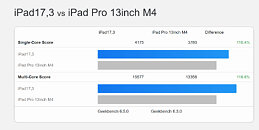
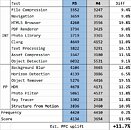
Apple's M-series of SoCs continues with generational performance improvements, and the upcoming M5 SoC will be no exception. A Russian YouTuber Wylsacom obtained an unreleased iPad Pro based on the M5 SoC and published benchmark data for it. As a reminder, the same source correctly previewed last year's M4 MacBook Pro. The early numbers suggest that Apple's next-generation tablet silicon focuses more on graphics than on a raw CPU jump. A single-core CPU IPC performance improves by roughly 12% relative to frequency, and multi-core performance improves by approximately 15% over the standard M4 in iPad Pro. Meanwhile, GPU performance shows significantly larger gains in some tests, reaching as much as 35% in graphics workloads. That kind of uplift won't transform every task, but it could deliver noticeably smoother frame rates in games and more sophisticated visual effects in creative apps.

Given Apple's habit of carrying phone-class architecture into its M-series chips, the M5's strengths align with improvements first seen in the family's A-class parts, where advances in neural and graphics subsystems have increasingly been used to augment traditional rendering pipelines. Digging into the sample that surfaced, the leaked iPad Pro is listed as a 256 GB model with 12 GB of RAM, which is a step up from last year's comparable 8 GB configuration. It is reasonable to expect Apple to reserve 16 GB or higher for larger storage tiers as it has in past launches. If the M5 really pairs modest CPU boosts with a substantial GPU jump, the benefits would extend beyond the iPad form factor, with thinner MacBook Air and Pro models that receive the chip also seeing improved CPU and GPU data scores, thanks to bigger cooling capacity. Especially with active cooling, Apple could push these chips way past this point, and again claim the performance crown.
Sources: @lafaiel on X, Geekbench v6
Add your own comment

41 Comments on Apple M5 SoC Brings 35% GPU Gain and 10-15% CPU Boost vs. M4

#1
sudothelinuxwizard
I'm calling it now: The new Macs will have 24GB RAM and 512GB SSD (or at the very minimum 512GB SSD) to start. That is based on the 50% increase in RAM on this iPad and the storage bump on the new iPhones.
Posted on Reply
#2
Event Horizon
The M series ipads have been great in terms of hardware. The Software was good until ipados 26 reared its ugly head. Now I'll wait and see what they do next on that front.
Posted on Reply
#3
Onasi
“A Russian YouTuber” is a bit downplaying things. I mean, yeah. It’s Wylsacom. He is absolutely trustworthy - one of the biggest and most influential RU segment tech guys. His numbers are reliable and he routinely gets his hands on stuff like this.
Posted on Reply
#4
Darmok N Jalad
Those are pretty solid gains, even on the CPU front. These days, 10% is a lot of improvement in that segment.
Posted on Reply
#5
R0H1T
sudothelinuxwizardThat is based on the 50% increase in RAM on this iPad and the storage bump on the new iPhones.
Seriously doubt that, gen on gen RAM increase with Mx chips, hasn't happened in generations!
Darmok N JaladThese days, 10% is a lot of improvement in that segment.
Not really, if this was IPC it would be impressive but it also likely involves (much?) higher clock speeds.

Also they're comparing CPU numbers across different GB versions, which is at least slightly deceptive!
Posted on Reply
#6
dgianstefani
TPU Proofreader
sudothelinuxwizardI'm calling it now: The new Macs will have 24GB RAM and 512GB SSD (or at the very minimum 512GB SSD) to start. That is based on the 50% increase in RAM on this iPad and the storage bump on the new iPhones.
I doubt it tbh, maybe for the pro chips, not the base M5.
Posted on Reply
#7
sudothelinuxwizard
dgianstefaniI doubt it tbh, maybe for the pro chips, not the base M5.
I mean, they already did that with the M4.
R0H1TSeriously doubt that, gen on gen RAM increase with Mx chips, hasn't happened in generations!
Im aware, but they also didn't have AI garbage they needed to power back then...

SSD upgrade is almost certainty gonna happen though
Posted on Reply
#8
R0H1T
sudothelinuxwizardI mean, they already did that with the M4.


Im aware, but they also didn't have AI garbage they needed to power back then...

SSD upgrade is almost certainty gonna happen though
Once, with a measly 8GB increase, I mean that's the only instance & probably just because they had "some" competition from QC & a lot from AMD/Intel especially with "battery" life this gen.

It's also ironic that base M3 had less RAM than flagship Android phones which came with up to 24GB on some models.
Posted on Reply
#9
Octavean
I would have waited for the new iPad Pro with M5 chip since it was fairly apparent that it was on the horizon. However, the possible threat of tariffs jacking impacting prices I opted to buy the M4 iPad Pro 13". My previous iPad was the 2018 iPad Pro 12.5" which IMO still holds its own,
Posted on Reply
#10
Philaphlous
Heck the M1 iPad that I've got does just fine...feels speedier than my Ryzen 9 4900hs laptop with like 40 less watts....
Posted on Reply
#11
DeathtoGnomes
Darmok N JaladThose are pretty solid gains, even on the CPU front. These days, 10% is a lot of improvement in that segment.
You're used to seeing intel generational single digit gains, this is apple not intel.
Posted on Reply
#12
LastDudeALive
DeathtoGnomesYou're used to seeing intel generational single digit gains, this is apple not intel.
TBF, a significant potion of Apple's gains come from being TSMC's VIP customer and getting first access to the latest node. M5 is on 2nm, which undoubtedly provides a significant portion of the performance improvements. And Intel's "generational single digit gains" come from when they were stuck on the same process for generations.

Not downplaying Apple's engineering team, they've done an incredible job. But the architecture is just one part of the puzzle.
Posted on Reply
#13
qcmadness
LastDudeALiveTBF, a significant potion of Apple's gains come from being TSMC's VIP customer and getting first access to the latest node. M5 is on 2nm, which undoubtedly provides a significant portion of the performance improvements. And Intel's "generational single digit gains" come from when they were stuck on the same process for generations.

Not downplaying Apple's engineering team, they've done an incredible job. But the architecture is just one part of the puzzle.
Probably N3E / N3P but not N2.
Posted on Reply
#14
RUSerious
LastDudeALiveM5 is on 2nm
TSMC N3 node, not sure which one. M6, supposedly, will be 2N.
Posted on Reply
#15
R0H1T
LastDudeALiveAnd Intel's "generational single digit gains" come from when they were stuck on the same process for generations.
They had zero IPC gains when they were stuck on 14nm, from 6th till "10th" gen chips went out. Ok technically have some(?) IPC increase with more cache as they increased core counts incrementally & clock speeds maniacally!
Posted on Reply
#16
dgianstefani
TPU Proofreader
DeathtoGnomesYou're used to seeing intel generational single digit gains, this is apple not intel.
I'll remind you of Zen 5%
PhilaphlousHeck the M1 iPad that I've got does just fine...feels speedier than my Ryzen 9 4900hs laptop with like 40 less watts....
M1 was such a generational leap.
Posted on Reply
#17
qcmadness
dgianstefaniI'll remind you of Zen 5%


M1 was such a generational leap.
Which Zen generation has got less than 10% of performance increase?

From what I know, there have been 10-15+% single thread performance increase from Zen 1 to Zen 5.
Posted on Reply
#18
Onasi
qcmadnessWhich Zen generation has got less than 10% of performance increase?
There is a reason for that Zen 5% joke. Pound for pound, as it was released, for desktop applications under Windows it was around 5% faster (I am going for the single fully enabled chiplet 7700X vs 9700X here). Now, later with a released extended TDP it became a bit faster and it was ALWAYS quite a bit better under Linux for enterprise applications, but as far as consumer segment goes Zen 5 was quite meh.
Posted on Reply
#19
Darmok N Jalad
LastDudeALiveTBF, a significant potion of Apple's gains come from being TSMC's VIP customer and getting first access to the latest node. M5 is on 2nm, which undoubtedly provides a significant portion of the performance improvements. And Intel's "generational single digit gains" come from when they were stuck on the same process for generations.

Not downplaying Apple's engineering team, they've done an incredible job. But the architecture is just one part of the puzzle.
This still requires really good execution, because there are real risks in going with the latest and greatest node. And even then, Apple still needs to show performance gains every generation. They certainly have a theoretical advantage with the latest node, which they largely appear to use to hold power consumption in check with every generation.
Posted on Reply
#20
Simon.J
OnasiThere is a reason for that Zen 5% joke. Pound for pound, as it was released, for desktop applications under Windows it was around 5% faster (I am going for the single fully enabled chiplet 7700X vs 9700X here). Now, later with a released extended TDP it became a bit faster and it was ALWAYS quite a bit better under Linux for enterprise applications, but as far as consumer segment goes Zen 5 was quite meh.
Well, I believe there’s more than some useless benchmarks, in this video you can see how industry plays this game of benchmarks especially with last one called “antutu”, another question is about sustainable performance which nobody talks about, back to x86 legacy I believe things will change with implementation of Intel APX (Advanced Performance Extensions) in consumer CPU/SoC.
Posted on Reply
#21
TheinsanegamerN
If only Apple would support Vulkan.....

Of course Rosetta 2 is getting binned so I guess it wouldnt make any sense either way.
Posted on Reply
#22
Unregistered
Simon.JI believe things will change with implementation of Intel APX (Advanced Performance Extensions) in consumer CPU/SoC.
I'm not sure either, but to be honest I feel like Intel will disappear before any APX implementation (P.S: Maybe I'm wrong, but for now the things for Intel seems to be very bad).
#23
sudothelinuxwizard
qcmadnessProbably N3E / N3P but not N2.
Given it's being released after A19 which is on N3P, there is pretty much no way it's not on N3P.
Posted on Reply
#24
Verpal
IntelJustDieI'm not sure either, but to be honest I feel like Intel will disappear before any APX implementation (P.S: Maybe I'm wrong, but for now the things for Intel seems to be very bad).
I am inclined to believe US administration will try its best to keep Intel alive, pretty sure this is a bipartisan thing, just minor difference in exactly how and some lip service.
Posted on Reply
#25
DeathtoGnomes
dgianstefaniI'll remind you of Zen 5%
ill remind you of the time before Ryzen.
Posted on Reply
Add your own comment
Nov 22nd, 2026 17:44 CST change timezone

New Forum Posts

Popular Reviews

TPU on YouTube

Controversial News Posts