News Posts matching #R9700

Return to Keyword Browsing

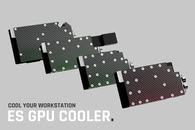
Alphacool Launches ES 1-Slot GPU Cooler for Blackwell and Radeon AI PRO GPUs

Alphacool International GmbH, based in Braunschweig, Germany, is a pioneer in the field of PC water-cooling technology. With one of the most comprehensive product portfolios in the industry and more than 20 years of experience, Alphacool is expanding its professional GPU cooling lineup with new high-performance water coolers designed for NVIDIA RTX PRO Blackwell and AMD Radeon AI PRO graphics cards.

The new ES GPU coolers are available for the NVIDIA RTX PRO 4000 Blackwell, RTX PRO 4500 Blackwell, RTX PRO 6000 Blackwell, and AMD Radeon AI PRO R9700.

Cooler Master Unveils New Custom Water Cooling Hardware for Workstation PCs

Cooler Master has been on a roll at Computex 2026, showing off a host of new air cooling and case hardware, but the hardware company has also debuted some interesting water cooling options that it plans to both sell as standalone hardware and in new pre-built workstation PCs. The new cooling line-up consists of both a CPU and GPU water block designed for workstation CPUs and a 360 × 360 mm radiator that Cooler Master calls the 360² Radiator, with accompanying 180 mm fans. The new liquid cooling system is allegedly capable of cooling up to 2,000 W of thermal load. The new radiator and CPU water block come with new Y-shaped hoses, which disperse liquid through the radiator. The example Cooler Master had at Computex had hot water entering two inlets in the center of the radiator and two outlets on opposite ends of the same edge of the radiator. Alternatively, it looks as though the cooling can be routed so that the CPU and GPU inlets and outlets are on opposite sides of the radiator. The radiator was also mounted in a separate chamber behind the motherboard tray, which appears to be basically the only feasible option, given its size.

At Computex, Cooler Master showed off an early prototype of what it is calling the MasterWorkStation: Project MasterFrame 800, a pre-built PC built around its aluminium MasterFrame 800 PC case. The exact specs of the workstation PC are being kept under wraps, but it was clear to see that the PC contained four ASRock AMD Radeon AI Pro R9700 GPUs and what looks to be an ASRock WRX90 WS EVO DDR5 motherboard, which means it will support AMD's latest Threadripper Pro 9000 and 7000 WX-series processors, up to eight DDR5 DIMMs, seven PCIe 5.0 ×16 expansion cards, SlimSAS SFF-8654 SSDs, and 10 Gb networking. ASRock is pitching the new MasterWorkStation workstations as a powerful option for everything from AI training to data processing, creative work, and general compute-heavy workloads. It remains to be seen when these workstations will launch or at what price point.

AMD Sees Agent Computers as the Next Step in AI PCs

AMD has published a guide for running OpenClaw locally on Windows through two distinct hardware paths it calls "RyzenClaw" and "RadeonClaw," both built around its own silicon and designed to keep AI agent workloads off the cloud entirely. The push is part of AMD's broader "Agent Computer" narrative, where it argues that not every AI workload belongs in a data center, people and businesses want control over their data, affordable always-on AI without usage limits, and the confidence that their models are running locally rather than on someone else's infrastructure. The setup runs through WSL2 with LM Studio handling local LLM inference via llama.cpp, and supports Memory.md through local embeddings, no cloud dependency required. AMD says the environment can be configured in under an hour, targeting early adopters and developers experimenting with personal AI agents.

The RyzenClaw path is built around a Ryzen AI Max+ system with 128 GB of unified memory, AMD specifically recommends reserving 96 GB as variable graphics memory for this use case. Running the Qwen 3.5 35B A3B model, that configuration delivers around 45 tokens per second, processes 10,000 input tokens in roughly 19.5 seconds, supports a 260K token context window, and can run up to six agents concurrently. AMD is positioning this as capable of "agent swarm" experimentation on consumer hardware. RadeonClaw takes a different approach, pairing OpenClaw with the Radeon AI PRO R9700, a workstation-class card with 32 GB of VRAM. That setup is considerably faster, around 120 tokens per second with the same model, and 10,000 input tokens processed in about 4.4 seconds. The tradeoff is a smaller 190K token context window and support for only two concurrent agents, compared to six on the Ryzen AI Max+ path.

Vastarmor Reveals "Custom" Radeon AI PRO R9700 32 GB Graphics Card

Vastarmor's Chinese website has been updated with a new workstation-grade graphics card model. This new addition seems to signal the AMD board partner's debut in the field of producing dedicated professional graphic solutions. The company is better known for its well-populated gaming product range, utilizing several generations of Team Red Radeon GPU tech. At CES 2026, TechPowerUp enjoyed sneak peeking a pleasingly low-profile prototype Radeon RX 9060 XT card at the Minisforum booth. Up until the start of this year, Vastarmor has deployed AMD's Navi 48 GPU die in flagship Super Alloy and regular Alloy Radeon RX 9070 XT SKUs. This supply relationship has expanded into Navi 48 XTW territories, as demonstrated by the manufacturer's fresh listing of a custom Radeon AI PRO R9700 32 GB model.

Somewhat disappointingly, the Chinese AIB has not deviated much from Team Red's official reference design. Visually, Vastarmor's largely faithful interpretation distinguishes itself by adding company logos/branding onto the shroud, backplate, and the blower fan's face. When compared to a slightly older low effort PowerColor rendition, Vastarmor's "customization" goes the extra mile. According to Vastarmor's spec sheet (translated from Mandarin), this new product adheres to AMD's reference levels. No details regarding pricing or regional availability are present on the company's product page. Last October, Team Red's official Radeon AI PRO R9700 reveal set an MSRP of $1299. The ongoing computer memory crisis will likely drive up costs across consumer and professional markets. Workstation cards, that pack 32 GB of GDDR6 or GDDR7 VRAM, are expected to become increasingly expensive prospects.

AMD Unveils Radeon AI PRO R9700S and R9600D GPUs

AMD has officially expanded its Radeon AI PRO R9000 workstation lineup with two new Navi 48-based cards built on the RDNA 4 architecture. The two models are the Radeon AI PRO R9700S and the Radeon AI PRO R9600D. Both models feature 32 GB of GDDR6 memory on a 256-bit interface, delivering a peak memory bandwidth of 640 GB/s. These additions offer a consistent hardware platform for professional customers who require larger frame buffer sizes for compute and visualization tasks.

The Radeon AI PRO R9700S maintains the full Navi 48 configuration with 64 CUs and 4,096 SPs. AMD rates the card at up to 47.8 TeraFLOPS of FP32 performance when the boost clock reaches 2,920 MHz, with a total board power of 300 W. The Radeon AI PRO R9600D, on the other hand, reduces the Navi 48 configuration to 48 active CUs and 3,072 SPs, offering approximately 24.8 TeraFLOPS of FP32 throughput at a boost clock of 2,020 MHz, while targeting a lower 150 W board power.

ASRock Prepares Workstation with Four AMD Radeon AI PRO R9700 Creator GPUs

ASRock is looking to enter the workstation business and capture the lucrative demand for local AI acceleration with its new product lineup. Called GAI4G-R9700, the 4U workstation is a rack-mount or standalone desktop solution that pairs AMD Ryzen Threadripper 9000 series CPUs with four Radeon AI PRO R9700 Creator GPUs. This gives the system a total VRAM capacity of 128 GB from the GPUs alone, which is 32 GB per GPU. For additional capacity, the system can utilize the 2 TB DDR5 capacity housed on the ASRock WRX90 WS EVO motherboard with horizontal CPU and memory placement.

Since ASRock doesn't manufacture CPUs and memory, the company will likely bundle the workstation with four GPUs, leaving users to acquire their own CPU and memory. This is especially tricky to figure out as the massive memory demand could impact final workstation pricing far more than anything else, especially in larger quantities such as 512+ GB. The system supports eight ECC RDIMMs running at 6400 MT/s, in eight-channel configuration (1DPC). The whole system is powered by a single 80 Plus Platinum 2500 W ATX 3.1 power supply.

AMD Plans to Release Radeon AI Pro R9700S and R9600D Graphics Cards

AMD is preparing two new professional GPUs: Radeon AI Pro R9700S and Radeon AI Pro R9600D, built off the Radeon AI Pro R9700 that launched on October 27. References to the R9600D recently appeared in AMD's 25.30.1 Linux driver, and reports suggest both cards are planned for announcement around CES 2026. The R9700S is described as a server-focused variant of the standard R9700. Instead of the blower cooler used on the original model, the R9700S is expected to switch to passive cooling for use in data-center systems that rely on chassis airflow. The R9600D is positioned as a cut-down version of the same GPU, similar in naming strategy to AMD's earlier Pro W7900D.

Since both cards are rumored to be based on the existing R9700, their general configuration should be similar. The R9700 uses a 4 nm Navi 48 GPU with 64 RDNA 4 compute units, totaling 4,096 stream processors and 128 AI accelerators. It ships with 32 GB of 20 Gbps GDDR6 on a 256-bit interface for 640 GB/s of bandwidth, backed by 64 MB of 3rd-generation Infinity Cache. AMD rates the card at up to 191 TFLOPS of FP16 dense compute or 1531 TOPS of INT4 performance, with a 300 W power target. The R9700 launched as a dual-slot, blower-style card designed for multi-GPU inference systems. The upcoming R9700S and R9600D would expand this lineup, offering a passive server option and a lower-tier configuration built from the same RDNA 4 foundation.

AMD Radeon AI PRO R9700 GPU Arrives October 27 at $1,299 for Retail

AMD has finally set the retailer date and the price tag for its professional Radeon AI PRO 9000 series graphics cards, suitable for tasks like professional visualization or workstations that can accommodate up to four cards. Set to launch on October 27 for retailers, the flagship Radeon AI PRO R9700 will arrive at $1,299. Previously, AMD focused solely on the OEM and system integrator segment, leaving retailers and individuals building their own workstations for AI and professional visualization workloads without options. The company aimed to launch this GPU for retailers by the end of July, but supply constraints prevented this, as OEMs and system integrators consumed the entire supply.

These Radeon AI PRO R9700 GPU features a 4 nm "Navi 48" GPU, equipped with 64 RDNA 4 compute units, providing 4,096 stream processors and 128 AI accelerators for enhanced matrix operations across various data formats. A key improvement over the RX 9070 XT gaming GPU is the increased memory capacity, now doubled to 32 GB. The memory subsystem includes 20 Gbps GDDR6 across a 256-bit wide interface, delivering 640 GB/s of memory bandwidth, supported by a 64 MB 3rd Gen Infinity Cache. The AMD Radeon AI PRO R9700 achieves up to 191 TeraFLOPS FP16 dense performance and up to 1531 TOPS INT4 sparse performance, all within a power footprint of up to 300 W. The card is packed in dual-slot design with blower-style cooler, so dense multi-GPU configurations can be easily achieved.

ASUS Announces Turbo Radeon AI Pro R9700 32GB Graphics Card

ASUS today announced the Turbo Radeon AI Pro R9700 32 GB graphics card, designed for AI developers and other professionals who seek efficient cooling, compact design, and reliability for their high-performance workstations. It empowers users to run large memory-intensive AI models locally, and its two-slot profile—cooled by a blower-style system—makes it ideal for multi-GPU setups and space-constrained cases.

Advanced cooling system
The blower-style fan generates high static pressure and is paired with a diecast metal shroud and backplate to help ensure efficient heat dissipation. This design expels most heat directly out of the case, which helps to keep system temperatures stable so consistently high performance can be maintained even under the most demanding AI workloads. The diecast backplate also features unique wave patterns and folds that can reduce memory temperature by up to 16%—a significant improvement over traditional designs. Meanwhile, the phase-change GPU thermal pad liquifies to fill in any gaps between the die and the heatsink, providing excellent heat transfer and more durable material than regular thermal paste.
Return to Keyword Browsing
Nov 11th, 2026 03:42 CST change timezone

New Forum Posts

Popular Reviews

TPU on YouTube

Controversial News Posts