News Posts matching #RTX 5070 Ti

Return to Keyword Browsing

NVIDIA's Latest 576.02 WHQL Driver Add Up to 8% Performance Bump in Synthetic Benchmarks

NVIDIA's latest GeForce 576.02 WHQL driver, released on April 16, which brought support for the GeForce RTX 5060 Ti, appears to deliver unexpected performance gains for several "Blackwell" GeForce RTX 50 series GPUS in UL's 3DMark Steel Nomad benchmark. ComputerBase community users with RTX 5070, 5070 Ti, and 5080 GPUs reported three to eight percent score uplifts after upgrading, prompting ComputerBase to verify these claims under controlled conditions. Their independent testing confirms that the RTX 5080 jumps from 8,094 to 8,550 points (a 5.6 percent boost), the RTX 5070 Ti climbs from 6,463 to 6,932 points (7.3 percent), and the RTX 5070 improves from 4,838 to 5,242 points (8.4 percent).

By contrast, the flagship RTX 5090 sees only a marginal lift from 14,032 to 14,117 points, which is well within standard test variance, while the RTX 5060 Ti remains essentially unchanged at roughly 3,530 points, likely because it launched with an up-to-date driver. When evaluating other popular UL benchmarks, namely Speed Way and Time Spy, ComputerBase observed no measurable uplift from driver version 576.02. In fact, some Time Spy runs dipped slightly, underlining that the anomaly appears confined to Steel Nomad's specific workload. It's important to note that synthetic benchmarks do not always translate directly to in-game performance. Historical data from ComputerBase's GPU suite suggests Blackwell cards sometimes outperform their synthetic gains in actual titles, but results vary by engine and title. Besides RTX 5060 Ti support and a strange performance increase, the 576.02 WHQL fixes a host of game-specific crashes, stutters, aliasing, and stability issues across titles like Fortnite, Overwatch 2, Hellblade II, Control, and more.


Acer Debuts Nitro Gaming PCs Featuring Latest NVIDIA GeForce RTX 50 Series GPUs

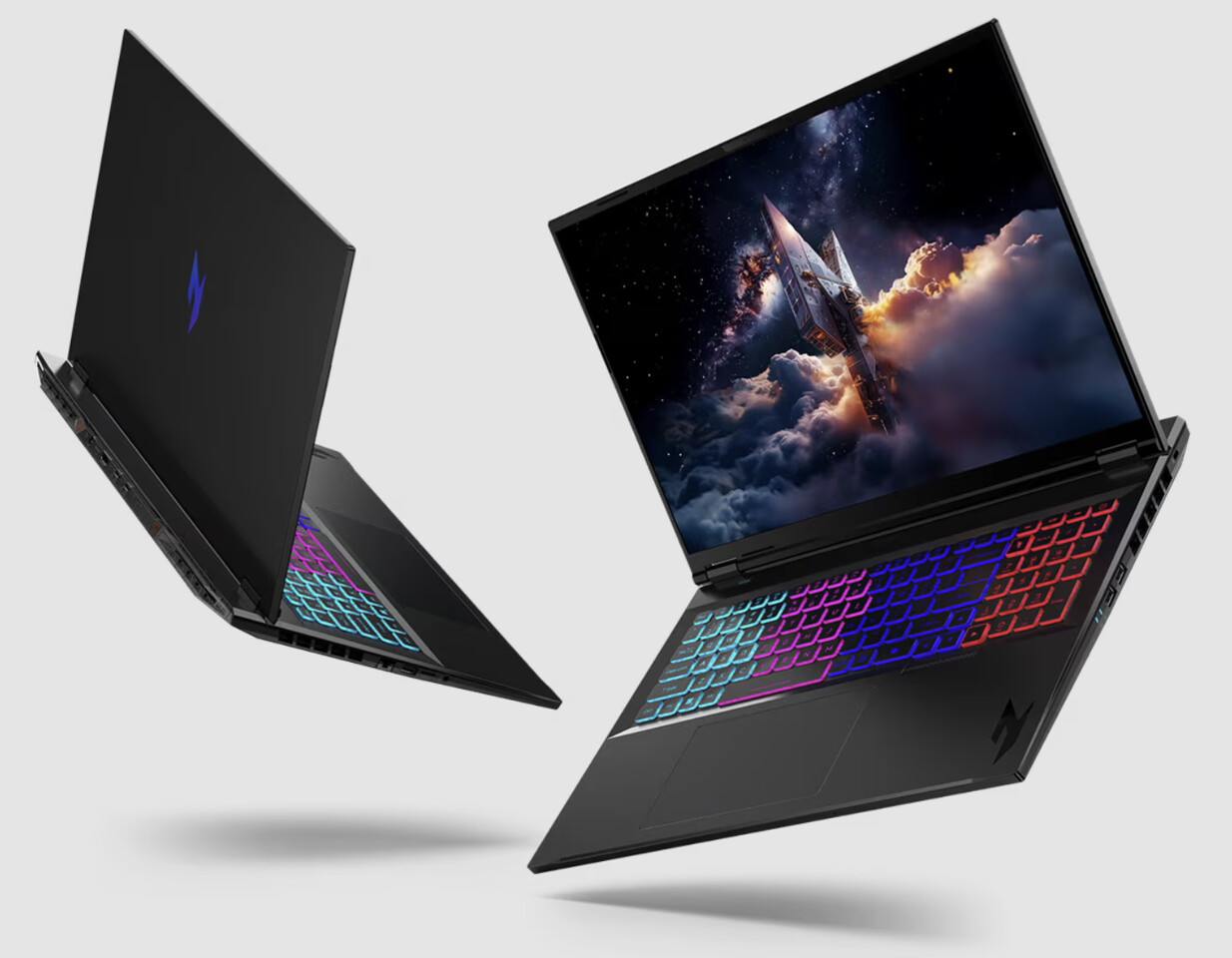
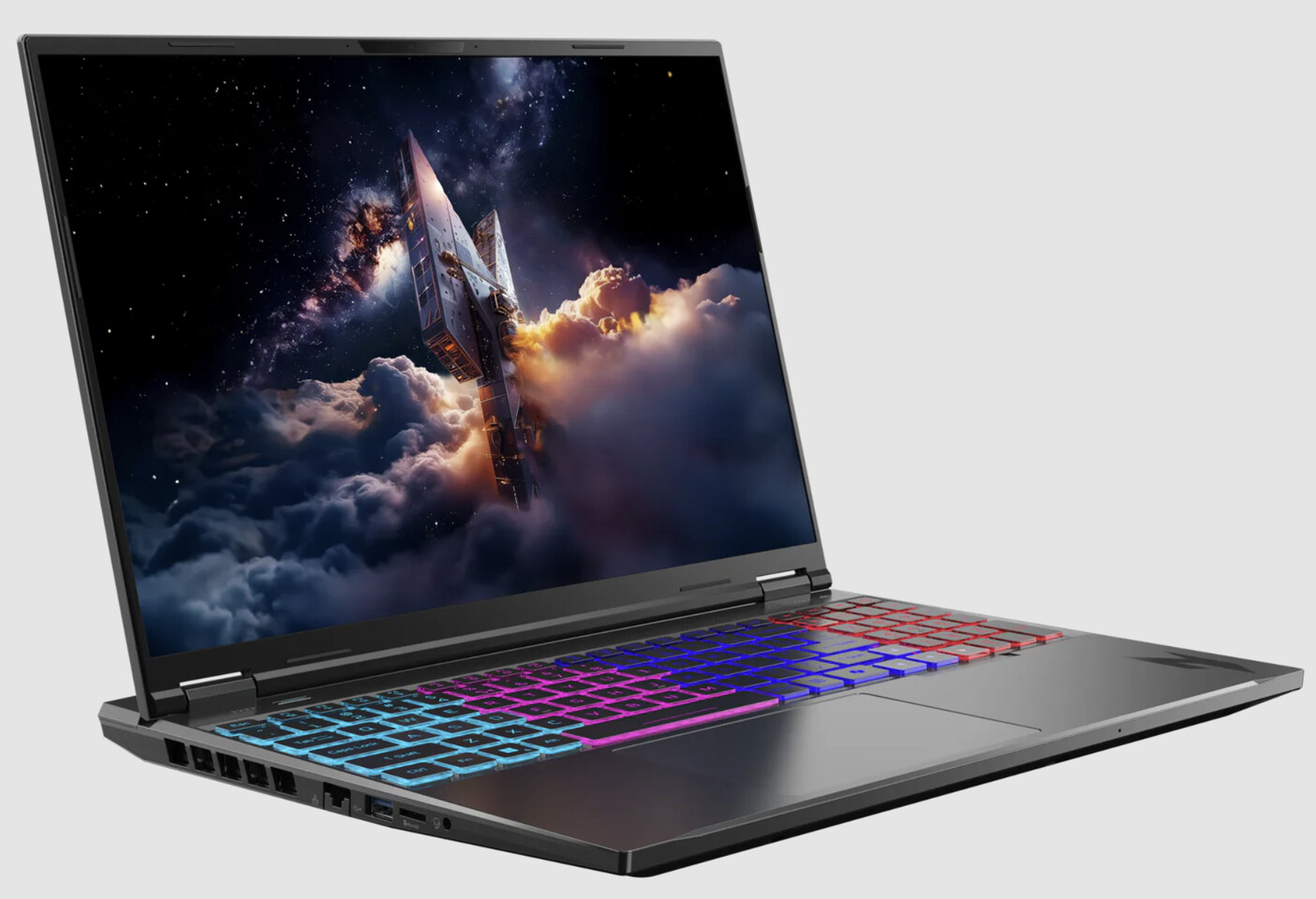
Acer today announced the expansion of its mainstream Nitro gaming line with the launch of the new Acer Nitro AI laptops and the Nitro 20 desktop. The Nitro range brings a full-package gaming experience and great value for gamers and content creators, combining robust processing power, essential computing features, and more without breaking the bank. The addition of slim laptops and a compact Windows PC option also support users with limited space for their gaming set-ups.

The Nitro AI laptops are Copilot+ PCs, powered by AMD Ryzen AI 300 Series processors and equipped with the game-changing NVIDIA GeForce RTX 50 Series Laptop GPUs to make more powerful AI rendering capabilities more accessible. The Nitro 20 desktop also utilizes AI processors and up to an NVIDIA GeForce RTX 5060 GPU, focusing on better energy efficiency with a smaller footprint.

ZOTAC Launches GeForce RTX 5080 & 5070 Ti Apocalypse Models in China

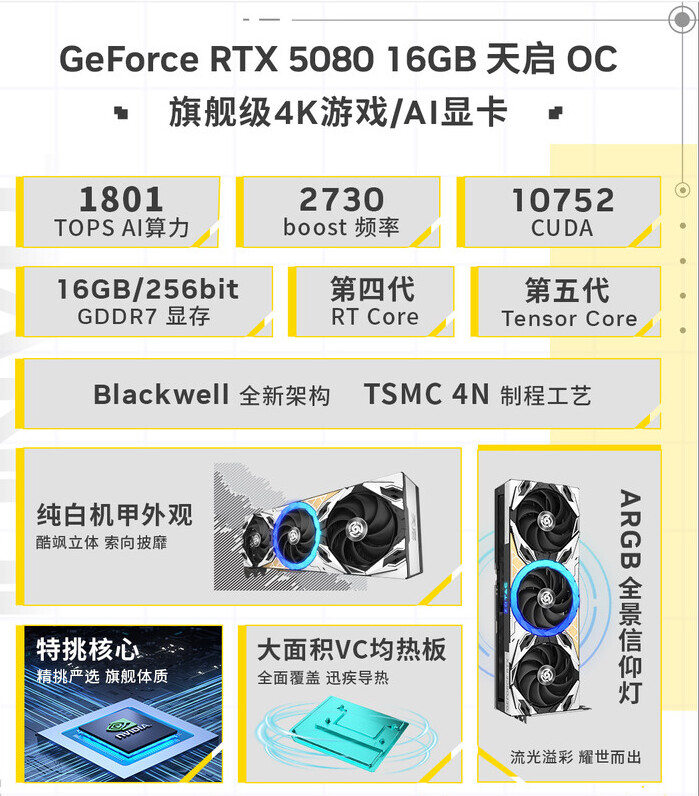
ZOTAC started teasing a refresh of its Apocalypse product line earlier in the year. Two months later, fairly concrete details of the (still) upcoming GeForce RTX 5080 16 GB variant emerged via the NVIDIA board partner's Weibo blog. Unfortunately, ZOTAC's ultra premium 3.5-slot thick/ARGB-lit behemoth design is expected to remain exclusive to the Chinese PC hardware market. Western hardcore gaming enthusiasts are best served by the manufacturer's alternative flagship triple-slotter: GeForce RTX 5080 AMP Extreme INFINITY ULTRA. ZOTAC's mainland China and Hong Kong offices have declared the arrival of brand-new Apocalypse SKUs at retail; utilizing NVIDIA's "Blackwell" GeForce RTX 5080 and RTX 5070 Ti GPUs.

Yesterday's Weibo bulletin commenced with: "when mecha aesthetics collide with technology, and gaming passion merges with extreme performance, the ZOTAC GeForce RTX 50 Apocalypse series graphics cards are born! After (our) continuous R&D, improvement, testing and adjustment—today, newly upgraded flagship graphics cards are officially launched!" The brand has advertised the return of an apparently much-missed product line mascot: "Apocalypse Princess is back with a new look, starting a game/AI exploration journey with you." Promotional imagery and box art feature a prominent illustration of ZOTAC's flagship series heroine—this "mecha artwork" demonstrates a serious sci-fi aesthetic, albeit with a cute female protagonist leading the way. A rival AIB specializes in this type of "marketing"—Yeston's similar-ish presentation language concentrates on enchanting fantasy characters.

Yeston Launches GeForce RTX 50 Deluxe Graphics Card Range, No "Waifu" Content Included

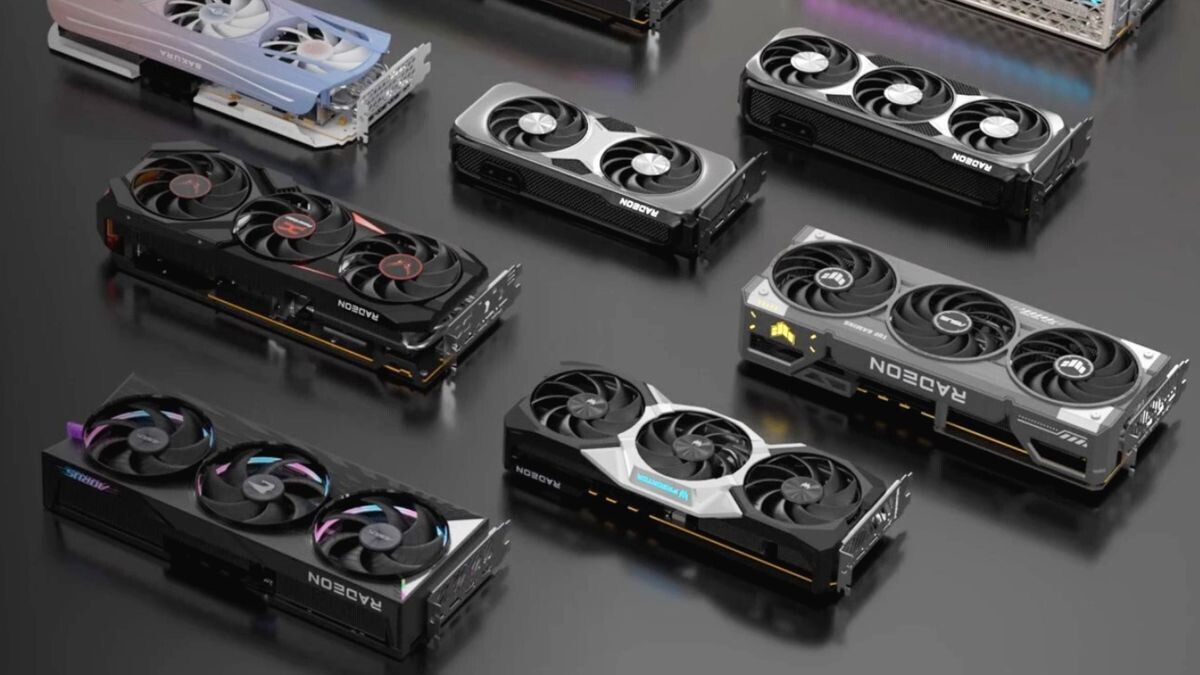
Over the past couple of months, Yeston has attracted plenty of media attention—in particular, with its recently launched Sakura Atlantis card design. The Chinese manufacturer produces custom AMD and NVIDIA gaming graphics cards—for its native market—but their unique Radeon RX 9070 Series offerings have made the most noise around the globe. Yeston did unveil GeForce RTX 50 Series Sakura and Game Ace designs around mid-January, but this announcement did not describe the exact nature of upcoming SKUs. As reported by VideoCardz earlier today, the company has distributed "new" GeForce RTX 5080, RTX 5070 Ti, and RTX 5070 models in China—e-tail listings have appeared on JD.com. Their rollout of rather sober looking affairs will disappoint many "waifu" illustration and bright color palette enthusiasts.

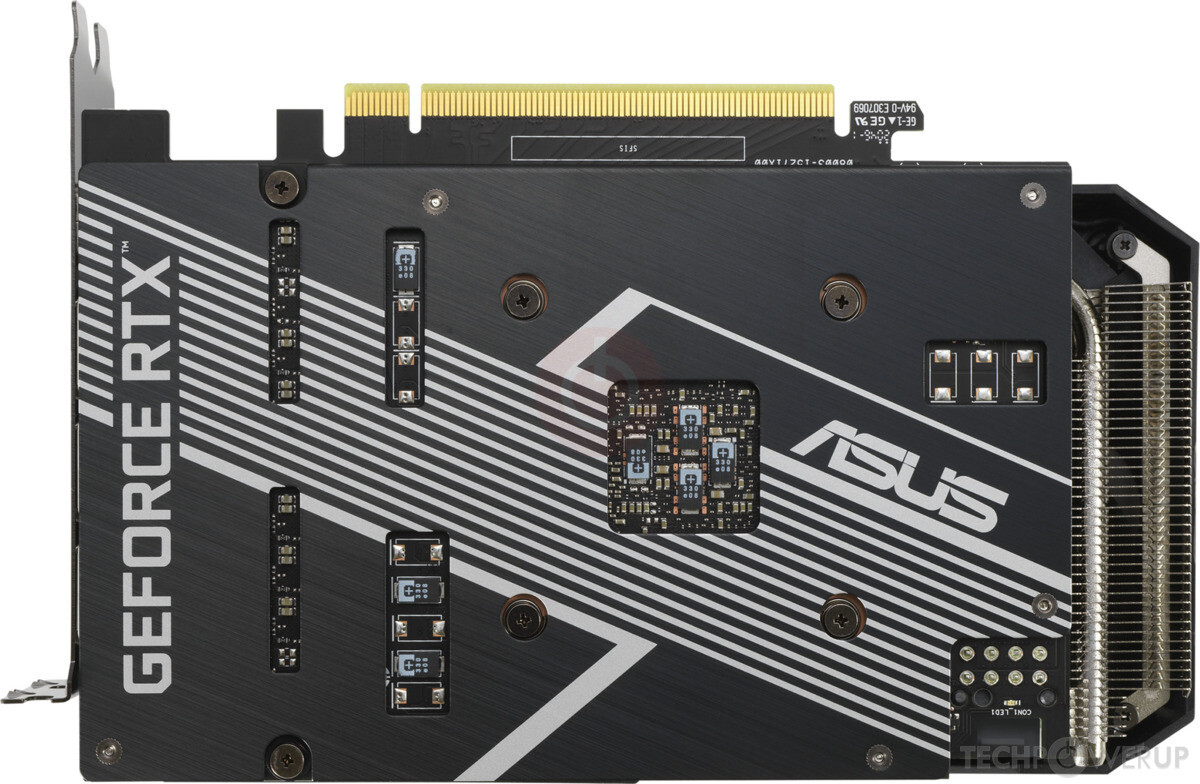
Yeston's Deluxe lineup was swiftly identified as a somewhat lazy rebadging of Gainward's GeForce RTX 50 Series Phoenix design. TechPowerUp's W1zzard reviewed the latter's GeForce RTX 5080 Phoenix GS model, just over two months ago. VideoCardz noted that Yeston has a short history of rebranding Gainward products; going back to an almost identical strategy with GeForce RTX 40 "Ada Lovelace" options (Phoenix => Deluxe). Three fan stickers differentiate the board partner brands—everything else is identical; including prominent "Phoenix" text on backplates and on top-mounted ARGB lighting zones. Yeston started to tease its new-gen Deluxe lineup around mid-February; as seen on their Weibo channel. At the time, this official account asked: "is this the card you've been waiting for?" We suspect that the majority of potential customers are preparing credit cards for the purchase of more elaborate options, in the near future.

NVIDIA Confirms Verified Priority Access Program for GeForce RTX 50 Series is Alive

NVIDIA has confirmed that its Verified Priority Access (VPA) program for the GeForce RTX 50 Series remains active following its initial announcement two months ago. The program allows a limited number of US-based GeForce account holders to purchase RTX 5090 and RTX 5080 Founders Edition cards directly from the NVIDIA Marketplace. The VPA scheme was introduced three weeks after the RTX 50 Series launch to address supply shortages and high reseller prices. Initially, two months ago, users with NVIDIA Accounts created on or before January 30, 2025, at 6 AM Pacific Time, could register their interest through an online form. Invitations would have been emailed to qualifying account holders, with the first notifications scheduled for next week.

This pilot program applies only to US GeForce users and is limited to the RTX 5090, RTX 5080, and RTX 5070 Founders Edition cards. The recently released RTX 5070 Ti is not included and must be purchased through AIB partner custom designs. NVIDIA has not disclosed how many priority access slots are available or whether the program will expand internationally. All we know is that an NVIDIA representative on Reddit posted, "VPA for the GeForce RTX 50 series Founders Edition graphics cards has not ended," responding to an alleged VPA program rumor that it has ended. If the US pilot is successful, the company may consider adding more markets and product lines. Eligible users should watch their inboxes for an invitation to buy at the original MSRP.

ZOTAC Expands GeForce RTX 5070 Ti SOLID Range with "SFF-Ready" Option & OC White Edition

ZOTAC GAMING has quietly added two more models to its SOLID GeForce RTX 50-series product range. Looking back into TechPowerUp's news archive, the Hong Kong-based manufacturer's latter half of March calendar has already introduced four brand-new SKUs, with adjusted dimensions. Two weeks ago, industry watchdogs spotted a low-key rollout of "slimmer profile" SOLID CORE GeForce RTX 5080 and RTX 5070 Ti options. As discovered earlier today by VideoCardz, ZOTAC has expanded its "no frills" range—again, without the issuing of an accompaniment press release. Starting with the most confusing aspect, their report highlighted the two-slot thick "GeForce RTX 5070 Ti SOLID SFF" model. The company's "SOLID CORE" cards were recently introduced with 2.5-slot thick shrouds, but attached I/O brackets still occupied three spaces. The original "SOLID" equivalents turned up at launch with substantial 3.5-slot thick cooling solutions.

Throughout early 2025, NVIDIA and certain board partners projected plenty of ballyhoo regarding multiple GeForce RTX 50-series custom options conforming to official "SFF-Ready" standards. ZOTAC seems to be heading in that direction with its "slimmer" new product strategy. Their freshly-added GeForce RTX 5070 Ti SOLID SFF SKU is advertised as an "NVIDIA SFF-Ready GeForce Enthusiast Card," and (thankfully) features a two-slot I/O bracket. A specification sheet lists this model's height as 41.6 mm—sporting a noticeable reduction in one dimension, when compared to SOLID CORE (56 mm) and SOLID (68 mm) equivalent dimensions. When looking at ZOTAC's brand-new GeForce RTX 5070 Ti SOLID CORE OC White Edition product page, we can see that it is simply a pale redecoration of the standard SKU. The manufacturer has seemingly missed another opportunity to bung in a matching white PCB design.

ZOTAC China Launches X-Gaming GeForce RTX 5070 Ti & 5070 Models

To Western audiences, ZOTAC's X-Gaming graphics card product line is not a well known quantity—a search of TechPowerUp's news archive produces one result (from 2021). As reported by VideoCardz, X-Gaming models are only available to buy in China. Roughly two months ago, the Hong Kong-headquartered manufacturer teased four new designs based on NVIDIA's emerging GeForce RTX 50-series "Blackwell" GPUs. As mentioned during our very recent coverage of ZOTAC's GeForce RTX 5080 Apocalypse OC model, the brand introduced familiar SOLID and AMP Extreme INFINITY families. A 2025 refresh of the company's "youthful" X-Gaming series was advertised as a subversion of: "the coldness of traditional graphics card industrial design through high-saturation contrasting color splicing, modular geometric segmentation and other techniques."

Since its beginnings, X-Gaming's core design concept is described as "breaking the dimensional wall between hardware and fashion." ZOTAC's local branch has just released brand-new X-Gaming GeForce RTX 5070 Ti and RTX 5070 SKUs, in factory-overclocked and standard/reference configurations. VideoCardz believes that the GeForce RTX 5080 X-Gaming OC model launched—in China—earlier in the year. So far, all of the launched variants share the same visual theme—ZOTAC cites "inspiration" from a famous source: "the GeForce RTX 50 X-Gaming series graphics cards have a white base and large areas of contrasting colors. The front pattern design is inspired by the well-known artist Mr. Doodle (aka Sam Cox), whose iconic intensive linearism style is accurately restored on the X-Gaming: the front of the graphics card is covered with hundreds of lines, and the seemingly disordered graffiti combination creates a vibrant visual effect. Through a special printing process, the front pattern presents a unique visual effect under different light angles, further increasing the texture and layering of the card's appearance." Regional ZOTAC enthusiasts expected the GeForce RTX 5070 Ti option to borrow its "larger" sibling's robust cooling solution, but the GB203 GPU-based model makes do with a thinner shroud profile—also present on the GeForce RTX 5070 (non-Ti) X-Gaming SKU.

NVIDIA Adjusts GeForce RTX 50 Series Pricing in Europe; Slight Reduction Result of Favourable Exchange Rate

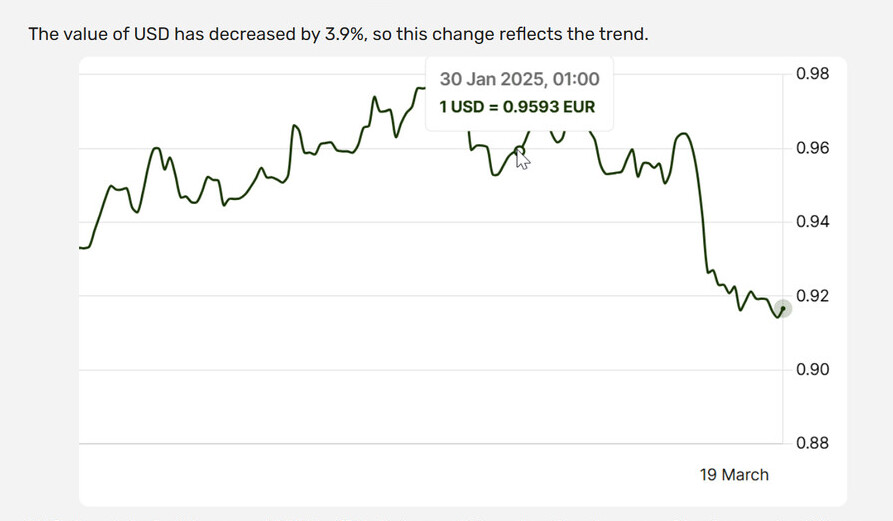
Graphics card price watchers have highlighted refreshing downward motion in Europe, apparently affecting three out of the four GeForce RTX 50 series graphics cards. VideoCardz received a couple of email tip-offs from its pan-European audience, prompting the publication of a short investigative piece. NVIDIA's slight adjustment of official pricing for GeForce RTX 5090, RTX 5080, and RTX 5070 models is the result of a strengthened Euro. The US dollar's value has dropped by roughly 3.9 %; according to recent detective work, focusing on German trends. Team Green's "generous" reductions have arrived roughly two weeks after a stabilization of the USD-EUR exchange rate.

Curiously, the GeForce RTX 5070 Ti is an outlier here—NVIDIA did not reduce its German guide price (€879 + VAT) for this upper-mid-range offer. A Founders Edition does not exist at this GPU level, so Team Green has tasked its board partners with the creation of so-called "MSRP conformant" alternatives. One of VideoCardz's tipsters has observed various GeForce RTX 50 series models simply "rotting on shelves," due to potential buyers balking at unreasonable retailer-implemented price hikes. NVIDIA's minor changes (4.3 to 4.6 %) are unlikely to make a noticeable impact across the Euro zone.

PNY Adds "Plus" Size Options to GeForce RTX 5070 Ti "Triple Fan" Lineup

PNY officially introduced its launch lineup of GeForce RTX 50-series graphics cards at CES 2025; all brand-new offerings were plainly labelled as "Triple Fan" models. Yesterday, VideoCardz alerted its readership to the emergence of "Plus" variants—all utilizing upper-mid-range NVIDIA's GeForce RTX 5070 Ti "Blackwell" GPU. In recent times, several of Team Green's board partners have stealthily added new products to web presences without any PR fanfare accompaniment. Last week, ZOTAC quietly expanded its SOLID GeForce RTX 5080 and RTX 5070 Ti product ranges with "slimmer" CORE options.

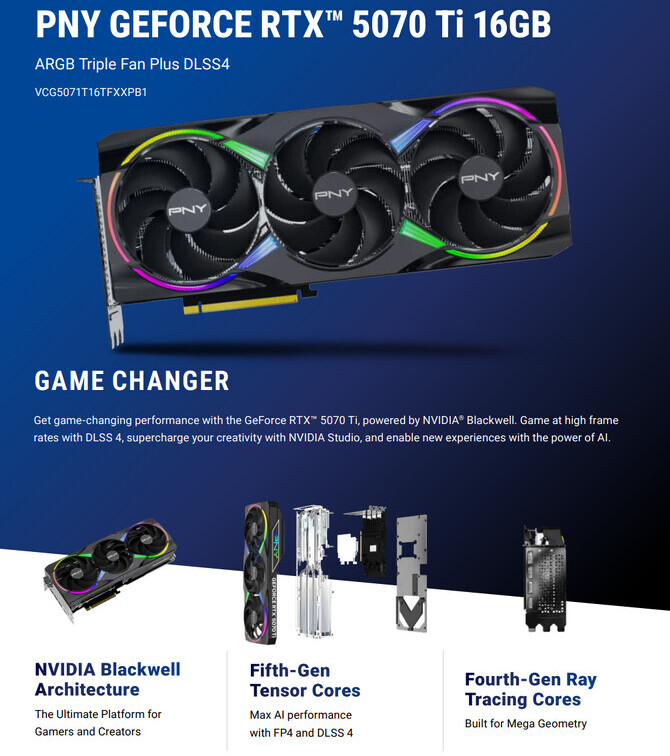
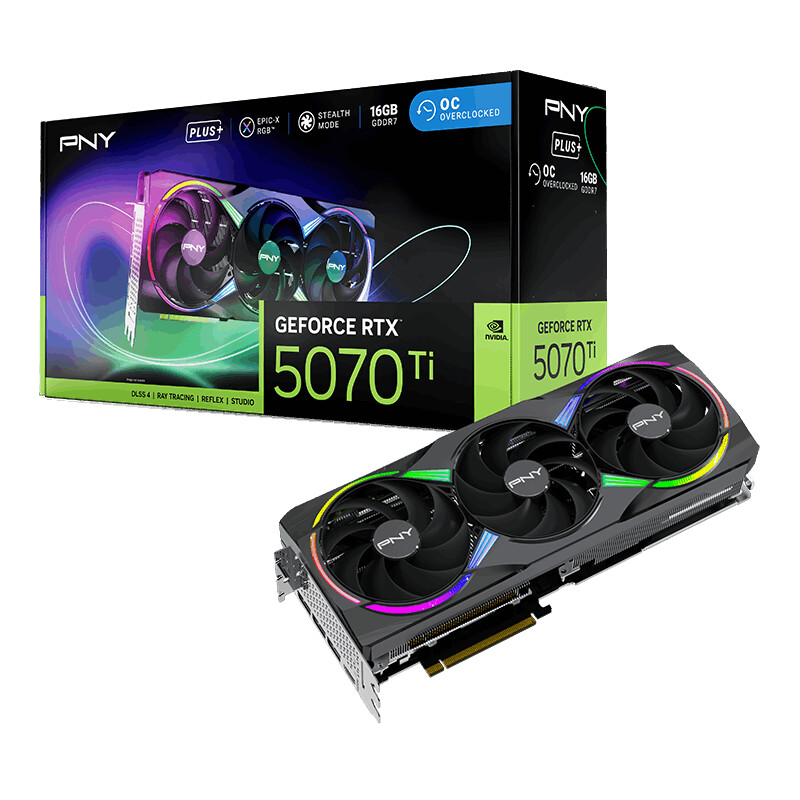
PNY's four freshest additions are dubbed "Triple Fan Plus"—quite fittingly, this updated moniker refers to larger card dimensions. Price and launch information was not available at the time of writing, but we can safely assume that their GeForce RTX 5070 Ti ARGB Triple Fan Plus OC SKU will sit at the top of the American AIB's resized pack. A non-overclocked ARGB-lit model is present on TPU's GPU database, alongside non-ARGB OC and standard variants. PNY's Triple Fan Plus shroud design is a chunky unit; VideoCardz noted growth (over vanilla variants) in two dimensions—gaining 1.7 cm in width, and roughly 3 cm in length. The already released Triple Fan housing officially occupied "2.8"-slots, but the larger "Plus" sibling is a proper 3-slot space filler. VideoCardz highlighted revised retail packaging—instead of a simple side-printed "GeForce RTX" logo, Plus boxes are adorned with a full GPU readout: "GeForce RTX 5070 Ti." The newer shroud design seems to sport shinier black accents, and wider ARGB lighting channels.

ZOTAC Goes Slimmer with "2.5-slot" SOLID CORE GeForce RTX 5080 & 5070 Ti Models

ZOTAC has quietly introduced its brand-new SOLID CORE graphics card design—four GeForce RTX 50-series models appeared on the brand's website at some point last week. An official press release was not issued alongside the fresh publication of product pages. On first inspection, the Hong Kong-based manufacturer seems to be reusing their existing SOLID shroud and backplate setup. As reported by VideoCardz, ZOTAC's engineering team has implemented a very mild shrink in one dimension. Triple-fan cooled SOLID COREs have arrived with a "slimmer profile" 2.5 slot design (56 mm/2.2 inches), albeit with an I/O bracket that still occupies three rows. The original SOLID card is a substantial 3.5-slot prospect; with its shroud's height measured at 68 mm/2.7 inches.

Specification sheets for SOLID CORE GeForce RTX 5080 and RTX 5070 Ti SKUs (standard and OC) advertise familiar feature sets—barring a difference in height, the usual SOLID provisions are present. Highlights include a vapor chamber-based "IceStorm 3.0 Advanced Cooling" solution, BladeLink Fans, 12V-2x6 Safety Light, and SPECTRA RGB Lighting. Circa-CES 2025, NVIDIA and its board partners were keenly advertising some "SFF-Ready" products, but ZOTAC's flagship and high-end "Blackwell" GB203 GPU-based models are distinct space fillers—even in 2.5-slot form. The company's GeForce RTX 5070 SOLID design exists as a proper 2-slot solution; VideoCardz believes that a variation of this shroud will be attached to upcoming GeForce RTX 5060 Ti models.

NVIDIA GeForce RTX 5050 Laptop Might Sport GDDR7 Memory, Prices Likely To Remain Sky-High

As we have witnessed in the past few weeks, leaked retailer listings are undoubtedly an interesting way to gain more information regarding upcoming hardware. A set of recent listings by the retailer PC21, as well as Acer Hong Kong, have revealed some details regarding the upcoming NVIDIA GeForce RTX 5060 Laptop and RTX 5050 Laptop GPUs. First of all, it appears that we now have concrete information regarding the launch date for the RTX 5060 laptop GPU. According to Acer, the RTX 5060 Laptop-equipped producs will start shipping sometime in May. Moreover, as the leaked listing has revealed, RTX 5060 and RTX 5050 Laptop GPUs will arrive with 8 GB of VRAM, both based on the new GDDR7 spec.

This is quite an interesting development, considering that the RTX 5050 Desktop GPU is expected to ship with GDDR6 memory, so it does appear that the Laptop variant will have superior memory speeds. Considering that the RTX 5070 laptop GPU will also boast 8 GB of GDDR7 memory, it is clear that the primary differences between the RTX 5050, RTX 5060, and RTX 5070 Laptop variants will be limited to core counts. Those who demand more than just 8 GB of VRAM will have to shell out extra for the RTX 5070 Ti Laptop, which is expected to ship with 12 GB of GDDR7 memory on a 192 bit bus. As for pricing, the leaked MSI VenturePro 16 with a Core 7 240H CPU, 16 GB DDR5 memory, 512 GB SSD and an RTX 5050 Laptop GPU is seemingly priced at €1580, or roughly $1720. Clearly, even the lowest-end of Blackwell GPUs are all set to boast price tags lofty enough to make even those with deep pockets weep.

Leadtek Reveals WinFast RTX 50-series HURRICANE Graphics Card Models

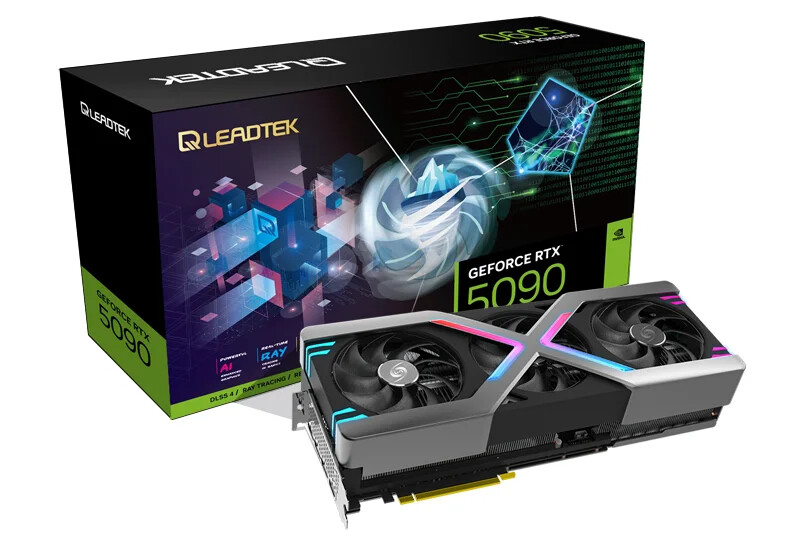
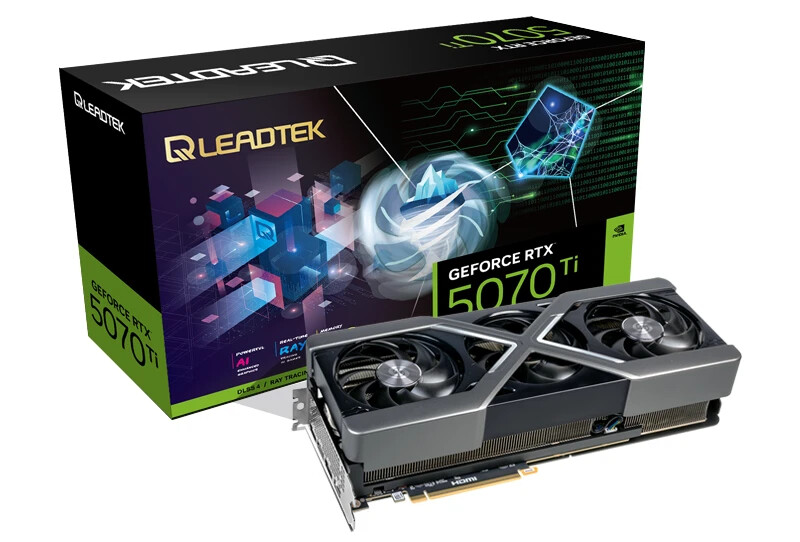
Leadtek has expanded its graphics card lineup into GeForce RTX 50-series territory, with a quiet introduction of three new generation WinFast models. We have not heard much—gaming-wise—from the Taiwanese manufacturer in recent years. Going back to Computex 2023, TechPowerUp staffers inspected several GeForce RTX 40-series offerings. Leadtek is involved in the production of NVIDIA professional graphics solutions—for data science and HPC workload purposes. Curiously, Team Green press material tends to only lightly mention its manufacturing partner's involvement. The newest WinFast entries have rolled out with "Blackwell" silicon and refreshed enclosures. As reported by VideoCardz, Leadtek has focused mainly on Asian PC gaming markets over the past decade—so the brand-new WinFast RTX 5090 HURRICANE 32G, RTX 5080 HURRICANE 16G, and RTX 5070 Ti HURRICANE 16G models are not expected to arrive on Western shores.

The 2025 WinFast HURRICANE package utilizes a triple-fan array paired with a robust heatsink design, and a "revamped" metal backplate. A total of ten heat pipes are advertised as providing strong heat dissipation—Leadtek's product description goes into more detail: "three 10 mm and seven 8 mm heat pipes, along with large aluminium fins and a vapor chamber base, quickly and efficiently dissipate heat." The three freshly introduced models all conform to NVIDIA reference specifications, so the HURRICANE cooling solution seems to be a bit over-engineered for purpose. Price details are not available at the time of writing, and an official press release is not present on Leadtek's website. The WinFast RTX 5090 HURRICANE card seems to sport a chunkier shroud, when lined up against its less powerful siblings. Leadtek has decorated its flagship with "Esports" ARGB lighting strips, while the RTX 5080 and RTX 5070 Ti variants make do with silver-ish accents instead.

NVIDIA DLSS Coming to FragPunk, Star Wars Outlaws, and More Games

More than 700 games and applications feature RTX technologies, and each week new games integrating NVIDIA DLSS, NVIDIA Reflex, and advanced ray-traced effects are released or announced, delivering the definitive PC experience for GeForce RTX players. Last week, DLSS 4 with Multi Frame Generation came to NARAKA: BLADEPOINT, and even more games launched with support for DLSS. This week, DLSS 4 with Multi Frame Generation will be available at launch in the new 5v5 shooter, FragPunk, while Star Wars Outlaws shows off DLSS 4 enhancements in a new RTX On trailer.

Additionally, Dragonkin: The Banished and Rise of the Ronin are launching with support for DLSS Frame Generation and DLSS Super Resolution. Vector Strike entered Early Access yesterday featuring DLSS frame Generation and DLSS Super Resolution. And Deadlock and Grand Theft Auto V Enhanced now boast DLSS and Reflex support on PC.

NVIDIA GeForce RTX 5070 Founders Edition GPU Available Late March, AIB Designs on March 5

We have just published our in-depth review of NVIDIA's latest GeForce RTX 5070 Founders Edition (FE) GPU, coming in at $550 MSRP. The first cohort of GeForce RTX 5070 GPUs is expected tomorrow with AIB partner designs, and NVIDIA confirmed that its special FE card will arrive a little later, in late March. While AIB designs are hitting shelves on March 5, NVIDIA's GeForce RTX 5070 FE GPU is going on shelves a few weeks later. NVIDIA's GeForce RTX 5070 arrives with a $550 MSRP--$50 cheaper than the RTX 4070's launch price—positioning it as a compelling value for its ray tracing, DLSS 4, and efficiency gains.

The 5070 comes with 6,144 cores enabled, vs 8,960 on its bigger brother, the RTX 5070 Ti. Other unit counts have been scaled accordingly, and you get 80 ROPs. Yes, we checked. Also included are 192 TMUs and 48 RT cores. The memory subsystem uses GDDR7, too, like the other RTX 50 cards, but you only get 12 GB VRAM, and it uses a 192-bit wide memory bus, clocked at 28 Gbps. While the MSRP of the FE card is known, AIB partners will price their customized designs at a 20-40% premium. We are yet to see the supply of these cards at NVIDIA's partner retail stores and the supply that NVIDIA dedicated to its AIB partners, but scalpers could drive pricing even higher if the initial supply is tight. A Swedish retailer, Inet AB, forewarned customers about the lack of stock, but this is yet to be confirmed by other stores.

Reports Point to Price Hiking of MSI GeForce RTX 5070 Ti "MSRP" Cards

Over the past weekend, PC hardware news outlets spent time analyzing NVIDIA GeForce RTX 50-series price fluctuations. One keen market watcher—VideoCardz—has consistently stuck to a main theory of Team Green AIBs implementing last minute price hikes/market manipulations; coinciding with product launch periods. Almost two weeks ago, the online publication directed ire at ASUS and MSI—noted as very high profile board partners. The current GeForce RTX 5070 Ti graphics card lineup is populated by custom designs only; a Founders Edition was not made available within this tier. VideoCardz and Hardware & Co. have observed worrying price trends with AIB-produced models that are supposed to conform to NVIDIA's baseline MSRP of $749 (USD). Their latest reports singled out MSI's North American webstore—already a source of some contention.

Hardware & Co. (a French outlet) observed movement at the bottom-end of the manufacturer's "Blackwell" GPU lineup: "in the case of the GeForce RTX 5070 Ti launched on February 20, 2025, it took nine days...for a "big" brand to officially turn its back on NVIDIA MSRP. On Saturday (March 1), MSI has just updated its RTX 50-series catalog on its official American website with new prices for the RTX 5070 Ti. From now on, the cheapest reference is $820, $70 more than MSRP." VideoCardz is steadfast in its belief that GeForce RTX 50-series "MSRPs are a joke" at this point in time. MSI's VENTUS 3X and (newer) SHADOW 3X models are barebones packages that are designed as alternatives to basic first-party solutions (i.e. Founders Editions)—but VideoCardz has accused the manufacturer of becoming its own "scalper," with (apparently) little intervention coming from NVIDIA. At the time of writing, MSI's US webstore has updated its GeForce RTX 5070 Ti VENTUS and SHADOW listings. Prices have (temporarily?) reverted to original figures (refer to the third screenshot below); likely in reaction to recent "constructive" criticism levied by popular hardware news sites. As evidenced by a sea of "notify me" tags, the official North American store appears to have zero stock in their warehouse(s).

NVIDIA GeForce RTX 50 Series Faces Compute Performance Issues Due to Dropped 32-bit Support

PassMark Software has identified the root cause behind unexpectedly low compute performance in NVIDIA's new GeForce RTX 5090, RTX 5080, and RTX 5070 Ti GPUs. The culprit: NVIDIA has silently discontinued support for 32-bit OpenCL and CUDA in its "Blackwell" architecture, causing compatibility issues with existing benchmarking tools and applications. The issue manifested when PassMark's DirectCompute benchmark returned the error code "CL_OUT_OF_RESOURCES (-5)" on RTX 5000 series cards. After investigation, developers confirmed that while the benchmark's primary application has been 64-bit for years, several compute sub-benchmarks still utilize 32-bit code that previously functioned correctly on RTX 4000 and earlier GPUs. This architectural change wasn't clearly documented by NVIDIA, whose developer website continues to display 32-bit code samples and documentation despite the removal of actual support.

The impact extends beyond benchmarking software. Applications built on legacy CUDA infrastructure, including technologies like PhysX, will experience significant performance degradation as computational tasks fall back to CPU processing rather than utilizing the GPU's parallel architecture. While this fallback mechanism allows older applications to run on the RTX 40 series and prior hardware, the RTX 5000 series handles these tasks exclusively through the CPU, resulting in substantially lower performance. PassMark is currently working to port the affected OpenCL code to 64-bit, allowing proper testing of the new GPUs' compute capabilities. However, they warn that many existing applications containing 32-bit OpenCL components may never function properly on RTX 5000 series cards without source code modifications. The benchmark developer also notes this change doesn't fully explain poor DirectX9 performance, suggesting additional architectural changes may affect legacy rendering pathways. PassMark updated its software today, but legacy benchmarks could still suffer. Below is an older benchmark run without the latest PassMark V11.1 build 1004 patches, showing just how much the newest generations suffers without a proper software support.

GALAX Rolls Out GeForce RTX 5070 Ti HOF OC LAB Deluxe Series

GALAX's Hall of Fame (HOF) graphics card family has welcomed another addition; their newest custom offerings house NVIDIA GeForce RTX 5070 Ti (GB203) GPUs. TechPowerUp's W1zzard reviewed a lower-end sibling card—GALAX's "1-Click OC White" model—that is provisioned to conform to Team Green's baseline MSRP ($750). By contrast, the freshly introduced GeForce RTX 5070 Ti HOF OC LAB Deluxe and Deluxe-X variants are expected to arrive at retail with significant premium upcharges—these are true flagships; featuring pre-binned GPU dies and high-end components. GALAX introduced its fancily-named GeForce RTX 5080 HOF OC LAB Plus-X model earlier last month, but hardcore enthusiasts will have to wait longer for an RTX 5090D-based sibling.

The GALAX GeForce RTX 5070 Ti HOF OC LAB Deluxe models are tipped to become world record breakers, due to their over-engineered makeup—prepped with a 14+6+6 phase power design. Quite fittingly, a signature (detachable) crown formation adorns several "Hall of Fame" shrouds—a similarly shaped cutout is present on HOF I/O brackets. VideoCardz believes that only two GeForce RTX 5070 Ti "Hall of Fame" SKUs will be released, instead of the expected four. Normally, GALAX introduces options that do not include their garish RGB-lit crown attachment. The publication noted a mere 30 MHz difference between Deluxe and Deluxe-X SKUs overclocked frequencies: 2580 MHz and 2610 MHz (respectively). Spec sheets reveal many shared traits; including gaming clocks of 2512 MHz, 300 W TGP (max. 350 W), and GB203 GPU. Visual analysis—of the bare HOF board—points to the utilization of Team Green's GB203-400 variant. VideoCardz reckons that the GALAX engineering team will be re-deploying the GeForce RTX 5080 HOF's PCB design, complete with 26 phase power design. The China-based AIB has not revealed price points for its two incoming GeForce RTX 5070 Ti HOF OC LAB Deluxe cards, but industry watchdogs anticipate costs going beyond $1000.

NVIDIA Opens Up Pre-orders for GeForce RTX 5090, 5080 & 5070 Ti Laptops

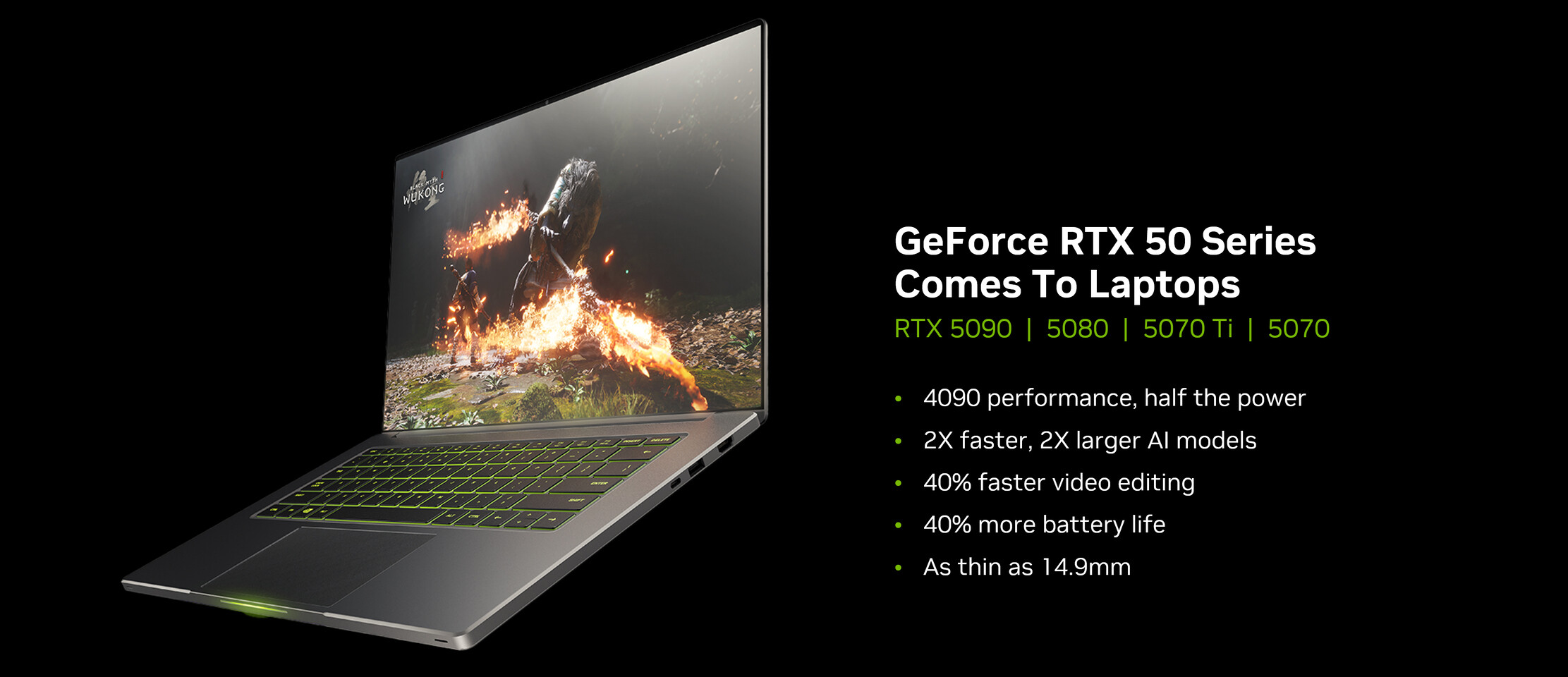
Starting now, you can pre-order GeForce RTX 5090, GeForce RTX 5080, and GeForce RTX 5070 Ti laptops ahead of their release in the coming months. Models will be available from top OEM partners including ASUS, GIGABYTE, HP, Lenovo, MECHREVO, MSI and Razer are available for pre-order now, with more coming soon. Availability will vary by country for each OEM partner and model. Powered by NVIDIA Blackwell, GeForce RTX 50 Series laptops bring game-changing capabilities to gamers and creators. Packed with incredible AI and neural rendering capabilities, GeForce RTX 50 Series Laptop GPUs enable new experiences and deliver unprecedented levels of detail in the latest, greatest games.

Multiply performance using DLSS 4 with Multi Frame Generation, generate AI content at incredible speeds, and unleash your creativity with NVIDIA Studio apps and enhancements. All in the thinnest and longest lasting RTX laptops, optimized by new Max-Q technologies. The NVIDIA Blackwell architecture, and partners' design innovations, have enabled the creation of the thinnest, most performant, and most efficient GeForce RTX laptops ever made. In laptop designs as thin as 14.9 mm, you can run AI models twice as large in half the time, encode videos 40% faster, and play the most advanced games at superfast framerates, using half the power of previous-gen laptop GPUs. And with our latest Blackwell Max-Q advancements, battery life is boosted by up to 40%, enabling you to get more done between charges.

ASUS Proposes that DUAL GeForce RTX 3060 OC Card Offers "Incredible Value" in 2025

Take a look at the Steam Hardware & Software Survey for January 2025, and you'll find no fewer than three graphics cards from the now-venerable NVIDIA GeForce GTX 10-Series lineup. We mean no offense to these battle-proven units, but we suspect that if your machine is still rocking one of these cards, you're probably looking for an upgrade. While we won't deter you from leapfrogging into next-gen territory with a GeForce RTX 50 Series card, we understand that not every gamer's budget can cover one of these chart-topping models.

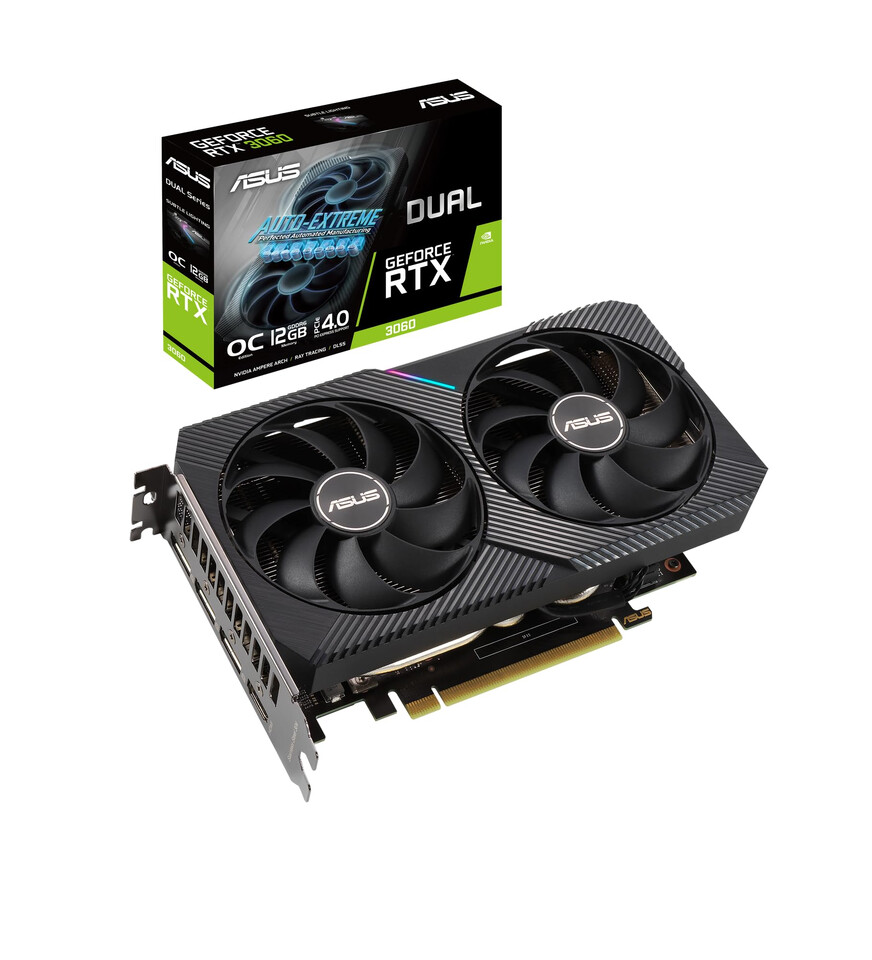
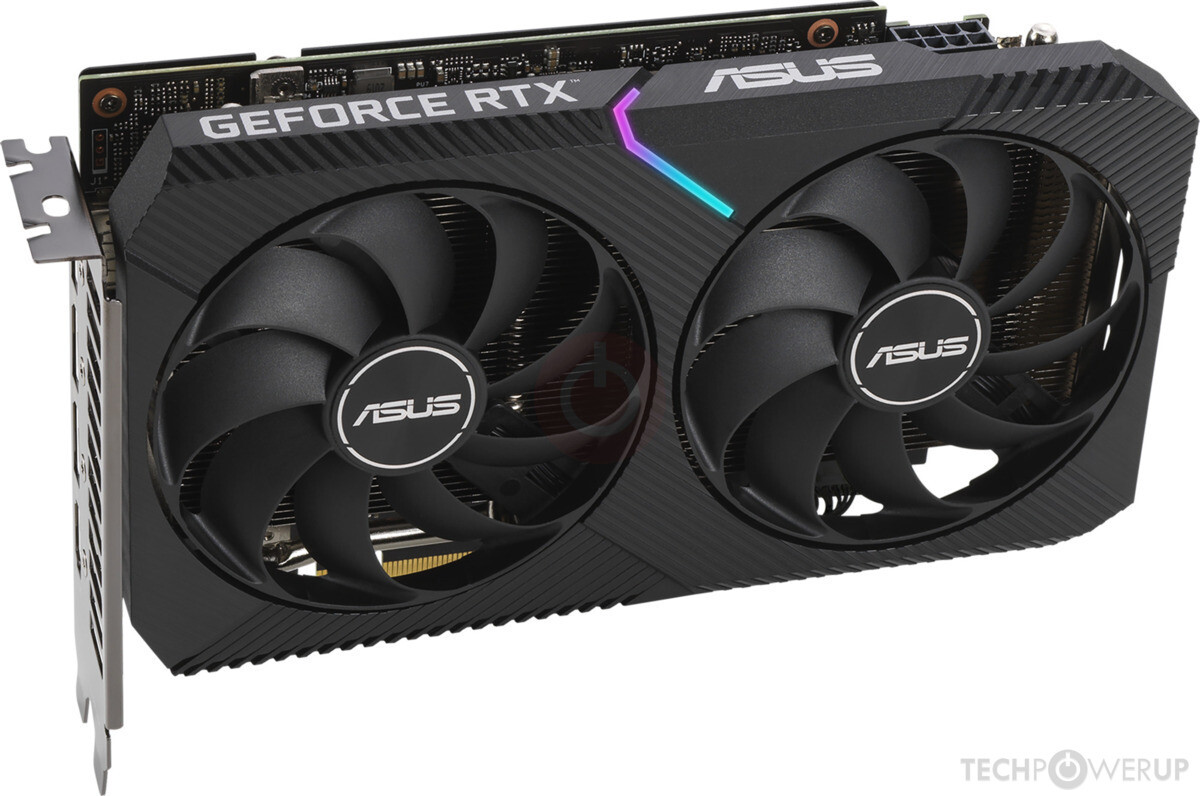
So here's a wallet-friendly alternative that's still very relevant in 2025: the ASUS Dual GeForce RTX 3060. Available for just about $300 (USD), equipped with 12 GB of VRAM, compatible with the most popular GeForce RTX features, and ready for a wide range of builds with its low wattage requirements and compact design, this is the best budget graphics card we offer in 2025 for gamers who prefer NVIDIA GPUs.

AMD Radeon RX 9070 and 9070 XT Official Performance Metrics Leaked, +42% 4K Performance Over Radeon RX 7900 GRE

AMD's internal benchmarks of its upcoming RDNA 4-based RX 9070 series graphics cards have been leaked, thanks to VideoCardz. The flagship RX 9070 XT delivers up to 42% better performance than the Radeon RX 7900 GRE at 4K resolution across a test suite of over 30 games, with the standard RX 9070 showing a 21% improvement in the same scenario. The performance data, encompassing raster and ray-traced titles at ultra settings, positions the RX 9070 series as a direct competitor to NVIDIA's RTX 4080 and RTX 5070 Ti. Notably, AMD's testing methodology focused on native rendering and ray tracing capabilities rather than upscaling technologies like FSR. The RX 9070 XT demonstrated large gains at 4K resolution, achieving a 51% performance uplift compared to the two-generations older RX 6900 XT. Meanwhile, the base RX 9070 model showed a 38% improvement over the RX 6800 XT at 4K with maximum settings enabled.

While AMD confirms its new cards are designed to compete with NVIDIA's RTX 50 series, specific comparative benchmarks against the RTX 5070 Ti were absent from the presentation. AMD acknowledges it has yet to acquire the competitor's hardware for testing. The company is expected to provide a comprehensive performance overview, potentially including additional GPU comparisons, during its official announcement on February 28. Both RX 9070 series cards will feature 16 GB of VRAM, matching the memory configuration of the RX 7900 GRE used as a primary comparison point. By the official launch date, AMD will have time to push final driver tweaks for optimal performance. Nonetheless, more information will surface as we near the official release date.

NVIDIA GeForce RTX 5080 Spotted with Missing ROPs, Too

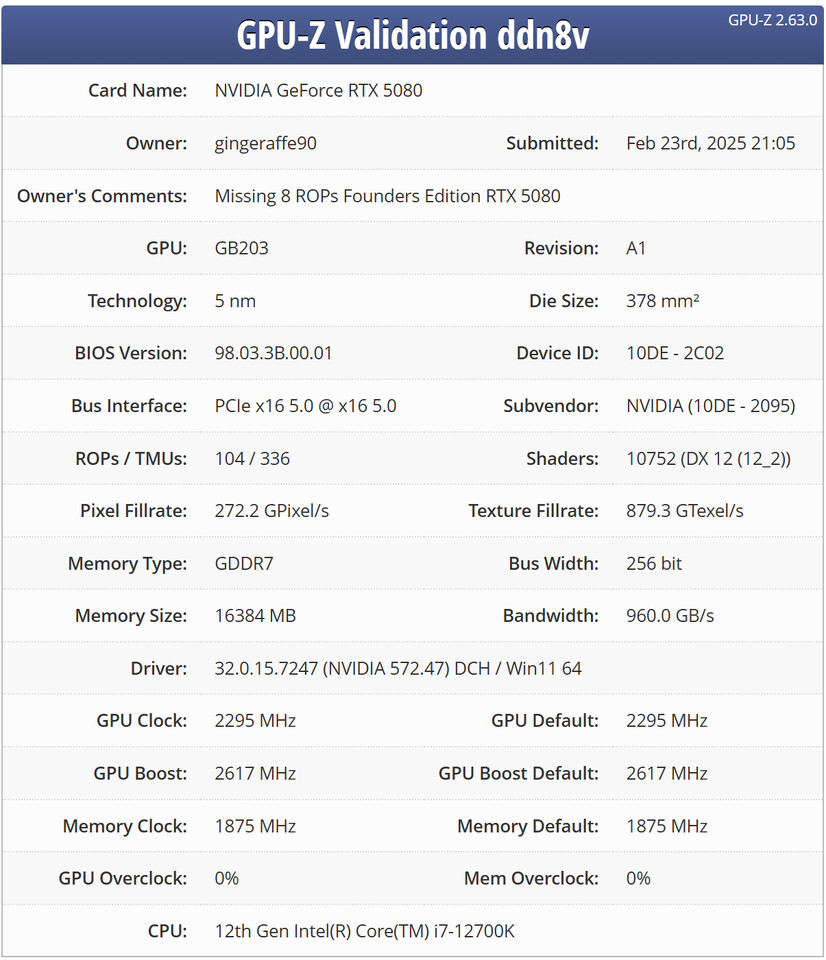
We previously covered that NVIDIA's GeForce RTX 5090 and RTX 5070 Ti chips were spotted with a few missing ROPs. NVIDIA confirmed this issue affects 0.5% of the supply of GeForce RTX 5090 / 5090D and 5070 Ti GPUs, and users should contact their vendors for a replacement. However, the case of missing ROPs is now extended further, with one user on Reddit reporting that his latest GeForce RTX 5080 Founders Edition GPU is reading only 104 ROPs, instead of the regular 112. That is eight missing ROPs—a number similar to eight missing ROPs found on GeForce RTX 5090 and RTX 5070 Ti. To double-check, the user installed the latest version of NVIDIA drivers and still recorded 104 ROPs only.

We previously found eight missing ROPs constitute a 4.54% loss in the GPU's raster hardware capability. The GPU's Raster Operations Pipeline (ROP) units handle the final stages of graphics processing—they manage pixel-level operations like blending colors, smoothing edges through antialiasing, writing pixels to texture memory, and ultimately storing the final pixel values in the frame buffer. This differs from shading units (GPU cores), which focus on calculating the colors, lighting effects, and material properties of pixels and vertices during rendering but don't directly work with the frame buffer. The performance loss from missing ROPs will differ from game to game, depending on whether a game heavily relies on ROP-intensive operations. Nonetheless, with GeForce RTX 5080 FE in the picture, we must wait and see if more future SKUs may appear with missing ROPs.
Update Feb 25th:
In response to this discovery, NVIDIA provided the following statement to TechPowerUp
NVIDIAUpon further investigation, we've identified that an early production build of GeForce RTX 5080 GPUs were also affected by the same issue. Affected consumers can contact the board manufacturer for a replacement.

NVIDIA Investigates GeForce RTX 50 Series "Blackwell" Black Screen and BSOD Issues

NVIDIA's problems with its latest flagship RTX 50 series "Blackwell" GPUs continue. First, it was melting power cables, then stability issues, and recently, the case of missing ROPs. Today, we got a confirmation that NVIDIA is investigating users experiencing significant stability problems, with reports of widespread black screen issues and system crashes since the launch of the dedicated 572 driver branch. Unlike owners of previous generation cards who can roll back to stable drivers, RTX 50 series users are particularly affected as no alternative drivers are available for their hardware. The problems span across the entire RTX 50 lineup, including the 5090, 5080, and newly announced 5070 Ti models. Users have reported issues ranging from display flickering to complete system failures, with some experiencing blue screen of death (BSOD) errors during normal operation.

The situation is especially problematic when using advanced features like DLSS 4 frame generation. NVIDIA staff member Manuel recently addressed these concerns on the GeForce Forums, confirming that the company is actively investigating the problems. Preliminary investigation suggests the issues might extend beyond driver software, potentially requiring VBIOS updates to resolve the stability problems fully. Some users have found temporary relief by reducing PCIe speeds below Gen 5 or lowering monitor refresh rates to 60 Hz, suggesting potential firmware-level compatibility issues. However, these workarounds are not guaranteed solutions for all affected users. The latest driver update (572.47), which added support for the RTX 5070 Ti, failed to address these critical stability issues, including only a single bug fix related to monitor wake-up from sleep mode. This has left many early adopters of the RTX 50 series frustrated with their premium hardware purchases.

NVIDIA Recommends GeForce RTX 5070 Ti GPU to AI Content Creators

The NVIDIA GeForce RTX 5070 Ti graphics cards—built on the NVIDIA Blackwell architecture—are out now, ready to power generative AI content creation and accelerate creative performance. GeForce RTX 5070 Ti GPUs feature fifth-generation Tensor Cores with support for FP4, doubling performance and reducing VRAM requirements to run generative AI models.

In addition, the GPU comes equipped with two ninth-generation encoders and a sixth-generation decoder that add support for the 4:2:2 pro-grade color format and increase encoding quality for HEVC and AV1. This combo accelerates video editing workflows, reducing export times by 8x compared with single encoder GPUs without 4:2:2 support like the GeForce RTX 3090. The GeForce RTX 5070 Ti GPU also includes 16G B of fast GDDR7 memory and 896 GB/sec of total memory bandwidth—a 78% increase over the GeForce RTX 4070 Ti GPU.

MSI RTX 5070 Ti VENTUS 3X Not Included in Launch Lineup, MSRP Models Reportedly Still in Short Supply

Over the past three weeks, press outlets and the buying public have levelled heavy criticism at NVIDIA board partners. The launches of three GeForce RTX 50-series "Blackwell" GPUs have—so far—been problematic; based on news reports and community feedback. Prior to release (on February 20), VideoCardz anticipated major price fluctuations for an all-custom portfolio of GeForce RTX 5070 Ti graphics cards. The publication did not hold back with its targeting of ASUS; one of Team Green's big time AIBs. Only a small selection of baseline MSRP ($749) conformant models were available on day one, and VideoCardz posited that manufacturers would implement price hikes soon after launch. A follow-up report continues their investigation into a lack of baseline MSRP options, as well as so-called "fake promotions."

VideoCardz repeated its belief that ASUS will jack-up the asking price for its PRIME GeForce RTX 5070 Ti model. When looking at Newegg's listing of baseline MSRP cards, the intrepid investigator stumbled up another notable absence: "we wrote three articles about the ASUS RTX 5070 Ti PRIME model not being listed as an MSRP card by retailers, which finally led ASUS to intervene (most likely for a limited time) to sell this card at the promised price. What we can immediately notice is the lack of the VENTUS 3X model from MSI, which was basically 90% of the MSRP card review coverage yesterday, as NVIDIA had no Founders Edition card for this launch and relied on board partners. In fact, the VENTUS 3X non-OC is not even included in the official launch, meaning that the card you saw yesterday in reviews is simply not available anywhere." It should be noted that TechPowerUp received an MSI GeForce RTX 5070 Ti Ventus 3X OC sample unit for evaluation purposes (review guide pricing was $749); Newegg lists this particular model with a current $829.99 price point, but stock is unavailable (at the time of writing).

TechPowerUp GPU-Z v2.63.0 Released

TechPowerUp today released the latest update to TechPowerUp GPU-Z, the graphics sub-system information and monitoring utility for PC gamers and enthusiasts. Version 2.63.0 comes with support for new GPUs that include the NVIDIA GeForce RTX 5070 Ti, and AMD Radeon RX 9070 XT, RX 9070, and RX 7650 GRE. We have introduced the ability to save or upload the video BIOS of NVIDIA RTX 50-series "Blackwell" GPUs. A bug that caused the GPU vendor logo to incorrectly scale on systems with high-DPI displays, has been fixed. DPI scaling of top-right action buttons on high-DPI monitors has also been fixed. Grab GPU-Z from the link below.

DOWNLOAD: TechPowerUp GPU-Z 2.63.0
Return to Keyword Browsing
Nov 25th, 2026 09:28 CST change timezone

New Forum Posts

Popular Reviews

TPU on YouTube

Controversial News Posts