News Posts matching #eGPU

Return to Keyword Browsing

TOPC Launches $6,399 AMD Ryzen AI Max+ Pro 495 Mini PC Workstation

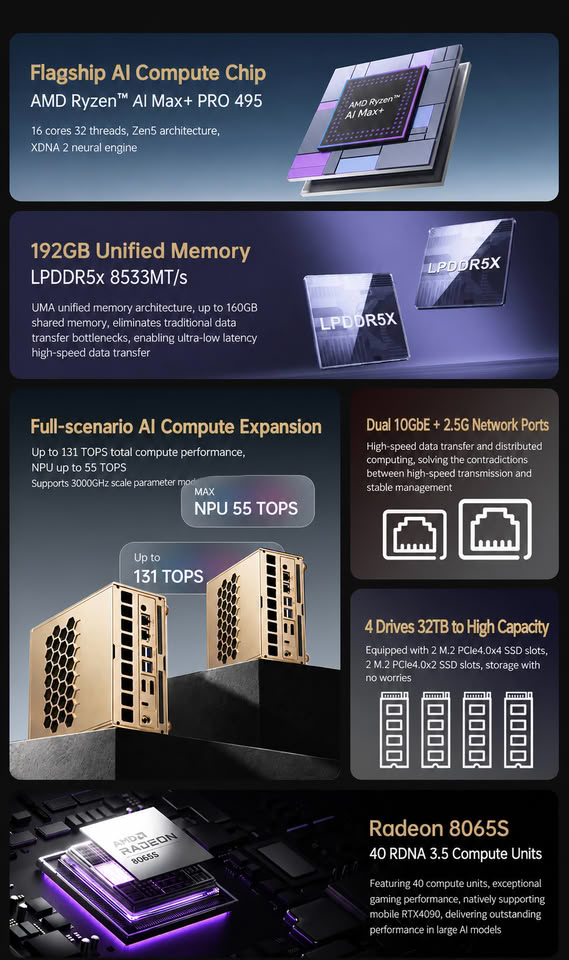
The ever-growing list of mini PCs powered by AMD's Gorgon Halo APUs has just received its latest addition in the TOPC TXA2, a new workstation built around AMD's Ryzen AI Max+ Pro 495 APU and its powerful Radeon 8065S iGPU. The TOPC TXA2 is available in two configurations, with either 2 TB of storage for $6,399 or 4 TB of storage for $6,699 on TOPC's online store—even though the price is high, it's still a solid $900 cheaper than AMD's in-house Ryzen AI Halo Developer platform.

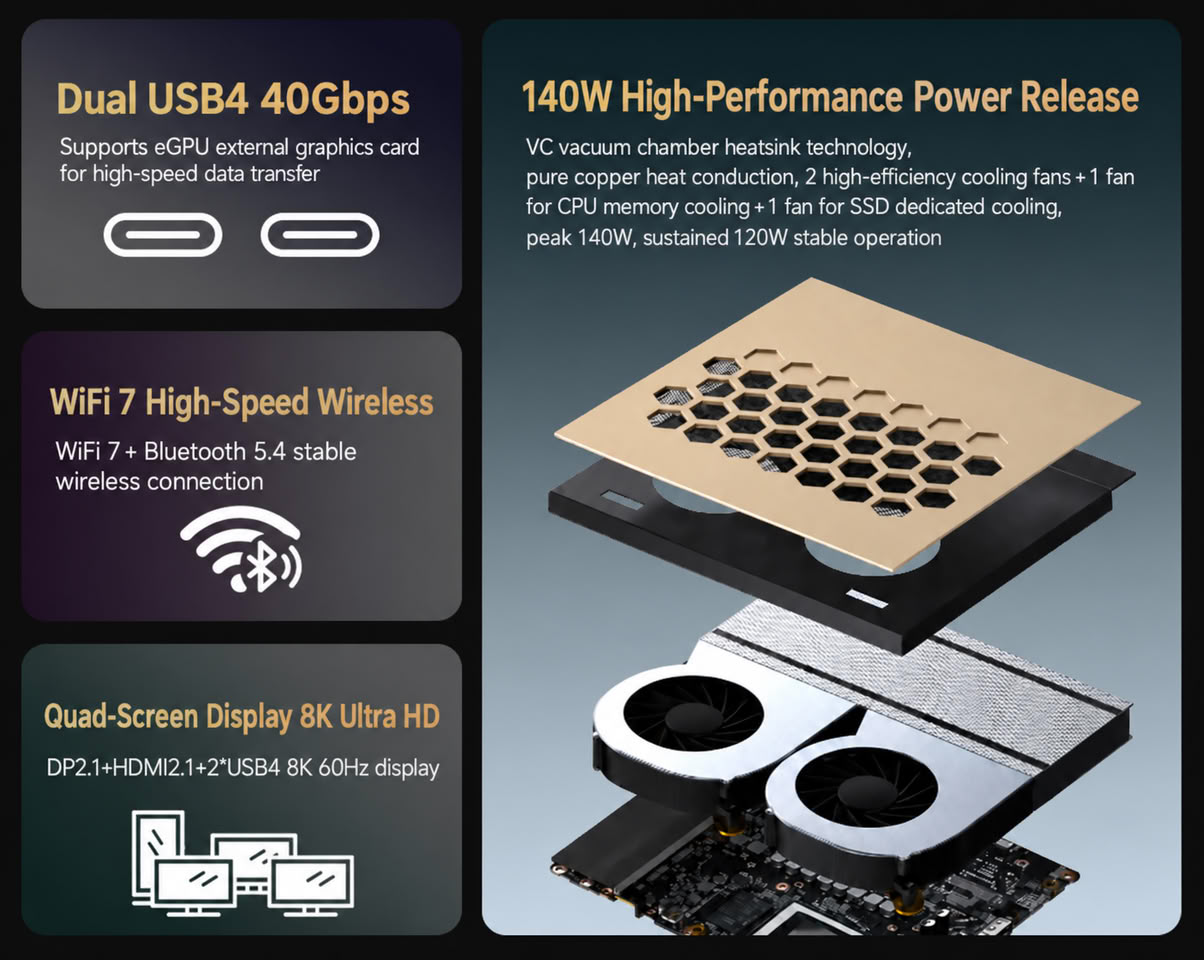
The TXA2 also packs 192 GB of LPDDR5X-8533 unified memory, with up to 160 GB shared with the iGPU for workstation use. Despite the 180 ×180 × 78 mm, or ~2.5 L chassis, TOPC claims that the TXA2 is capable of a 120 W TDP. It's also no slouch in the I/O department, with Wi-Fi 7 and Bluetooth 5.4 for wireless networking and connectivity, and it has a healthy port selection, to boot.

Acemagic Launches F9A: $6,500 Workstation Mini PC with AMD Ryzen AI Max+ Pro 495

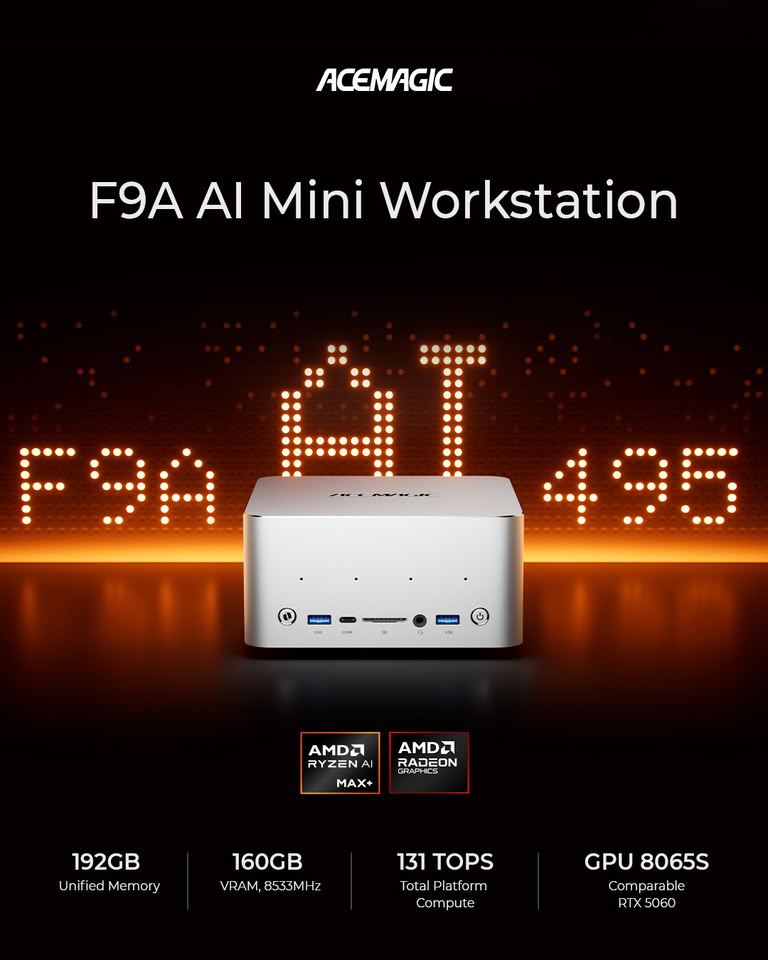
After showing off its Gorgon Halo mini workstations at IFA 2026, Acemagic has officially launched the F9A mini PC as an AI workstation powered by the AMD Ryzen AI Max+ APU with its Radeon 8065S iGPU, for 131 TOPS of AI compute and up to 192 GB of unified memory. The Ryzen AI mini PC's all-metal chassis measures in at just 158.5 x 158.5 x 81.5 mm, or 2 L volume, and pricing starts at $6,499 for 192 GB of memory and a 2 TB SSD.

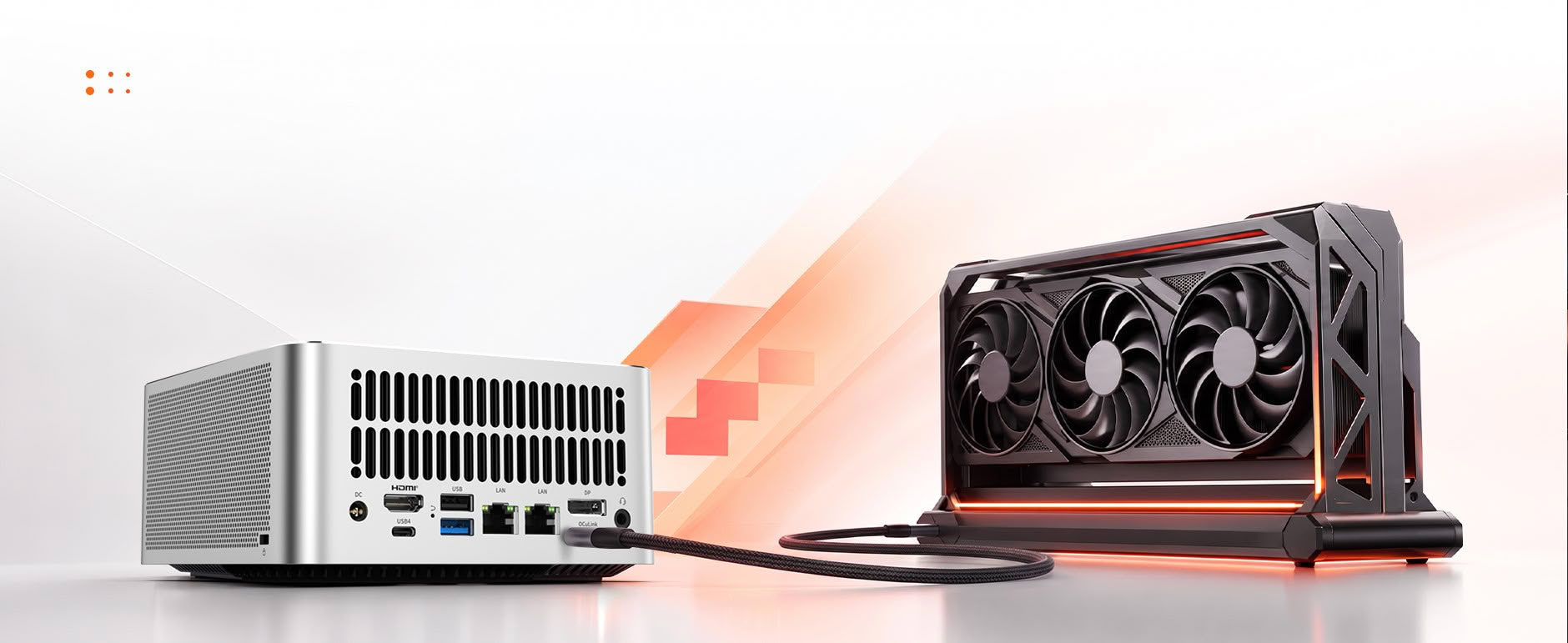
The mini PC features a modern ports selection, with front I/O consisting of dual USB 3.2 Gen 2 Type-A ports, a USB4 Type-C port, an SD card reader, and a 3.5 mm audio combo jack. The back of the mini PC, meanwhile, features another USB4 port, DisplayPort 2.1, HDMI 2.1, dual 2.5 GbE, a USB 2.0 port, another USB 3.2 Gen 2 port, and an OCuLink port for eGPU expansion in the event that you need more power than the Radeon 8065S can put out. The 192 GB of LPDDR5X-8355 unified memory can be configured so that 160 GB is dedicated to video memory.

Sonnet Launches Thunderbolt 5 eGPU Box with 850 W PSU and Triple-Slot GPU Support

Sonnet, the US-based accessory maker who previously launched the Echo 20 and 21 Thunderbolt 5 docking stations with 10 GbE, has officially released the Breakaway Box 850 T5, a Thunderbolt 5-based eGPU box with an industrial aesthetic and a built-in 850 W PSU. The Breakaway Box 850 T5 is available from Sonnet for $599.99.

The Breakaway Box 850 T5 is designed to accept triple-slot GPUs with dimensions up to 345 × 155 × 70 mm, and the included PSU features three 8-pin connectors that can be adapted to a 12v-2×6 connector in the case of the latest NVIDIA and certain AMD Radeon GPUs. The enclosure itself weighs 6.4 kg and measures 210 × 400 × 250 mm, and it is backwards-compatible with Thunderbolt 4 and USB4 in addition to Thunderbolt 5.

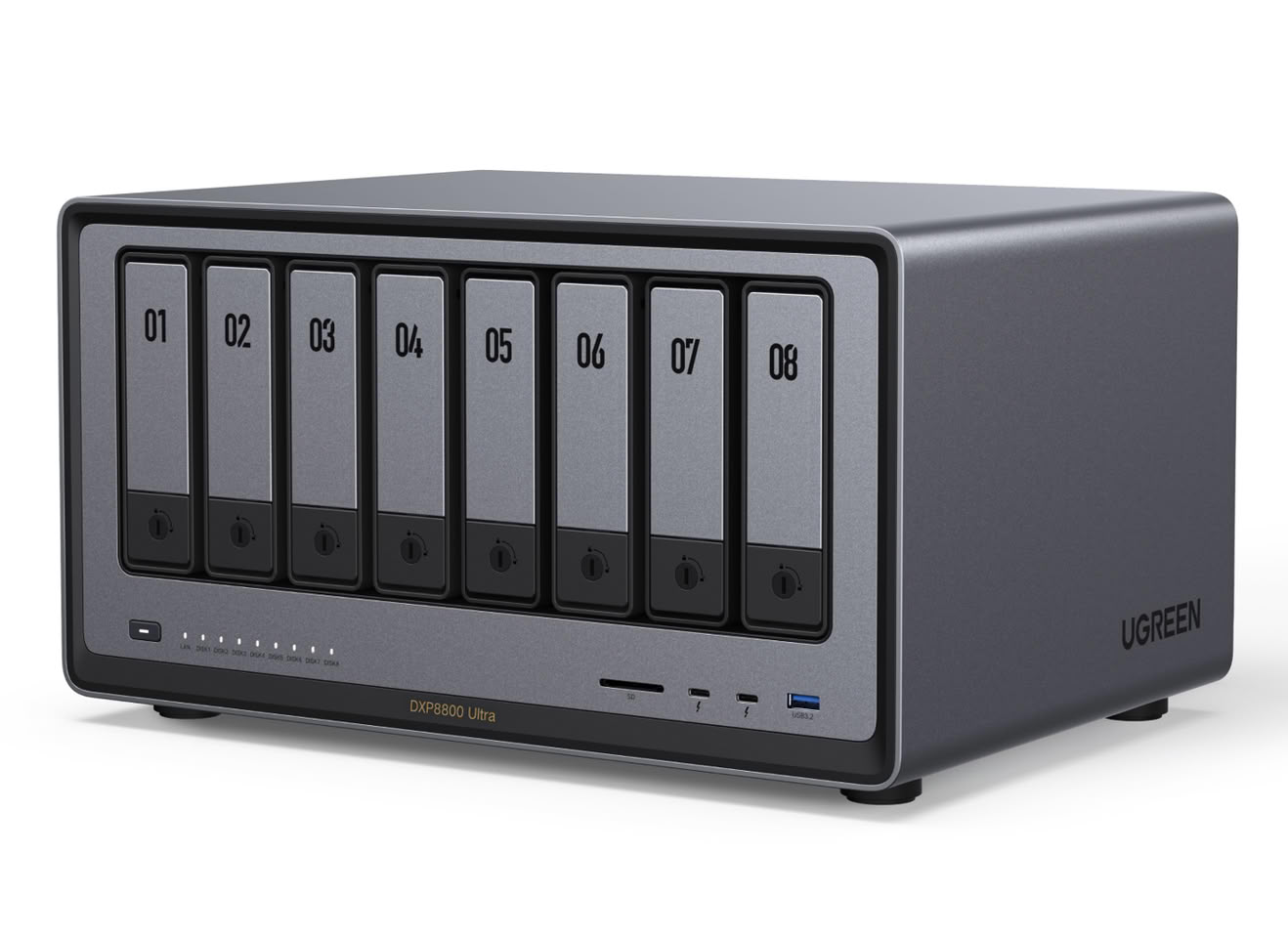
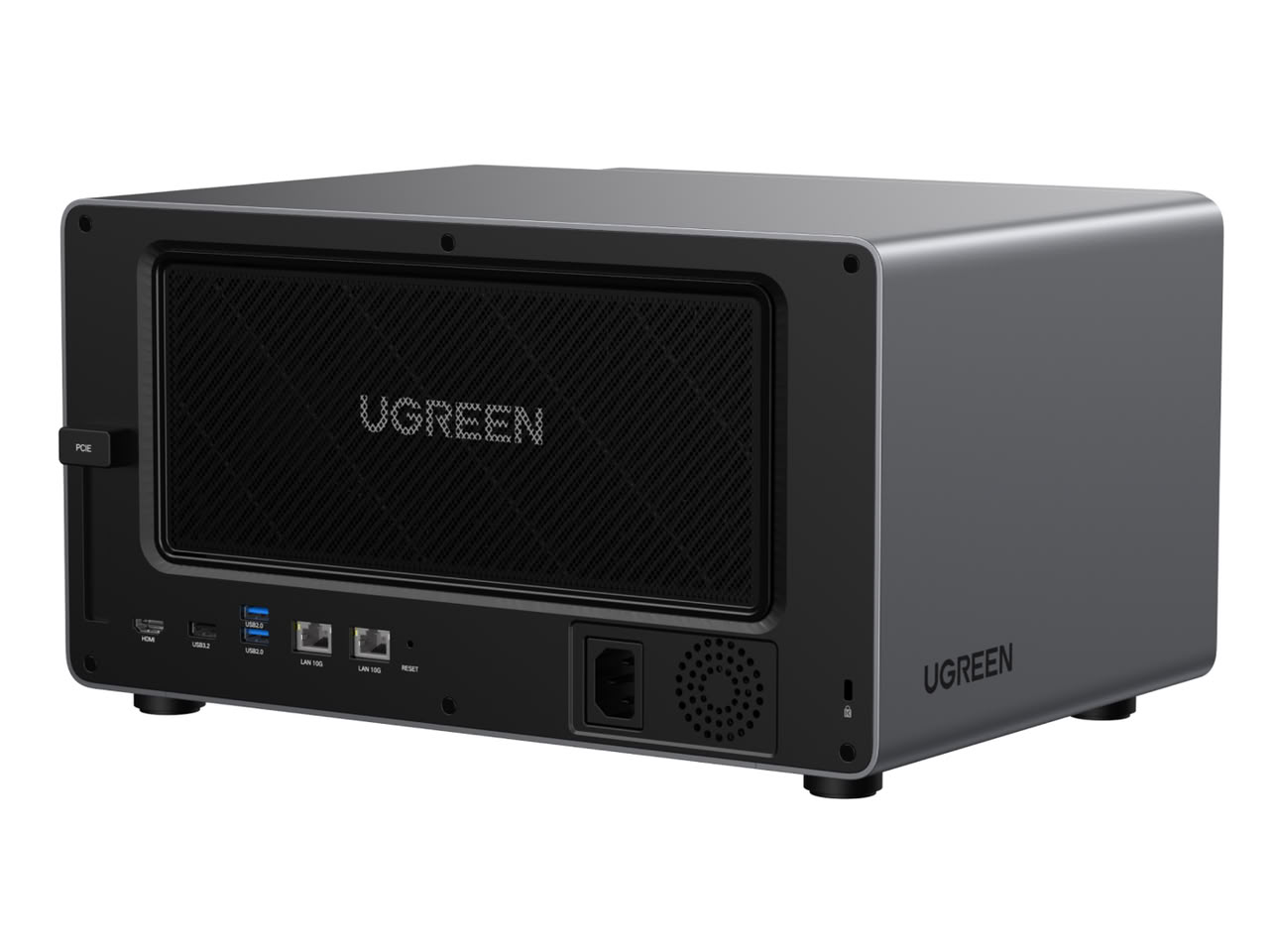
Ugreen Launches the NASync DXP6800 Ultra and DXP8800 Ultra at IFA 2026

Ugreen, a leading global consumer technology company, is due to showcase the Ugreen NASync DXP6800 Ultra and DXP8800 Ultra at IFA 2026. Designed as powerful local data centers for small studios and growing businesses, the new systems extend Ugreen's NAS portfolio beyond storage and backup to support high-speed collaboration, centralized data management, and local business applications.

To meet the growing storage, computing, and collaboration needs of creative studios and expanding businesses, Ugreen developed the DXP Ultra Series as the highest-performance tier in its NASync portfolio. Bringing high-capacity storage, high-speed connectivity, centralized data management, and expandable computing power into one local platform, the series helps teams manage large media workflows, protect critical business data, and run lightweight business applications on infrastructure they control.

GPD Box Mini PC: $1,452 Base Price—PCIe 5.0 x8 MCIO Port Skips Intel Core Ultra X7 SKU

We previously covered the announcement of the GPD Box, a new Panther Lake mini PC that features an MCIO 8i port and dual USB4 v2.0 ports for expanded connectivity with eGPUs and other high-bandwidth applications. Now, the GPD Box has finally launched on Indiegogo with a starting price of HK$11,377 ($1,452.25 converted). The base configuration is powered by an Intel Core Ultra 7 356H with 32 GB LPDDR5-8533 RAM and a 1 TB M.2 2280 NVMe SSD. The next level up upgrades the CPU to the Core Ultra X7 358H for HK$12,020 ($1,534 converted), and the bundles with the Box mini PC and the G2 MCIO eGPU Dock come in at HK$14,394 ($1,837 converted) for the Core Ultra 7 356H version and HK$15,036 ($1,919 converted) for the X7 358H variant. The biggest difference between the Core Ultra X7 358H and the Ultra 7 356H is the significantly more powerful Arc B390 iGPU in the former—importantly, there is no MCIO connection on the Core Ultra X7 358H version of the Box, leaving it with only USB4 for eGPU connections.

Despite its compact chassis, at just 175 × 134 × 39.5 mm, the GPD Box has decent I/O capabilities, with the highlight of the show being the MCIO 8i port that allows for eGPU expansion with minimal bandwidth loss compared to USB4 and Thunderbolt connections. According to GPD, the maximum bidirectional bandwidth of the GPD Box's MCIO port is 512 Gbps, which effectively matches a native PCIe 5.0 x8 cable connection. Notably, while the G2 eGPU dock does include a PSU with an 800 W ATX 3.1 PSU with two GPU power cables, you will need to bring your own GPU if you buy the bundle with the dock. The G2 dock can also be purchased separately via Indiegogo at a starting price of $385. The GPD Box itself also features dual 2.5 GbE RJ45 ports with link aggregation support. For wireless support, there is Bluetooth 5.3 and Wi-Fi 6E, while the physical I/O includes 2× USB4 V2 Type-C ports, 2× USB 3.2 Gen 2 Type-A, and a 3.5 mm audio combo jack on the front. The rear I/O has a DP 2.1 UHBR20 port, 1× HDMI 2.1 FRL ports, 2× RJ45 ports with 2.5 Gbps speeds, 2× USB 3.2 Gen 2 Type-A ports, and the MCIO 8i port.

Minix Shows Bunch of New Mini-PCs and Portable Monitors at Computex 2026

Minix brought several new Mini-PCs and a couple of new portable monitors to the Computex 2026 show. Minix is covering almost every market segment with its Mini-PCs, and some upcoming designs are quite interesting. In addition, the company showcased several of its own portable monitors, including a 10-inch one.

Minix had an extensive lineup of Mini-PCs at the show, including the two new and upcoming Mini-PCs based on AMD's Ryzen AI Max+ 395 processor, the ER939-AI Pro and the ER939-AI Ultra. Both are branded as AI Mini Workstations and are practically the same hardware but packed in a completely different chassis design. The ER939-AI Pro is your standard Mini-PC packed in a white box with a rather neat leather handle at the top, while the ER939-AI Ultra uses a bolder design and even incorporates an LCD screen at the top of the case. Both offer up to 126 TOPS of overall AI performance, have all the usual connectivity and dual 10 Gb Ethernet, and can be equipped with up to 128 GB of LPDDR5X memory and up to 8 TB of NVMe SSD storage. Bear in mind that the ER939-AI Ultra is still in its early stages, so we might see some changes in the design, but, hopefully, they will keep the LCD screen.

Sparkle Showcases New eGPU Enclosures and Docks at Computex 2026

Sparkle introduced a handful new eGPU products at Computex 2026. We begin our tour with the Sparkle eGPU Studio-G Ultra 850. Designed for high-end graphics cards, including the RTX 5090, the enclosure packs a 4-slot graphics card up to 33 cm in length, and features an 850 W power supply with a 12V-2x6 connection to the graphics card that's capable of 600 W continuous power delivery. It features a Thunderbolt 5 interface, and is capable of 120 Gbps Rx + 40 Gbps Tx asymmetric mode, or 80 Gbps + 80 Gbps Tx/Rx symmetric mode.

Next up, is the Sparkle eGPU Creator Station, a pre-built external GPU that features a Thunderbolt 5 interface with asymmetric mode, just like the eGPU Studio-G Ultra, but it encloses an NVIDIA GeForce RTX 3060 12 GB GPU. This is more than an eGPU, there's also some downstream I/O, such as two 10 Gbps USB 3.2 Gen 2 type-A ports, two downstream Thunderbolt 5 ports, and 1 GbE wired LAN. The GPU puts out four full-sized DisplayPorts, but one of the two downstream Thunderbolt ports has DisplayPort passthrough shared with one of these full-sized ports. The Creator Station comes in five body color options, including silver, white, red, blue, and gold.

Intel Launches Thunderbolt Share for PC-to-PC File and Peripheral Sharing on Windows 11

Following the recent release of the Intel USB4Stream protocol enabling direct PC-to-PC file and peripheral sharing on Linux, Intel has officially released Thunderbolt Share for Windows, which accomplishes the same thing on Windows over a Thunderbolt 4 or 5 connection. Thunderbolt Share allows the same peripheral and file sharing, backup, and migration capabilities as the Linux USB4 protocol, but with an official GUI and somewhat more limited compatibility thanks to a required Thunderbolt Share certification. The software is currently available to download from Intel directly.

Thunderbolt Share works with a direct PC-to-PC connection as well as in cases where two systems are connected via an accessory, like a dock, hub, or monitor. Additionally, only one device in the chain needs to be Thunderbolt Share licensed. There is a list of Thunderbolt Share licensed products on a website hosted by Intel, although it currently appears to be limited to a handful of MSI laptops, nine ASUS, HP, and Lenovo pre-built desktops and DIY motherboards, a smattering of Thunderbolt docks and hubs, an ASUS Thunderbolt 5 expansion card, and a Sparkle Thunderbolt 5 eGPU dock.

GPD Box Mini PC and G2 eGPU Get MCIO 8i Connectivity With 512 Gbps Bandwidth

GPD has officially announced its Box mini PC and its G-series eGPUs, which both now feature faster external PCIe interfaces for gaming and AI use cases. The GPD Box itself is a fairly standard Panther Lake mini PC, although not too much has been revealed about the Box aside from its new eGPU interface. The GPD Box swaps out the traditional USB4 or Thunderbolt 5 port with an MCIO 8i (Mini Cool Edge IO) port, which is capable of full PCIe 5.0 ×8 bandwidth. MCIO 8i aside, the Box looks to have a healthy assortment of ports, with dual USB Type-A and Type-C ports, alongside a 3.5 mm audio jack on the front and two USB Type-A ports, DP and HDMI for display, and dual Ethernet ports on the back of the mini PC. That MCIO ×8 port is theoretically capable of bidirectional bandwidth of up to 512 Gbps, although there are legitimate concerns about rated insertion cycles and wear on the ports, given that MCIO was initially designed for server applications, where hardware would be plugged and unplugged far less frequently than in consumer applications. It should also be noted that it is limited to PCIe ×8, even on PCIe Gen 5, meaning it will be limited to 256 Gbps bidirectional bandwidth on PCIe Gen 5.

The GPD G2 itself is the eGPU enclosure launching alongside the Box mini PC, and it is capable of connecting either over USB4 v2.0 or MCIO 8i, making it useful for more than just the GPD mini PC. GPD claims that the G2 can run an NVIDIA RTX 4090 with only 2% performance loss, which is a level of throughput that neither Thunderbolt 5 nor OCuLink can achieve. The G2 eGPU dock itself has dual USB Type-A ports for peripherals and a USB4 port with 100 W PD charging, and there's a built-in PCIe SSD expansion slot in the eGPU dock for extra storage. The G2 also has its own on-board PSU that connects to the GPU with an externally routed 12v-2×6 cable—GPD has not yet revealed the output of that unit, but presumably, it will at least be enough to power an RTX 4090 if that's what the company is staking its performance claim on. Availability and pricing have not yet been announced, but the Weibo announcement post lists 2026 as the release date, so we will likely find out more, including more specifications, later this year.

OCuLink Dev Kit Gives Framework Laptop 16 Desktop-Class PCIe Expansion

Alongside the Framework 13 Pro that was just announced, Framework also released the OCuLink Dev Kit, which is a new modular adaptor that replaces the Framework Laptop 16's Graphics Module with an external OCuLink port, allowing you to connect high-performance peripherals and hardware across a PCIe 5.0×8 interface and offering a theoretical maximum bandwidth of 128 GT/s. Framework suggests that users could use the OCuLink port to build out their Framework Laptop 16 as a lightweight on-the-go laptop, removing the dGPU and using that in an eGPU setup while docked at a desk and relying on the iGPU in the laptop for work away from the desk.

The Framework OCuLink Dev Kit includes the hardware that goes into the laptop itself, an OCuLink Expansion Bay adaptor, as well as the external bits, including a Graphics Module OCuLink Dock, for mounting your Framework Graphics Module externally, a PCIe OCuLink Dock with a full-size PCIe slot for hardware like GPUs, networking cards, capture cards, and whatever else goes into a PCIe slot; and an OCuLink 8i cable to connect the dock to the laptop itself. In order to use the external graphics module, you'll need to supply your own desktop PSU, since Framework does not include one in the package, and it should also be noted that the OCuLink port does not support the same charging capabilities as USB4 or Thunderbolt, so you'll still need to run at least two cables when using the Dev Kit.

Khadas Mind Pro Mini-PC Gets Intel Panther Lake, New Mind Graphics 2 eGPU Packs RTX 5060 Ti

Amid the flurry of CES 2026 news, Khadas, a popular mini PC maker, announced a series of updates coming to its Mind product line. Most exciting of the lot of updates is the new Intel Panther Lake-powered Khadas Mind Pro mini PC and the new Mind Graphics 2 eGPU dock. The Mind Pro Mini-PC, which is slated to launch gradually in Q1 2026, is a Mini-PC with Intel's new Panther Lake Core Ultra X7 358H or Core Ultra X9 388H CPUs and all the juicy new Intel Arc graphics that come with that. Khadas describes the Mind Pro as a modular design, suggesting that the new Mini-PC could be somewhat easily upgraded. The Mind Pro's chassis is said to come in at just 0.46 liters, and the Intel Arc graphics inside the Panther Lake CPU should deliver entry-level dGPU performance. It will also be available with up to 64 GB of LPDDR5X memory and up to 2 TB of NVMe storage. Given that it's an Intel system, the Mind Pro will also have dual Thunderbolt 4 ports, which have four PCIe 4.0 lanes for connectivity. The Mind Pro is not yet available, and pricing has not yet been confirmed.

One of the coveted use cases for Thunderbolt 4 ports on a Mini-PC is the ability to connect an eGPU for additional performance. Khadas itself provides one such eGPU, the Mind Graphics dock, which has now been updated to the Mind Graphics 2, receiving an NVIDIA GeForce RTX 5060 Ti 16 GB upgrade in the process. The Mind Graphics 2 and the Mind Pro mini PC feature what Khadas calls the Mind Link, which enables PCIe 4.0 x8 support for improved performance when docked. The Mind Pro also sits neatly atop the Mind Graphics 2, in a dedicated recess in the chassis, when docked to the Mind Graphics 2. The Mind Graphics 2 dock is already available for $1,349. For users looking for an on-the-go solution, Khadas has also announced the xPlay portable monitor, which features a 2.8 K, 3:2 display and a 47.94 Wh battery, which Khadas says is capable of powering itself and Khadas's Mini-PCs—that said, battery life will likely be limited due to the size. The xPlay monitor also connects to the Mind mini PCs with the Mind Link port, which should make it a lot neater to carry around than a regular USB-C monitor, although it also operates over USB-C. The Mind xPlay portable display is available for $99 from Khadas.

j5create Shows Docks with Built-In Displays, 8K 144 Hz Support, and AI Meeting Tools at CES 2026

j5create dedicated its CES 2026 booth to high-end connectivity solutions that enhance modern IT infrastructure, particularly in video streaming at high resolutions and refresh rates. All new products are based on the Thunderbolt 5 series, offering 120 Gbps bandwidth, which is three times the capacity of the previous generation. The JTP5172 Triple 8K60 Docking Station supports 8K at 144 Hz and delivers 140 W of power. For those in need of an eGPU, the JTD5175 enclosure is compatible with NVIDIA's GeForce RTX 5090 for gaming and AI applications. Real-time monitoring is featured in two products: the JCD3195 Dashboard Dock and JCDP3140 Powerbase Docking Station, both equipped with built-in displays for performance and power status checks.

Good Way Shows Off Thunderbolt 5 eGPU Dock

Does your external graphics card have to be completely enclosed? Can it be a dock so you could revel upon the card, and it can ventilate itself better? Good Way has a possible answer to this solution, with its new DBF7059 Thunderbolt 5 eGPU Dock. This dock features a Thunderbolt 5 upstream link, including the ability to segment the interconnect such that the host-to-GPU transfers operate at 120 Gbps, and GPU-to-host at 40 Gbps, ensuring the best possible bandwidth for the GPU in an eGPU configuration.

The dock features a PCI-Express 4.0 x16 slot, and a bridge chip that converts this to Thunderbolt 5. It also integrates a 700 W power supply, so it can supply a modern graphics card with a 600 W-capable 12V-2x6, besides 75 W from the slot, and the remaining power for its bridge chip and other dock features to function. The dock has been extensively stress-tested by its designers using high-end graphics cards to ensure endurance in a professional and enterprise environment, where its target users are trying to expand their commercial laptop's graphics capabilities with a high-end GPU. Lastly, Good Way also threw in some downstream connectivity, including stereo USB audio, an SD Express card reader, a 10 Gbps USB 3.2 Gen 2 type-A, a 10 Gbps type-C, and a Thunderbolt 5 downstream port, so you can daisy-chain the dock to additional devices.

OneXPlayer Shows Off AMD Strix Halo and Panther Lake Gaming Tablet and Handheld With External Liquid Cooling at CES 2026.

OneXPlayer first announced the OneXPlayer Super X, a 14-inch AMOLED gaming tablet powered by AMD's Strix Halo APUs, in early December 2025, with a Kickstarter campaign making some bold claims about 120 W sustained performance. At CES 2026, the TechPowerUp team stopped by the OneXPlayer booth and managed to take a look at the hardware in person. The brand also revealed that the gaming tablet will be available with the newly released Intel Panther Lake Core Ultra X7 358H CPU, which should also put up almost the same GPU performance as the Radeon 8060S, thanks to the included Intel Arc B390 iGPU, but perhaps better efficiency, which will be key for a mobile gaming device.

UGREEN LinkStation eGPU Dock Launched in China, Features 850 W PSU & OCuLinK Interface

Ugreen is best known for producing a wide range of USB hardware, cables, and AC adapters. Earlier in the week, Chinese PC hardware press outlets noticed the retail listing of a brand-new LinkStation Graphics Card Expansion Dock. Ugreen's entry into this loftier market segment has generated buzz outside of China. A sleek semi-open enclosure design is combined with an impressive set of internals. An initial JD.com store entry advertises a 2299 Yuan (~$325 USD) price tag. Promotional renders show a hosted NVIDIA GeForce RTX Founders Edition graphics cards—matching the dock's largely brushed aluminium aesthetic—but Ugreen's spec sheet states that users can slot in their favored AMD or Intel products.

A fully-closed LinkStation can house a maximum card length of 370 mm. Excessively proportioned units can be accommodated, as long as a modular top cover is removed. This 5.08 kg eGPU setup can be hooked up to laptops, mini PCs, and gaming handhelds. Ugreen's dock sports an OCuLink port; supporting data transfer speeds up to 64 Gbps. Alternatively, USB4 (40 Gbps) connectivity is present—granting 100 W of reverse charging for connected devices. According to a contents rundown, 0.5 m OCuLink and 0.8 m USB4 cables are bundled in as standard. A 850 W Gold-rated ATX 3.1 power supply is fitted within the LinkStation Dock; good enough to take on GeForce RTX 40 or 50-series dGPUs. In-housing testing of the dock's OCuLink connection shows near-to direct-to-desktop mainboard interface performance.

GIGABYTE Introduces AORUS RTX 5060 Ti AI BOX eGPU

GIGABYTE has unveiled the AORUS RTX 5060 Ti AI BOX eGPU during today's Beyond Edge online event. This external graphics solution features NVIDIA's desktop-grade GeForce RTX 5060 Ti with 16 GB VRAM in a compact 117 x 243 x 45 mm form factor. Unlike most existing eGPUs that rely on mobile AMD Radeon RX 7600M XT chips, GIGABYTE opted for a full desktop GPU implementation complete with their WINDFORCE cooling system. The decision to use desktop silicon means users get double the memory capacity compared to typical 8 GB variants, though this will likely push pricing above the $460 desktop card MSRP.

It features Thunderbolt 5 connectivity, delivering PCIe 4.0 x4 bandwidth that's reportedly only 5% slower than desktop PCIe 4.0 x16 performance. While Thunderbolt 5 adoption remains limited to high-end laptops and mini PCs, it maintains USB4 backward compatibility. In USB4 mode, it can work alongside laptop integrated graphics through Project G-Assist for balanced workloads. The AORUS RTX 5060 Ti AI BOX does more than just boost graphics. It serves as a full docking station offering three USB 3.2 Gen 2 ports with Power Delivery 3.0, provides Ethernet connectivity and allows Thunderbolt 5 daisy-chaining. The AORUS logo and interior light up with RGB lighting. GIGABYTE is yet to announce pricing and exact availability.

Peladn Unveils Link S-3, Its First Thunderbolt 5 eGPU Dock

Chinese company Peladn is preparing the Link S-3 as its first external GPU dock to feature Thunderbolt 5 connectivity, following its previous Link S-1 and Link S-2 models that used Thunderbolt 4 and OCuLink, respectively. This low-profile dock enables desktop graphics card connectivity for systems lacking dedicated GPUs. The device features dual Thunderbolt 5 ports with up to 80 Gbps bidirectional speeds; however, practical performance is limited to 64 Gbps due to constraints of its PCIe 4.0 x4 slot for the graphics card. The dock supports external ATX or SFX power supplies and 140 W Power Delivery through its Thunderbolt 5 connection. Its open-air design exposes the connected graphics card to ambient air for cooling, eliminating the need for built-in fans.

Peladn Link S-3 includes 2.5 Gigabit Ethernet connection via Realtek's RTL8156B controller, an M.2 2280 slot for PCIe 3.0 x1 SSDs, a USB 3.2 Gen 2 Type-A port at 10 Gbps, and an SD card reader. While Thunderbolt 5 offers higher theoretical bandwidth than OCuLink's 64 Gbps, the practical advantage is minimal due to PCIe constraints. OCuLink connections may still provide lower latency in some scenarios, though the Link S-3's Thunderbolt 5 implementation enables additional connectivity features that OCuLink docks typically lack. The Peladn Link S-3 is available for pre-order in China at CNY 1,599 (approximately $223), with shipping starting on July 26. Global availability has not been announced.

Razer Introduces New Thunderbolt 5 Dock and Core X V2

Razer, the leading global lifestyle brand for gamers, today announced the launch of two cutting-edge PC accessories powered by Thunderbolt 5: the Razer Thunderbolt 5 Dock and Razer Core X V2 external graphics enclosure. Designed to elevate PC connectivity and external graphics capabilities, this powerful duo delivers expanded bandwidth, immersive display options, and modular flexibility for both work and play.

Thunderbolt 5 sets a new benchmark in docking station with high-speed connectivity, offering peak transfer speeds of up to 120 Gb/s—nearly 12 times faster than USB 3.0. This next-gen technology enables seamless operation of high-performance peripherals, ultra-fast storage, and drive multiple 4K displays, while also supporting daisy-chaining with other Thunderbolt devices for unmatched productivity and immersive gameplay. Whether simplifying setups with a single-cable connection to a 4K triple-display configuration or boosting laptops with desktop-class GPU performance, Razer's Thunderbolt 5 ecosystem delivers reliable performance, sleek cable management, and broad device compatibility.

Minisforum Unveils AI X1 Pro Mini PC With Ryzen AI 9 HX 370

Minisforum is proud to unveil AI X1 Pro, the world's first Copilot-empowered AI mini PC, setting a new standard in low power efficiency and redefining performance. Powered by the cutting-edge AMD Ryzen AI 9 HX 370 processor, the AI X1 Pro delivers next-level AI technology, supercharging multitasking, boosting productivity, and enhancing teamwork like never before. With performance up to 45% faster than competitors, this mini PC is designed to meet the demands of professionals, creators, and gamers alike.

Unmatched Gaming and Creativity
Equipped with the powerful AMD Radeon 890M processor, AI X1 Pro transforms your gaming experience. Dive into AAA titles with smooth, breathtaking visuals and zero lag. Every battle and adventure comes to life in stunning detail, delivering pure excitement. For creators, the AI X1 Pro is optimized for AI workloads, featuring total 80 TOPS NPU for all-local AI processing. Streamline your daily tasks, enhance creativity, and save valuable time with unparalleled convenience.

GeForce RTX 4090 Laptop-Powered Morefine G1 eGPU Unveiled With Compact Chassis

Morefine is a relatively reputed brand of mini PCs that we have covered in the past. The company has now introduced a powerful new eGPU dubbed the G1, which can also function as a dock, courtesy of its healthy selection of ports. The eGPU can be equipped with the RTX 4060 Laptop, RTX 4080 Laptop, or even the RTX 4090 Laptop GPUs. The product is already available for purchase, with prices starting from $659 for the RTX 4060 L variant, $1,099 for the RTX 4080 L variant, and the highest-end RTX 4090 Laptop variant is unfortunately out of stock as of this writing, which otherwise carries a price tag of $1,699.

For those who need a refresher, the RTX 4060 Laptop packs 3,072 CUDA cores paired with 8 GB of GDDR6 VRAM, allowing for performance that is roughly in the same league as the Radeon RX 7600M GPU found in many other eGPUs. The RTX 4080 Laptop and RTX 4090 Laptop GPUs pack 7,424 and 9,728 CUDA cores coupled with 12 and 16 GB of GDDR6 VRAM respectively. Morefine has revealed the 3D Mark scores for each of the systems, which is certainly a good thing for prospective buyers. The 14 x 10 x 5.4 cm chassis is impressively compact, and as mentioned previously, the ports on offer are equally impressive. An OCuLink port is provided, along with Thunderbolt 3 (85W PD), which can swapped with a dual USB-C module for folks with systems that cannot take advantage of OCuLink. Other ports include triple USB-A 3.2, dual HDMI 2.1, and DisplayPort 1.4 ports.

ASUS China Sets February 25 Launch Date for ROG XG eGPU, Featuring GeForce RTX 5090M or 5070M Ti

Last month, ASUS revealed its refreshed ROG XG Mobile design at CES 2025. The latest iteration of their premium external GPU dock is prepped for NVIDIA's "Blackwell" GeForce RTX 50 Mobile GPU-series. According to an ITHome report, the new model will be released next week; the manufacturer's Chinese office has seemingly produced marketing material that teases a launch on February 25. The redesigned ROG XG platform leverages an improved vapor chamber system; offering "150% more cooling surface area," and features "pioneering" Thunderbolt 5 connectivity (max. 80 Gbps bidirectional bandwidth). Press material from January indicated that a top configuration would house Team Green's GeForce RTX 5090 Mobile 24 GB GPU.

An updated official product page also lists support for NVIDIA's "GeForce RTX 5070 Ti Laptop" 12 GB GPU. ASUS will bundle in a 330 W AC adapter, according to its spec sheet. The off-black translucent enclosure weighs in at 0.952 kg, and dimensions are listed as: "20.8 x 15.5 x 2.96 cm." ITHome expects ASUS to reveal regional pricing (for China) on February 25; Western markets will be charged $2199.99 (US MSRP) for the flagship configuration, if price hikes do not go into effect at launch. The less potent variant—powered by a GB205 GPU—is priced at $1199.99.

Intel Core Ultra 7 255H-Powered Khadas Mind 2s Launched With $1,599 Price Tag

Khadas is a relatively well-known name in realm of mini PCs, offering quite a unique approach. Unlike other mini PCs which rely on eGPUs and docks for expansion, the Khadas utilizes a base compute unit, aptly named the "Mind", which can dock with expansion units and eGPUs utilizing the 'Mind Link' interface, offering up to eight PCIe 5.0 lanes - or, in other words, a maximum bandwidth of 256 GT/s. That said, the Mind 2s was announced at CES, and is now available for purchase at a hefty price of $1,599. There exists only a single variant for now, and it is unclear as of this writing whether higher- and lower-tier variants will ever see the light of day.

That said, the Mind 2s is no slouch - the system packs the decently performant Core Ultra 7 255H Arrow Lake-H CPU paired with 64 GB of LPDDR5X memory. Clearly, the memory is not upgradeable, although the storage very much is, courtesy of the M.2 2230 slot. The ports on the Mind 2s 'brain' are far from plenty for a desktop system, featuring a single Thunderbolt 4, USB4, HDMI 2.1, and dual USB 3.2 ports. As mentioned previously, the system can be expanded using the Mind Link interface. For instance, the Khadas Mind Dock offers a plethora of additional I/O, and the Khadas Mind Graphics eGPU offers a massive boost to graphics performance. Another module, dubbed the Mind xPlay is also in the works, which will function as a portable external display for the Mind unit. The Mind 2s also features a 5.55 Wh built-in battery, allowing the system to go to sleep instead of completely dying on its user in the case of a power cut.

GMKTec AD-GP1: Brand-New Radeon RX 7600M XT eGPU Unveiled With OCuLink

We frequently find ourselves stunned with the sheer number of mini PCs and SFF systems that are hitting the market as of late. This segment of the personal computing market is undeniably expanding at an unprecedented rate, clearly indicating a positive growth in interest surrounding compact systems. However, a majority of such SFF and mini PCs lack the advantage of being able to thermally afford discrete graphics, which makes them rely either on passable iGPU performance, or go the eGPU route. Thankfully, the list of eGPUs available on the market also appear to be on the rise, especially systems with OCuLink support, which allows for a comparatively low performance downgrade as compared to USB4.

GMKTec has now announced its latest offering for the segment, dubbed the AD-GP1. This eGPU, unlike many others, comes pre-installed with a Radeon RX 7600M XT GPU, which means that it is not upgradeable or replaceable down the road. The RDNA 3-based 7600M XT is a decently potent GPU, which is commonly found in gaming laptops. However, the GPU is paired with a paltry 8 GB of GDDR6 memory, which is might not be enough for a number of modern demanding titles, considering that AMD GPUs generally need more VRAM than NVIDIA counterparts (different texture compression methods, for the most part). In terms of ports, the AD-GP1 sports dual HDMI 2.1 ports, dual DisplayPort 2.0 ports, USB4, and the aforementioned OCuLink port. Priced at $460 on GMKTec's official website as of this writing, the AD-GP1 is an interesting option for those on the lookout for a mid-range eGPU with OCuLink support.

GMK Unveils AD-GP1 eGPU Powered By AMD Radeon RX 7600M XT

To be honest, it is rather tiresome to look for mini PCs with adequately powerful graphics. Of course, AMD's Strix Halo is all set to change that narrative with the help of its powerful integrated graphics that rivals discrete cards, but those stuck with last-gen systems have no option but to opt for an eGPU. Thankfully, the options are plenty on the market, and prominent mini PC brand GMK has now arrived with its own solution as well.

Dubbed the GMK AD-GP1, the eGPU sports the decently powerful AMD Radeon RX 7600M XT graphics card with a measly 8 GB of GDDR6 memory. While that would have been enough 4 or 5 years ago, 8 GB of VRAM is hardly sufficient for modern titles, especially at higher resolutions. Making matters worse, the GMK AD-GP1 does not feature a replaceable GPU, which means that its buyers will be stuck with the RX 7600M XT that its ships with. That said, the system is undeniably rather compact at 16.3 x 11.0 x 3.9 cm, and sports a visually appealing design.

Sparkle eGPU Studio-G Enclosure Series Updated with Thunderbolt 5

Sparkle debuted its new eGPU Studio-G 850 enclosure at last week's CES trade event—sporting a clear upgrade, obvious when inspecting the nearby product placard: a bump up to Thunderbolt 5 connectivity. The Hardwareluxx team managed to get the scoop on this one during their visit to Sparkle's Las Vegas suite—the latter's latest development joins the already released Thunderbolt eGPU Studio-G 750 (black finish) model, that makes do with Thunderbolt 3. The newer standard (offering up to 120 GB/s upstream/downstream) is emerging across a number of new products (mostly premium-tier laptops), but industry experts believe that adoption rates are relatively slow—Intel revealed the TB5 "Barlow Ridge" specification back in September 2023.

Sparkle's newly unveiled white-shelled eGPU Studio-G 850 is generously proportioned (403 x 200 x 237 mm) enough to house 3.5-slot discrete desktop graphics cards—taking a different approach to the likes of ASUS ROG and their XG Mobile model. An integrated handle grants a modicum of portability. Reports from CES suggest that Sparkle did not divulge any details about pricing or upcoming launch windows, but the demonstration sample seemed to be in finalized form. As the model's moniker denotes, the pre-installed internal power supply is an 850 W unit featuring 16-pin connectivity.
Return to Keyword Browsing
Nov 11th, 2026 17:19 CST change timezone

New Forum Posts

Popular Reviews

TPU on YouTube

Controversial News Posts