Monday, October 12th 2026

AMD Introduces Its Next Ryzen AI Halo Developer Platform With Ryzen AI Max+ PRO 495
Today, AMD is introducing the next AMD Ryzen AI Halo Developer Platform, powered by the AMD Ryzen AI Max+ PRO 495 processor.
With up to 192 GB of unified memory, support for 300-billion-parameter and larger models, and a curated software experience, the new platform gives developers and creators the freedom to build, experiment, and run more AI locally. Choose your models, frameworks, operating system, and workflows, then put them to work on your terms.
 Serious Local AI Performance, Right on Your Desk
AI is evolving from assistants that generate responses into agents that coordinate tools, work across applications, and complete multistep tasks. These workflows demand more than fast inference. They need CPU performance for orchestration, accelerated compute for AI, and enough memory to keep models, applications, and working data available at once.
AMD Ryzen AI Halo brings those capabilities together with up to 16 "Zen 5" CPU cores, 40 AMD RDNA 3.5 GPU compute units, up to 55 TOPS NPU, and up to 192 GB of LPDDR5x unified memory.
It is serious AI, graphics and CPU performance in a compact system designed to sit quietly on your desk.
Run Bigger Models. Keep More AI Local.
With up to 192 GB of unified memory, AMD Ryzen AI Halo can support 300-billion-parameter and larger language models at 4-bit quantization. Developers can also run multiple large agents concurrently with discrete KV caches, creating new possibilities for complex local and multi-agent workflows.
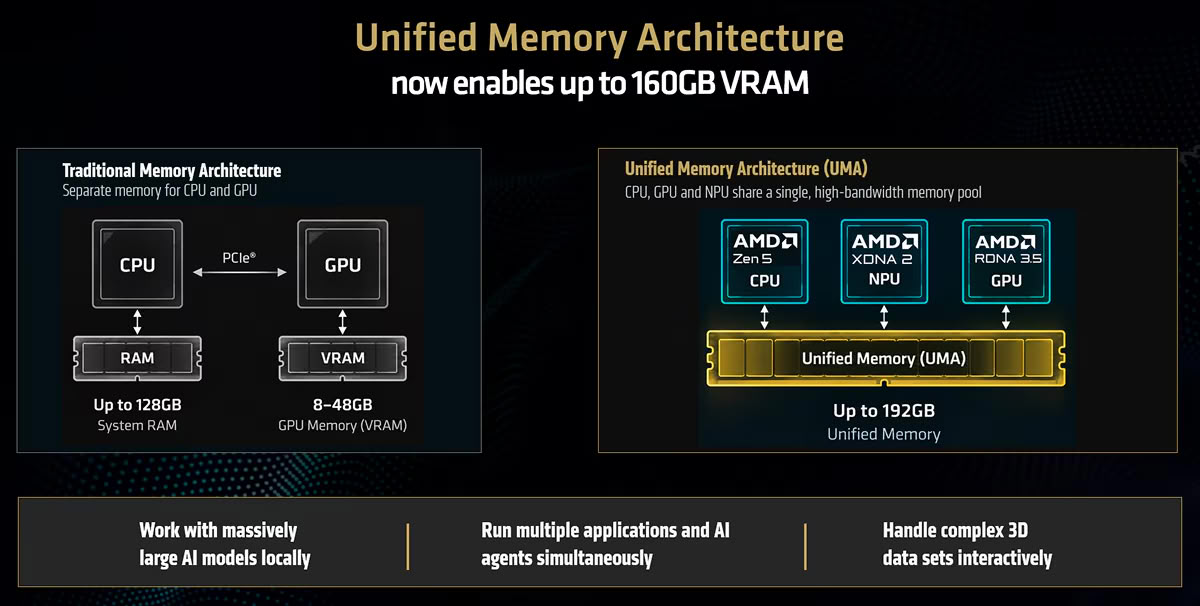
This is possible because the CPU, GPU, and NPU share a single high-bandwidth memory pool. Up to 160 GB can be allocated to the GPU as VRAM, providing significantly more room for models, datasets, applications, and active working context.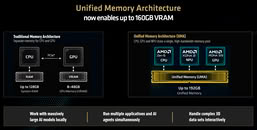 More stays in memory. More can run locally. More remains under your control.
Go Beyond Tokens to Finished Work
Tokens per second and time-to-first-token remain useful measures, but agentic AI does more than generate a response.
An agent may read files, call tools, coordinate parallel processes, create content, validate its output, and prepare a finished deliverable. That makes orchestration, memory, and end-to-end completion as important as model inference alone. Ryzen AI Halo is balanced for the entire workflow. The CPU orchestrates. The GPU and NPU accelerate. Unified memory keeps models and working data ready.
The goal is not simply the next token; it is finishing the job.
Performance for a New Generation of Creative AI
Large-model capacity is only part of the Ryzen AI Halo story. Developers also need performance across a rapidly expanding range of generative AI experiences, including image, video, music, and 3D creation.
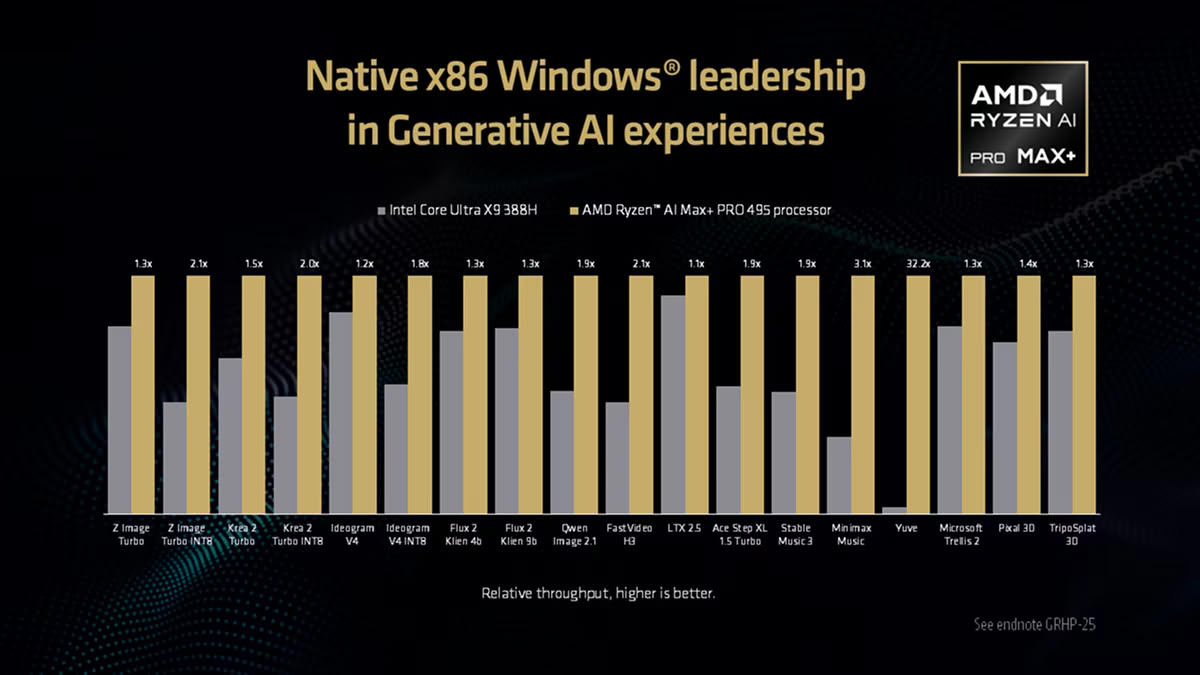
Powered by the AMD Ryzen AI Max+ PRO 495 processor and AMD ROCm software, Ryzen AI Halo delivers native x86 Windows performance across a broad collection of generative AI workloads. AMD testing covers experiences including Z Image Turbo, Krea 2 Turbo, Ideogram V4, FLUX.2, Qwen Image, FastVideo, LTX, ACE-Step, Stable Music, Microsoft Trellis, and emerging 3D-generation tools.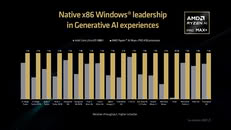 Across the workloads tested, the AMD Ryzen AI Max+ PRO 495 processor delivered higher relative throughput than the Intel Core Ultra X9 388H comparison system. These results demonstrate the breadth of generative AI experiences available through the native x86 Windows ecosystem.
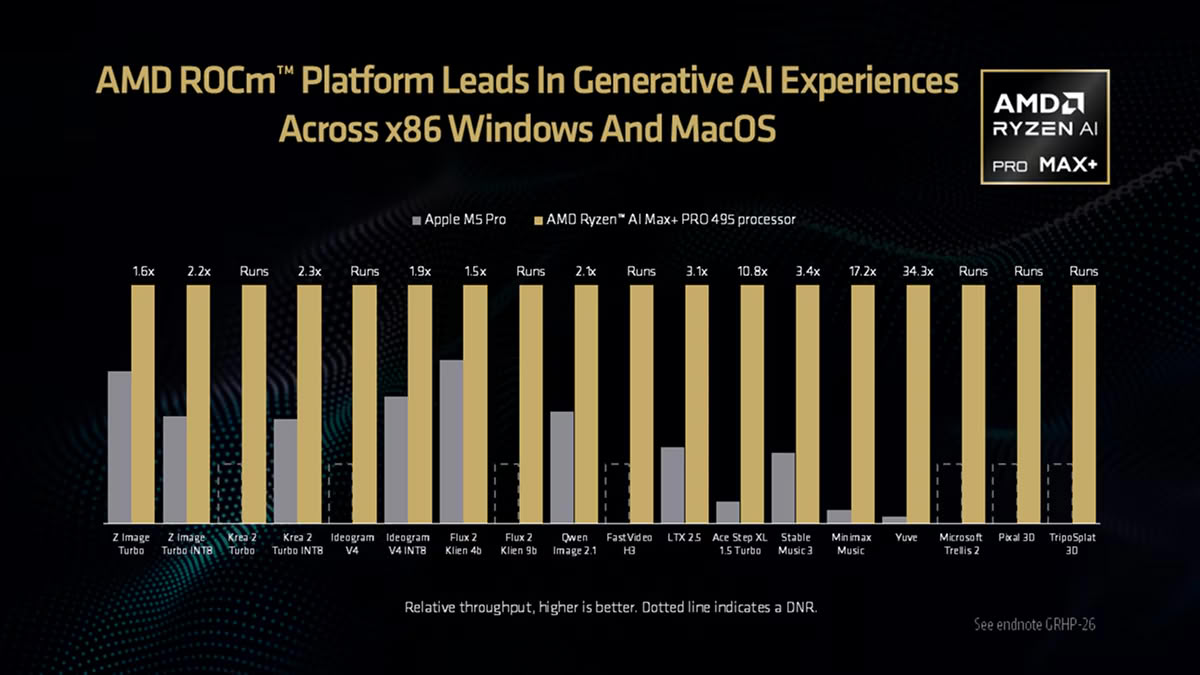
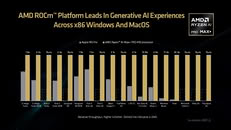 In AMD testing against an Apple M5 Pro comparison system, Ryzen AI Halo delivered higher relative throughput across the tested generative AI workloads, while several workloads on the comparison platform couldn't run. Together, the results show how AMD ROCm software, integrated AMD RDNA 3.5 graphics, and large unified memory provide a strong foundation across image, video, audio, and 3D generation.
Power On and Start Building
AMD Ryzen AI Halo is designed to shorten the distance between first boot and first token.
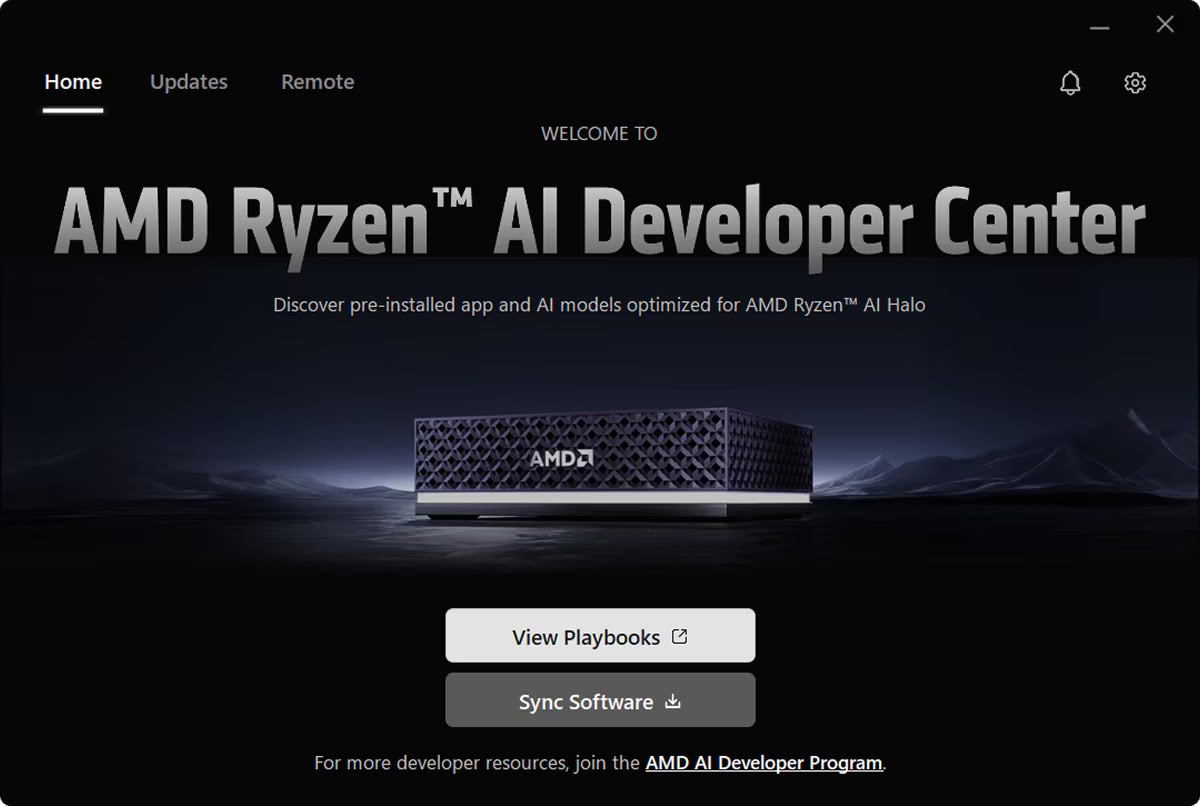
The AMD Ryzen AI Developer Center brings software, platform controls, features, and updates into one destination. Preloaded apps and models help developers get started quickly, while AMD AI Playbooks provide guided paths through supported AI workflows. AMD validates ROCm software, drivers, frameworks, applications, and models together as a Best-Known Configuration. Developers can explore new tools while retaining the ability to update or restore the validated environment through the Developer Center.
Less setup. Less troubleshooting. More time building. Plug it in, power it on, and get to your first token in minutes.
Your AI. Your Workflow. Your Terms.
Run large models locally. Build agents around your own tools and data. Accelerate creative workflows across image, video, music, and 3D. Connect to the cloud when the work calls for it, not because the platform requires it.
AMD Ryzen AI Halo brings the compute, memory, software, and freedom to turn ambitious ideas into finished work, right on your desk.
Order your Ryzen AI Halo, powered by the AMD Ryzen AI Max+ PRO 495 processor today from Micro Center.
Windows-based Ryzen AI Halo developer platforms equipped with the AMD Ryzen AI Max+ PRO 495 processor and Windows Project Zenith will be coming soon.
Source:
AMD blog
With up to 192 GB of unified memory, support for 300-billion-parameter and larger models, and a curated software experience, the new platform gives developers and creators the freedom to build, experiment, and run more AI locally. Choose your models, frameworks, operating system, and workflows, then put them to work on your terms.


AI is evolving from assistants that generate responses into agents that coordinate tools, work across applications, and complete multistep tasks. These workflows demand more than fast inference. They need CPU performance for orchestration, accelerated compute for AI, and enough memory to keep models, applications, and working data available at once.
AMD Ryzen AI Halo brings those capabilities together with up to 16 "Zen 5" CPU cores, 40 AMD RDNA 3.5 GPU compute units, up to 55 TOPS NPU, and up to 192 GB of LPDDR5x unified memory.
It is serious AI, graphics and CPU performance in a compact system designed to sit quietly on your desk.
Run Bigger Models. Keep More AI Local.
With up to 192 GB of unified memory, AMD Ryzen AI Halo can support 300-billion-parameter and larger language models at 4-bit quantization. Developers can also run multiple large agents concurrently with discrete KV caches, creating new possibilities for complex local and multi-agent workflows.
This is possible because the CPU, GPU, and NPU share a single high-bandwidth memory pool. Up to 160 GB can be allocated to the GPU as VRAM, providing significantly more room for models, datasets, applications, and active working context.
Go Beyond Tokens to Finished Work
Tokens per second and time-to-first-token remain useful measures, but agentic AI does more than generate a response.
An agent may read files, call tools, coordinate parallel processes, create content, validate its output, and prepare a finished deliverable. That makes orchestration, memory, and end-to-end completion as important as model inference alone.
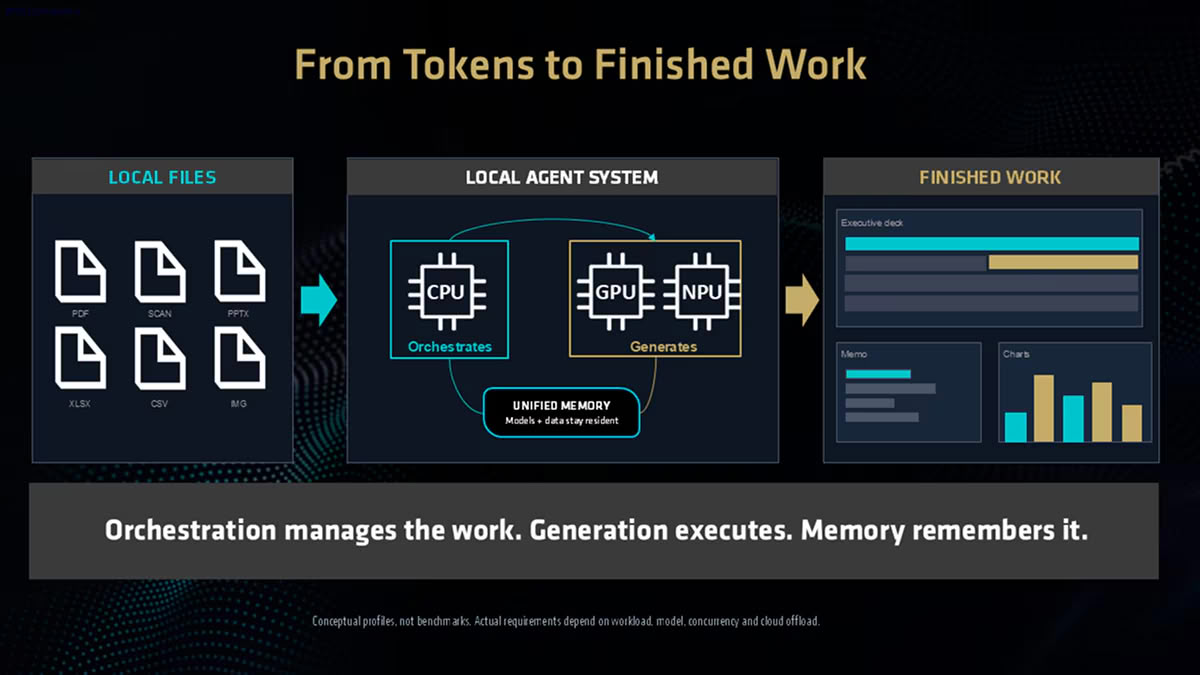
The goal is not simply the next token; it is finishing the job.
Performance for a New Generation of Creative AI
Large-model capacity is only part of the Ryzen AI Halo story. Developers also need performance across a rapidly expanding range of generative AI experiences, including image, video, music, and 3D creation.
Powered by the AMD Ryzen AI Max+ PRO 495 processor and AMD ROCm software, Ryzen AI Halo delivers native x86 Windows performance across a broad collection of generative AI workloads. AMD testing covers experiences including Z Image Turbo, Krea 2 Turbo, Ideogram V4, FLUX.2, Qwen Image, FastVideo, LTX, ACE-Step, Stable Music, Microsoft Trellis, and emerging 3D-generation tools.
Power On and Start Building
AMD Ryzen AI Halo is designed to shorten the distance between first boot and first token.
The AMD Ryzen AI Developer Center brings software, platform controls, features, and updates into one destination. Preloaded apps and models help developers get started quickly, while AMD AI Playbooks provide guided paths through supported AI workflows.
Less setup. Less troubleshooting. More time building. Plug it in, power it on, and get to your first token in minutes.
Your AI. Your Workflow. Your Terms.
Run large models locally. Build agents around your own tools and data. Accelerate creative workflows across image, video, music, and 3D. Connect to the cloud when the work calls for it, not because the platform requires it.
AMD Ryzen AI Halo brings the compute, memory, software, and freedom to turn ambitious ideas into finished work, right on your desk.
Order your Ryzen AI Halo, powered by the AMD Ryzen AI Max+ PRO 495 processor today from Micro Center.
Windows-based Ryzen AI Halo developer platforms equipped with the AMD Ryzen AI Max+ PRO 495 processor and Windows Project Zenith will be coming soon.
6 Comments on AMD Introduces Its Next Ryzen AI Halo Developer Platform With Ryzen AI Max+ PRO 495
Rdna5 isn't coming out until second half of 2027 (read: end of year) and the mobile chips lag behind significantly from desktop releases. Since Medusa is going to be rDNA 5, it'll be at least a year if not longer.
I mean, price for price, this seems way more capable than what the heck PS6, Helix or Machine² are going to be capable of (based on rumors), and you might just as well double as a regular desktop.
Medusa halo will be interesting but odds are it will be significantly smaller than the next gen consoles.
(Not to mention the rest, and a smaller footprint)