News Posts matching #equipment

Return to Keyword Browsing

Sercomm Unveils Wi-Fi 8 Platform at Network X

Sercomm (TWSE: 5388), a leading provider of telecom and broadband equipment, today announced the launch of its next-generation wireless connectivity platforms built on Broadcom's latest Wi-Fi 8 chipset. Designed around the new IEEE 802.11bn standard, Sercomm's Wi-Fi 8 platform delivers deterministic latency, multi-gigabit throughput, intelligent spectrum management, and integrated AI/ML capabilities—the ideal foundation for AI-driven homes. The platform enables operators to elevate subscriber experience while unlocking new service revenues.

"Wi-Fi 8 is a strategic enabler for carriers aiming to differentiate on experience, not just bandwidth," said Derek Elder, President of Sercomm's Service Provider Business Group. "We are proud to be among the first OEMs partnering with Broadcom to introduce Wi-Fi 8 connectivity solutions. Together, we're providing operators a turnkey platform that unifies next-generation connectivity, smart-home orchestration, and edge intelligence—all within a single device."

Texas Instruments Unveils DLP991UUV Digital Micromirror Device for Advanced Packaging

Texas Instruments is enhancing the next generation of digital lithography with the introduction of the DLP991UUV digital micromirror device (DMD), the company's highest resolution direct imaging solution to date. With 8.9 million pixels, sub-micron resolution capabilities and a data rate of 110 gigapixels per second, the device eliminates the need for expensive mask technology while delivering the scalability, cost-effectiveness and precision needed for increasingly complex packaging.

Why it matters
Maskless digital lithography machines - which project light for etching circuit designs on materials without a photomask or high-end stencil - are becoming increasingly popular for the manufacturing of advanced packaging. Advanced packaging combines multiple chips and technologies into a single package, enabling high-computing applications, such as data centers and 5G, to have systems that are smaller, faster, and more power-efficient.

Jarnistech Launches Glass Substrate Solutions, Breaking Through the Boundaries of Next-Generation PCB Materials

Jarnistech, a PCB manufacturer specializing in high-end multilayer and specialty material boards, has recently launched its glass-based PCB solution. The solution has already been adopted in customer prototype validation projects, targeting applications that demand tight control over signal loss, thermal stability, and optical transparency.

As electronic systems evolve toward RF transmission, optoelectronic integration, and miniaturization, glass PCBs have emerged as a promising alternative to overcome material performance bottlenecks. Compared with traditional FR-4, glass substrates offer superior insertion loss characteristics, impedance consistency, thermal stability, and optical clarity.

TECO Electric & Machinery and Hon Hai Technology Group Announce Strategic Alliance Targeting AI Data Center Capabilities

TECO Electric & Machinery Co Ltd ("TECO") and Hon Hai Technology Group ("Foxconn") held a major press conference today (30th) at the Taiwan Stock Exchange to announce a strategic alliance through a board-approved share exchange. This partnership combines TECO's strengths in electromechanical systems with Foxconn's expertise in ICT to seize the global trend of AI data center development toward standardization and modularization, jointly tapping into vast AI data center (AIDC) business opportunities worldwide. Going forward, the strategic alliance will explore the possibility of expanding cooperation in Foxconn's "3+3+3" areas.

According to terms approved by both boards, respectively, TECO will take a 0.519% stake in Foxconn. In turn, Foxconn will own 10% in TECO. The latter will issue 237,644,068 new shares to Foxconn, and Foxconn will issue 72,481,441 new shares to TECO, implying a share exchange ratio of approx. 1 to 0.305. The no-cash transaction is targeted to complete in the fourth quarter of this year, conditional on regulatory approvals.

This Week in Gaming (Week 31)

Welcome to the last week of July and another fairly packed week of new game releases. We kick off the week with a cosy trip to the shire, which is swiftly followed by some vehicular combat, some insect action, a virtual rebellion, a bit of law and order and finally landing in a post-apocalyptic world. We also have a few more new games that didn't quite make the list this week.

Tales of the Shire: A The Lord of The Rings Game / This week's major release / Tuesday 29 July
Welcome home, Hobbit! Live the cosy life of a Hobbit in the wonderfully serene landscape of the Shire. Discover, decorate, & share in this idyllic corner of Middle-earth. Join friendly Hobbits & familiar faces awaiting your arrival in Tales of the Shire: A The Lord of the Rings Game. Steam link

Landmark Esports Suite Launches on UK Aircraft Carrier as Royal Navy and British Esports Partner for Unique Facility

The floating esports suite will allow the ship's company of HMS Prince of Wales to compete against each other in an immersive gaming environment as part of a partnership between the Royal Navy and the British Esports Federation. While the classic Royal Navy game 'Uckers' is still going strong, the suite will allow further opportunities for ship's company to enhance digital skills and an additional space to decompress in their down time.

It's the result of a partnership between the Royal Navy and the British Esports Federation, the national body for esports in the United Kingdom. The facility includes 12 high-end Alienware Aurora R15 gaming desktop PCs, powered by NVIDIA GeForce RTX 4080 and Intel Core i7 processors. It will join other sports facilities onboard, including gyms, a boxing ring, plus areas for table tennis and running.

ZOWIE Unveils First European Sports Science Lab

ZOWIE, the leading esports-focused brand of BenQ Corporation, proudly announces the establishment of its first European Sports Science Lab in Eindhoven. As the third lab in ZOWIE's global network, this new facility underscores the brand's commitment to applying sports science to esports peripheral design, now with strategic emphasis on Europe's thriving competitive scene.

"With the ZOWIE Sports Science Lab, we're bringing scientific methodology to help European pro players unlock their full potential," said Jay Wu, President of BenQ Europe B.V. "Every design is grounded in real-world player data and expert insights, reflecting our dedication to performance-driven product innovation and the future of esports."

TSMC Reportedly Surpasses 90% Production Yield Rate with 2 nm Process

At the tail end of Q1'25, industry whispers suggested that TSMC's premier facilities had completed cutting/leading-edge 2 nm (N2) trial production runs. By early April, company insiders alluded to a confident push into preparations for a futuristic 1.4 nm node at the "P2" Baoshan Plant. This is a very distant prospect; watchdogs envision a 2028 release window. According to expert predictions, cross-facility 2 nm wafer mass production phases are expected to start by the end of this year. Foundry staff seem to be actively pursuing an improvement in yields; earlier guesstimates indicated the crossing of a 70% milestone—good enough for full-blown manufacturing runs.

Fresher musings point to staffers and advanced equipment achieving and stepping just beyond an impressive 90% mark, albeit with silicon intended for "memory products." As of mid-May, Samsung's competing "SF2" product—allegedly—remains in testing phases. South Korean insider news reports posit 2 nm GAA trial yields passing 40%—a significant development for the megacorp's foundry business. Roughly a month ago, (in public) TSMC leadership spoke about an unprecedented demand for 2 nm wafers. Due to rumors of greater than anticipated charges for important TSMC clients, Samsung Semi's top brass is supposedly trying to woo the likes of NVIDIA and Qualcomm.

D-Link Unveils the New DBR Router & Access Point

D-Link Corporation, a global leader in networking solutions, is pleased to announce the launch of its latest DBR Series, which includes the DBR-600-P and DBR-700 business routers, as well as the DBR-X3000-AP smart access point. This new series delivers powerful, secure, and easy-to-manage networking tailored specifically for small business environments such as startups, retail shops, satellite offices, and educational facilities with fewer than 100 users.

With the growing demands of hybrid work and decentralized operations, many small businesses face challenges in establishing a stable and secure network without dedicated IT resources. The DBR Series addresses these challenges by offering streamlined deployment, reliable performance, and centralized management. Each product in the series embodies D-Link's unwavering commitment to high-quality, Made-in-Taiwan craftsmanship, which stands for trusted engineering, meticulous manufacturing, and product reliability. This quality standard reflects Taiwan's globally respected technology ecosystem and reinforces the durability and integrity of the DBR series.

NVIDIA & SAP Partnership Will Bring AI Agents to the Physical World

As robots increasingly make their way to the largest enterprises' manufacturing plants and warehouses, the need for access to critical business and operational data has never been more crucial. At its Sapphire conference, SAP announced it is collaborating with NEURA Robotics and NVIDIA to enable its SAP Joule agents to connect enterprise data and processes with NEURA's advanced cognitive robots. The integration will enable robots to support tasks including adaptive manufacturing, autonomous replenishment, compliance monitoring and predictive maintenance. Using the Mega NVIDIA Omniverse Blueprint, SAP customers will be able to simulate and validate large robotic fleets in digital twins before deploying them in real-world facilities.

Virtual Assistants Become Physical Helpers
AI agents are traditionally confined to the digital world, which means they're unable to take actionable steps for physical tasks and do real-world work in warehouses, factories and other industrial workplaces. SAP's collaboration with NVIDIA and NEURA Robotics shows how enterprises will be able to use Joule to plan and simulate complex and dynamic scenarios that include physical AI and autonomous humanoid robots to address critical planning, safety and project requirements, streamline operations and embody business intelligence in the physical world.

Open-world survival game Horizon Journey lands on Steam (and Mars) on June 27, 2025

Prepare for humanity's next giant leap in Horizon Journey, an ambitious open-world survival game set on a stunningly authentic recreation of Mars, launching on Steam on June 27, 2025. Developed using real NASA imagery, Horizon Journey challenges players to colonise the infamous Red Planet. Future pioneers can get an early taste of Martian life during the upcoming Steam Next Fest in June, with a playable demo available shortly before the event kicks off!

In Horizon Journey, players step into the boots of a member of the 17th Endeavor Mission in the year 2053. Your mission: survive the hostile Martian environment, establish a foothold for humanity, and begin the monumental task of terraforming. This is not just another sci-fi backdrop; Horizon Journey offers a vast, explorable Mars rendered with unparalleled realism, presenting unique survival challenges drawn from the planet's actual conditions.

China Rumored to Acquire 12-High HBM3E Bonders Through Korean Companies

China is pushing forward with its HBM (High Bandwidth Memory) progress as part of its plan to be self-sufficient in the semiconductor industry. JCET Group, China's top semiconductor packaging firm, has bought advanced TC (thermal compression) bonders that are usually used for 12-high stacks of HBM3E chips, according to Money Today Korea (MTN). This state-of-the-art equipment comes from Korean companies where export rules are less strict. This lets China jump from its current HBM2 technology to more advanced memory solutions. However, even if China isn't yet going to produce HBM3E chips soon, having this equipment is useful to boost manufacturing yields even for lower-spec HBM products.

China's desire to make HBM chips at home is a reaction to U.S. rules and taxes meant to hold back its chip abilities. These steps haven't slowed progress; instead, they have made China more determined to stand on its own in chip-making. The AI chip design market hit $18.4 billion last year and is set to grow 28% each year until 2032. The plan aims to supply Chinese-made HBM chips to big tech firms like Huawei, Tencent, and DeepSeek. This helps China get around U.S. export limits while moving its chip industry up in value. Choi Jae-hyeok, Professor of Electrical and Information Engineering, Seoul National University says, "In China's case, it is government-led... In the case of DDR, they are making up to DDR4 and DDR5. China has always wanted to move from low-value-added products to high-value-added products. The next direction is HBM..."

China's Semiconductor Equipment Market Share Rises as Taiwan, Korea and Japan Decline

The global semiconductor industry is experiencing notable shifts, largely influenced by the rapid expansion of the Mainland China market. From 2010 to 2024, China's share of global semiconductor equipment sales rose significantly, from just 6% in 2010 to 38% in 2024. On the other side McKinsey reports that market shares in Taiwan, Korea and Japan are declining. Taiwan has started to build semiconductor fabs in the US and Europe, while Japan has seen few new fab projects despite TSMC's upcoming Kumamoto plant. At the same time, the US and Europe, the Middle East, and Africa have kept their market shares steady.

Globalization helped the semiconductor industry grow from 2010 to 2019, during this time Chinese semiconductor companies expanded, with local firms growing by about 21% each year. But growth slowed from 2019 to 2023 because of US sanctions on Huawei which affected its chip division HiSilicon. Even without HiSilicon, China's semiconductor industry still grew by 9-10% in that period. Experts think this growth will continue in the future, a trend that the current US tariffs are only accentuating. China's growing importance in industries like electric vehicles (EVs) and commercial drones is pushing its semiconductor goals even further. In 2023, China accounted for 60% of all new EV registrations around the world. At the same time, political tensions between countries have made China more eager to build a self-reliant domestic semiconductor ecosystem. China is testing a domestic extreme ultraviolet (EUV) lithography system at Huawei's Dongguan facility. The system uses laser-induced discharge plasma technology and is scheduled for trial production in Q3 2025, with mass manufacturing planned for 2026.

Cincoze Unveils 60 New Meteor Lake PS Panel PCs

Rugged embedded computing brand—Cincoze, recently launched 60 new industrial panel PCs based on the Meteor Lake PS platform, expanding the lineup of the Display Computing-CRYSTAL product line to meet increasing performance requirements for edge AI applications. These latest models support Intel Core Ultra i7/i5/i3 processors, include rich native I/O interfaces, and support various expansion sockets, such as M.2 Key E, Key B, and PCI/PCIe expansion slots (P2302E only) to maximize flexibility and help customers meet rapidly-changing application requirements. The new models include industrial panel PCs, sunlight readable panel PCs, and open frame panel PCs for comprehensive coverage of every display computing need.

Improved performance x Power-Saving x AI Boost
Enhanced performance comes courtesy of the latest Intel 4 Core Ultra i7/i5/i3 U series (Meteor Lake-PS) processors, with up to 12 cores and only 15 W low power consumption, providing 1.8x the performance of the previous models. The new built-in Intel NPU delivers faster and more efficient AI boost capabilities for high-volume image processing and AI recognition. There is a dynamic thermal mechanism that automatically adjusts tolerances in all directions to ensure the closest fit between the upper cover and the CPU heat sink. These adjustments solve the heat dissipation challenges of high-performance computing and allow the CPU to operate at full performance.

OKI Develops 124-Layer PCB Technology for Next-Generation Semiconductor Testing Equipment

OKI Circuit Technology, the OKI Group printed circuit board (PCB) company, has successfully developed 124-layer PCB technology for wafer inspection equipment designed for next-generation high bandwidth memory, such as HBM mounted on AI semiconductors. This is a roughly 15% increase in the number of layers over conventional 108-layer designs. OTC is seeking to establish mass production technology by October 2025 at its Joetsu Plant in Joetsu City, Niigata Prefecture, which has a proven track record and advanced development and production capabilities in the field of high multilayer, high-precision, large-format PCBs for semiconductor inspection equipment.

AI processing requires the transmission of vast data volumes between graphics processing unit (GPU) semiconductors and memory. As semiconductor performance increases, the memory installed is also required to have high-speed, high-frequency, and high-density data transfer capabilities. HBM features a stacked DRAM structure, requiring technology capable of fabricating wafers even more thinly and precisely. This configuration also requires that the PCBs used in inspection equipment meet even higher levels of performance and quality.

Fanatec Introduces CSL Elite Steering Wheel Porsche Vision GT

Fanatec, a brand of Corsair and the global leader in sim racing hardware, proudly announces the launch of the CSL Elite Steering Wheel Porsche Vision GT. This officially licensed steering wheel, inspired by the Porsche Vision Gran Turismo concept car in Gran Turismo 7, brings Porsche's visionary design to sim racers worldwide. The CSL Elite Steering Wheel Porsche Vision GT features a 310 mm diameter and a robust cast aluminium frame that balances strength and lightness, making it suitable for the full range of Fanatec bases—from the 5 Nm CSL DD to the 25 Nm Podium DD2. To retain the signature shape and spoke cutouts, our engineers developed an innovative shifter mechanism, delivering a uniquely tactile response.

This is the first wheel to use Fanatec's new Tactaris material. This premium microfiber fabric enhances durability, comfort, and handling during intense racing sessions. Ergonomically optimized for sim racing, the CSL Elite Steering Wheel Porsche Vision GT features a versatile input layout, including two buttons built into the rim—another first for a Fanatec wheel. It features seven rotary encoders, including two multi-position switches and a 7-way FunkySwitch. The four primary encoders are automatically assigned to Gran Turismo 7's MFD system, allowing quick access to traction control, brake balance, torque split, and fuel mapping. The Tuning Menu button is seamlessly integrated into the Porsche crest, allowing for real-time force feedback adjustments via the OLED display.

Foxconn Allegedly Moving its iPhone Production to India

The Taiwan media is reporting that Foxconn has been busy moving more and more of its production from China to India, with the main focus being on Apple's iPhone and iPad products for now. Foxconn has been producing iPhones for the Indian market in India since 2019, but the story here is that China has banned Foxconn from sending Chinese staff to India to train the local staff and oversee the production. This has resulted in Foxconn having to send staff from Taiwan to India instead, but they might not be as familiar with the entire production process as the ones that are based in the factories in China.

This is only part of the issue though, as the news reports are also mentioning that China is preventing Foxconn from sending machines and equipment needed for the production to India. The same issue is said to be affecting other Taiwanese companies that are moving some of their production out of China to India, but they've had no issues when it comes to sending equipment to other nations in South East Asia. The equipment is apparently not possible to produce locally in India either, which means that these companies are more or less being forced to keep their production in China. To work around this issue, Foxconn is said to be sending half-finished phones and components to India, to do the final assembly there, to keep up production in India. So far, this is just rumours out of Taiwan, but it looks like China is intent on keeping the production on its shores for as long as it can.

Tariffs Push US Wafer Fab Equipment Costs Up 15% for Domestic Fabs

As the US works to bring more semiconductor manufacturing back home, the machines needed to turn silicon into the world's most advanced processors are becoming pricier and harder to get, thanks to tariffs. Foundries building new fabs report that the specialized equipment they rely on, everything from extreme ultraviolet (EUV) lithography steppers to chemical vapor deposition chambers, carries a roughly 15% premium compared with similar gear sold overseas. Several forces are at play. The raw materials, high-grade quartz for vacuum enclosures, and exotic metal alloys for precision optics have climbed in price. At the same time, key components like ultra-accurate motion stages and alignment sensors are in short supply, sometimes stretching lead times for critical subsystems well beyond 18 months. For a fab racing to move from a 7 nm to a 5 nm process, those delays can mean missing tight ramp-up targets and pushing out product launches.

Smaller chipmakers feel the squeeze the hardest. With fewer orders to negotiate volume discounts, second-tier foundries may see their capital budgets balloon by 20 percent or more. In response, some are taking a mixed approach, sourcing commoditized tools such as oxidation furnaces and rapid thermal processors from multiple suppliers while reserving single-vendor deals for high-stakes systems like EUV scanners. Government support through the CHIPS Act offers a partial safety net, helping to subsidize capital expenditures. Yet even with grants and tax credits, the challenges will remain. Success will hinge on tight coordination between fabs, equipment makers, and policymakers to tame rising costs, shorten delivery schedules, and keep America's chip renaissance on track.

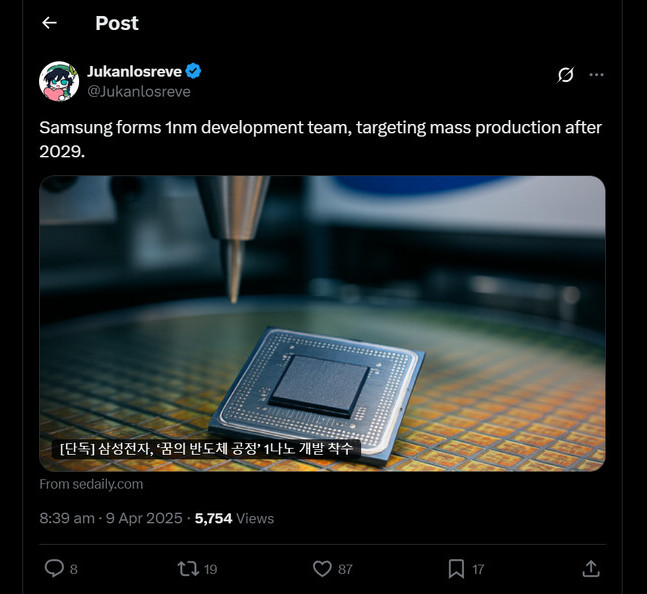
Insider Report Suggests Start of 1 nm Chip Development at Samsung, Alleged 2029 Mass Production Phase Targeted

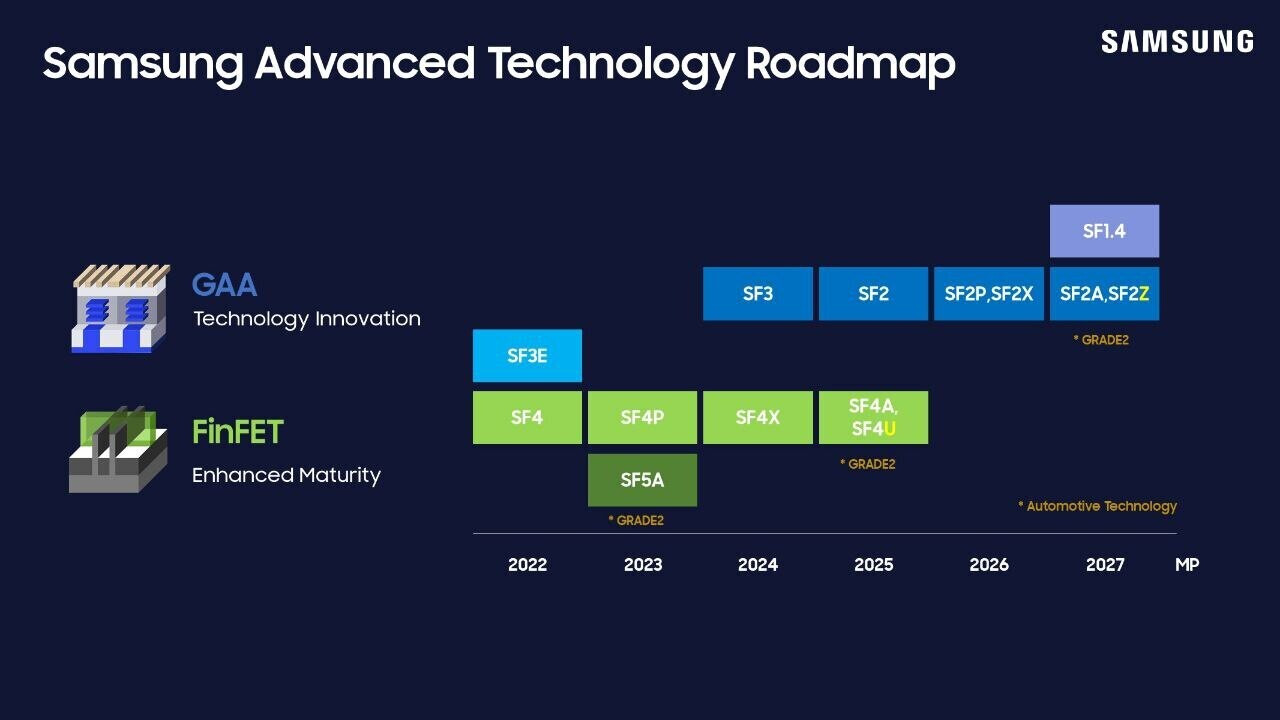
Samsung's foundry business seems to be busying itself with the rumored refinement of a 2 nm GAA (SF2) manufacturing node process—for possible mass production by the end of 2025, but company leadership will very likely be considering longer term goals. Mid-way through last month, industry moles posited that the megacorporation's semiconductor branch was questioning the future of a further out 1.4 nm (SF1.4) production line. Officially published roadmaps have this advanced technology rolling out by 2027. Despite present day "turmoil," insiders believe that a new team has been established—tasked with the creation of a so-called "dream semiconductor process." According to a fresh Sedaily news article, this fledgling department has started development of a 1 nm foundry process.

Anonymous sources claim that Samsung executives are keeping a watchful eye on a main competitor—as stated in the latest South Korean report: "there is a realistic gap with Taiwan's TSMC in technologies that are close to mass production, such as the 2 nm process, the company plans to speed up the development of the 1 nm process, a future technology, to create an opportunity for a turnaround." A portion of the alleged "1 nm development chip team" reportedly consists of veteran researchers from prior-gen projects. Semiconductor industry watchdogs theorize that a canceled SF1.4 line could be replaced by an even more advanced process. Sedaily outlined necessary hardware upgrades: "the 1.0 nanometer process requires a new technology concept that breaks the mold of existing designs as well as the introduction of next-generation equipment such as high-NA EUV exposure equipment. The company is targeting mass production after 2029." Samsung's current Advanced Technology Roadmap does not extend beyond 2027—inside sources claim that the decision to roll with 1.0 nm was made at some point last month.

SMIC Reportedly On Track to Finalize 5 nm Process in 2025, Projected to Cost 40-50% More Than TSMC Equivalent

According to a report produced by semiconductor industry analysts at Kiwoom Securities—a South Korean financial services firm—Semiconductor Manufacturing International Corporation (SMIC) is expected to complete the development of a 5 nm process at some point in 2025. Jukanlosreve summarized this projection in a recent social media post. SMIC is often considered to be China's flagship foundry business; the partially state-owned organization seems to heavily involved in the production of (rumored) next-gen Huawei Ascend 910 AI accelerators. SMIC foundry employees have reportedly struggled to break beyond a 7 nm manufacturing barrier, due to lack of readily accessible cutting-edge EUV equipment. As covered on TechPowerUp last month, leading lights within China's semiconductor industry are (allegedly) developing lithography solutions for cutting-edge 5 nm and 3 nm wafer production.

Huawei is reportedly evaluating an in-house developed laser-induced discharge plasma (LDP)-based machine, but finalized equipment will not be ready until 2026—at least for mass production purposes. Jukanlosreve's short interpretation of Kiwoom's report reads as follows: (SMIC) achieved mass production of the 7 nm (N+2) process without EUV and completed the development of the 5 nm process to support the mass production of the Huawei Ascend 910C. The cost of SMIC's 5 nm process is 40-50% higher than TSMC's, and its yield is roughly one-third." The nation's foundries are reliant on older ASML equipment, thus are unable to produce products that can compete with the advanced (volume and quality) output of "global" TSMC and Samsung chip manufacturing facilities. The fresh unveiling of SiCarrier's Color Mountain series has signalled a promising new era for China's foundry industry.

ASUS Republic of Gamers Bolsters Partnership with Team Vitality

ASUS Republic of Gamers (ROG) and Team Vitality are delighted to announce the extension of their partnership. As of today, Team Vitality's Counter-Strike 2 and VALORANT teams will also benefit from a full range of ROG laptops, desktops and handheld consoles, providing them with even better hardware on their road toward excellence.

Thanks to this new phase of collaboration, Team Vitality players will benefit from cutting-edge gaming equipment, adapted to the demands of the highest competitive level. These computers will offer unrivalled processing power, ultra-high refresh rates and minimal latency, guaranteeing maximum precision and responsiveness in both training and competition. This partnership with Team Vitality marks a further step in ROG's drive to innovate and offer professional and amateur gamers alike an increasingly immersive and high-performance gaming experience.

Cervoz Announces T455 NVMe SSD Series - Offering Advanced Endurance for Demanding Industries

In industrial environments, equipment runs 24/7, handling frequent and intensive write operations. To support these demanding workloads, storage solutions must offer high endurance to extend lifespan, minimize downtime, and lower Total Cost of Ownership (TCO). Designed to meet these demands, the Cervoz T455 Series, M.2 2280 NVMe SSD delivers 35% greater endurance through a refined firmware architecture and proven storage technologies. Ideal for industrial automation, edge computing, and high-performance computing (HPC), it ensures reliable performance under heavy workloads.

Enhanced Endurance for Demanding Industrial Applications—Over-Provisioning Technology: Endurance SSD Performance and Longevity
Cervoz's Over-Provisioning technology optimizes SSD performance by reserving extra storage space, boosting efficiency, and extending lifespan. How SSD Over-Provisioning Delivers Benefits:
  • Extended Lifespan: Efficiently reserves additional storage space, enhancing NAND durability at least 35%.
  • Consistent Performance: Maintains steady performance levels even under high-intensity workloads.
  • Optimized Resource Management: Reserved space allocation for optimal write efficiency.

Chinese SiCarrier Shows a Complete Silicon Manufacturing Flow: Deposition, Etching, Metrology, Inspection, and Electrical Testing

SiCarrier, a Huawei-backed Chinese semiconductor tool manufacturer, has launched a comprehensive suite of semiconductor manufacturing tools at this year's Semicon China. These tools are strategically essential to China's semiconductor self-sufficiency and a major step towards competitive nodes from the mainland. The new lineup spans multiple categories: optical inspection, deposition, etch, metrology, and electrical performance testing. Until now, Chinese chipmakers often depended on older-generation foreign equipment, but SiCarrier's new lineup promises domestic alternatives tailored to modern manufacturing processes. The tools address every stage of semiconductor fabrication, from inspecting microscopic defects to etching intricate circuits.

For quality control, SiCarrier's Color Mountain series functions like a high-powered microscope, using intense lighting and advanced imaging algorithms to examine both sides of silicon wafers for flaws as small as dust particles. Complementing this, the Sky Mountain series ensures the perfect alignment of circuit layers, which need perfect stacking, using diffraction-based measurements (analyzing light patterns) and direct image comparisons. The New Mountain suite combines specialized tools to analyze materials at the atomic level. One standout is the atomic force microscope (AFM), which maps surface topography with a nanoscale "finger," while X-ray techniques (XPS, XRD, XRF) act like forensic tools, revealing the chemical composition, crystal structure, and elemental makeup.

China Leads as Global Semiconductor Fab Investment Expected to Reach $110B in 2025

Global fab equipment spending for front-end facilities in 2025 is anticipated to increase by 2% year-over-year (YoY) to $110 billion, marking the sixth consecutive year of growth since 2020, SEMI announced today in its latest quarterly World Fab Forecast report.

Fab equipment spending is projected to rise by 18% in the following year, reaching $130 billion. This growth in investment is driven not only by demand in the high-performance computing (HPC) and memory sectors to support data center expansions, but also by the increasing integration of artificial intelligence (AI), which is driving up the silicon content required for edge devices.

Capcom Details First Free Content Update for Monster Hunter Wilds, Coming April 3

It's been nearly one month since the release of Monster Hunter Wilds on PC and modern consoles! Thank you to all hunters around the world for your incredible support. Whether you're a series veteran with many hunts under your belt, or started your hunting journey with Wilds, we hope you've been enjoying making your way through the game and putting in many hours of hunts in High Rank, long after the credits have rolled. Today, we're excited to share what's next for Monster Hunter Wilds by taking the wraps off of the game's first Free Title Update.

The graceful Leviathan Mizutsune makes its way to the Wilds
Equal parts dazzling and dangerous, Mizutsune moves almost as if it's dancing, and skillfully attacks foes with debilitating bubbles. Get your gear ready to take on this returning monster for the first time in Monster Hunter Wilds. Mizutsune also comes with stylish new armor sets to forge for your hunter and Palico. An eight-star Tempered Mizutsune will also appear. To start the Mizutsune hunt, talk to Kanya in the Scarlet Forest Base Camp at Hunter Rank (HR)21 or above.
Return to Keyword Browsing
Nov 26th, 2026 19:39 CST change timezone

New Forum Posts

Popular Reviews

TPU on YouTube

Controversial News Posts