 284
AMD FSR 5 Scarlet Cortex Preview - Published April 1st
Visual Comparisons »SDK Integration
While Scarlet Cortex's driver-level mode is impressive on its own, AMD says they will also release an SDK that allows developers to optionally provide first-class integration. The SDK exposes additional rendering data that the driver can't reliably reconstruct on its own, giving the neural renderer significantly more (and better) information to work with.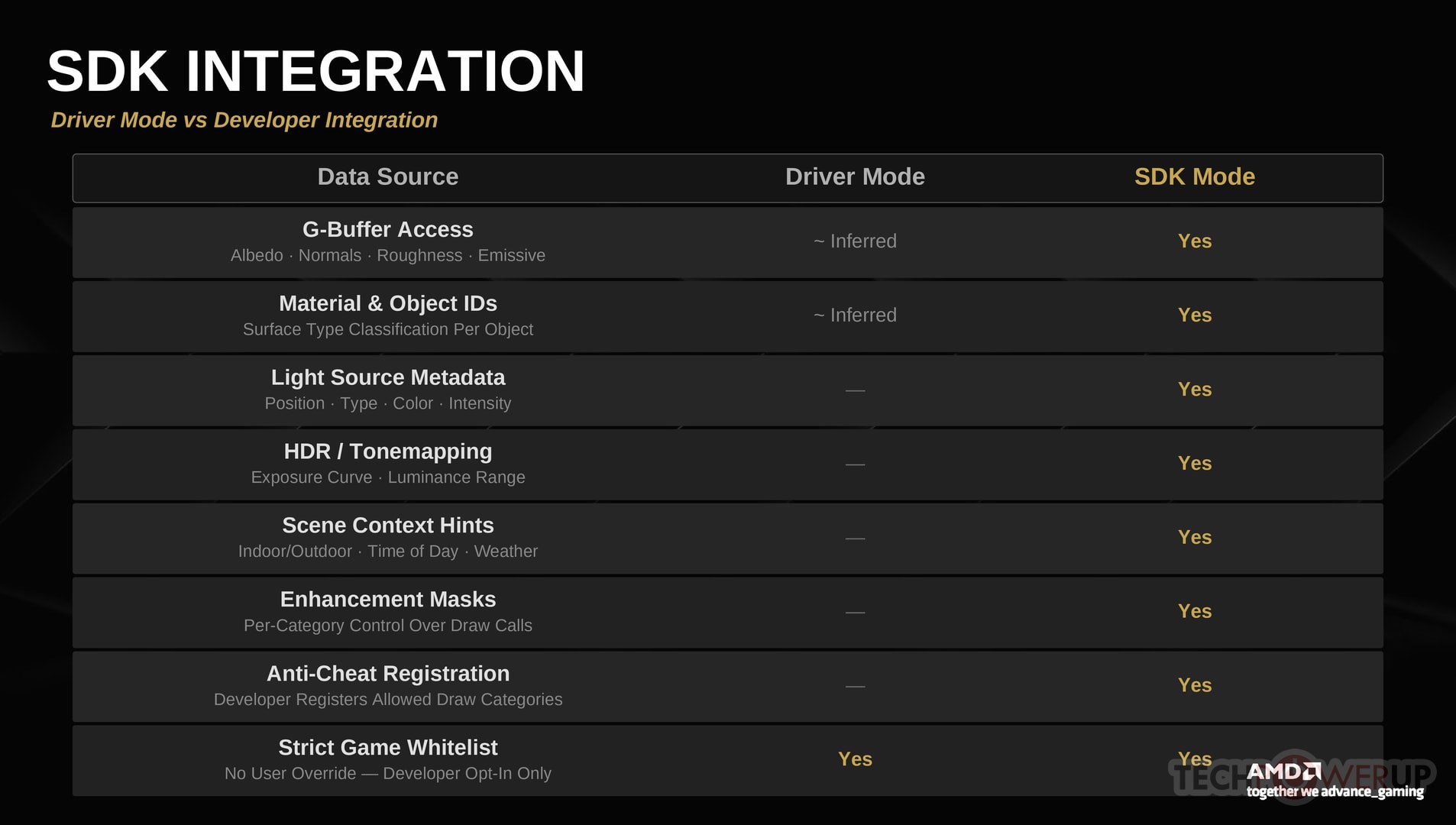
With SDK integration, developers can provide:
- Direct G-buffer access: albedo, world-space normals, roughness/metallic maps, and emissive data—eliminating guesswork from the shader introspection stage.
- Material and object IDs: explicit classification of surfaces (skin, hair, foliage, glass, water) so the model can apply specialized enhancement per material type.
- Light source metadata: position, type (point, spot, directional, area), color, and intensity for all active lights in the scene—giving the neural renderer ground truth about where light is coming from.
- HDR exposure and tonemapping parameters: the intended brightness curve for the scene, so FSR 5 can enhance within the correct luminance range.
- Scene context hints: indoor/outdoor flag, time of day, weather state—metadata that helps the model prioritize the right kind of enhancement.
AMD tells us that several developers are already working on SDK integration for upcoming titles. The SDK uses the same FidelityFX framework that developers are already familiar with from FSR 4, which should lower the integration barrier.
Anti-Cheat and Multiplayer
A technology that modifies how a game looks like raises obvious questions about competitive multiplayer. Could FSR 5 enhance enemy player visibility? Could it make dark corners brighter or highlight characters against backgrounds? It definitely could.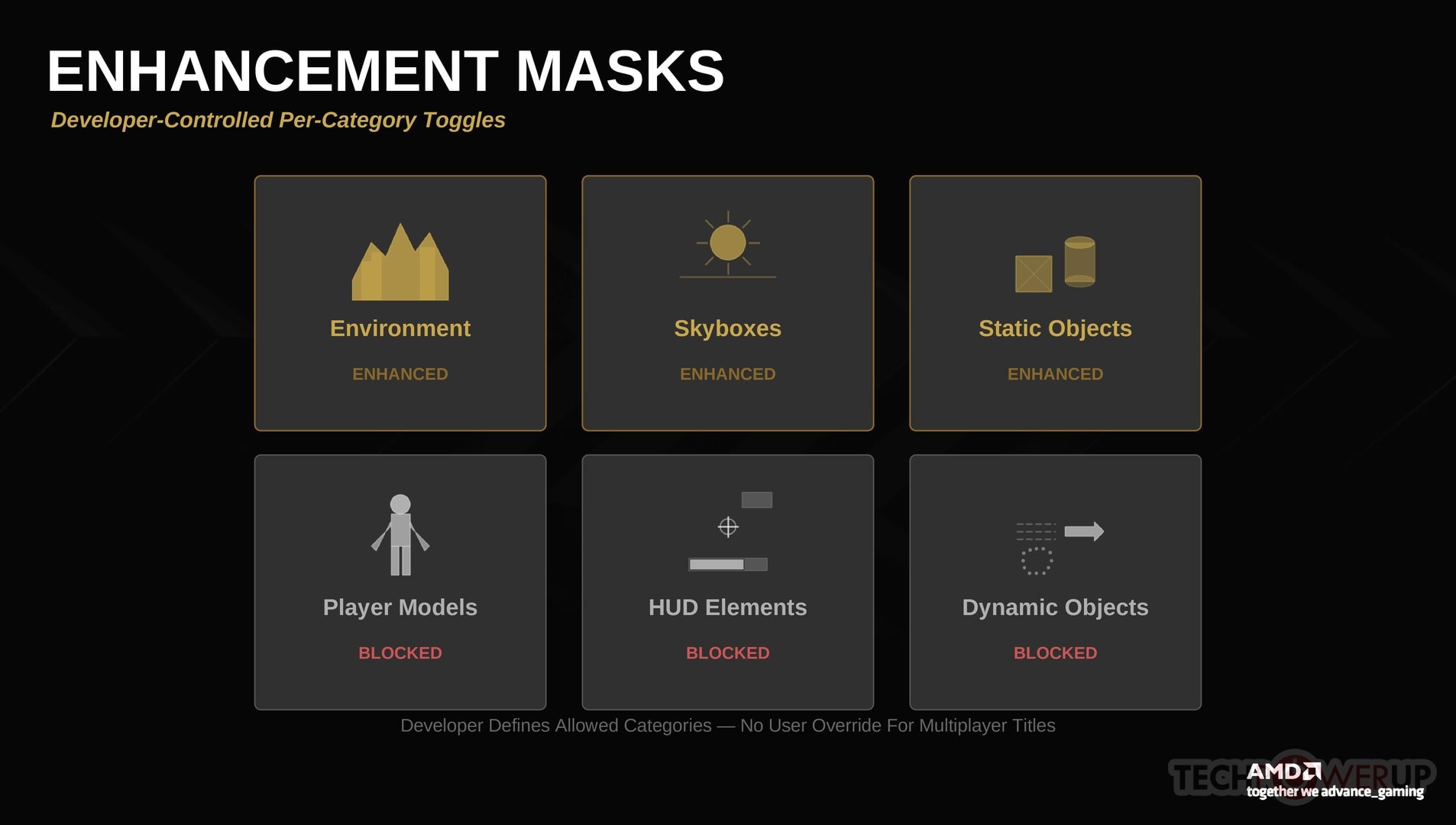
AMD has taken a conservative approach for the launch phase. FSR 5 only activates in games that have been explicitly added to AMD's validated game list. This is a strict whitelist—if the game isn't on the list, the feature is unavailable, and there is no user override. AMD plans to relax this over time: once the technology has matured, the goal is to make FSR 5 available as a user-toggleable option in Radeon Software for any single-player game, similar to how NVIDIA allows DLSS overrides in the GeForce control panel today. Competitive multiplayer titles will remain on an exclusion list.
For multiplayer games with anti-cheat systems (EAC, BattlEye, Vanguard, etc.), the game's developer must additionally register an enhancement mask before the game can be whitelisted. This mask provides fine-grained toggles, to define which draw call categories FSR 5 is allowed to touch. A typical multiplayer configuration would allow enhancement of environment geometry, skyboxes, terrain, and static objects, while excluding all player models, HUD elements, and dynamic gameplay objects. The driver's mesh and shader classification system (described on the previous page) is what enables this per-category control.
Without developer opt-in, multiplayer games with active anti-cheat systems will simply never appear on the whitelist. The decision about what constitutes a competitive advantage is left entirely to the game's developer.
AMD has told us they are working with Activision, Ubisoft, and EA on early multiplayer whitelisting for several titles. For now, the launch whitelist consists entirely of single-player games and cooperative titles:
Supported Games (at Launch)
- Black Myth: Wukong
- Cyberpunk 2077
- F1 25
- God of War Ragnarok
- Grand Theft Auto V Enhanced
- Hogwarts Legacy
- Mafia: The Old Country
- Stalker 2
- Starfield
Nov 15th, 2026 00:37 CST
change timezone
Latest GPU Drivers
New Forum Posts
- Bought MAX-P495 - Which model? (32)
- "Legacy Control Panel" won't install (1)
- Tell me about your favourite graphics card (84)
- Honestly, do you care about GTA VI? (25)
- WarpCoreBench scores! (45)
- Planning for Prolonged High Prices and Maintaining What You Already Have (72)
- What can the FX 8320 do today? Here is the answer. (47)
- Recommendations Wanted - Affordable Enterprise SSD for Boot (3)
- [INTEL]-How To Update Your Microcode for Intel HX 13/14th Gen. CPUs Laptops/Mobile Easily. (260)
- [Intel AX1xx/AX2xx/AX4xx/AX16xx/BE2xx/BE17xx] Intel Modded Wi-Fi Driver with Intel® Killer™ Features (632)
Popular Reviews
- AMD Zen 6 Technical Deep Dive
- ASUS ROG Strix B850-I Gaming Wi-Fi7 W Review
- Corsair HX1000i Shift Crystal Review
- Upcoming Hardware Launches 2027 (Updated Nov 2026)
- Montech King 95 3D PRO Review
- NZXT C1200 Platinum Review
- NZXT H7 RGB+ Review
- NZXT H5 Review
- Phantom Blade Zero Performance Benchmark Review - 35 GPUs Tested
- AMD Ryzen 7 9800X3D Review - The Best Gaming Processor
TPU on YouTube
Controversial News Posts
- NVIDIA Co-Founder and CEO Jensen Huang Officially Resigns (408)
- OpenAI CEO Argues Home PCs Waste the World's Limited DRAM Supply (152)
- NVIDIA Launches Investigation Into Jensen Huang's Relationship With Suspected Chinese Spy (136)
- Intel "Raptor Lake Next" 16-Core and 20-Core CPUs Surface (130)
- Legendary Game Studio BioWare Shuts Down Following EA Layoffs (104)
- Dell CEO Says the Memory Shortage Will Get Worse in 2027 (95)
- NVIDIA GeForce RTX 50-Series Scheduled for up to $500 Price Hike This Week (89)
- Modder Fits RTX 5090 With Four 8-Pin Connectors, Halving Current per Wire (80)