 284
AMD FSR 5 Scarlet Cortex Preview - Published April 1st
Conclusion »Performance
All performance testing was done on a Radeon RX 9070 XT at 1440p resolution with maximum game settings. Frame rates were measured after the FSR 5 model had fully converged (10+ minutes of gameplay).FPS Impact by Quality Mode

The performance overhead is consistent with AMD's claims: roughly 8–10% for Quality, 4–5% for Balanced, and 2–3% for Performance. These numbers are remarkably stable across different games, which makes sense—the AI core workload is largely independent of what the shader units are doing. Whether the game is GPU-bound or CPU-bound doesn't significantly affect FSR 5's overhead, because the neural rendering runs on dedicated hardware.
VRAM Usage
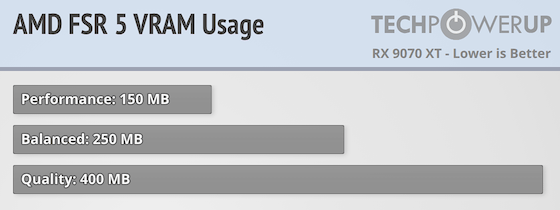
VRAM overhead matches AMD's specifications: approximately 400 MB for Quality, 250 MB for Balanced, and 150 MB for Performance. This is on top of the game's own VRAM usage. On the RX 9070 XT with its 16 GB of VRAM, this was never an issue, but it could become a concern on 12 GB GPUs in VRAM-heavy titles at 4K. The per-game pre-analysis cache stored on disk is typically 20–50 MB per game.
Level Load Times
The one-time texture, mesh, and shader pre-analysis adds a small amount of time to level loads. In our testing, the overhead ranged from 1.2 seconds (F1 25, relatively few unique assets) to 3.1 seconds (Cyberpunk 2077, massive open world with extensive asset streaming). On subsequent launches, the cached analysis data is reused and the overhead drops to near zero—typically under 0.3 seconds for cache validation.This is a one-time cost per game that most players will barely notice, especially since modern games can already have substantial load times, even on NVMe SSDs.
Nov 15th, 2026 00:23 CST
change timezone
Latest GPU Drivers
New Forum Posts
- Bought MAX-P495 - Which model? (32)
- "Legacy Control Panel" won't install (1)
- Tell me about your favourite graphics card (84)
- Honestly, do you care about GTA VI? (25)
- WarpCoreBench scores! (45)
- Planning for Prolonged High Prices and Maintaining What You Already Have (72)
- What can the FX 8320 do today? Here is the answer. (47)
- Recommendations Wanted - Affordable Enterprise SSD for Boot (3)
- [INTEL]-How To Update Your Microcode for Intel HX 13/14th Gen. CPUs Laptops/Mobile Easily. (260)
- [Intel AX1xx/AX2xx/AX4xx/AX16xx/BE2xx/BE17xx] Intel Modded Wi-Fi Driver with Intel® Killer™ Features (632)
Popular Reviews
- AMD Zen 6 Technical Deep Dive
- ASUS ROG Strix B850-I Gaming Wi-Fi7 W Review
- Corsair HX1000i Shift Crystal Review
- Upcoming Hardware Launches 2027 (Updated Nov 2026)
- Montech King 95 3D PRO Review
- NZXT C1200 Platinum Review
- NZXT H7 RGB+ Review
- NZXT H5 Review
- Phantom Blade Zero Performance Benchmark Review - 35 GPUs Tested
- AMD Ryzen 7 9800X3D Review - The Best Gaming Processor
TPU on YouTube
Controversial News Posts
- NVIDIA Co-Founder and CEO Jensen Huang Officially Resigns (408)
- OpenAI CEO Argues Home PCs Waste the World's Limited DRAM Supply (152)
- NVIDIA Launches Investigation Into Jensen Huang's Relationship With Suspected Chinese Spy (136)
- Intel "Raptor Lake Next" 16-Core and 20-Core CPUs Surface (130)
- Legendary Game Studio BioWare Shuts Down Following EA Layoffs (104)
- Dell CEO Says the Memory Shortage Will Get Worse in 2027 (95)
- NVIDIA GeForce RTX 50-Series Scheduled for up to $500 Price Hike This Week (89)
- Modder Fits RTX 5090 With Four 8-Pin Connectors, Halving Current per Wire (80)