 48
AMD Radeon RX 480 CrossFire Review
(48 Comments) »Introduction

The AMD Radeon RX 480 is an impressive graphics card that strikes a price-to-performance sweet spot for 1080p resolutions and beyond, at $239 for the 8 GB variant and just $199 for the 4 GB card. Be sure to check out our main review of the RX 480. We were wondering about just how viable the upgrade path for buyers of this card would be and had two cards lying around, which had us put them together for this Radeon RX 480 CrossFire review.
At $478 for two 8 GB cards or $398 for two 4 GB cards, Radeon RX 480 CrossFire presents an interesting alternative to buying a premium GeForce GTX 1070. What also makes RX 480 CrossFire an interesting solution are its low power requirements, which makes CrossFire with even smaller PSUs possible. You could get into this ecosystem with as little as $199 now and spend your Christmas stash on the second card a little later.
Unlike NVIDIA SLI, the latest AMD CrossFire is relatively painless, with no bridge cables running between cards. AMD is also pretty lax about its motherboard certification requirements, and so CrossFire should even work on boards with second PCIe x16 slots that are electrical x4 slots wired to the PCH.
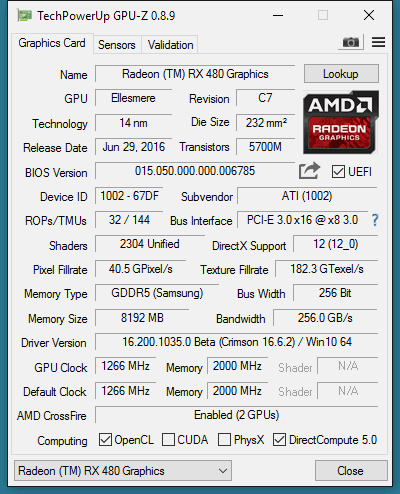
In this review, we'll be putting this solution through its paces across our graphics benchmark suite. Its performance at 1440p and 4K could be particularly noteworthy.
Test System
| Test System - VGA Rev. 42 | |
|---|---|
| Processor: | Intel Core i7-6700K @ 4.5 GHz (Skylake, 8192 KB Cache) |
| Motherboard: | ASUS Maximus VIII Hero Intel Z170 |
| Memory: | G.SKILL 16 GB Trident-Z DDR4 @ 3000 MHz 15-16-16-35 |
| Storage: | WD Caviar Blue WD10EZEX 1 TB |
| Power Supply: | Antec HCP-1200 1200W |
| Cooler: | Cryorig R1 Universal 2x 140 mm fan |
| Software: | Windows 10 64-bit |
| Drivers: | NVIDIA: 365.10 WHQL AMD: Crimson 16.4.2 Beta GTX 1070/1080: 368.39 WHQL AMD RX480: 16.6.2 Beta |
| Display: | Acer CB240HYKbmjdpr 24" 3840x2160 |
- All video card results are obtained on this exact system with exactly the same configuration.
- All games are set to their highest quality setting unless indicated otherwise.
- AA and AF are applied via in-game settings, not via the driver's control panel.
- 1600x900: Common resolution for most smaller flatscreens and laptops today (17" - 19").
- 1920x1080: Most common widescreen resolution for larger displays (22" - 26").
- 2560x1440: Highest possible 16:9 resolution for commonly available displays (27"-32").
- 3840x2160: 4K Ultra HD resolution, available on the latest high-end monitors.
Anno 2205

After the smash-hit Anno 2070 from three years ago, Ubisoft is back with an even more futuristic sim set in the year 2205 in which mankind has colonized the moon beyond scientific expeditions, having established flourishing economies set way up there. In addition to that, you get to build inspirational cities down here on Earth in various climates.
Based on a proprietary game engine, Anno 2205 takes advantage of DirectX 11, and unlike most RTS games, should be fairly taxing on modern graphics hardware owing to just how much more detail there is in the game's design and its models.


Our Patreon Silver Supporters can read articles in single-page format.
Nov 11th, 2026 07:07 CST
change timezone
New Forum Posts
- Excessively high prices for RAM (92)
- DO NOT RMA YOUR MSI CARDS (59)
- budget home NAS – X79, X99 or another platform? (135)
- Meeting point of those who broke their GPUs. Please share what GPUs you've burned, shattered, ionized or melted accidentally. (35)
- When you could finally run Crysis maxed out? (25)
- Samsung 870 EVO - Beware, certain batches prone to failure! (1484)
- High performance power plan is worse than balanced on 12 th CPUs? (85)
- My dell g15 5510 is stuck at 210 mhz while pulling impossible wattage (21)
- Planning for Prolonged High Prices and Maintaining What You Already Have (62)
- I cannot download games that are larger than 30–40 GB. (82)
Popular Reviews
- AMD Zen 6 Technical Deep Dive
- Upcoming Hardware Launches 2027 (Updated Nov 2026)
- Gigabyte Z890I Aorus Ultra Review
- INNOCN 45C1R Review - Two QHD Screens, Zero Bezels
- XPG NIMBUS PLUS Review - Mid-range Chair With Strong Competitors
- Phantom Blade Zero Performance Benchmark Review - 35 GPUs Tested
- NZXT H7 RGB+ Review
- Gears of War: E-Day Performance Benchmark Review - 35 GPUs Tested
- NZXT H5 Review
- be quiet! Light Mount TKL Keyboard Review
TPU on YouTube
Controversial News Posts
- OpenAI CEO Argues Home PCs Waste the World's Limited DRAM Supply (152)
- NVIDIA Launches Investigation Into Jensen Huang's Relationship With Suspected Chinese Spy (136)
- Intel "Raptor Lake Next" 16-Core and 20-Core CPUs Surface (130)
- Legendary Game Studio BioWare Shuts Down Following EA Layoffs (104)
- Dell CEO Says the Memory Shortage Will Get Worse in 2027 (95)
- NVIDIA GeForce RTX 50-Series Scheduled for up to $500 Price Hike This Week (88)
- Modder Fits RTX 5090 With Four 8-Pin Connectors, Halving Current per Wire (80)
- AMD Radeon Owners Can Now Run Nearly Every DLSS Feature Through Fan-Made Mod (80)