 90
AMD Ryzen 9 9950X3D2 Dual Edition Review - Maximum Cache
Architecture »Introduction

AMD Ryzen 9 9950X3D2 Dual Edition is the company's ultimate AM5 desktop processor, and the first X3D chip to feature 3D V-Cache on both CCDs. Where the original Ryzen 9 9950X3D and 7950X3D had stacked cache on only one of their two chiplets, the 9950X3D2 eliminates that asymmetry, giving each CCD its own 96 MB L3 cache pool. This is a significant evolution that not only boosts gaming performance across all cores, but also promises to eliminate the software-level scheduling complexity that plagued dual-CCD X3D processors since the Ryzen 9 7950X3D. The "Dual Edition" branding reflects the dual 3D V-Cache configuration. It is a 16-core/32-thread processor with 192 MB of L3 cache—96 MB per CCD (32 MB on-die + 64 MB stacked). The 9950X3D2 offers clock speeds of 4.30 GHz base with up to 5.60 GHz boost, and comes with a TDP of 200 W. The default socket power limit (PPT) is 270 W, up from 200 W on the 9950X3D, with higher current limits to match (EDC 250 A, TDC 180 A). AMD recommends a 360 mm liquid cooler for this chip, compared to 240-280 mm for the 9950X3D.
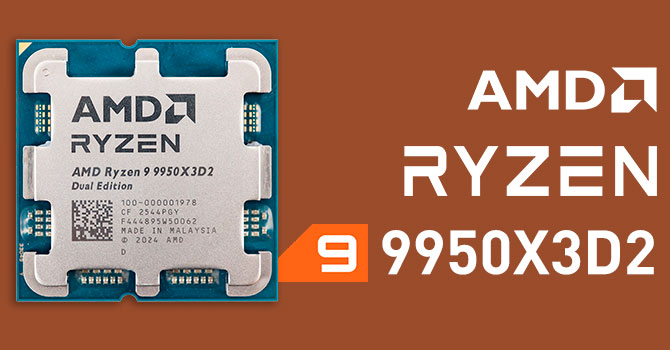
The 9950X3D2 is based on the same Granite Ridge platform as the rest of the Ryzen 9000 series, with two 8-core Zen 5 chiplets on the 4 nm TSMC N4P node, paired with a 6 nm I/O die. The key difference is that both CCDs now feature 3D V-Cache, so there is no longer a "fast CCD" and a "slow CCD" for gaming. AMD's chipset driver still uses Game Bar to park CCD1 cores during gaming, but does it actually matter? We test this specifically in this review.
3D V-Cache technology has been the most impactful hardware-level innovation by AMD in recent times, establishing the company as the maker of the world's fastest processors for PC gaming for several years running. The Ryzen 7 5800X3D matched the gaming performance of the Intel Core i9-12900K despite being based on the older Zen 3 microarchitecture with slower DDR4 memory. The Ryzen 7 7800X3D dominated gaming over Intel's 13th and 14th Gen Raptor Lake. The 9800X3D and 9850X3D extended that lead with Zen 5 and the inverted die stacking that enabled overclocking on X3D processors for the first time. The original 9950X3D brought 3D V-Cache to the 16-core dual-CCD segment, but only one CCD had the extra cache, requiring Game Bar integration for optimal thread scheduling. Now, the 9950X3D2 takes the concept to its logical conclusion: maximum cores, maximum cache, no compromises.
With Zen 5, AMD inverted the way the CCD and 3D V-Cache die (L3D) are stacked. On older X3D processors, the L3D was stacked on top of the CCD, with structural silicon conducting heat from the CPU cores through the stack. With Zen 5, the CCD sits on top, with the L3D below it, connected via through-silicon vias (TSVs). This means the CPU cores directly dissipate heat to the cooling solution over STIM, with no structural silicon in the way, enabling the same thermal and overclocking characteristics as non-X3D models. Previously, dual 3D V-Cache was exclusive to AMD's server-grade EPYC processors. The 9950X3D2 brings this technology to the consumer desktop for the first time.
The AMD Zen 5 microarchitecture involves a comprehensive reworking of nearly all the core components compared to Zen 4, with a particular focus on the number-crunching capabilities. The core comes with a true 512-bit floating point data-path to more effectively execute 512-bit SIMD workloads that use instruction-sets such as AVX-512, VNNI, etc.; when compared to Zen 4, which uses a dual-pumped 256-bit data-path to execute these instruction-sets.
AMD is pricing the Ryzen 9 9950X3D2 Dual Edition at $900, which positions it as the most premium consumer desktop processor on the market. In return, you get the fastest application performance, combined with class-leading gaming performance across all cores without scheduling compromises. The 9950X3D2 is compatible with all Socket AM5 motherboards; support on AMD 600-series chipset motherboards requires a BIOS update, while AMD 800-series chipset motherboards are drop-in compatible with the latest BIOS.
| Price | Cores / Threads | Base Clock | Max. Boost | L3 Cache | TDP | Architecture | Process | Socket | |
|---|---|---|---|---|---|---|---|---|---|
| Intel Core i5 | |||||||||
| Core i5-12400F | $110 | 6/12 | 2.5 GHz | 4.4 GHz | 18 MB | 65 W | Alder Lake | 10 nm | LGA 1700 |
| Core i5-13400F | $170 | 6+4/16 | 2.5/1.8 GHz | 4.6/3.3 GHz | 20 MB | 65 W | Raptor Lake | 10 nm | LGA 1700 |
| Core i5-12600K | $170 | 6+4/16 | 3.7/2.8 GHz | 4.9/3.6 GHz | 20 MB | 125 W | Alder Lake | 10 nm | LGA 1700 |
| Core i5-13600K | $225 | 6+8/20 | 3.5/2.6 GHz | 5.1/3.9 GHz | 24 MB | 125 W | Raptor Lake | 10 nm | LGA 1700 |
| Core i5-14600K | $260 | 6+8/20 | 3.5/2.6 GHz | 5.3/4.0 GHz | 24 MB | 125 W | Raptor Lake | 10 nm | LGA 1700 |
| Intel Core Ultra 5 | |||||||||
| Core Ultra 5 245K | $310 | 6+8/14 | 4.2/3.6 GHz | 5.2/4.6 GHz | 24 MB | 159 W | Arrow Lake | 3 nm | LGA 1851 |
| AMD Ryzen 5 | |||||||||
| Ryzen 5 8500G | $150 | 6/12 | 3.5 GHz | 5.0 GHz | 16 MB | 65 W | Phoenix 2 | 4 nm | AM5 |
| Ryzen 5 5600X | $135 | 6/12 | 3.7 GHz | 4.6 GHz | 32 MB | 65 W | Zen 3 | 7 nm | AM4 |
| Ryzen 5 7600 | $185 | 6/12 | 3.8 GHz | 5.1 GHz | 32 MB | 65 W | Zen 4 | 5 nm | AM5 |
| Ryzen 5 7600X | $210 | 6/12 | 4.7 GHz | 5.3 GHz | 32 MB | 105 W | Zen 4 | 5 nm | AM5 |
| Ryzen 5 9600X | $185 | 6/12 | 3.9 GHz | 5.4 GHz | 32 MB | 65 W | Zen 5 | 4 nm | AM5 |
| Intel Core i7 | |||||||||
| Core i7-12700K | $210 | 8+4/20 | 3.6/2.7 GHz | 5.0/3.8 GHz | 25 MB | 125 W | Alder Lake | 10 nm | LGA 1700 |
| Core i7-13700K | $280 | 8+8/24 | 3.4/2.5 GHz | 5.4/4.2 GHz | 30 MB | 125 W | Raptor Lake | 10 nm | LGA 1700 |
| Core i7-14700K | $355 | 8+12/28 | 3.4/2.5 GHz | 5.6/4.3 GHz | 33 MB | 125 W | Raptor Lake | 10 nm | LGA 1700 |
| Intel Core Ultra 7 | |||||||||
| Core Ultra 7 265K | $290 | 8+12/20 | 3.9/3.3 GHz | 5.5/4.6 GHz | 30 MB | 250 W | Arrow Lake | 3 nm | LGA 1851 |
| Core Ultra 7 270K Plus | $300 | 8+16/24 | 3.7/3.2 GHz | 5.5/4.7 GHz | 36 MB | 250 W | Arrow Lake Plus | 3 nm | LGA 1851 |
| AMD Ryzen 7 | |||||||||
| Ryzen 7 5700G | $165 | 8/16 | 3.8 GHz | 4.6 GHz | 16 MB | 65 W | Zen 3 + Vega | 7 nm | AM4 |
| Ryzen 7 5700X | $160 | 8/16 | 3.4 GHz | 4.6 GHz | 32 MB | 65 W | Zen 3 | 7 nm | AM4 |
| Ryzen 7 7700 | $280 | 8/16 | 3.8 GHz | 5.3 GHz | 32 MB | 65 W | Zen 4 | 5 nm | AM5 |
| Ryzen 7 7700X | $275 | 8/16 | 4.5 GHz | 5.4 GHz | 32 MB | 105 W | Zen 4 | 5 nm | AM5 |
| Ryzen 7 9700X | $305 | 8/16 | 3.8 GHz | 5.5 GHz | 32 MB | 65 W | Zen 5 | 4 nm | AM5 |
| Ryzen 7 5800X | $165 | 8/16 | 3.8 GHz | 4.7 GHz | 32 MB | 105 W | Zen 3 | 7 nm | AM4 |
| Ryzen 7 5800X3D | $340 | 8/16 | 3.4 GHz | 4.5 GHz | 96 MB | 105 W | Zen 3 | 7 nm | AM4 |
| Ryzen 7 7800X3D | $375 | 8/16 | 4.2 GHz | 5.0 GHz | 96 MB | 120 W | Zen 4 | 5 nm | AM5 |
| Ryzen 7 9800X3D | $450 | 8/16 | 4.7 GHz | 5.2 GHz | 96 MB | 120 W | Zen 5 | 4 nm | AM5 |
| Ryzen 7 9850X3D | $500 | 8/16 | 4.7 GHz | 5.6 GHz | 96 MB | 120 W | Zen 5 | 4 nm | AM5 |
| Intel Core i9 | |||||||||
| Core i9-12900K | $280 | 8+8/24 | 3.2/2.4 GHz | 5.2/3.9 GHz | 30 MB | 125 W | Alder Lake | 10 nm | LGA 1700 |
| Core i9-13900K | $415 | 8+16/32 | 3.0/2.2 GHz | 5.8/4.3 GHz | 36 MB | 125 W | Raptor Lake | 10 nm | LGA 1700 |
| Core i9-14900K | $460 | 8+16/32 | 3.2/2.4 GHz | 6.0/4.4 GHz | 36 MB | 125 W | Raptor Lake | 10 nm | LGA 1700 |
| Intel Core Ultra 9 | |||||||||
| Core Ultra 9 285K | $570 | 8+16/24 | 3.7/3.2 GHz | 5.7/4.6 GHz | 36 MB | 250 W | Arrow Lake | 3 nm | LGA 1851 |
| AMD Ryzen 9 | |||||||||
| Ryzen 9 5900X | $265 | 12/24 | 3.7 GHz | 4.8 GHz | 64 MB | 105 W | Zen 3 | 7 nm | AM4 |
| Ryzen 9 7900 | $370 | 12/24 | 3.7 GHz | 5.4 GHz | 64 MB | 65 W | Zen 4 | 5 nm | AM5 |
| Ryzen 9 7900X | $400 | 12/24 | 4.7 GHz | 5.6 GHz | 64 MB | 170 W | Zen 4 | 5 nm | AM5 |
| Ryzen 9 7900X3D | $580 | 12/24 | 4.4 GHz | 5.6 GHz | 128 MB | 120 W | Zen 4 | 5 nm | AM5 |
| Ryzen 9 9900X | $430 | 12/24 | 4.4 GHz | 5.6 GHz | 64 MB | 120 W | Zen 5 | 4 nm | AM5 |
| Ryzen 9 5950X | $345 | 16/32 | 3.4 GHz | 4.9 GHz | 64 MB | 105 W | Zen 3 | 7 nm | AM4 |
| Ryzen 9 7950X | $660 | 16/32 | 4.5 GHz | 5.7 GHz | 64 MB | 170 W | Zen 4 | 5 nm | AM5 |
| Ryzen 9 7950X3D | $550 | 16/32 | 4.2 GHz | 5.7 GHz | 128 MB | 120 W | Zen 4 | 5 nm | AM5 |
| Ryzen 9 9950X | $490 | 16/32 | 4.3 GHz | 5.7 GHz | 64 MB | 170 W | Zen 5 | 4 nm | AM5 |
| Ryzen 9 9950X3D | $645 | 16/32 | 4.3 GHz | 5.7 GHz | 128 MB | 170 W | Zen 5 | 4 nm | AM5 |
| Ryzen 9 9950X3D2 | $900 | 16/32 | 4.3 GHz | 5.6 GHz | 192 MB | 200 W | Zen 5 | 4 nm | AM5 |
Nov 22nd, 2026 06:05 PST
change timezone
Latest GPU Drivers
New Forum Posts
- UPS what one to get? (37)
- Gigabyte AORUS RTX 5080 MASTER – Up to 30°C GPU Hotspot Delta! Is This Normal, a Cooling Defect, or Should I RMA? (8)
- Honestly, do you care about GTA VI? (246)
- TPU's Nostalgic Hardware Club (22195)
- repair an NVIDIA Quadro M4000 (2)
- The TPU UK Clubhouse (27289)
- Your PC ATM (36449)
- Zen 3 IF/IMC degradation (244)
- Local LLM General Discussion (696)
- How to prevent OLED burn damage due to PC freezes or power outtages? (54)
Popular Reviews
- Microsoft Surface Laptop Ultra Review - The Next-gen Arm Laptop
- Corsair RM1200e (Second Generation) Review
- Pulsar Office Tour & First Look at P1 Dual-Sensor Mouse
- Upcoming Hardware Launches 2027 (Updated Nov 2026)
- Ugreen NASync DXP4800 GT Review
- AMD Ryzen 7 9800X3D Review - The Best Gaming Processor
- Biwin Black Opal NV7400 2 TB Review
- AMD Zen 6 Technical Deep Dive
- Phantom Blade Zero Performance Benchmark Review - 35 GPUs Tested
- AMD Ryzen 7 5800X3D 10th Anniversary Review
TPU on YouTube
Controversial News Posts
- NVIDIA Co-Founder and CEO Jensen Huang Officially Resigns (492)
- Report: Jensen Huang Eyes NVIDIA Comeback (262)
- Open Letter Asking NVIDIA to Reinstate Jensen Huang Passes 115,000 Signatures (184)
- OpenAI CEO Argues Home PCs Waste the World's Limited DRAM Supply (152)
- NVIDIA Launches Investigation Into Jensen Huang's Relationship With Suspected Chinese Spy (136)
- Intel "Raptor Lake Next" 16-Core and 20-Core CPUs Surface (130)
- NVIDIA GeForce RTX 50-Series Scheduled for up to $500 Price Hike This Week (89)
- Intel Razor Lake Gets a 12 P-Core bLLC Chip With No E-Cores, Per Leak (86)