 40
AMD Ryzen AI Halo Review - Local-AI Powerhouse with 128 GB of Memory
TechPowerUp Proofreader »GPU-Z Bug Hunt
The previous coding page worked on a throwaway toy—nothing that's worth keeping private. Testing on this page uses real, shipping source from GPU-Z, our popular graphics card monitoring tool. That changes the rules: Handing proprietary code to a cloud API is forbidden at most companies, because you can bet that everyone who sees your code will mine it and train their AIs on it. Cybersecurity can also become an issue: actors could find security issues and exploit your software, without you ever knowing about it until it's too late. Last but not least, I've signed non-disclosure agreements with all the GPU vendors, so I can't just violate those by uploading my code to an AI.I tested a single file, which is relatively small, but logically complex; it deals with resizing images. I also planted a handful of bugs myself, typical stuff that human programmers get wrong. I ran two models: a smaller 30 billion everyday coding model that runs on almost any PC; the other is the big 235-billion-parameter model that only fits because of the box's 128 GB of memory.
Bugs Discovered
| GPU-Z Bug Hunt | Qwen3-Coder-30B | Qwen3-235B |
|---|---|---|
| Planted bugs found | 4 of 6 | 4 of 6 |
| Real Bugs Found | A broken safety check | A format mismatch |
| False Positives | 8 | none |
| Time for one file | 31 seconds | 12 minutes |
Both models found four of our six planted bugs, the more serious ones. They were not perfect, though, and the smaller model produced more false positives than actual errors it found. This makes both of them "an assistant"—you check what it does, you can't trust it blindly.
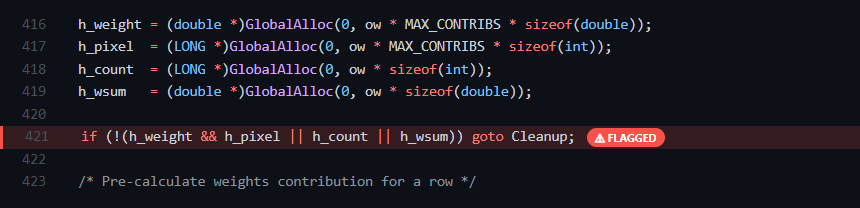
This check is meant to stop the program if it runs out of memory, but it was written with OR (||) where it needs AND (&&), so it only returns when every allocation fails; if just one does, the code continues running and crashes. It has been shipping in GPU-Z like this for years.
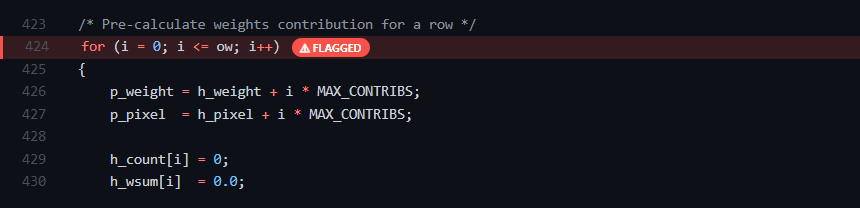
This loop fills one entry for every pixel across the output row, but <= makes it run one step too far: on the last pass it writes into the slot just past the end of every array set up above. Writing one place beyond the end is the classic off-by-one that quietly corrupts memory and crashes later. The matching vertical loop further down gets it right, with <.
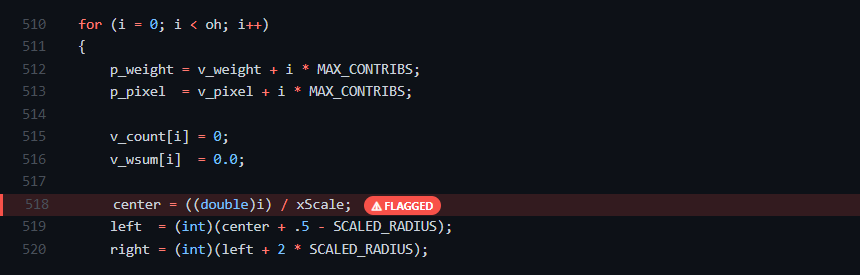
This is the vertical half of the resize: note the v_ arrays. Everything here is about up-and-down scaling, so it should divide by yScale; instead it divides by xScale, the horizontal scale. The whole block was copied and pasted from the row code above and the one name was never switched.
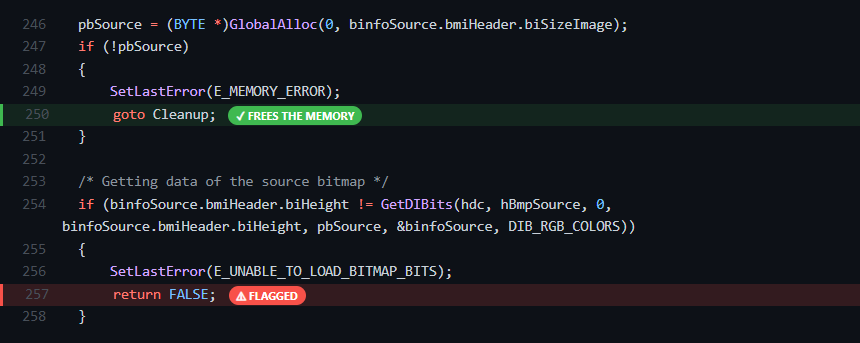
Line 246 allocates a block of memory for the image. Every error path after it is meant to jump to Cleanup, which frees the memory; line 250 does exactly that. But the other path returns straight out of the function instead, so the memory is never released, resulting in a memory leak.
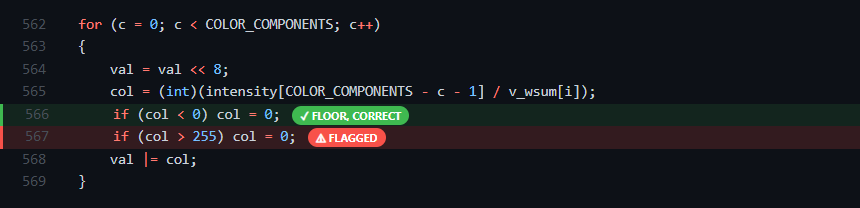
The two lines below keep each color channel in range. Line 566 is right: anything below 0 is pulled up to 0. But line 567 clamps anything above 255 to 0 as well, so the brightest pixels, instead of staying white, wrap all the way to black. One wrong number; it compiles cleanly and only shows up once you look at the picture. This is the one planted bug that both local models missed.
Cloud?
So eventually I got curious enough and fed the same source file to the cloud-powered Claude, and here too, it impressed. It found all six planted bugs, both of the undiscovered year-old latent ones, without any false positives, in a couple of minutes.Claude Fable went even further and found three more real bugs that we never planted or noticed: an odd input value that slips past a check and makes the code try to reserve a nonsensical amount of memory, a division-by-zero that can happen under certain settings, and a size calculation that quietly breaks on very large images.
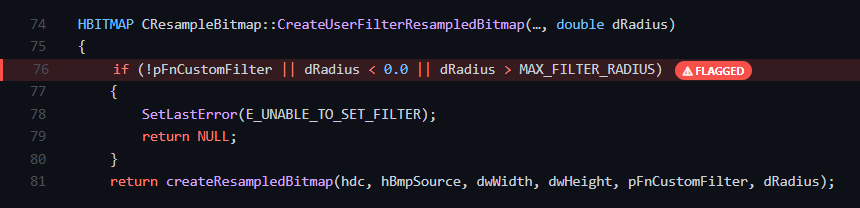
This check is designed to reject a radius that is negative or bigger than the maximum, but it misses one case: a radius that's set to a NaN value. In floating-point math, the NaN is a special value that indicates "not a number," and every comparison with a NaN is false, so the radius counts as neither too small nor too large and doesn't get skipped. I checked the calling code: NaN can really end up as a value for radius. The code further down will decide how much memory to allocate, based on the radius. With a NaN, it will try to grab a large negative amount of memory, which will crash the program.
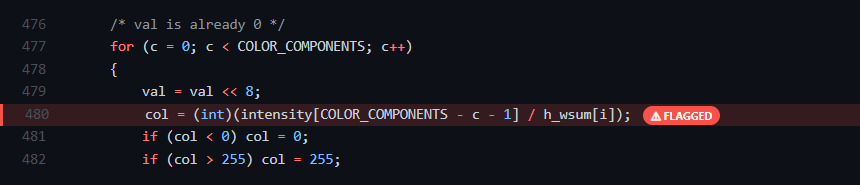
When the image is resized, each new pixel's color is based on source pixels near it. To do that, it's averaging the pixel value and dividing by the number of the weights (h_wsum). In virtually all cases that sum is positive, so all good, but certain filter and scaling combinations can result in no contributing source pixels at all, which means the sum value is 0, resulting in a crash with division by zero.

This code figures out the image's size in bytes by multiplying the bit depth, width, and height together, then dividing by eight. Those values are multiplied as 32-bit integers, which top out around 4.3 billion, so a large enough image with a very high resolution at 32 bits per pixel pushes the multiplication past that limit: it wraps around, and the stored size comes out wrong, probably negative, causing a program crash.
These are real, and they have been sitting in shipping GPU-Z, software millions of people run, for years. And I had just read through that same file line by line, looking for good places to plant my own bugs, and I missed all three! Even after Claude flagged them, it took me a while to understand the actual issue.
That is the trade-off with the current cloud vs offline model situation: the price of keeping your code private is that you might not get the best result.
Nov 22nd, 2026 19:49 CST
change timezone
Latest GPU Drivers
New Forum Posts
- DTS DCH Driver for Realtek HDA [DTS:X APO4 + DTS Interactive] (2818)
- Honestly, do you care about GTA VI? (266)
- Increasing Power Limit? (6)
- What are you playing? (26240)
- UPS what one to get? (48)
- Your PC ATM (36458)
- Gacha Games - Discussions, Pulls, Updates, etc. (1157)
- Last game you purchased? (1414)
- Making a game in Godot engine (19)
- Intel D270 (5)
Popular Reviews
- Microsoft Surface Laptop Ultra Review - The Next-gen Arm Laptop
- Corsair RM1200e (Second Generation) Review
- Upcoming Hardware Launches 2027 (Updated Nov 2026)
- Pulsar Office Tour & First Look at P1 Dual-Sensor Mouse
- Ugreen NASync DXP4800 GT Review
- AMD Ryzen 7 9800X3D Review - The Best Gaming Processor
- AMD Zen 6 Technical Deep Dive
- AMD Ryzen 7 5800X3D 10th Anniversary Review
- Phantom Blade Zero Performance Benchmark Review - 35 GPUs Tested
- Biwin Black Opal NV7400 2 TB Review
TPU on YouTube
Controversial News Posts
- NVIDIA Co-Founder and CEO Jensen Huang Officially Resigns (492)
- Report: Jensen Huang Eyes NVIDIA Comeback (266)
- Open Letter Asking NVIDIA to Reinstate Jensen Huang Passes 115,000 Signatures (184)
- OpenAI CEO Argues Home PCs Waste the World's Limited DRAM Supply (152)
- NVIDIA Launches Investigation Into Jensen Huang's Relationship With Suspected Chinese Spy (136)
- Intel "Raptor Lake Next" 16-Core and 20-Core CPUs Surface (130)
- NVIDIA GeForce RTX 50-Series Scheduled for up to $500 Price Hike This Week (89)
- Intel Razor Lake Gets a 12 P-Core bLLC Chip With No E-Cores, Per Leak (86)