 40
AMD Ryzen AI Halo Review - Local-AI Powerhouse with 128 GB of Memory
Hardware Rumors. Do They Come True? »TechPowerUp Proofreader
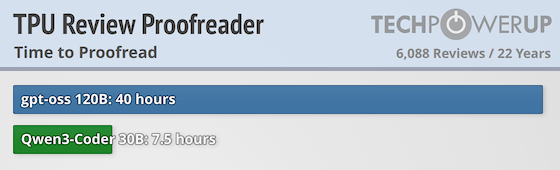
With AIs getting so good at processing text, I wondered what it could do for proofreading of our reviews. That's why I pointed it at every published TechPowerUp review (6,088 reviews total, going back to 2004) and ran two local models. Each model's job was to check for spelling, grammar, naming and consistency. Here, too, I ran Qwen3-Coder-30B and gpt-oss-120b.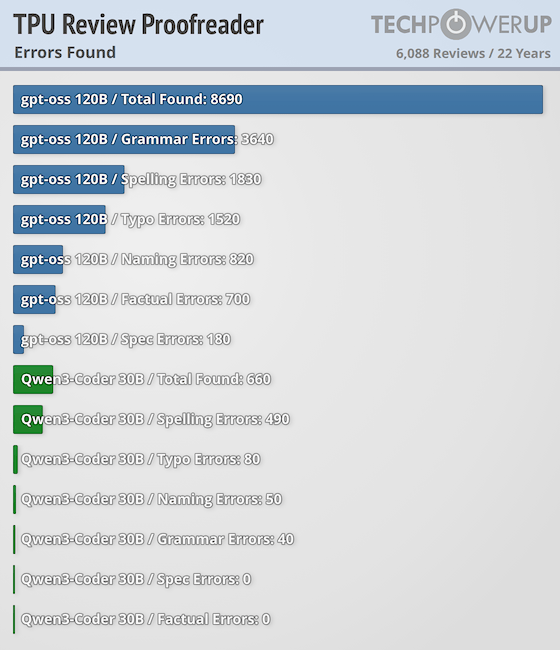
gpt-oss with 120 billion parameters is an excellent proofreader. It found roughly 8,700 errors! Real grammar, spelling, typos and wrong names across almost every review. The smaller Qwen Coder model that runs on most hardware can't keep up, but still discovered 700 errors, nearly all plain misspellings. It also returned a ton of false positives in the category "specs" and "factual," like flagging the line "Crucial is a division of Micron" as a factual error about the company (it isn't—Crucial was Micron's consumer memory brand), or calling the math in "227 MHz (1000/4.4)" a wrong calculation. Both lines were correct in the original; the model invented the mistake.
Examples
The (sold seperately) fan addon option package ZM-OP1...A plain misspelling of "separately," in our Zalman ZM-80C review.
...the Integrated Memory Controller, which means the the CPU itself manages the computer's memory."The," printed twice, in the Athlon64 3800+ review.
...the heatspeader on this side of the module is a perfect match..."Heatspreader" with a letter dropped, in the G.Skill Ripjaws Z review. The exact same typo turns up in more than a dozen other reviews over the years.
...the Ninteen Hundred is joining the fray...The case's own name misspelled, in the Antec Nineteen Hundred review.
Two thick Styrofoam spacers hold the case in place and keep it save during transportation..."Safe" written as "save," in the Phanteks Enthoo Evolv mATX review, and copy-pasted into a couple of others.
...no comprises were made in terms of build quality..."Compromises" with two letters missing, in the Glorious Model O Wireless review.
Opening the box revels a neatly packaged unit..."Reveals" turned into "revels," in the Cooler Master X Silent Edge Platinum review.
Softears, formally known as Softear Acoustics..."Formerly" written as "formally," in the Softears Studio4 review.
It catches more than spelling:
Geforce 3 ... Geforce 4...NVIDIA's brand is GeForce, with a capital F, printed as "Geforce" in the compatibility table of the Arctic Cooling VGA Silencers preview.
BIOS: AwardBiosThe spec table on the 2006 ECS PF5 Extreme lists an Award BIOS, but the board actually runs an AMI BIOS: the review's own BIOS section says "ECS is using an AMI Bios," and ECS's spec sheet lists "AMI BIOS." Catching it means cross-checking the table against another part of the review, nice find!
Four pixel shader processors ... Two vertex shader processors...The Radeon X1300 XT is RV530 silicon, with 12 pixel and 5 vertex shaders, but the Sapphire X1300 XT spec list has the plain X1300's numbers listed instead, 4 and 2, which come from the RV516 GPU—and nobody ever noticed it. Spotting that requires knowledge that the "XT" is a different chip, not just checking a dictionary.
None of these are dramatic on their own. The point is that there are thousands like them across 22 years, nobody was ever going to find them by hand, and the box turned them up in an overnight sweep.
Cloud Tokens Are Expensive
Based on the number of tokens in our reviews (43 million), I calculated the cost for the same task when using the various cloud-based APIs. For the Ryzen AI Halo I measured its power consumption while completing the task.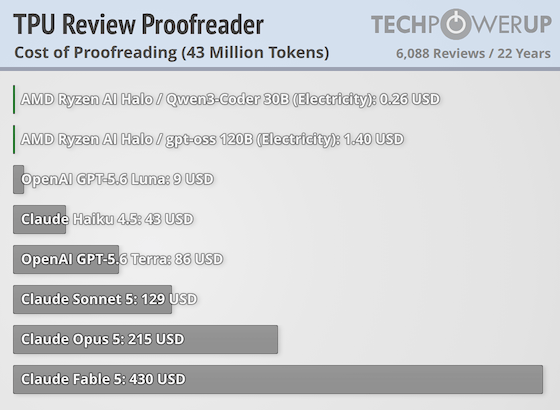
There is a privacy angle here, too, no doubt, but it's not as strong as for coding. Every single AI company has scraped all our reviews many times over and trained everything on them, so here, the reason to run this on the box is not primarily secrecy; it is cost, especially when you run it multiple times, live, while content is being written.
Nov 22nd, 2026 19:37 CST
change timezone
Latest GPU Drivers
New Forum Posts
- DTS DCH Driver for Realtek HDA [DTS:X APO4 + DTS Interactive] (2818)
- Honestly, do you care about GTA VI? (266)
- Increasing Power Limit? (6)
- What are you playing? (26240)
- UPS what one to get? (48)
- Your PC ATM (36458)
- Gacha Games - Discussions, Pulls, Updates, etc. (1157)
- Last game you purchased? (1414)
- Making a game in Godot engine (19)
- Intel D270 (5)
Popular Reviews
- Microsoft Surface Laptop Ultra Review - The Next-gen Arm Laptop
- Corsair RM1200e (Second Generation) Review
- Upcoming Hardware Launches 2027 (Updated Nov 2026)
- Pulsar Office Tour & First Look at P1 Dual-Sensor Mouse
- Ugreen NASync DXP4800 GT Review
- AMD Ryzen 7 9800X3D Review - The Best Gaming Processor
- AMD Zen 6 Technical Deep Dive
- AMD Ryzen 7 5800X3D 10th Anniversary Review
- Phantom Blade Zero Performance Benchmark Review - 35 GPUs Tested
- Biwin Black Opal NV7400 2 TB Review
TPU on YouTube
Controversial News Posts
- NVIDIA Co-Founder and CEO Jensen Huang Officially Resigns (492)
- Report: Jensen Huang Eyes NVIDIA Comeback (266)
- Open Letter Asking NVIDIA to Reinstate Jensen Huang Passes 115,000 Signatures (184)
- OpenAI CEO Argues Home PCs Waste the World's Limited DRAM Supply (152)
- NVIDIA Launches Investigation Into Jensen Huang's Relationship With Suspected Chinese Spy (136)
- Intel "Raptor Lake Next" 16-Core and 20-Core CPUs Surface (130)
- NVIDIA GeForce RTX 50-Series Scheduled for up to $500 Price Hike This Week (89)
- Intel Razor Lake Gets a 12 P-Core bLLC Chip With No E-Cores, Per Leak (86)