 40
AMD Ryzen AI Halo Review - Local-AI Powerhouse with 128 GB of Memory
But CUDA? »Power, Heat, Noise
Both the Ryzen AI Halo and the DGX Spark are unified-memory SoCs with no separate GPU rail, so I measured whole-system power draw, at the wall. These are machines people leave on 24/7, so idle and noise are just as relevant as power.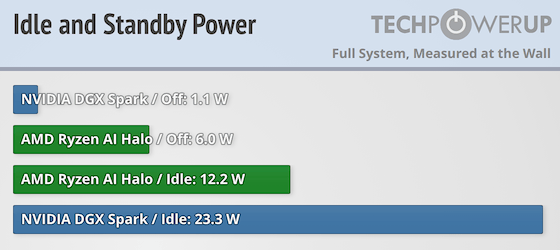
We measured two states: sitting idle at the desktop, and switched off but still plugged in. When off, the Spark is really very close to no power consumption with just 1 W. The Halo, on the other hand, uses 6 W even when it appears off. This seems to be an effect of the power brick, switching to the power brick of the DGX Spark eliminated that extra power consumption. In idle, things are reversed: while the Ryzen AI Halo is very lean with just 12 W, the NVIDIA system uses over 20 W, which seems like quite a lot for sitting idle, doing nothing.
Power Under Load
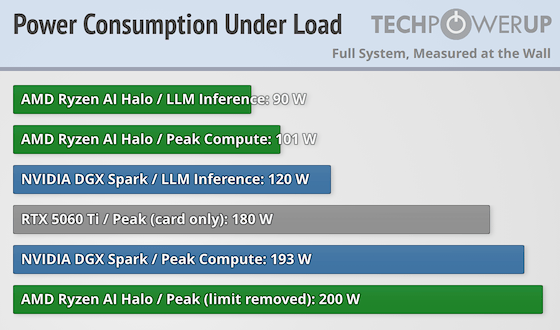
Under load the two diverge because the AMD AI Halo is hard-capped to a ~100 W power limit, so heavy loads all top out at the same number. I also figured out how to unlock the power limit, more on that in the next section, which results in a measured power consumption of 200 W with a heavy load. There is no such wall on the Spark, and its power usage scales up to almost 200 W when hitting all the Blackwell tensor cores. I also included a discrete GPU here; an RTX 5060 Ti alone runs at 180 W card only power.
Overclocking
While there is no classic support for overclocking on the Ryzen AI Halo, it is possible to raise the power limit of the various CPU components (not officially though). I built a small software that overwrites the CPU's limit registers and sets them to their maximum values, which are:- STAPM 132 W (up from 45 W)
- Fast-boost 176 W (up from 71 W)
- Slow-boost 154 W (up from 60 W)
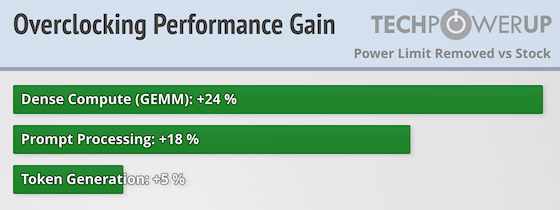
The gains are modest for the extra power and heat: dense compute rises about 24%, prompt processing 18%, but the token generation that dominates many workloads rises only 5%, all while the box roughly doubles its power draw and runs about 30 °C hotter, so not really worth it.
Temperature
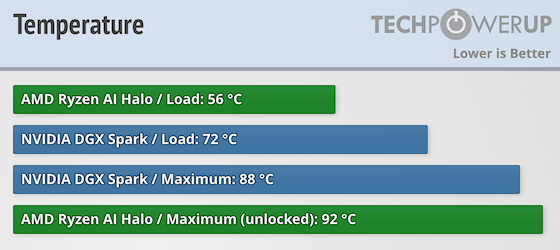
The DGX Spark runs at considerably higher temperatures than the Ryzen AI Halo for two reasons. First, it does more work at higher power usage, and the fan is running more quietly and slower, but that results in a higher temperature. The power-unlocked AI Halo does get pretty warm at 92 °C, and its fan works hard.
Fan Noise
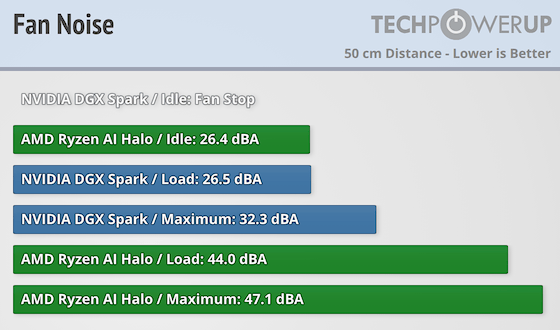
What I found most distracting in terms of fan noise is that the Ryzen AI Halo does not have fan-stop, so its fan will always run and emit a very quiet hum. It's barely audible, but completely unnecessary in my opinion—temperatures are low enough when idle. NVIDIA's DGX Spark does stop the fan properly, for a perfect noise-free experience.
Once you put load on the boxes, the fan ramps up gently. I separated "Load," which is typical LLM work, and "Maximum," which is hardcore matrix math, because you typically don't fully load either box during normal usage. Here we can see that the Ryzen AI Halo is considerably louder than the DGX Spark, but it runs at a much lower temperature, as we've seen in the previous section. Given these values, I feel like AMD didn't properly tune the fan curve; it would be much better to allow higher temperatures in return for lower noise levels.
Nov 22nd, 2026 19:13 CST
change timezone
Latest GPU Drivers
New Forum Posts
- Increasing Power Limit? (6)
- What are you playing? (26240)
- UPS what one to get? (48)
- Honestly, do you care about GTA VI? (265)
- Your PC ATM (36458)
- Gacha Games - Discussions, Pulls, Updates, etc. (1157)
- Last game you purchased? (1414)
- Making a game in Godot engine (19)
- Intel D270 (5)
- X870E AORUS ELITE WIFI7 thread with setting and OC (69)
Popular Reviews
- Microsoft Surface Laptop Ultra Review - The Next-gen Arm Laptop
- Corsair RM1200e (Second Generation) Review
- Upcoming Hardware Launches 2027 (Updated Nov 2026)
- Pulsar Office Tour & First Look at P1 Dual-Sensor Mouse
- Ugreen NASync DXP4800 GT Review
- AMD Ryzen 7 9800X3D Review - The Best Gaming Processor
- AMD Zen 6 Technical Deep Dive
- AMD Ryzen 7 5800X3D 10th Anniversary Review
- Phantom Blade Zero Performance Benchmark Review - 35 GPUs Tested
- Biwin Black Opal NV7400 2 TB Review
TPU on YouTube
Controversial News Posts
- NVIDIA Co-Founder and CEO Jensen Huang Officially Resigns (492)
- Report: Jensen Huang Eyes NVIDIA Comeback (266)
- Open Letter Asking NVIDIA to Reinstate Jensen Huang Passes 115,000 Signatures (184)
- OpenAI CEO Argues Home PCs Waste the World's Limited DRAM Supply (152)
- NVIDIA Launches Investigation Into Jensen Huang's Relationship With Suspected Chinese Spy (136)
- Intel "Raptor Lake Next" 16-Core and 20-Core CPUs Surface (130)
- NVIDIA GeForce RTX 50-Series Scheduled for up to $500 Price Hike This Week (89)
- Intel Razor Lake Gets a 12 P-Core bLLC Chip With No E-Cores, Per Leak (86)