 40
AMD Ryzen AI Halo Review - Local-AI Powerhouse with 128 GB of Memory
AMD + NVIDIA = <3 »Is the Lack of CUDA a Problem?
Everyone assumes the same thing about a machine like this: sure, it has the memory, but surely CUDA means NVIDIA's software just murders it when it comes to anything AI. We had both boxes on the bench, so I measured it, layer by layer, on one small model (Qwen3-8B) where every other variable could be held constant.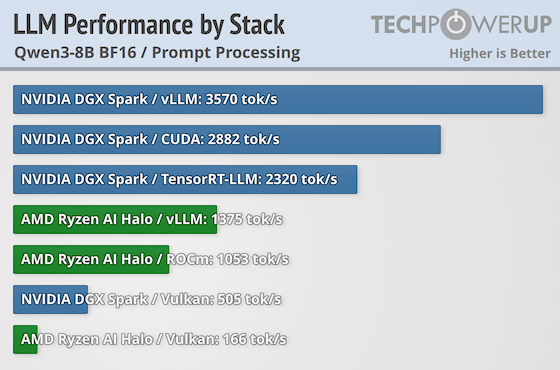
Same hardware, CUDA vs Vulkan: On the Spark's own GPU, changing nothing but the llama.cpp backend (CUDA versus the portable Vulkan path) makes prompt processing run up to 6x faster on CUDA. That gap is not just silicon; it is NVIDIA's mature kernels against the most generic backend, that works almost everywhere though.
The default path is the slow path: The biggest performance lever here isn't AMD versus NVIDIA, it's the software stack! The default Vulkan route is the wrong one. The preinstalled tools fall back to the generic Vulkan backend, which is slow on both boxes and especially poor on the Halo: just 166 tok/s of prompt processing against the Spark's 505. More speed can be achieved, but you have to put in work to get it: switching to the Halo's own ROCm build is about 6x faster, and with vLLM it's roughly 8x. NVIDIA's Spark gains too, around 7x with vLLM (and close to 6x on CUDA)—and from a higher baseline, so the Spark pulls even further ahead in absolute terms. Unfortunately this huge gap is something that many buyers will never see, because unlocking it means leaving the default path—and that is harder on the AMD side specifically, because vLLM is an experimental preview there, while it's a mature, production-ready stack on NVIDIA. AMD should definitely put in some work here to make this the default out-of-the-box option.
Tuned stacks, head to head: AMD ships a Ryzen-AI build of vLLM for this exact GPU; NVIDIA has both vLLM and TensorRT-LLM. At BF16, NVIDIA's tuned stacks are clearly faster at prompt processing—its vLLM reaches about 3,570 tok/s and TensorRT-LLM about 2,320, against AMD's vLLM at 1,375. Generation is much closer, roughly 13 to 15 tok/s either way, with NVIDIA slightly ahead.
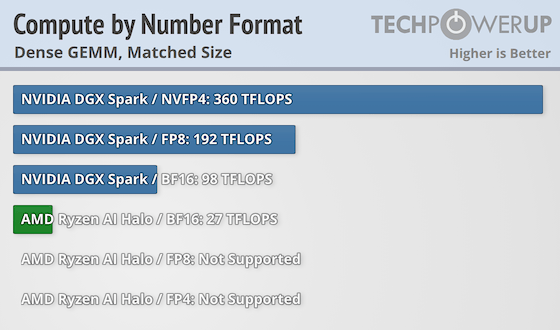
The real edge is number formats: NVIDIA's Blackwell has native 8-bit and 4-bit float, and each step down roughly doubles throughput: in a matched GEMM the Spark climbs from 98 TFLOPS at BF16 to 192 at FP8 to 360 at NVFP4. AMD's RDNA 3.5 has neither format in hardware; its ceiling is BF16 and the low-precision calls simply do not run. The payoff is real: NVFP4 more than doubles TensorRT-LLM prompt processing to about 6,200 tok/s, doubles generation and cuts memory by 4x. The Halo can still load 4-bit GGUF models through llama.cpp for the memory savings (that is how it fits the giant models in the first place), but not in a fast, tuned stack.
The bleeding edge lands on NVIDIA first: NVIDIA is the default everyone develops and tests against, so the newest, most experimental models sometimes run only there. We hit this with MiniMax H3, a brand-new text-to-video model that generated fine on the Spark but would not run on the Halo at all, because its working path needs FP8 and NVIDIA-specific kernels. For the production work people will actually do on a box like this, running established local models, AMD is perfectly fine. And if your goal is the opposite, evaluating AMD accelerators or learning HIP and ROCm, this is exactly the box for it.
Nov 22nd, 2026 19:23 CST
change timezone
Latest GPU Drivers
New Forum Posts
- Increasing Power Limit? (6)
- What are you playing? (26240)
- UPS what one to get? (48)
- Honestly, do you care about GTA VI? (265)
- Your PC ATM (36458)
- Gacha Games - Discussions, Pulls, Updates, etc. (1157)
- Last game you purchased? (1414)
- Making a game in Godot engine (19)
- Intel D270 (5)
- X870E AORUS ELITE WIFI7 thread with setting and OC (69)
Popular Reviews
- Microsoft Surface Laptop Ultra Review - The Next-gen Arm Laptop
- Corsair RM1200e (Second Generation) Review
- Upcoming Hardware Launches 2027 (Updated Nov 2026)
- Pulsar Office Tour & First Look at P1 Dual-Sensor Mouse
- Ugreen NASync DXP4800 GT Review
- AMD Ryzen 7 9800X3D Review - The Best Gaming Processor
- AMD Zen 6 Technical Deep Dive
- AMD Ryzen 7 5800X3D 10th Anniversary Review
- Phantom Blade Zero Performance Benchmark Review - 35 GPUs Tested
- Biwin Black Opal NV7400 2 TB Review
TPU on YouTube
Controversial News Posts
- NVIDIA Co-Founder and CEO Jensen Huang Officially Resigns (492)
- Report: Jensen Huang Eyes NVIDIA Comeback (266)
- Open Letter Asking NVIDIA to Reinstate Jensen Huang Passes 115,000 Signatures (184)
- OpenAI CEO Argues Home PCs Waste the World's Limited DRAM Supply (152)
- NVIDIA Launches Investigation Into Jensen Huang's Relationship With Suspected Chinese Spy (136)
- Intel "Raptor Lake Next" 16-Core and 20-Core CPUs Surface (130)
- NVIDIA GeForce RTX 50-Series Scheduled for up to $500 Price Hike This Week (89)
- Intel Razor Lake Gets a 12 P-Core bLLC Chip With No E-Cores, Per Leak (86)