 40
AMD Ryzen AI Halo Review - Local-AI Powerhouse with 128 GB of Memory
Photos & First Impressions »Introduction

The Ryzen AI Max+ 395 isn't new. AMD's top "Strix Halo" APU has shipped in Mini-PCs for about a year, and is almost always reviewed like a small gaming PC. That misses the point: it was built to run large AI models locally, on your own desk and without a cloud account, and it's very good at it. So that's what we'll focus on in this review.
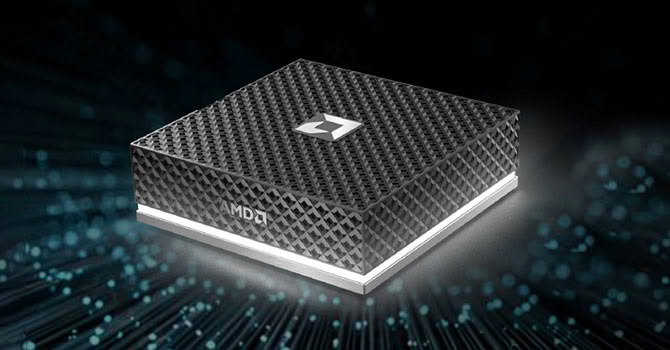
The AMD Ryzen AI Halo is a complete 150 mm-square, ~1 kg machine with 16 Zen 5 cores, a Radeon 8060S RDNA 3.5 GPU and an XDNA 2 NPU, but the number that really matters is the 128 GB of unified LPDDR5X-8000 memory. That's the core of the story for this product—you'll be able to run huge AI models that no other consumer hardware can touch. A GeForce RTX 5090, the fastest consumer GPU you can buy, has "just" 32 GB GDDR7 VRAM, so the moment a model no longer fits, it's the little AMD box that keeps running while the mighty 5090 will fail. AMD brands this specific model as the Ryzen AI Halo Developer Platform, priced at $4,000 compared to $7,000 for NVIDIA's 128 GB DGX Spark. The same concept is available from many other Mini-PC vendors; look for "Ryzen AI 395."
Gorgon Halo—the Ryzen AI 495 successor to Strix Halo—has been announced recently, too, and will start shipping in the coming weeks and months, with support for up to 192 GB of faster LPDDR5X-8533 memory. It seems to be the exact same design, just with more memory and the upgraded CPU, which is really just clocked 100 MHz higher on both the CPU and GPU (it's the same silicon chip).
So this isn't your typical Mini-PC review. The usual material is here (photos, teardown, gaming, power), but I'll be investigating what 128 GB of unified memory makes possible: local LLMs, image and text generation, speech-to-text, a coding assistant and a few experiments we haven't seen anyone else try.
| Specifications | |
|---|---|
| APU | AMD Ryzen AI Max+ 395 "Strix Halo" 16 cores / 32 threads, Zen 5 Up to 5.1 GHz boost TSMC N4P process |
| GPU | Integrated GPU AMD Radeon 8060S RDNA 3.5 40 Compute Units (2560 shaders) |
| NPU | AMD XDNA 2 up to 50 TOPS |
| Memory | 128 GB unified LPDDR5X-8000 ~256 GB/s bandwidth Up to 96 GB for the GPU |
| Storage | 2 TB M.2 NVMe SSD PCIe Gen 4 x4 |
| Display Outputs | 1x HDMI 2.1b DisplayPort via USB-C |
| I/O Ports | 3x USB-C (USB4) 1x USB-C (power input only) 1x 10 Gbps Ethernet (RJ-45) |
| Networking | Wi-Fi 7 Bluetooth 5.4 10 GbE wired |
| Operating System | Windows 11 or Linux |
| TDP | 120 W |
| Dimensions / Weight | 150 x 150 x 45.4 mm (5.9 x 5.9 x 1.79 in) 1016 g (AMD claims <1.2 kg, which seems wrong, we measured it) |
| Price | $4,000 |
Nov 27th, 2026 15:00 CST
change timezone
Latest GPU Drivers
New Forum Posts
- -18C on GPU by moving it to the front of the case. (12)
- What's your main Black Friday / Cyber Monday purchase? (39)
- The TPU UK Clubhouse (27302)
- Anthrophics IPO (47)
- Exit Adobe - PDF reader, and PDF editor recommendations (9)
- Mouse Pad advice - Shidenkai out of production? (20)
- Samsung TV screen care: check the finish before choosing a cleaning method (3)
- Unigine Superposition on Linux (20)
- Making a game in Godot engine (23)
- TPU's WCG/BOINC Team (34814)
Popular Reviews
- VZMORE AX9 Max Review
- Upcoming Hardware Launches 2027 (Updated Nov 2026)
- ASRock X870E Challenger Wi-Fi White Review
- AMD Ryzen 7 9800X3D Review - The Best Gaming Processor
- Microsoft Surface Laptop Ultra Review - The Next-gen Arm Laptop
- AMD Zen 6 Technical Deep Dive
- Montech CyberFlow ARGB 360 Review
- Phantom Blade Zero Performance Benchmark Review - 35 GPUs Tested
- ORICO Obook15 AI Review
- Corsair RM1200e (Second Generation) Review
TPU on YouTube
Controversial News Posts
- Jensen Huang Reinstated as CEO of NVIDIA (622)
- NVIDIA Co-Founder and CEO Jensen Huang Officially Resigns (492)
- Report: Jensen Huang Eyes NVIDIA Comeback (281)
- Open Letter Asking NVIDIA to Reinstate Jensen Huang Passes 115,000 Signatures (184)
- OpenAI CEO Argues Home PCs Waste the World's Limited DRAM Supply (152)
- NVIDIA Launches Investigation Into Jensen Huang's Relationship With Suspected Chinese Spy (136)
- Intel Razor Lake Gets a 12 P-Core bLLC Chip With No E-Cores, Per Leak (94)
- NVIDIA GeForce RTX 50-Series Scheduled for up to $500 Price Hike This Week (89)