 124
AMD Zen 6 Technical Deep Dive
The Venice SoC »The FP Pipeline
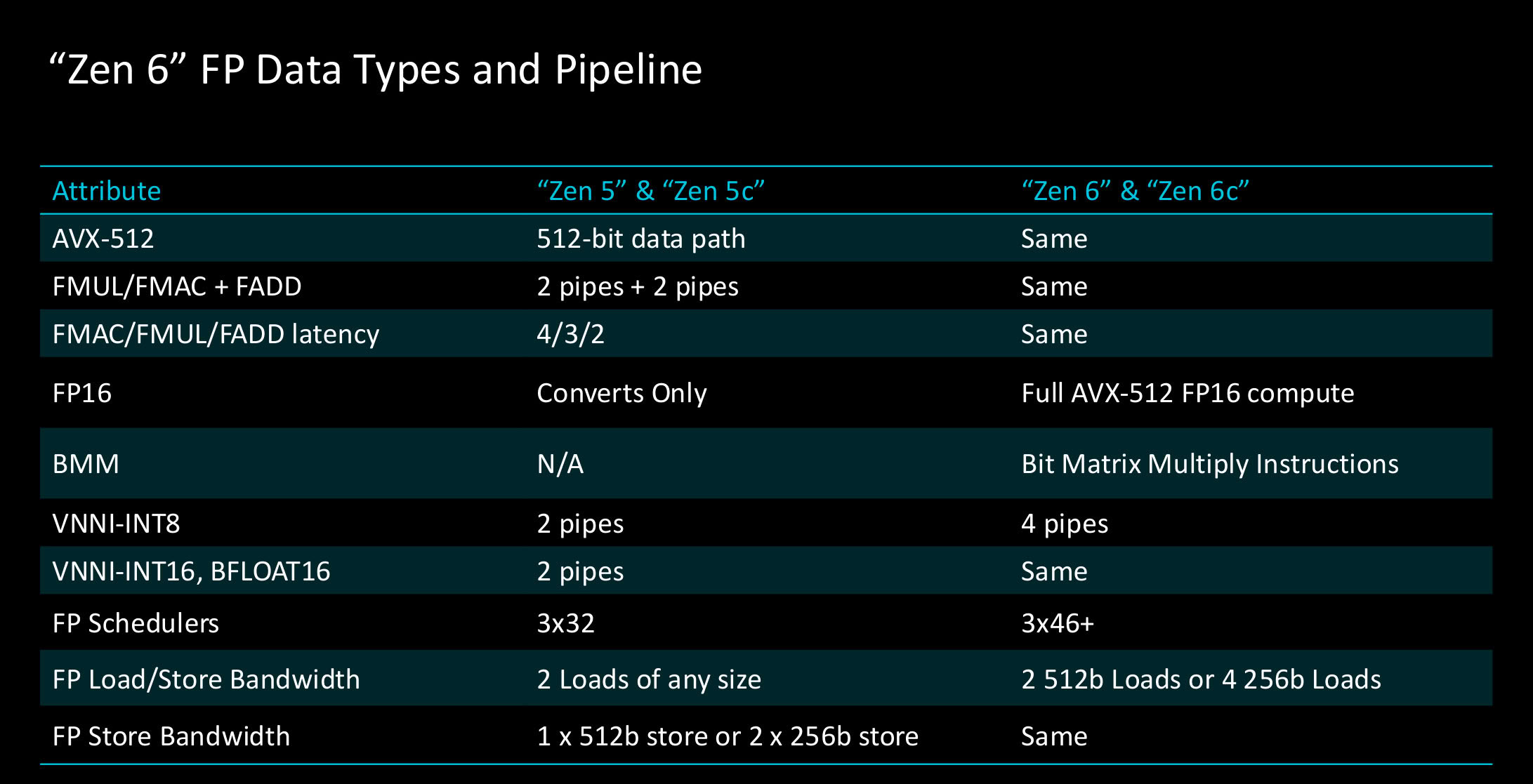
Zen 5 was the generation that rebuilt AMD's floating-point unit, replacing the dual-pumped 256-bit design from Zen 4 with a physical 512-bit datapath. Zen 6 keeps that structure intact and spends its transistor budget on data types instead.
| Attribute | Zen 5 / Zen 5c | Zen 6 / Zen 6c |
|---|---|---|
| AVX-512 | 512-bit data path | Same |
| FMUL/FMAC + FADD | 2 pipes + 2 pipes | Same |
| FMAC/FMUL/FADD latency | 4 / 3 / 2 | Same |
| FP16 | Converts only | Full AVX-512 FP16 compute |
| BMM | N/A | Bit Matrix Multiply instructions |
| VNNI-INT8 | 2 pipes | 4 pipes |
| VNNI-INT16, BFLOAT16 | 2 pipes | Same |
| FP load bandwidth | 2 loads of any size | 2x 512-bit or 4x 256-bit loads |
| FP store bandwidth | 1x 512-bit or 2x 256-bit | Same |
Three changes matter here. FP16 moves from conversion-only to full AVX-512 FP16 compute. On Zen 5 a half-precision value had to be widened to FP32, operated on and converted back, which costs instructions and registers and halves the useful lane count; Zen 6 runs FP16 arithmetic natively at 32 lanes per 512-bit register. That is the AVX512-FP16 extension Intel introduced with Sapphire Rapids, now on x86 from both vendors. VNNI INT8 doubles from two pipes to four, which doubles INT8 dot-product throughput per core for quantized inference, the data type most CPU-side LLM work has settled on. BMM, bit matrix multiply, is new. If it follows the classical definition it treats a register as a matrix of bits and multiplies over GF(2), where addition is XOR, which is the primitive behind a surprising amount of cryptography, error-correcting codes, hashing and arbitrary bit permutation. AMD did not say what it expects BMM to be used for, and it is the kind of instruction that appears because some hyperscale customer asked for it early enough.
The FP load path also doubled in the 256-bit case. Zen 5 could issue two FP loads of any width; Zen 6 can issue two 512-bit loads or four 256-bit loads. A lot of real vector code is still 256-bit, and that code now gets twice the load bandwidth. The vector register file holds 384 entries of 512 bits, with 6-wide vector rename. Those pipes set the arithmetic for the HPC numbers quoted later. Two FMA pipes at 512 bits is 16 FP32 lanes each, two operations per lane per cycle, so 64 FP32 FLOPs per core per cycle, exactly as on Zen 5. That is why AMD's DGEMM claim is 1.3x over Turin while its integer claim is 2.0x: dense matrix math is pipe-bound, the pipes did not change, and 1.3x is in line with the step from 192 cores to 256 with no change in per-core throughput. Our inference, not AMD's statement. The 2-cycle FADD deserves a mention in the other direction. It is unusually short, Zen 5 brought it down from 3, and it is what dependent chains of additions in physics and audio code sit waiting on.
New Instructions
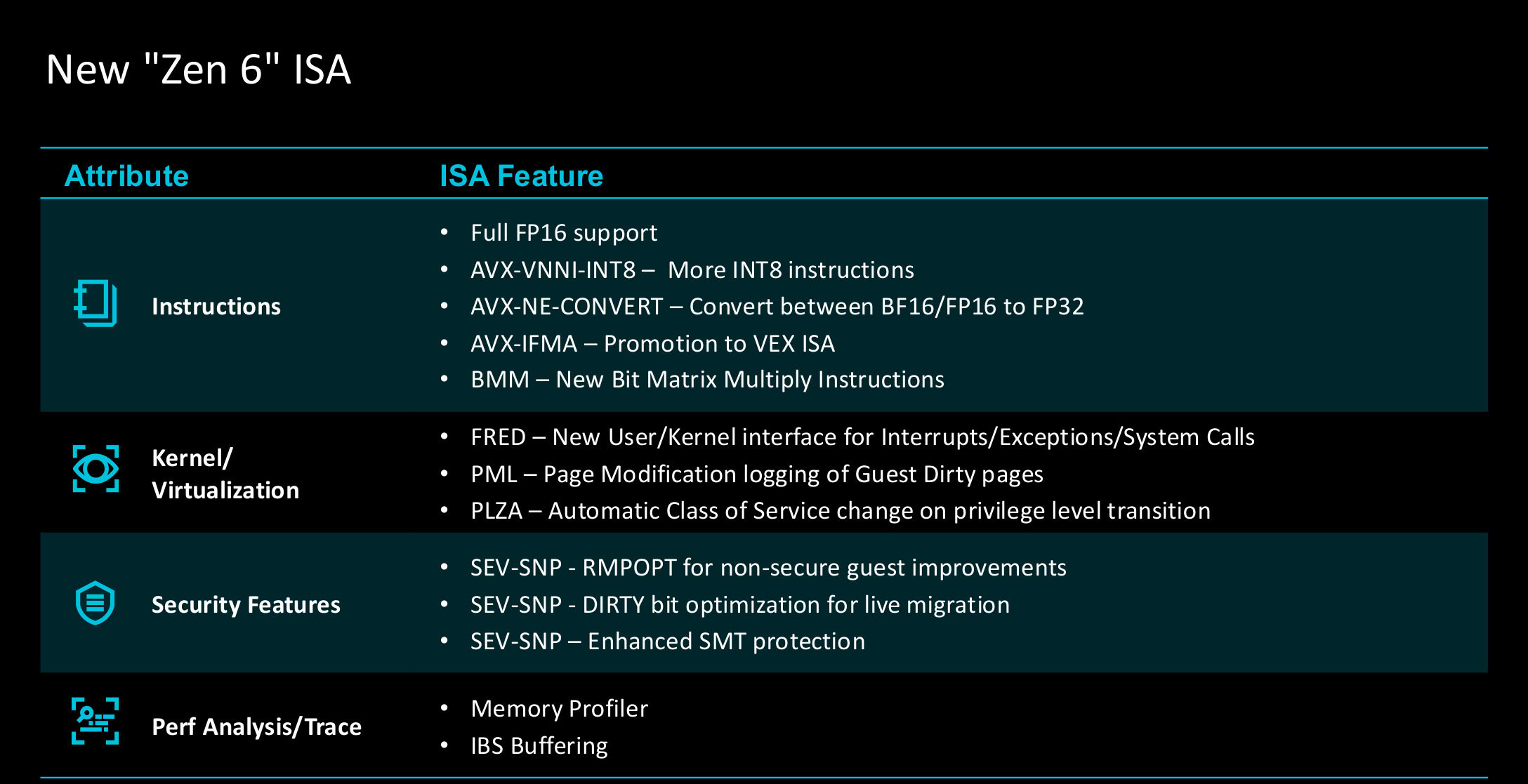
The Zen 6 ISA additions go well beyond vectors:
- Full FP16 support: half-precision as a first-class compute type
- AVX-VNNI-INT8: more INT8 instructions
- AVX-NE-CONVERT: conversion between BF16/FP16 and FP32
- AVX-IFMA: promoted to the VEX encoding
- BMM: bit matrix multiply
On the kernel and virtualization side:
- FRED: a new user/kernel interface for interrupts, exceptions and system calls, replacing a mechanism that dates to the 386
- PML: page modification logging of guest dirty pages
- PLZA: automatic class-of-service change on privilege level transition
What This Means for Gamers
The FP16 and VNNI INT8 work is aimed at server inference, but it lands on every Zen 6 core. On desktop that mostly matters for local AI that runs on the CPU rather than the GPU or NPU. Doubling INT8 throughput per core is a real gain for small models and for the quantized workloads people run on CPUs today.
Games will not touch BMM or VNNI. The AVX-512 picture barely moves either: the 512-bit datapath and the FADD latency are unchanged from Zen 5, so the emulators and engines that picked up 512-bit vectors on Zen 5 gain little here beyond the general IPC lift.
Security and Profiling
Security gets RMPOPT, a dirty-bit optimization for live migration, and enhanced SMT protection, all under SEV-SNP. The RMP is the reverse map table SNP uses to record which guest owns every physical page, and the slide's wording, improvements for non-secure guests, implies that ordinary unencrypted VMs sharing a host with SNP ones have been paying something for checks against it; RMPOPT is aimed at letting the two kinds coexist without the plain ones subsidizing the secure ones. For performance work, AMD added a memory profiler and buffering for IBS, its instruction-based sampling mechanism, which records what individual instructions did on their way through the pipeline. Buffering the samples instead of interrupting on each one makes profiling cheap enough to leave running in production.
Nov 13th, 2026 17:45 PST
change timezone
Latest GPU Drivers
New Forum Posts
- Tell me about your favourite graphics card (21)
- TMOG - post your benchmark results here (16)
- no "PhysX" workable (7)
- Microsoft Exchange/365 outages? (61)
- Opinion on Monitor Replacement (5)
- Unallocated space in ssd , is it normal? (18)
- Last game you purchased? (1401)
- Game Soundtracks You Love (1286)
- I'll flash a ASUS ROG Strix RX480 O8G in Cause of Code 43, as a Newbie (0)
- WarpCoreBench scores! (28)
Popular Reviews
- AMD Zen 6 Technical Deep Dive
- Corsair HX1000i Shift Crystal Review
- NZXT C1200 Platinum Review
- Upcoming Hardware Launches 2027 (Updated Nov 2026)
- ASUS ROG Strix B850-I Gaming Wi-Fi7 W Review
- Montech King 95 3D PRO Review
- NZXT H7 RGB+ Review
- NZXT H5 Review
- Phantom Blade Zero Performance Benchmark Review - 35 GPUs Tested
- XPG NIMBUS PLUS Review - Mid-range Chair With Strong Competitors
TPU on YouTube
Controversial News Posts
- NVIDIA Co-Founder and CEO Jensen Huang Officially Resigns (377)
- OpenAI CEO Argues Home PCs Waste the World's Limited DRAM Supply (152)
- NVIDIA Launches Investigation Into Jensen Huang's Relationship With Suspected Chinese Spy (136)
- Intel "Raptor Lake Next" 16-Core and 20-Core CPUs Surface (130)
- Legendary Game Studio BioWare Shuts Down Following EA Layoffs (104)
- Dell CEO Says the Memory Shortage Will Get Worse in 2027 (95)
- NVIDIA GeForce RTX 50-Series Scheduled for up to $500 Price Hike This Week (89)
- Modder Fits RTX 5090 With Four 8-Pin Connectors, Halving Current per Wire (80)