 76
ASUS GeForce RTX 5080 Noctua OC Review - Amazing Cooling
Pictures & Teardown »Introduction

ASUS GeForce RTX 5080 Noctua OC is the third generation of enthusiast-segment graphics cards from the collaboration between ASUS and Noctua. We were blown away by the RTX 3080 Noctua OC, and the two companies only levelled things up with the RTX 4080 Noctua OC, which tremendously raised our expectations for the card we're reviewing today. Noctua is a pioneering brand with ultra-quiet fans that implement hydro-dynamic bearings, and the company constantly innovates new motor, impeller and bearing designs with its main line of case fans that are sold both as standalone units, and included with its class-leading range of CPU coolers. ASUS, on the other hand, is the market leader in custom PCB design for graphics cards, and has a formidable lineup of custom design graphics cards on its own, under its ROG Astral, ROG Strix, and TUF Gaming brands. Thus, the ASUS x Noctua collaboration can only be seen from the lens of an enthusiast-segment product that prioritizes low noise above everything else, without compromising on out-of-the-box performance or overclocking headroom.
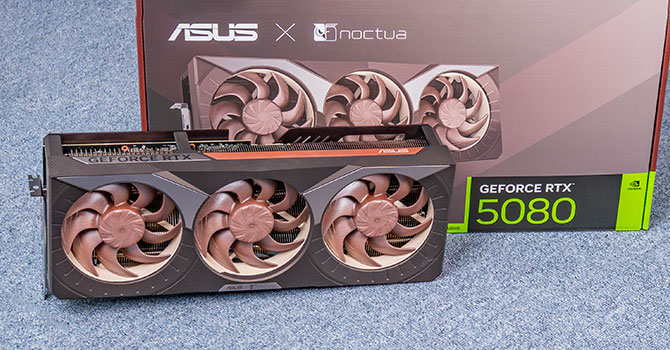
The ASUS GeForce RTX 5080 Noctua OC is built upon the foundation of the ROG Astral RTX 5080 OC PCB, with a complete replacement of its cooling solution. Noctua leads the design effort of this cooler, which consists of two sets of aluminium fin-stack heatsinks with an asymmetric arrangement of fins that improves heat dissipation. The heatsink makes contact with the GPU over a vapor chamber plate, and a premium phase-change thermal pad. The real star of the show is the trio of Noctua NF-A12x25 G2 120 mm fans. These are proper retail grade fans that have been integrated into the cooling solution.
Compared to the past two generations, ASUS and Noctua have taken greater care to ensure that the cooler shroud design makes the card appear like a cohesive factory-made product, and not a card with a DIY cooling solution installed by the user. The G2 fan features Noctua's second generation progressive-bend impeller with flow-acceleration channels, winglets, and a unique hub design Noctua calls centralized turbulator. The impeller is made of Sterrox liquid-crystal polymer. The fan also comes with Noctua's SSO2 hydro-dynamic bearing. The cooler has been extensively tested by Noctua to ensure the lowest possible noise levels from an air-cooled RTX 5080, lower than even a DIY liquid cooling setup that includes pump noise.
The GeForce RTX 5080 is an enthusiast-segment graphics card from NVIDIA that's second only to the flagship RTX 5090. It is designed for maxed out gameplay at 4K Ultra HD resolution, including ray tracing. It is powered by the latest Blackwell graphics architecture, which introduces new technologies such as Neural Rendering—the ability to combine photorealistic objects created by generative AI models into raster graphics—ray tracing with Mega Geometry, and the new DLSS 4 feature-set, which introduces Transformer-based AI models that are more accurate and significantly improve image quality at every performance preset. NVIDIA also introduced the Blackwell-exclusive Multi Frame Generation feature, which lets the GPU draw up to three frames following every conventionally rendered one, to effectively quadruple frame-rates.
The GeForce RTX 5080 is based on the GB203 silicon, which it maxes out, enabling all 84 SM physically present on the chip, to enjoy 10,752 CUDA cores, 336 Tensor cores, 84 RT cores, 336 TMUs, and 112 ROPs. You get 16 GB of 30 Gbps GDDR7 memory across the chip's full 256-bit wide memory bus, for 960 GB/s of memory bandwidth. Besides GDDR7, the other new standards Blackwell implements are a PCI-Express 5.0 host interface, and ATX 3.1 with PCIe 5.1 CEM power architecture. The power input is the more durable 12V-2x6, an evolution of the 12VHPWR connector.
ASUS has given the RTX 5080 Noctua OC factory overclocked speeds of 2700 MHz boost compared to 2617 MHz, which is halfway between those of the ROG Astral RTX 5080, and the ROG Astral RTX 5080 OC Edition. The company is pricing the card at around $1500, which is a steep premium, but what's on offer are noise levels that beat even liquid cooling solutions.
| Price | Cores | ROPs | Core Clock | Boost Clock | Memory Clock | GPU | Transistors | Memory | |
|---|---|---|---|---|---|---|---|---|---|
| RTX 4070 Super | $600 | 7168 | 80 | 1980 MHz | 2475 MHz | 1313 MHz | AD104 | 35800M | 12 GB, GDDR6X, 192-bit |
| RX 7900 GRE | $550 | 5120 | 160 | 1880 MHz | 2245 MHz | 2250 MHz | Navi 31 | 57700M | 16 GB, GDDR6, 256-bit |
| RTX 4070 Ti | $700 | 7680 | 80 | 2310 MHz | 2610 MHz | 1313 MHz | AD104 | 35800M | 12 GB, GDDR6X, 192-bit |
| RTX 5070 | $550 | 6144 | 80 | 2325 MHz | 2512 MHz | 1750 MHz | GB205 | 31100M | 12 GB, GDDR7, 192-bit |
| RTX 4070 Ti Super | $750 | 8448 | 96 | 2340 MHz | 2610 MHz | 1313 MHz | AD103 | 45900M | 16 GB, GDDR6X, 256-bit |
| RX 7900 XT | $620 | 5376 | 192 | 2000 MHz | 2400 MHz | 2500 MHz | Navi 31 | 57700M | 20 GB, GDDR6, 320-bit |
| RX 9070 | $550 | 3584 | 128 | 2070 MHz | 2520 MHz | 2518 MHz | Navi 48 | 53900M | 16 GB, GDDR6, 256-bit |
| RX 9070 XT | $615 | 4096 | 128 | 2400 MHz | 2970 MHz | 2518 MHz | Navi 48 | 53900M | 16 GB, GDDR6, 256-bit |
| RTX 5070 Ti | $750 | 8960 | 96 | 2295 MHz | 2452 MHz | 1750 MHz | GB203 | 45600M | 16 GB, GDDR7, 256-bit |
| RX 7900 XTX | $750 | 6144 | 192 | 2300 MHz | 2500 MHz | 2500 MHz | Navi 31 | 57700M | 24 GB, GDDR6, 384-bit |
| RTX 4080 | $850 | 9728 | 112 | 2205 MHz | 2505 MHz | 1400 MHz | AD103 | 45900M | 16 GB, GDDR6X, 256-bit |
| RTX 4080 Super | $1000 | 10240 | 112 | 2295 MHz | 2550 MHz | 1438 MHz | AD103 | 45900M | 16 GB, GDDR6X, 256-bit |
| RTX 5080 | $1000 | 10752 | 112 | 2295 MHz | 2617 MHz | 1875 MHz | GB203 | 45600M | 16 GB, GDDR7, 256-bit |
| ASUS RTX 5080 Noctua OC | $1500 | 10752 | 112 | 2295 MHz | 2700 MHz | 1875 MHz | GB203 | 45600M | 16 GB, GDDR7, 256-bit |
| RTX 4090 | $1800 | 16384 | 176 | 2235 MHz | 2520 MHz | 1313 MHz | AD102 | 76300M | 24 GB, GDDR6X, 384-bit |
| RTX 5090 | $2200 | 21760 | 176 | 2017 MHz | 2407 MHz | 1750 MHz | GB202 | 92200M | 32 GB, GDDR7, 512-bit |
Nov 15th, 2026 15:56 CST
change timezone
Latest GPU Drivers
New Forum Posts
- WarpCoreBench scores! (51)
- Asus Rog Maximus Z890 Extreme. (Various questions). (25)
- TPU's Nostalgic Hardware Club (22165)
- HP Office Jet 7740 Pro - Supply system problem with replacement cartridge (3)
- Recommendations Wanted - Affordable Enterprise SSD for Boot (9)
- Folding Pie and Milestones!! (10204)
- What can the FX 8320 do today? Here is the answer. (59)
- Power supply noise stops when I move the mouse (8)
- What are you playing? (26221)
- How do you get games for PC? (59)
Popular Reviews
- AMD Zen 6 Technical Deep Dive
- ASUS ROG Strix B850-I Gaming Wi-Fi7 W Review
- Corsair HX1000i Shift Crystal Review
- Upcoming Hardware Launches 2027 (Updated Nov 2026)
- Montech King 95 3D PRO Review
- NZXT C1200 Platinum Review
- NZXT H7 RGB+ Review
- NZXT H5 Review
- Phantom Blade Zero Performance Benchmark Review - 35 GPUs Tested
- AMD Ryzen 7 9800X3D Review - The Best Gaming Processor
TPU on YouTube
Controversial News Posts
- NVIDIA Co-Founder and CEO Jensen Huang Officially Resigns (420)
- Open Letter Asking NVIDIA to Reinstate Jensen Huang Passes 115,000 Signatures (184)
- OpenAI CEO Argues Home PCs Waste the World's Limited DRAM Supply (152)
- NVIDIA Launches Investigation Into Jensen Huang's Relationship With Suspected Chinese Spy (136)
- Intel "Raptor Lake Next" 16-Core and 20-Core CPUs Surface (130)
- Legendary Game Studio BioWare Shuts Down Following EA Layoffs (104)
- Dell CEO Says the Memory Shortage Will Get Worse in 2027 (95)
- NVIDIA GeForce RTX 50-Series Scheduled for up to $500 Price Hike This Week (89)