 13
ASUS ROG GR70 Mini PC Review
Value & Conclusion »Power and Noise Levels
Power and efficiency can be just as important as raw performance in a more compact system, so I measured how much the system draws under CPU stress, during GPU-heavy tests, while gaming, and during a 24-hour idle period.24-Hour Idle Power Draw
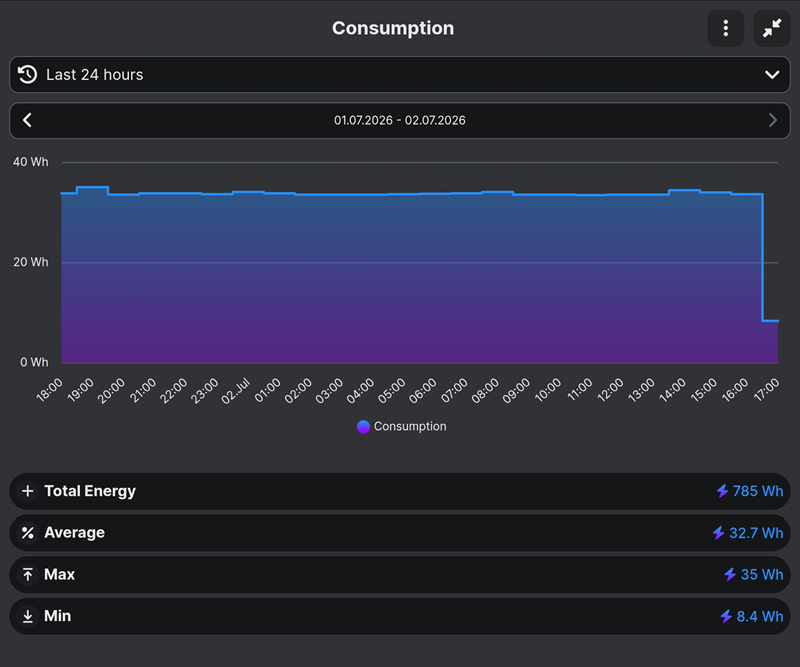
Over a full 24-hour idle period, the ASUS ROG GR70 averages 32.7 W, with a peak of 35.0 W and a low point of 8.4 W. For most of the monitoring period, power draw stays remarkably steady in the 33 to 34 W range, with only minor fluctuations and no signs of unnecessary background activity or erratic power behavior.
In context, this is one of the highest idle results among the mini PCs we've tested, but it is also entirely expected given the hardware. Unlike typical integrated-graphics Mini-PCs, the GR70 combines a Ryzen 9 9955HX3D with a GeForce RTX 5070 Laptop GPU, along with high-speed DDR5 memory, multiple cooling fans, and other always-active components that naturally increase idle power consumption.
At an average of 32.7 W, leaving the system idle around the clock would use roughly 286.5 kWh per year, which works out to about $43 to $57 annually, depending on local electricity rates. While the idle draw is significantly higher than more traditional Mini-PCs, it fits a compact gaming system with this level of CPU and GPU hardware.
CPU and GPU Power Draw
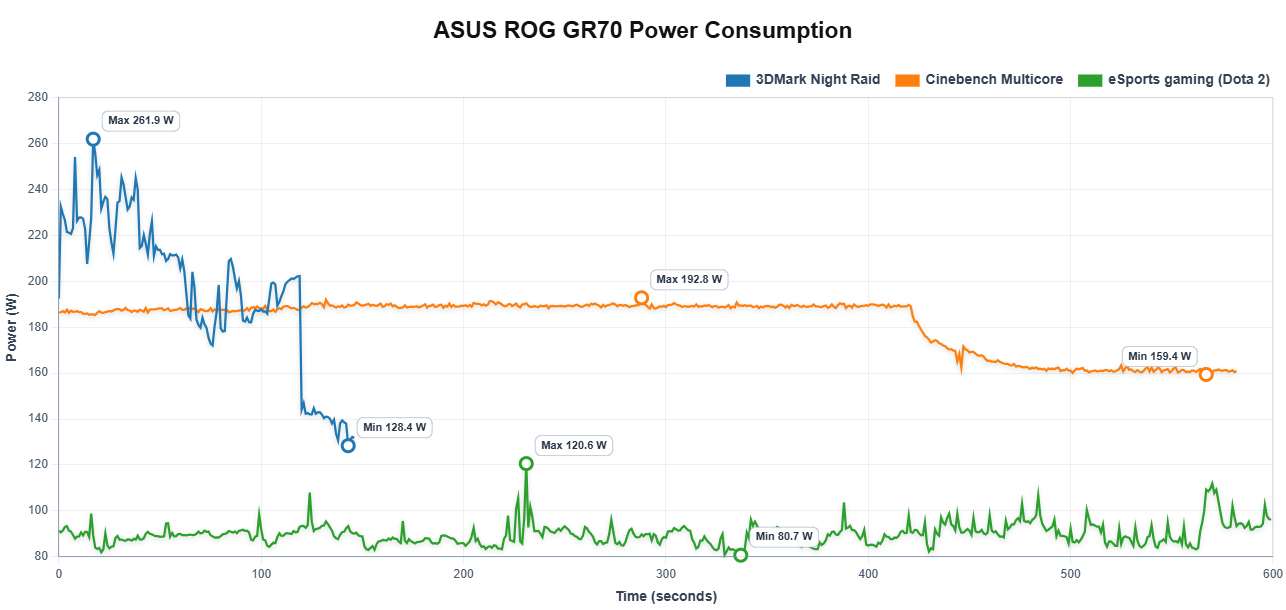
I also looked at three different power scenarios to see how the system behaves under different types of load: an esports gaming run with Dota 2 to observe real-world gaming power behavior, a GPU-focused pass using 3DMark Night Raid to show how the system ramps under heavy graphics demand, and a Cinebench multicore run that fully loads the CPU to measure sustained power delivery over time.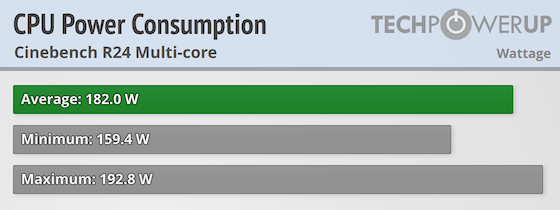
Cinebench (Multicore)
During the Cinebench multicore test, the ROG GR70 averages 182.0 W, with readings ranging from 159.4 W to 192.8 W. Power draw stays in a tight range through most of the workload, with only a gradual reduction toward the end of the run.
eSports (Dota 2)
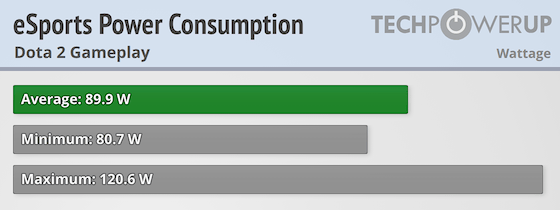
In the Dota 2 workload, the system averages 89.9 W, with readings between 80.7 W and 120.6 W. Power consumption stays relatively steady during gameplay, with occasional spikes as the CPU and GPU briefly boost during more demanding scenes.
3DMark (Night Raid)
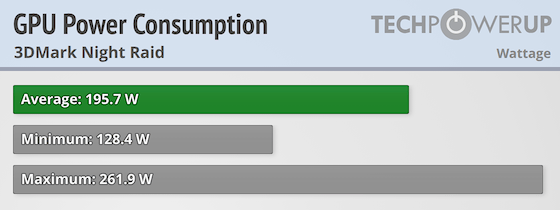
Running 3DMark Night Raid, the system averages 195.7 W, with readings between 128.4 W and 261.9 W. The benchmark produces the highest sustained power draw of the three workloads, with GPU-intensive scenes driving consumption well above 250 W before settling into lower-power rendering and transition phases.
Here's a full view of the ASUS ROG GR70's power draw across all three profiles:
Noise Levels
During idle and lighter use, the ROG GR70 stays quiet at around 31 to 33 dB(A), with fan noise blending into the background during normal desktop work, browsing, media playback, and other everyday tasks. You can hear a soft rush of air if the room is especially quiet, but it never becomes distracting. Nothing unusual.Under heavier workloads, the fans become much easier to hear as the CPU and RTX 5070 Laptop GPU ramp up, usually settling around 47 to 50 dB(A) during sustained gaming and benchmark runs. I did see brief spikes into the 60 to 61 dB(A) range when the system first reacted to intensive loads, which is definitely distracting, but those peaks did not last long before the noise dropped back into the 50 dB(A) range. Overall, the GR70 was a bit quieter than the AtomMan G7 Pro running in its Performance fan mode, and the fan noise was mostly a steady rush of air, not a harsh or uneven sound.
Nov 19th, 2026 17:46 CST
change timezone
Latest GPU Drivers
New Forum Posts
- How to prevent OLED burn damage due to PC freezes or power outtages? (30)
- TPU's Nostalgic Hardware Club (22170)
- Security Apps (3)
- Got the EOL 32GB TridentZ 6000 CL26 1.4V (12)
- Honestly, do you care about GTA VI? (167)
- Dell Workstation Owners Club (3517)
- Making a game in Godot engine (6)
- Introducing DST Bench : one of the most advanced disk benchmark and storage analyzer real-time software (6)
- Windows 11 General Discussion (7736)
- Current Sales, Bundles, Giveaways (10448)
Popular Reviews
- Acemagic Retro X3 Review
- Ugreen NASync DXP4800 GT Review
- Upcoming Hardware Launches 2027 (Updated Nov 2026)
- Pulsar Office Tour & First Look at P1 Dual-Sensor Mouse
- AMD Zen 6 Technical Deep Dive
- Biwin Black Opal NV7400 2 TB Review
- Corsair RM1200e (Second Generation) Review
- Sapphire Radeon RX 7700 XT Pure Review
- Sapphire Radeon RX 7700 XT Pulse Review
- AMD Ryzen 7 9800X3D Review - The Best Gaming Processor
TPU on YouTube
Controversial News Posts
- NVIDIA Co-Founder and CEO Jensen Huang Officially Resigns (489)
- Report: Jensen Huang Eyes NVIDIA Comeback (223)
- Open Letter Asking NVIDIA to Reinstate Jensen Huang Passes 115,000 Signatures (184)
- OpenAI CEO Argues Home PCs Waste the World's Limited DRAM Supply (152)
- NVIDIA Launches Investigation Into Jensen Huang's Relationship With Suspected Chinese Spy (136)
- Intel "Raptor Lake Next" 16-Core and 20-Core CPUs Surface (130)
- Legendary Game Studio BioWare Shuts Down Following EA Layoffs (104)
- Dell CEO Says the Memory Shortage Will Get Worse in 2027 (95)