 6
Chieftec Stealth SPX-1200-FC Review
Value & Conclusion »Result Summary
| Full-Range Load Testing (230 V) | |||||||||
|---|---|---|---|---|---|---|---|---|---|
| All-rail Load | 12 V | 5 V | 3.3 V | Power (DC/AC) | Efficiency | Fan Speed | Noise Level | Power Factor | |
| 0 % | 0.00 A | 0.00 A | 0.00 A | 0.00 W | N/A | Fan Stop | 0.06 | ||
| 12.16 V | 5.08 V | 3.33 V | 3.60 W | ||||||
| 5 % | 5.00 A | 4.00 A | 6.06 A | 60.00 W | 74.23 % | Fan Stop | 0.64 | ||
| 12.15 V | 5.08 V | 3.33 V | 82.60 W | ||||||
| 10 % | 10.00 A | 4.00 A | 6.06 A | 120.00 W | 86.17 % | Fan Stop | 0.72 | ||
| 12.12 V | 5.07 V | 3.33 V | 140.30 W | ||||||
| 20 % | 20.00 A | 4.00 A | 6.06 A | 240.00 W | 90.21 % | Fan Stop | 0.91 | ||
| 12.08 V | 5.07 V | 3.32 V | 268.60 W | ||||||
| 30 % | 30.00 A | 4.00 A | 6.06 A | 360.00 W | 91.78 % | 531 RPM | 26.3 dBA | 0.94 | |
| 12.06 V | 5.06 V | 3.32 V | 396.90 W | ||||||
| 40 % | 40.00 A | 4.00 A | 6.06 A | 480.00 W | 92.28 % | 531 RPM | 26.3 dBA | 0.95 | |
| 12.03 V | 5.06 V | 3.32 V | 527.60 W | ||||||
| 50 % | 50.00 A | 4.00 A | 6.06 A | 600.00 W | 92.47 % | 531 RPM | 26.3 dBA | 0.96 | |
| 12.00 V | 5.05 V | 3.32 V | 659.70 W | ||||||
| 60 % | 60.00 A | 4.00 A | 6.06 A | 720.00 W | 92.26 % | 531 RPM | 26.3 dBA | 0.97 | |
| 11.97 V | 5.05 V | 3.32 V | 795.40 W | ||||||
| 70 % | 70.00 A | 4.00 A | 6.06 A | 840.00 W | 91.91 % | 617 RPM | 27.1 dBA | 0.97 | |
| 11.94 V | 5.04 V | 3.32 V | 933.90 W | ||||||
| 80 % | 80.00 A | 4.00 A | 6.06 A | 960.00 W | 91.57 % | 994 RPM | 30.9 dBA | 0.98 | |
| 11.92 V | 5.04 V | 3.31 V | 1074.00 W | ||||||
| 90 % | 90.00 A | 4.00 A | 6.06 A | 1080.00 W | 91.29 % | 1328 RPM | 39.2 dBA | 0.98 | |
| 11.88 V | 5.03 V | 3.31 V | 1215.00 W | ||||||
| 100 % | 100.00 A | 4.00 A | 6.06 A | 1200.00 W | 90.73 % | 1560 RPM | 45.8 dBA | 0.98 | |
| 11.85 V | 5.03 V | 3.31 V | 1362.00 W | ||||||
| 110 % | 110.00 A | 4.00 A | 6.06 A | 1320.00 W | 90.14 % | 1654 RPM | 47.1 dBA | 0.98 | |
| 11.81 V | 5.02 V | 3.31 V | 1512.00 W | ||||||
Efficiency
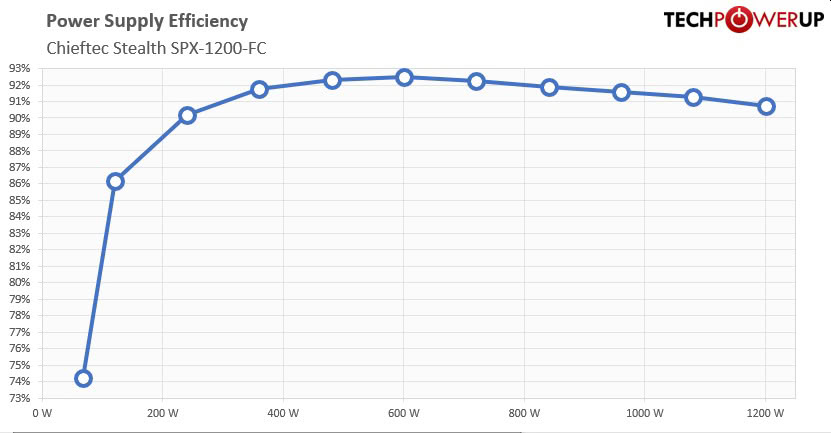
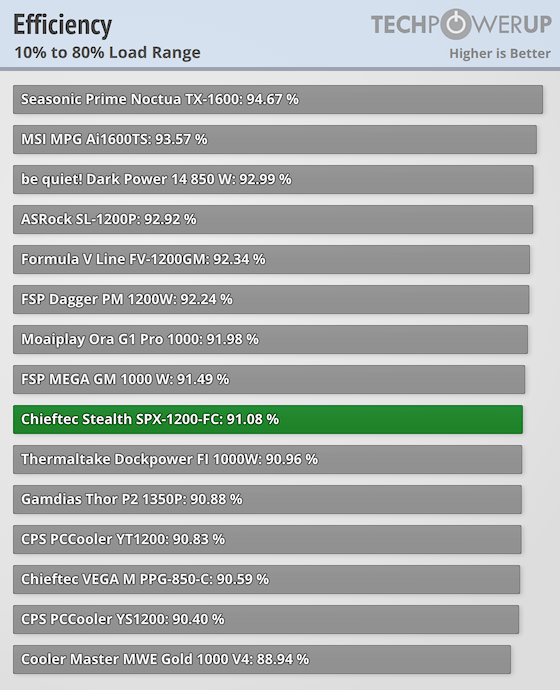
The efficiency curve is really nice, remaining relatively flat between 30-70% which is where the supply will be performing mostly during normal and even heavy use. This indicates that the platform has headroom and should result in great reliability.
This supply is rated as 80 Plus Platinum; however, this will be based on the 115 V measurements. Chieftec do not provide an 80 Plus rating at 230 V, so we will compare the measurements to the 80 Plus Gold (230 V) standard.
| Rated Efficiency Validation (230 V) | ||||
|---|---|---|---|---|
| Certification: 80 Plus Gold | ||||
| Test Load | Required | Measured | Margin | Status |
| 20% | 90.00 % | 90.21 % | +0.21 % | Pass |
| 50% | 92.00 % | 92.47 % | +0.47 % | Pass |
| 100% | 89.00 % | 90.73 % | +1.73 % | Pass |
At 230 V, it is a little way off achieving a Platinum rating, but comfortably hits the Gold 230 V standard, performing well at higher loads. This is a decent result for this amount of power and price point. The only thing that stands out a bit different to other units is the low efficiency at 5% load, but the power will rarely be at this level in a real world environment.
Fan Noise
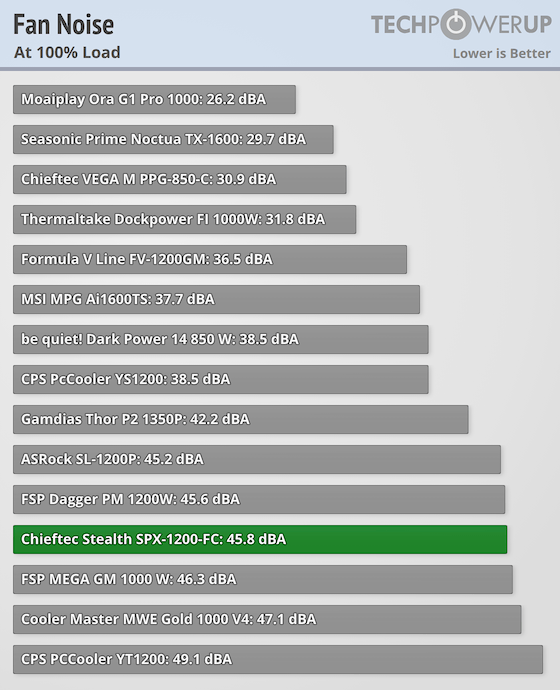
As predicted, when the fan ramps up to a good speed above 1500 RPM, the noise is noticeable; but as others have reported with this fan, the sound is non-obtrusive, and a lot of it comes from the act of pushing a lot of air through a very dense layout quickly, rather than the fan motor or bearings themselves. Up to around 70% load, any sound from the fan or air it is pushing will be completely unnoticeable when paired with typical room noise floor and other fans in the system.
Voltage Regulation
All ATX PSUs have a voltage regulation feedback loop, which increases the PWM duty cycle for each rail to account for voltage drop when current is drawn. However, most PSUs only measure voltage at the PSU output, rather than at the end of the cable going to the load. This means any voltage drop across the cable is not automatically adjusted for. The ATX 3.1 specification outlines a maximum allowed voltage drop at the load itself to ensure system stability,| Voltage Regulation & ATX 3.0 Compliance | |||||
|---|---|---|---|---|---|
| Test Load | Rail | Measured | ATX 3.0 Spec Limit | Margin | Status |
| Idle (0%) | +12V | 12.16 V | +5% / -8% | +1.33 % | Pass |
| +5V | 5.08 V | ±5% | +1.60 % | Pass | |
| +3.3V | 3.33 V | ±5% | +0.91 % | Pass | |
| 100% Load | +12V | 11.85 V | +5% / -8% | -1.25 % | Pass |
| +5V | 5.03 V | ±5% | +0.60 % | Pass | |
| +3.3V | 3.31 V | ±5% | +0.30 % | Pass | |
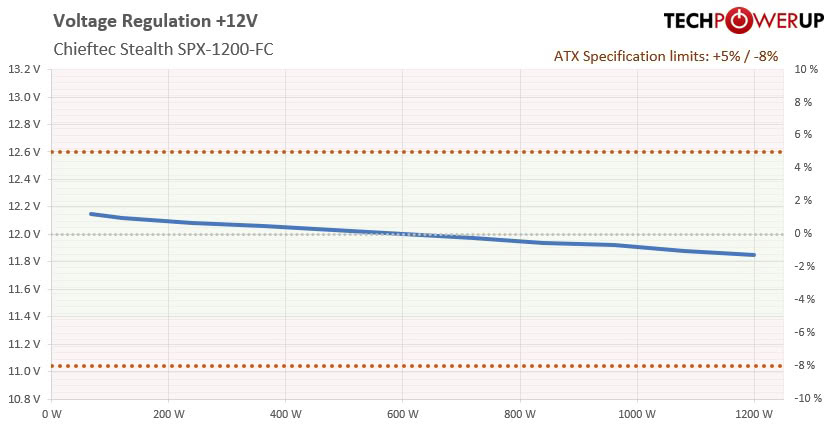
The 12 V and 5 V rail both start out a touch high which helps account for losses across the cables under load. The 12 V rail ends up a little lower than some other 1200 W models we have tested, but it is still plenty high enough to be well within spec. The minor rails both stay pretty solid throughout testing.
Cable Quality
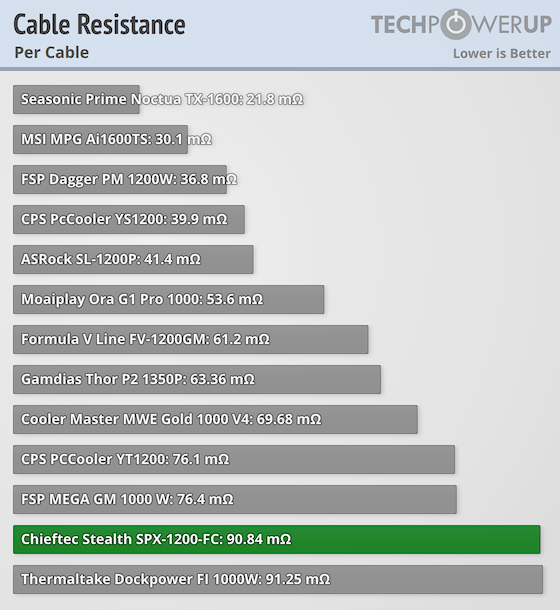
Although voltage regulation inside modern PSUs is extremely stable, voltage drop and thus power losses will occur across the cables as current is drawn through them. This results in a lower voltage available to the system components than what is actually measured at the PSU outputs. Thicker cables will cause less voltage drop and more power to the components. Any power lost across the cables is wasted as heat in the wire itself. By measuring the voltage drop at a known load, we can calculate the resistance of the cables.| Cable Losses at Full Load | |
|---|---|
| Applied 12 V Load | 97.92 A |
| Measured @ Supply | 12.11 V |
| Measured @ Load | 11.81 V |
| Power Lost in Cable | 29.72 W |
| Per-Cable Resistance | 90.84 mΩ |
| Cable Temperature | 39.8°C |
The cable resistance is a touch high for a 1200 W model, and the wires run warmer than others under full load.
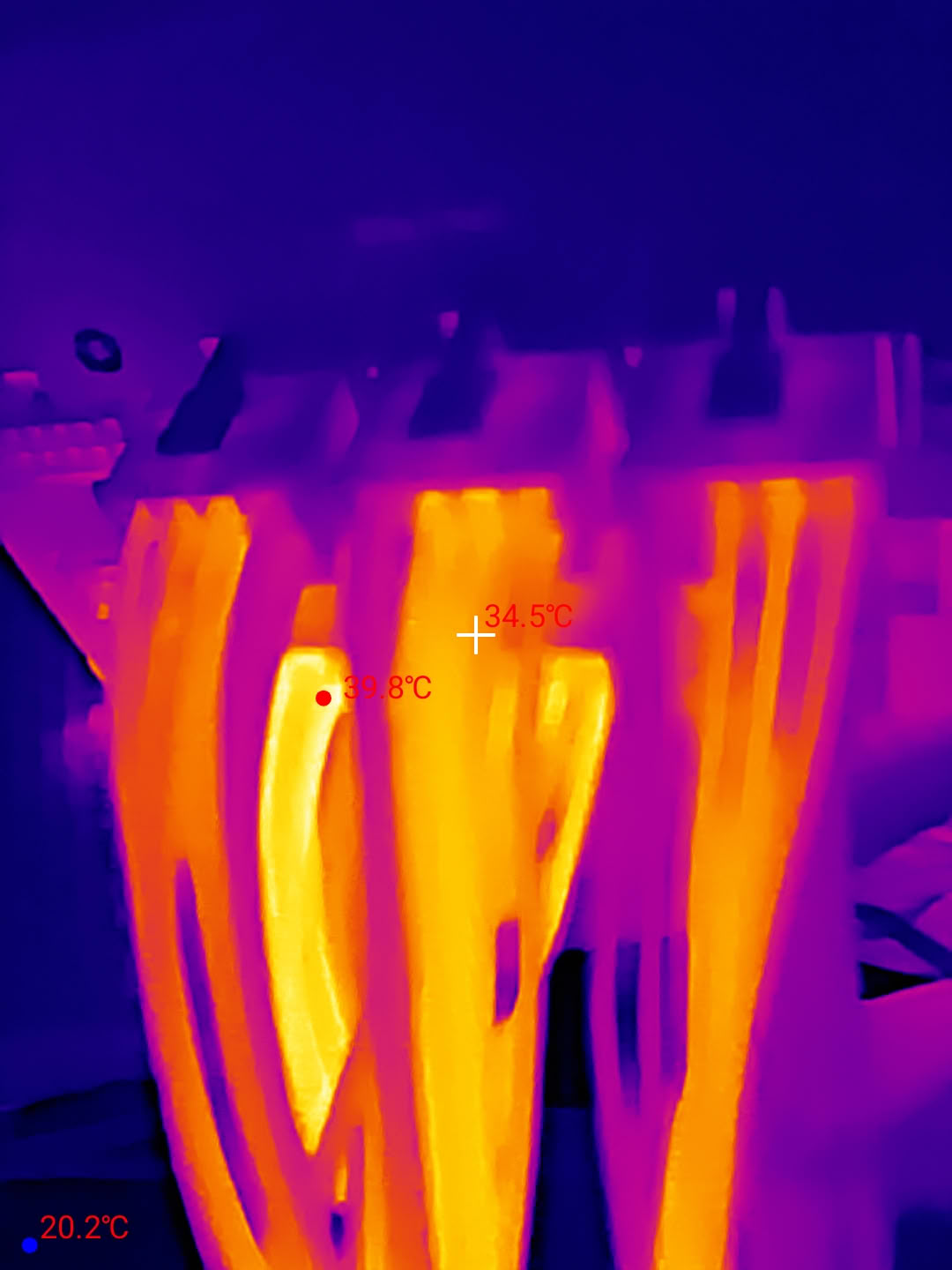
Going by the thermals, it looks as if the current isn't shared particularly evenly between the PCIe and CPU power cables, even though they are all perfectly in parallel. This can be down to trace routing on the connector board itself having a lower resistance path to the CPU connectors.
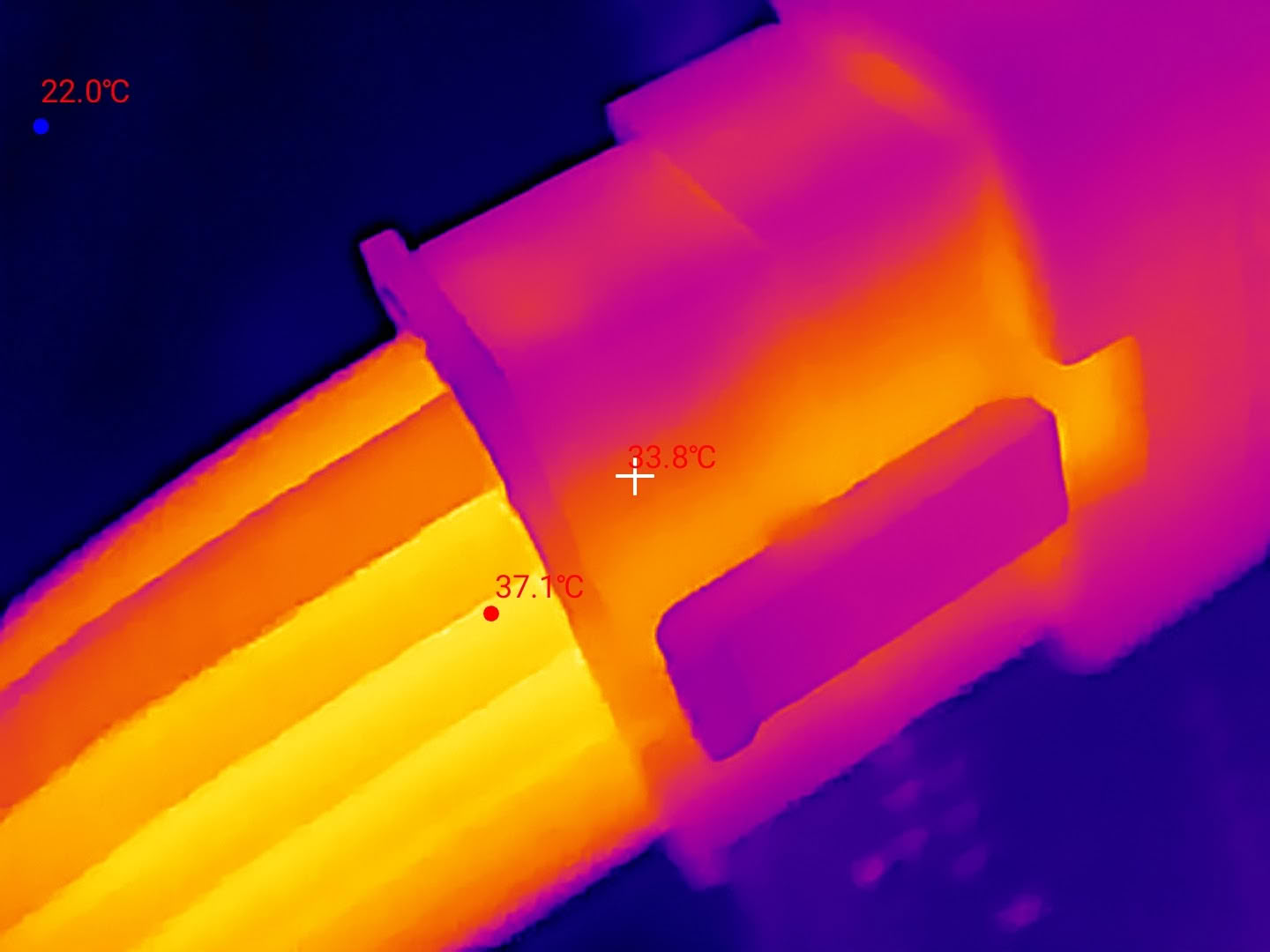
When testing the 12V-2x6 alone with a constant 600 W load, we found the resistance of the cable as a whole was 3.97 (47.64 per wire), showing us that these are thicker gauge than the standard CPU and PCIe wires. We lost about 10 W across the 12V-2x6, and it reached a safe maximum temperature of 37.1 C.
Ripple
Ideally you want the DC voltage delivered by your power supply to be a completely flat line when looking through an oscilloscope. However, due to the switching nature of the ATX power supply and the less than ideal real world behavior of all the components involved, we get very small fluctuations in the voltage output, known as ripple and noise. The ATX spec allows a ripple of up to 120 mV for the +12 V rail and 50 mV for the minor rails.| Ripple (mV) | ||||
|---|---|---|---|---|
| Test Load | 12 V | 5 V | 3.3 V | Status |
| 5% | 14 mV | 9 mV | 11 mV | Pass |
| 10% | 15 mV | 10 mV | 11 mV | Pass |
| 20% | 16 mV | 11 mV | 13 mV | Pass |
| 30% | 18 mV | 12 mV | 14 mV | Pass |
| 40% | 19 mV | 13 mV | 15 mV | Pass |
| 50% | 20 mV | 14 mV | 17 mV | Pass |
| 60% | 22 mV | 15 mV | 18 mV | Pass |
| 70% | 24 mV | 16 mV | 19 mV | Pass |
| 80% | 26 mV | 18 mV | 21 mV | Pass |
| 90% | 27 mV | 20 mV | 23 mV | Pass |
| 100% | 29 mV | 21 mV | 24 mV | Pass |
| 110% | 32 mV | 23 mV | 26 mV | Pass |
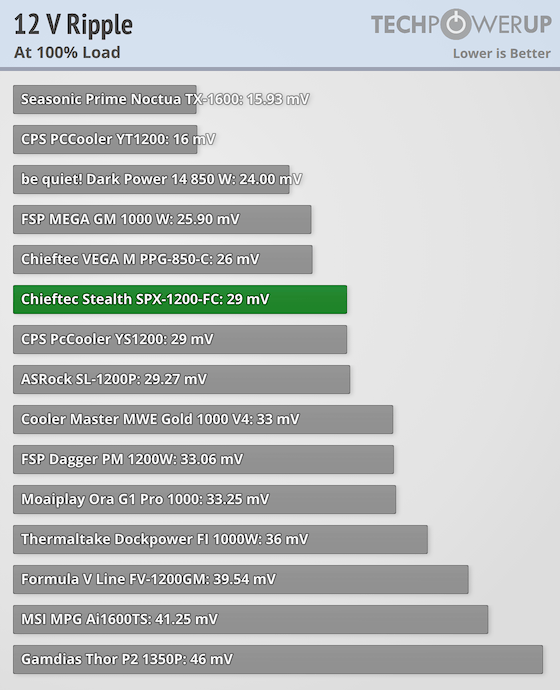
This is a solid ripple control result considering the power density and layout of this model. There should be no concerns here on any of the three main rails regardless of load.
Short Circuit Protection
Short circuit protection is one of the most fundamental and important protections for a power supply. If a short circuit is detected on any rails, the PSU should turn off and prevent damage to itself and other components.| Short Circuit Protection | |
|---|---|
| +12 V rail | Operational |
| +5 V rail | Operational |
| +3.3 V rail | Operational |
SCP was working as expected with the unit.
Nov 11th, 2026 18:00 CST
change timezone
New Forum Posts
- When you could finally run Crysis maxed out? (43)
- WarpCoreBench scores! (14)
- Warning for Windows 10 and 11 users running newer AMD GPU drivers (49)
- Bought MAX-P495 - Which model? (29)
- GeekMagic Ultra Smart WiFi Weather Station (3)
- DTS DCH Driver for Realtek HDA [DTS:X APO4 + DTS Interactive] (2809)
- Rare GPUs / Unreleased GPUs (2271)
- Samsung 870 EVO - Beware, certain batches prone to failure! (1486)
- Windows new update 26H2 - Throttlestop (10)
- TPU's F@H Team (20569)
Popular Reviews
- AMD Zen 6 Technical Deep Dive
- Upcoming Hardware Launches 2027 (Updated Nov 2026)
- Gigabyte Z890I Aorus Ultra Review
- XPG NIMBUS PLUS Review - Mid-range Chair With Strong Competitors
- INNOCN 45C1R Review - Two QHD Screens, Zero Bezels
- NZXT H7 RGB+ Review
- Phantom Blade Zero Performance Benchmark Review - 35 GPUs Tested
- Gears of War: E-Day Performance Benchmark Review - 35 GPUs Tested
- NZXT H5 Review
- be quiet! Light Mount TKL Keyboard Review
TPU on YouTube
Controversial News Posts
- OpenAI CEO Argues Home PCs Waste the World's Limited DRAM Supply (152)
- NVIDIA Launches Investigation Into Jensen Huang's Relationship With Suspected Chinese Spy (136)
- Intel "Raptor Lake Next" 16-Core and 20-Core CPUs Surface (130)
- Legendary Game Studio BioWare Shuts Down Following EA Layoffs (104)
- Dell CEO Says the Memory Shortage Will Get Worse in 2027 (95)
- NVIDIA GeForce RTX 50-Series Scheduled for up to $500 Price Hike This Week (89)
- Modder Fits RTX 5090 With Four 8-Pin Connectors, Halving Current per Wire (80)
- AMD Radeon Owners Can Now Run Nearly Every DLSS Feature Through Fan-Made Mod (80)