 30
Galax GeForce RTX 5070 EX Gamer 1-Click OC Review
Pictures & Teardown »Introduction

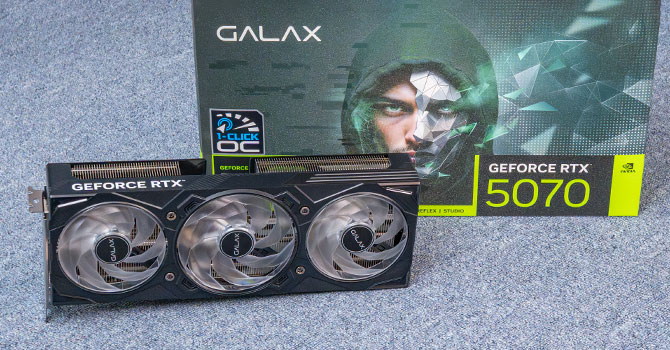
We have with us the Galax GeForce RTX 5070 EX Gamer 1-Click OC graphics card. The EX Gamer line of graphics cards by Galax and its sister brand KFA2 form the company's baseline custom-design products, priced at or close to the NVIDIA MSRP. Galax tends to pack these cards with features typically not found with MSRP cards from other brands, such as RGB lighting, ARGB headers, or a noise-optimized design with large fans. The GeForce RTX 5070 is an important product for NVIDIA as it's both the most affordable GPU from the company for the 1440p class of cards, and one that succeeds a long line of GPUs that dominate the market segment. The RTX 5070 comes with a starting price of $550, making this the new entry point for a cutting-edge 1440p gaming PC build. The RTX 5070 has enough muscle to play any of today's games at 1440p with maxed out settings, including ray tracing. You're also given the latest features NVIDIA introduced with the RTX 50-series Blackwell generation, such as Neural Rendering, and DLSS 4 Multi Frame Generation.
With the new Blackwell graphics architecture, NVIDIA is sticking to the same exact foundry node it built its previous RTX 40-series Ada generation on, focusing instead on performance per watt gains from advances in the architecture, and updated power management tech. Blackwell introduces Neural Rendering, a potentially revolutionary concept in 3D graphics, where a generative AI model creates photorealistic objects in real time, and the GPU combines this with classic raster 3D graphics just like it combines real time ray traced objects. You already know the awesome potential of generative AI, and can tell what the near future holds for such a technology. Getting Neural Rendering to work requires AMP (AI Management Processor), a dedicated hardware scheduler being introduced with Blackwell, which lets the GPU run both AI models and render graphics in tandem.
Blackwell also introduces generational improvements to all key components of the GPU. The new Blackwell CUDA core introduces generational IPC improvements, and support for Neural Shaders. The 4th generation RT core further reduces the performance cost of ray tracing, and introduces support for Mega Geometry, or the ability for ray traced objects to have significantly higher triangle counts or geometric detail. The 5th generation Tensor core lays the foundation for Neural Rendering, and introduces support for even higher throughput data formats, such as FP4. NVIDIA has generationally increased the memory bandwidth over Ada, by implementing the latest GDDR7 memory standard. The RTX 5070 gets 12 GB of 28 Gbps GDDR7 memory across a 192-bit memory bus. While the memory size hasn't changed over the RTX 4070, there's a significant 33.3% increase in memory bandwidth, which should come in handy with the new AI-heavy workloads.
The GeForce RTX 5070 is based on the GB205 silicon, which it nearly maxes out, enabling 48 out of 50 streaming multiprocessors (SM). This works out to 6,144 CUDA cores, 192 Tensor cores, 48 RT cores, 192 TMUs, and 80 ROPs—a significant update in ROP count over the 64 that the RTX 4070 had. Another major update over the RTX 4070 is the L2 cache size, the RTX 5070 gets all 48 MB physically present on the GB205 silicon, compared to the 36 MB that the RTX 4070 was configured with.
Galax GeForce RTX 5070 EX Gamer 1-Click OC comes with a tiny factory overclock of 2557 MHz compared to 2512 MHz reference, although the Galax Xtreme Tuner Plus application comes with a software-based 2572 MHz overclock, which is how the card gets its name. The EX Gamer comes with a generous triple-slot cooling solution that uses a combination of 92 mm and 102 mm fans to ventilate an aluminium fin-stack heatsink. These fans come with RGB illumination, and there's an additional RGB element along the top edge of the card. The card also puts out an ARGB header. Galax is pricing the RTX 5070 EX Gamer 1-Click OC at $570, or a $20 premium over the MSRP.
| Price | Cores | ROPs | Core Clock | Boost Clock | Memory Clock | GPU | Transistors | Memory | |
|---|---|---|---|---|---|---|---|---|---|
| RTX 4070 | $500 | 5888 | 64 | 1920 MHz | 2475 MHz | 1313 MHz | AD104 | 35800M | 12 GB, GDDR6X, 192-bit |
| RX 7800 XT | $470 | 3840 | 96 | 2124 MHz | 2430 MHz | 2425 MHz | Navi 32 | 28100M | 16 GB, GDDR6, 256-bit |
| RTX 4070 Super | $600 | 7168 | 80 | 1980 MHz | 2475 MHz | 1313 MHz | AD104 | 35800M | 12 GB, GDDR6X, 192-bit |
| RX 7900 GRE | $550 | 5120 | 160 | 1880 MHz | 2245 MHz | 2250 MHz | Navi 31 | 57700M | 16 GB, GDDR6, 256-bit |
| RTX 4070 Ti | $700 | 7680 | 80 | 2310 MHz | 2610 MHz | 1313 MHz | AD104 | 35800M | 12 GB, GDDR6X, 192-bit |
| RTX 5070 | $550 | 6144 | 80 | 2325 MHz | 2512 MHz | 1750 MHz | GB205 | 31100M | 12 GB, GDDR7, 192-bit |
| Galax RTX 5070 EX | $570 | 6144 | 80 | 2325 MHz | 2557 MHz | 1750 MHz | GB205 | 31100M | 12 GB, GDDR7, 192-bit |
| RTX 4070 Ti Super | $750 | 8448 | 96 | 2340 MHz | 2610 MHz | 1313 MHz | AD103 | 45900M | 16 GB, GDDR6X, 256-bit |
| RX 7900 XT | $620 | 5376 | 192 | 2000 MHz | 2400 MHz | 2500 MHz | Navi 31 | 57700M | 20 GB, GDDR6, 320-bit |
| RX 9070 | $550 | 3584 | 128 | 2070 MHz | 2520 MHz | 2518 MHz | Navi 48 | 53900M | 16 GB, GDDR6, 256-bit |
| RX 9070 XT | $615 | 4096 | 128 | 2400 MHz | 2970 MHz | 2518 MHz | Navi 48 | 53900M | 16 GB, GDDR6, 256-bit |
| RTX 5070 Ti | $750 | 8960 | 96 | 2295 MHz | 2452 MHz | 1750 MHz | GB203 | 45600M | 16 GB, GDDR7, 256-bit |
| RX 7900 XTX | $750 | 6144 | 192 | 2300 MHz | 2500 MHz | 2500 MHz | Navi 31 | 57700M | 24 GB, GDDR6, 384-bit |
| RTX 4080 | $850 | 9728 | 112 | 2205 MHz | 2505 MHz | 1400 MHz | AD103 | 45900M | 16 GB, GDDR6X, 256-bit |
| RTX 4080 Super | $1000 | 10240 | 112 | 2295 MHz | 2550 MHz | 1438 MHz | AD103 | 45900M | 16 GB, GDDR6X, 256-bit |
| RTX 5080 | $1000 | 10752 | 112 | 2295 MHz | 2617 MHz | 1875 MHz | GB203 | 45600M | 16 GB, GDDR7, 256-bit |
Nov 21st, 2026 05:55 PST
change timezone
Latest GPU Drivers
New Forum Posts
- Differences i might've missed between these ultrawides to decide which to buy during BF. (0)
- UPS what one to get? (2)
- Honestly, do you care about GTA VI? (220)
- Anthrophics IPO (31)
- Without Jensen, PC gaming will be (53)
- WarpCoreBench scores! (88)
- What's your latest tech Freebie? (86)
- TPU's Nostalgic Hardware Club (22179)
- [Poll] 12V-2x6 Connector Protection: What Are You Using? (WireView / Ampinel / Equalizer / Other / Nothing) (50)
- RX 9000 series GPU Owners Club (2252)
Popular Reviews
- Microsoft Surface Laptop Ultra Review - The Next-gen Arm Laptop
- Ugreen NASync DXP4800 GT Review
- Corsair RM1200e (Second Generation) Review
- Pulsar Office Tour & First Look at P1 Dual-Sensor Mouse
- Upcoming Hardware Launches 2027 (Updated Nov 2026)
- Acemagic Retro X3 Review
- Biwin Black Opal NV7400 2 TB Review
- AMD Ryzen 7 9800X3D Review - The Best Gaming Processor
- AMD Zen 6 Technical Deep Dive
- Chieftec Iceberg PRO 360 DARK Review
TPU on YouTube
Controversial News Posts
- NVIDIA Co-Founder and CEO Jensen Huang Officially Resigns (491)
- Report: Jensen Huang Eyes NVIDIA Comeback (258)
- Open Letter Asking NVIDIA to Reinstate Jensen Huang Passes 115,000 Signatures (184)
- OpenAI CEO Argues Home PCs Waste the World's Limited DRAM Supply (152)
- NVIDIA Launches Investigation Into Jensen Huang's Relationship With Suspected Chinese Spy (136)
- Intel "Raptor Lake Next" 16-Core and 20-Core CPUs Surface (130)
- Legendary Game Studio BioWare Shuts Down Following EA Layoffs (104)
- NVIDIA GeForce RTX 50-Series Scheduled for up to $500 Price Hike This Week (89)