 4
GEEKOM IT13 (2025 Edition) Review
Packaging & Contents »Introduction

The GEEKOM IT13 (2025 Edition) is a compact PC built around Intel's Core i9-13900HK, for quick everyday work, fast code builds, and light creative tasks. It uses dual-channel DDR4 up to 64 GB, which keeps costs reasonable but limits integrated graphics performance, so it's better for office work, photo edits, and multi-monitor productivity than modern 1080p gaming. Storage is flexible with an M.2 2280 slot, a secondary M.2 2242, and a 2.5-inch SATA bay.
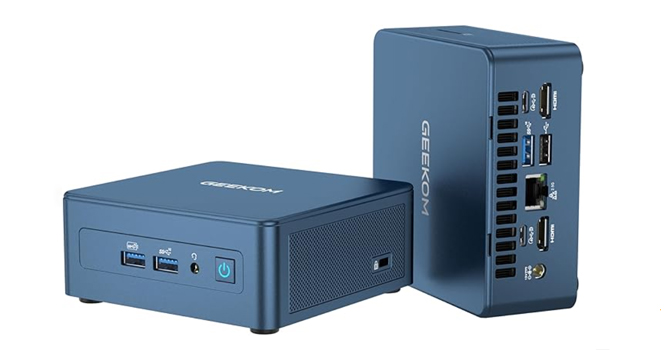
The 2025 model swaps the i9-13900H for the i9-13900HK, which is a higher-bin part that can hold boost clocks a little longer when cooling allows, and also supports overclocking. GEEKOM also revised the thermal design, the new stronger cooler helps the CPU sustain performance more consistently and with less fan rush during workloads. Day-to-day behavior feels the same, but sustained multicore tasks and extended exports are steadier on the 2025 unit.
What To Keep In Mind
While the CPU performance is better in the newest model, the platform still uses DDR4, not DDR5. That choice limits memory bandwidth and holds back Intel's Iris Xe graphics in games or GPU-leaning workloads. You can still use it as a 4K desktop and stream smoothly, just don't expect modern gaming at high settings on the iGPU. It also has comprehensive I/O for its class, featuring two 40 Gbps USB4, dual HDMI 2.0, 2.5 GbE, Wi-Fi 6E, Bluetooth 5.2, an SD card reader, and plenty of USB-A, which makes multiple-display setups and connecting fast external devices a simple affair.Compared with the GEEKOM A9 Max I recently reviewed, the IT13 is the more affordable box at about $649 for the 32 GB/1 TB configuration. Its i9-13900HK is solid for everyday work, code builds, and quick exports, and the port layout makes multi-display setups simple. Where it trails is memory bandwidth and graphics. DDR4 plus Iris Xe makes it a capable office and light-creation box, not a 1080p-gaming or GPU-heavy workstation. If your priority is a compact Windows workstation with lots of I/O and consistent CPU speed, the IT13 fits that role; the A9 Max's DDR5 and stronger Radeon iGPU simply target a different use case.
Next, we'll open it up, check the build quality, cover the I/O and wireless, and run our benchmarks to see how it holds up.
| Specifications | |
|---|---|
| CPU | Intel Core i9-13900HK, 14C/20T (6P+8E), up to 5.40 GHz, 24 MB cache |
| Video Engine / Graphics | Intel Iris Xe (96 EUs), up to 1.50 GHz |
| Memory | Dual-channel DDR4-3200 SODIMM, up to 64 GB |
| Audio | 3.5 mm combo jack (headphone/mic) |
| Storage | 1x M.2 2280 PCIe Gen 4 x4 slot, up to 2 TB 1x M.2 2242 SATA slot, up to 1 TB 1x 2.5" SATA bay (7 mm), up to 2 TB |
| I/O Ports | 3x USB 3.2 Gen 2 Type-A 1x USB 2.0 Type-A 2x USB4 Type-C (40 Gbps, DP Alt Mode) 2x HDMI 2.0 1x SD card reader 1x 2.5GbE LAN (RJ45) 1x DC-in 1x Power button |
| Ethernet | 2.5 GbE (Intel controller) RJ45 |
| Wireless | Wi-Fi 6E (Intel AX211), Bluetooth 5.2 |
| Cooling System | IceBlast 2.0 solution (dual heat pipes + fan) |
| Kensington Lock | Yes |
| Power Adapter | 19 V, 6.32 A (approx. 120 W) AC adapter |
| Operating System | Windows 11 Pro |
| Additional Features | SD reader (UHS-I), USB4 multi-display support Supports up to four 4K60 displays (two HDMI 2.0, two via USB4/DP Alt Mode). 8K output depends on the adapter and DP/DSC and was not validated here |
| Pricing | 1 TB SSD: $649 2 TB SSD: $739 |
Nov 29th, 2026 08:18 CST
change timezone
Latest GPU Drivers
New Forum Posts
- Asus XG27AQWMG-R none of the oled care features work except for the proximity sensor but nonexistent grey banding to my eyes. (1)
- What are you playing? (26262)
- -18C on GPU by moving it to the front of the case. (37)
- Can i play GTA 6 now? (Joke) (16)
- Last game you purchased? (1424)
- Windows 11 General Discussion (7752)
- purchased Tesla V100 PCIE 32GB card, came flashed with SXM Vbios, Need help flashing back to PCIE VBIOS (5)
- Which new games will you be buying? (370)
- What's your main Black Friday / Cyber Monday purchase? (52)
- AI generated images... (240)
Popular Reviews
- Upcoming Hardware Launches 2027 (Updated Nov 2026)
- Moaiplay Ora Pro G1 850 Review
- Montech CyberFlow ARGB 360 Review
- AMD Ryzen 7 9800X3D Review - The Best Gaming Processor
- ORICO Obook15 AI Review
- AMD Zen 6 Technical Deep Dive
- VZMORE AX9 Max Review
- Acemagic Retro X3 Review
- Phantom Blade Zero Performance Benchmark Review - 35 GPUs Tested
- Microsoft Surface Laptop Ultra Review - The Next-gen Arm Laptop
TPU on YouTube
Controversial News Posts
- Jensen Huang Reinstated as CEO of NVIDIA (632)
- NVIDIA Co-Founder and CEO Jensen Huang Officially Resigns (492)
- Report: Jensen Huang Eyes NVIDIA Comeback (281)
- Open Letter Asking NVIDIA to Reinstate Jensen Huang Passes 115,000 Signatures (184)
- OpenAI CEO Argues Home PCs Waste the World's Limited DRAM Supply (154)
- NVIDIA Launches Investigation Into Jensen Huang's Relationship With Suspected Chinese Spy (136)
- Intel Razor Lake Gets a 12 P-Core bLLC Chip With No E-Cores, Per Leak (94)
- NVIDIA GeForce RTX 50-Series Scheduled for up to $500 Price Hike This Week (89)