 4
GEEKOM IT13 (2025 Edition) Review
(4 Comments) »Value and Conclusion
- The GEEKOM IT13 2025 Edition is currently priced around US $649-$739 (depending on the SSD size).
- Fast single-thread performance makes for a responsive desktop experience
- Strong Office scores, especially Word and PowerPoint
- USB4, dual HDMI, 2.5GbE, and SD reader
- Quiet at idle and controlled under sustained load
- Four-display support including USB-C DP Alt-Mode
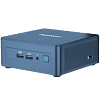
- The metallic blue shell looks good and feels sturdy
- DDR4-3200 dual channel bandwidth limits performance
- Iris Xe iGPU lags well behind Radeon 780M/860M graphics
- Bundled SSD writes are only mid-pack
- No front USB-C port
Technology & Positioning
The GEEKOM IT13 is a compact Windows Mini-PC with strong I/O, quiet everyday behavior, and a responsive feel for multi-display office work, coding, and light creative tasks. Inside is Intel's Core i9-13900HK with 96-EU Iris Xe graphics plus hardware AV1 decode and HEVC/VP9 encode/decode through Quick Sync. That covers 4K streaming and creator apps that use Intel's media blocks. The iGPU also supports up to four displays. Memory is where the system has some limits. This model runs DDR4-3200, so bandwidth is lower than DDR5 Mini-PCs, which caps iGPU throughput in modern games and GPU-heavy workloads. The I/O is the counterbalance, however, as it comes with two USB4 ports for 40 Gbps devices and displays, dual HDMI 2.0, 2.5 GbE, Wi-Fi 6E, Bluetooth 5.2, an SD card reader, and several USB-A ports. It also supports up to four 4K displays or one 8K display, and it officially supports up to 64 GB RAM with multi-drive storage (M.2 + M.2 + 2.5-inch), so upgrades are simple. GEEKOM includes a three-year limited warranty. That said, if your work leans on GPU acceleration, DDR5-equipped Mini-PCs based on AMD Zen 4/5 or Intel Arrow Lake//Meteor Lake/Lunar Lake are a better fit.
Gaming Performance
Modern AAA gaming is not one of its strengths. In Baldur's Gate 3 and Cyberpunk 2077, 720p Medium is the only preset that comes close, and even that dips once busy scenes hit. So, 720p High and both 1080p presets can't be recommended. Esports fare better though: Dota 2 is smooth at 720p and 1080p, and Counter-Strike 2 is comfortable at 720p, with 1080p workable if you accept reduced headroom. Switch emulation matches expectations for this class, as Tears of the Kingdom averages about 15 FPS with long loads, making it effectively unplayable for that title and typical of Iris Xe on demanding Switch games.
Real-World Performance
As a daily workstation, the IT13 feels quick and consistent. Web work, video calls, Office, and light photo edits are smooth, which fits a high-clocking Intel P-core under short bursts. Quick Sync helps with H.264/H.265 exports, timeline scrubbing in light projects, and streaming that can use iGPU encode, while AV1 decode keeps modern streaming efficient. Long, memory-sensitive or GPU-accelerated tasks are where it trails. y-cruncher, heavy Blender scenes, and some Photoshop filters expose the DDR4 ceiling and the limits of Iris Xe compared with DDR5 systems and AMD's RDNA 3 iGPUs. If most of your time is CPU-bound, the experience is very good. If you lean on GPU acceleration, a 780M or 860M Mini-PC will finish jobs faster.
Storage Performance
The included NVMe SSD feels quick in daily use. Read speeds are strong and write speeds are mid-pack, so apps install and open fast, while very large file copies take longer than on top Gen 4 drives. A 3DMark Storage score around 2,971 backs that up with smooth game loading and patching. Upgrades are simple: keep a fast M.2 2280 as the system drive, add a second M.2 2242 SATA SSD, and use the 2.5-inch bay for large libraries. For external storage, USB4 supports up to 40 Gbps; many NVMe enclosures operate in the 10–40 Gbps range, depending on controller and cable quality.
Connectivity and I/O
The port layout keeps desk setups simple while offering a ton of options. Two USB4 ports handle fast external drives and extra displays, dual HDMI 2.0 covers 4K at 60 Hz, and a 2.5 GbE port speeds up wired networking. Wi-Fi 6E and Bluetooth 5.2 cover wireless gear, the SD reader makes camera imports easy, and multiple USB-A ports take care of keyboards, mice, dongles, and gamepads. Running four monitors is easy by using the two HDMI ports and adding two more through USB4 with DisplayPort Alt Mode, or by using a USB4 hub. For higher refresh rates at 4K, route those screens through USB4 to DisplayPort since the HDMI ports top out at 4K60. USB4 works with many Thunderbolt 3 and 4 devices when paired with a proper 40 Gbps cable. Most ports sit on the back to keep cables out of sight, while the front ports are easy to reach for quick plug-ins. Official support includes up to four 4K displays or one 8K display.
Build Quality
The IT13 features a nice blue metal shell that looks great on a desk and feels sturdier than the plastic minis you often see in this price range. Getting inside is straightforward once you remove the base, with both SODIMM slots and the primary M.2 2280 bay right in view. Cable routing is neat, the 2.5-inch drive bracket is easy to work with, and upgrades take only a few minutes if you have your parts ready.
Noise depends on workload and room acoustics, but day-to-day use is quiet and blends into background noise. Ultimately, it will stay quiet during web and office work, ramp to a polite whoosh under longer renders or compiles, and is audible if you keep the CPU pegged for extended periods. GEEKOM's three-year warranty adds peace of mind for long-term use, too.
Pricing and Alternatives
Street pricing for the IT13 (i9-13900HK, 32 GB, 1 TB) is around 649 dollars, with higher prices for larger SSDs. That is competitive for an Intel Mini-PC with two USB4 ports and 2.5 GbE, though the value shifts if graphics performance matters. The GEEKOM A9 Max is the step-up, with a faster Radeon 890M iGPU, DDR5 memory, and an NPU for Windows AI features. It costs more but brings smoother 1080p in lighter modern games, and quicker GPU-assisted work. For less money, the Minisforum UM790 Pro is a strong pick with Radeon 780M and DDR5, USB4, and quiet behavior. If you prefer to add your own parts, the ASRock 4X4 BOX-AI350 is a compact barebones system with DDR5 and Radeon 860M.
If value is the focus, the ALLIWAVA H90 Pro often undercuts other Intel Mini-PCs and beats them in gaming and GPU-leaning apps, while offering dual 2.5 GbE for NAS and lab setups. If you want to stay on Intel, the Beelink GTi12 Ultra pairs a Core i9 CPU with DDR5 for better memory bandwidth than the IT13, though Iris Xe still limits gaming.
Bottom Line
The IT13 is easy to recommend as a quiet, capable desk PC with excellent I/O and a responsive feel. It isn't built for modern AAA gaming or heavy GPU work, though. However, for Web, Office, coding, photo work, and multi-display productivity, it delivers a smooth, low-maintenance experience.
Nov 29th, 2026 08:18 CST
change timezone
Latest GPU Drivers
New Forum Posts
- Asus XG27AQWMG-R none of the oled care features work except for the proximity sensor but nonexistent grey banding to my eyes. (1)
- What are you playing? (26262)
- -18C on GPU by moving it to the front of the case. (37)
- Can i play GTA 6 now? (Joke) (16)
- Last game you purchased? (1424)
- Windows 11 General Discussion (7752)
- purchased Tesla V100 PCIE 32GB card, came flashed with SXM Vbios, Need help flashing back to PCIE VBIOS (5)
- Which new games will you be buying? (370)
- What's your main Black Friday / Cyber Monday purchase? (52)
- AI generated images... (240)
Popular Reviews
- Upcoming Hardware Launches 2027 (Updated Nov 2026)
- Moaiplay Ora Pro G1 850 Review
- Montech CyberFlow ARGB 360 Review
- AMD Ryzen 7 9800X3D Review - The Best Gaming Processor
- ORICO Obook15 AI Review
- AMD Zen 6 Technical Deep Dive
- VZMORE AX9 Max Review
- Acemagic Retro X3 Review
- Phantom Blade Zero Performance Benchmark Review - 35 GPUs Tested
- Microsoft Surface Laptop Ultra Review - The Next-gen Arm Laptop
TPU on YouTube
Controversial News Posts
- Jensen Huang Reinstated as CEO of NVIDIA (632)
- NVIDIA Co-Founder and CEO Jensen Huang Officially Resigns (492)
- Report: Jensen Huang Eyes NVIDIA Comeback (281)
- Open Letter Asking NVIDIA to Reinstate Jensen Huang Passes 115,000 Signatures (184)
- OpenAI CEO Argues Home PCs Waste the World's Limited DRAM Supply (154)
- NVIDIA Launches Investigation Into Jensen Huang's Relationship With Suspected Chinese Spy (136)
- Intel Razor Lake Gets a 12 P-Core bLLC Chip With No E-Cores, Per Leak (94)
- NVIDIA GeForce RTX 50-Series Scheduled for up to $500 Price Hike This Week (89)