 4
GEEKOM IT13 (2025 Edition) Review
Web & Office Productivity »General Performance
AIDA64 Cache & Memory
The AIDA64 memory benchmark measures how quickly data moves between system memory and the CPU's cache hierarchy. It provides insight into bandwidth (read/write/copy speeds) and latency, which directly affect responsiveness in everyday computing and the performance of integrated graphics that share system memory.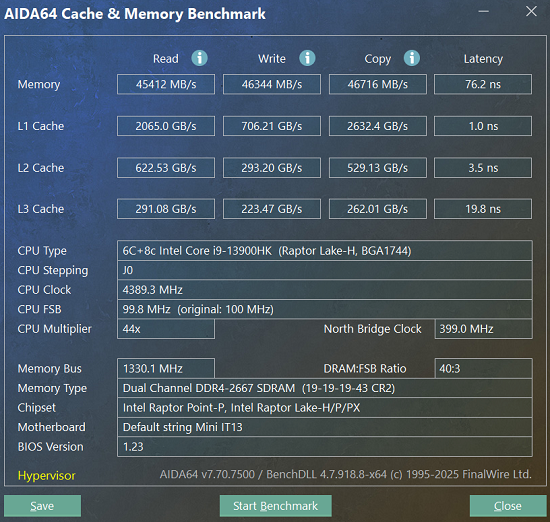
On the IT13, AIDA64 reports ~45.4 GB/s read, 46.3 GB/s write, 46.7 GB/s copy, and 76 ns latency with dual-channel DDR4. That is comfortably quick for everyday work, but it trails DDR5 minis and shows up later in iGPU-leaning and heavy multi-thread tests. These figures are typical for DDR4-3200 and cap all-core scaling versus DDR5 Mini-PCs.
Cinebench
Cinebench is a CPU rendering benchmark based on Maxon's Cinema 4D engine. It evaluates both single-threaded and multithreaded workloads, giving a clear picture of how a processor handles everyday tasks as well as heavier rendering scenarios.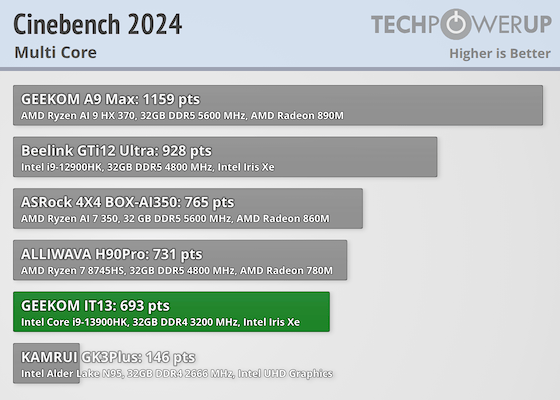
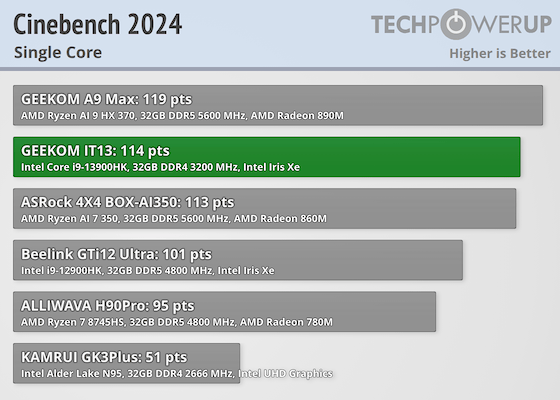
The IT13 posts 693 in multicore and 114 in single-core. Single-thread is near the top of the stack and lines up with a healthy 13900HK, while multicore lands behind DDR5 systems and Ryzen AI boxes because of bandwidth limitations and sustained power curve scaling. Short, bursty tasks feel quick; long renders favor DDR5 systems like the A9 Max or a DDR5-equipped 12900HK Mini-PC.
7-Zip
7-Zip's built-in benchmark measures CPU performance when compressing and decompressing data. It's a good indicator of how a system handles file-heavy workloads such as packing archives, installing software, or building projects.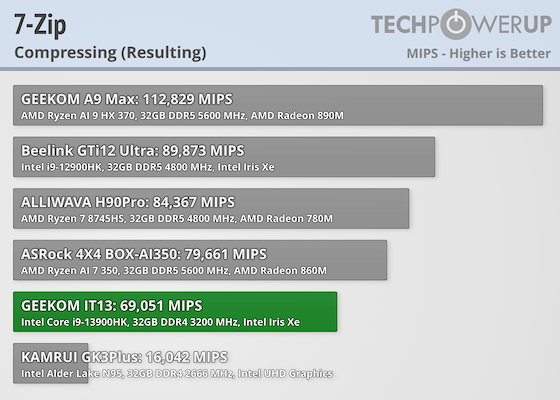
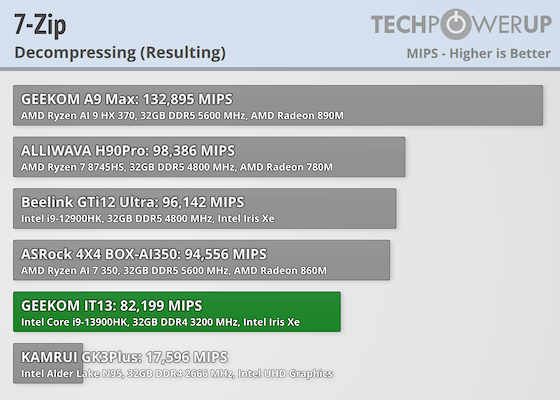
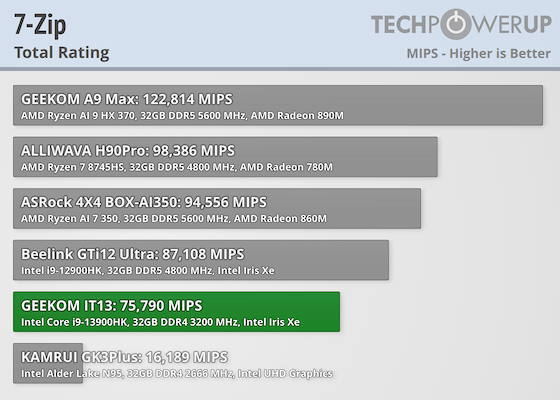
Compression at 69,051 MIPS and decompression at 82,199 MIPS put the IT13 mid-pack, which is behind DDR5 and Ryzen AI systems. It moves archives quickly enough for routine work, yet bigger builds and large codebases see a clear advantage on higher-bandwidth platforms.
PCMark 10
PCMark simulates common desktop activities across browsing, video conferencing, office apps, and media workflows. It provides a composite view of how a system will feel in day-to-day usage.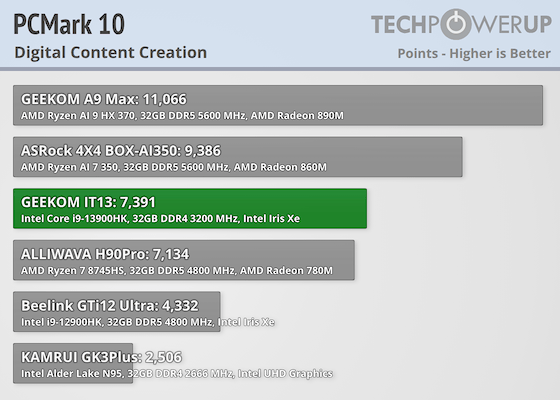
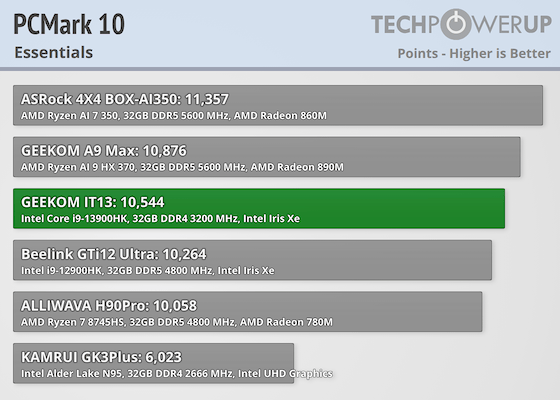
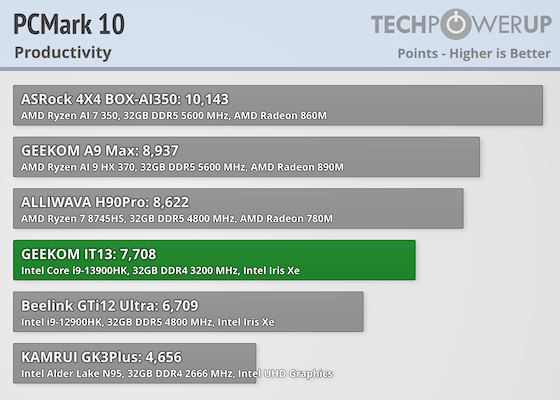
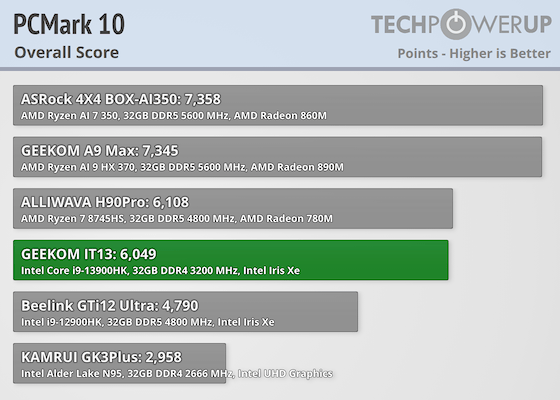
Essentials at 10,544 and Productivity at 7,708 show the IT13 is very comfortable as a daily machine. Digital Content Creation at 7,391 trails RDNA-based competitors, mostly due to the iGPU and RAM ceiling. Overall at 6,049 places just below the Ryzen AI Mini-PCs.
y-cruncher
Y-Cruncher calculates digits of Pi with extreme precision, pushing both CPU and memory to their limits. It's useful for gauging raw compute ability and stability under heavy math workloads.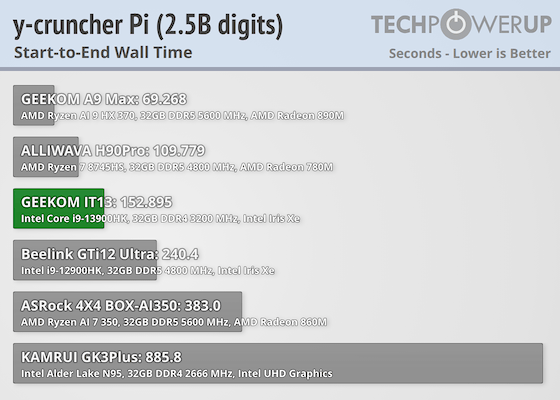
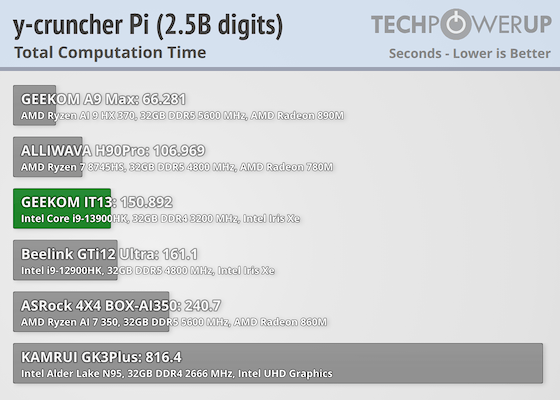
At 150.9 seconds compute and 152.9 seconds wall, the IT13 tracks sits well behind Ryzen AI results. This is a classic memory-and-power-sensitive workload, so the DDR4 setup and modest long-term power limits keep it from catching the DDR5 12900H systems.
Geekbench
Geekbench tests a wide variety of workloads, from encryption and machine learning to office productivity and photo editing. It also includes GPU acceleration, giving a broader view of system capability.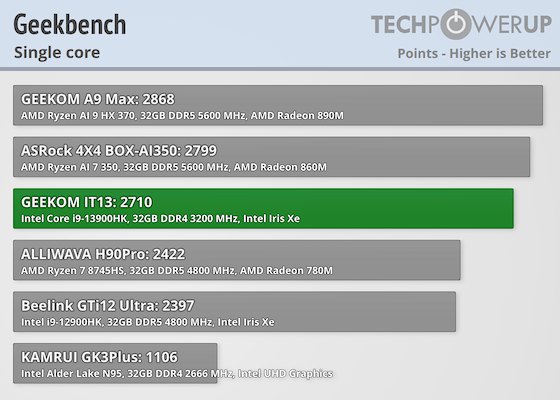
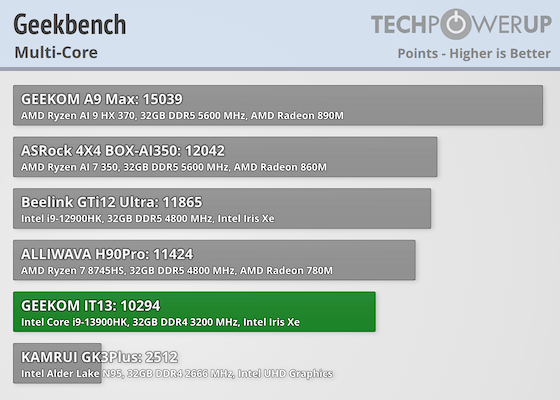
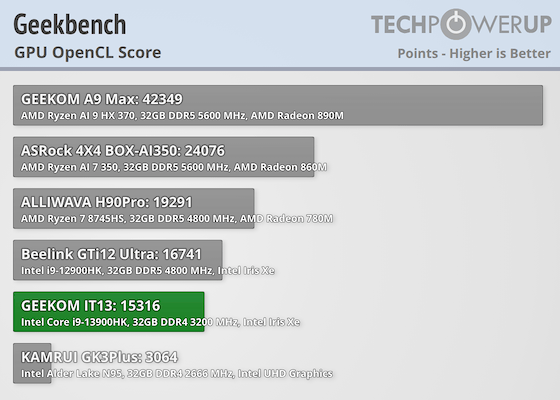
Here, the IT13 scores 2,710 single and 10,294 multi, which is better single-thread than the 12900HK machines and a touch lower multi-thread than the DDR5 12900H. OpenCL at 15,316 shows Iris Xe is fine for UI and light effects, but it trails the Radeon 780M/860M iGPUs by a wide margin.
Nov 29th, 2026 08:40 CST
change timezone
Latest GPU Drivers
New Forum Posts
- Which new games will you be buying? (371)
- Exit Adobe - PDF reader, and PDF editor recommendations (21)
- -18C on GPU by moving it to the front of the case. (38)
- Asus XG27AQWMG-R none of the oled care features work except for the proximity sensor but nonexistent grey banding to my eyes. (1)
- What are you playing? (26262)
- Can i play GTA 6 now? (Joke) (16)
- Last game you purchased? (1424)
- Windows 11 General Discussion (7752)
- purchased Tesla V100 PCIE 32GB card, came flashed with SXM Vbios, Need help flashing back to PCIE VBIOS (5)
- What's your main Black Friday / Cyber Monday purchase? (52)
Popular Reviews
- Upcoming Hardware Launches 2027 (Updated Nov 2026)
- Moaiplay Ora Pro G1 850 Review
- Montech CyberFlow ARGB 360 Review
- AMD Ryzen 7 9800X3D Review - The Best Gaming Processor
- ORICO Obook15 AI Review
- AMD Zen 6 Technical Deep Dive
- VZMORE AX9 Max Review
- Acemagic Retro X3 Review
- Phantom Blade Zero Performance Benchmark Review - 35 GPUs Tested
- Microsoft Surface Laptop Ultra Review - The Next-gen Arm Laptop
TPU on YouTube
Controversial News Posts
- Jensen Huang Reinstated as CEO of NVIDIA (632)
- NVIDIA Co-Founder and CEO Jensen Huang Officially Resigns (492)
- Report: Jensen Huang Eyes NVIDIA Comeback (281)
- Open Letter Asking NVIDIA to Reinstate Jensen Huang Passes 115,000 Signatures (184)
- OpenAI CEO Argues Home PCs Waste the World's Limited DRAM Supply (154)
- NVIDIA Launches Investigation Into Jensen Huang's Relationship With Suspected Chinese Spy (136)
- Intel Razor Lake Gets a 12 P-Core bLLC Chip With No E-Cores, Per Leak (94)
- NVIDIA GeForce RTX 50-Series Scheduled for up to $500 Price Hike This Week (89)