 102
GeForce x60: History, Benchmarks, Image Quality
Performance Summary & Analysis »Performance Testing
Next up, performance testing of all these cards. To do that, I've picked some highly popular games of these times and tested them on our Ryzen 7 9800X3D GPU Test System running Windows 11. This setup was chosen to ensure an apples-to-apples comparison, maintaining consistency and avoiding potential issues that could result from different hardware or operating system configurations.All games are running at ultra settings or the equivalent highest settings profile. Upscaling is disabled.
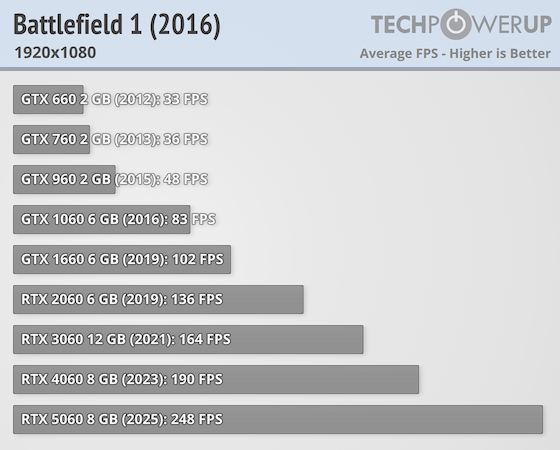
Battlefield 1 was highly demanding on hardware at the time, and definitely ran much better on the GTX 1060 that was released in the same year, compared to older GPUs. Those older models struggled to reach 60 FPS, often requiring settings to be lowered considerably to reach decent performance. It's impressive to see how well Battlefield scales with newer GPU hardware.
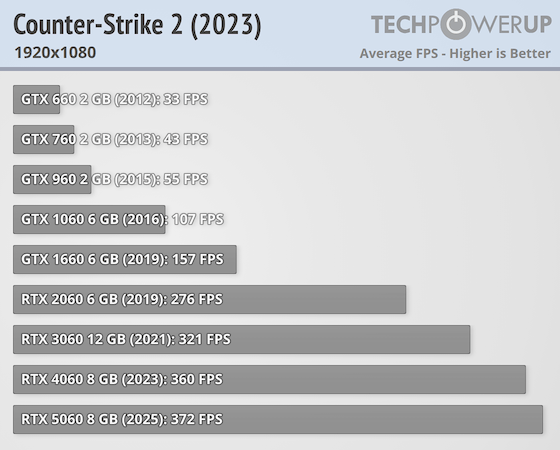
Counter-Strike 2 is the most-played game in the world, being played by millions of people right now—more than all the other games combined on this page. No doubt, at lowered settings it will run well on older hardware, too, but you also want it to look as clear as possible while maintaining smooth high FPS, to get those headshots. The game scales very well up to around 350 FPS, at which point it does look like it ends up a little bit CPU-limited, despite the X3D CPU.
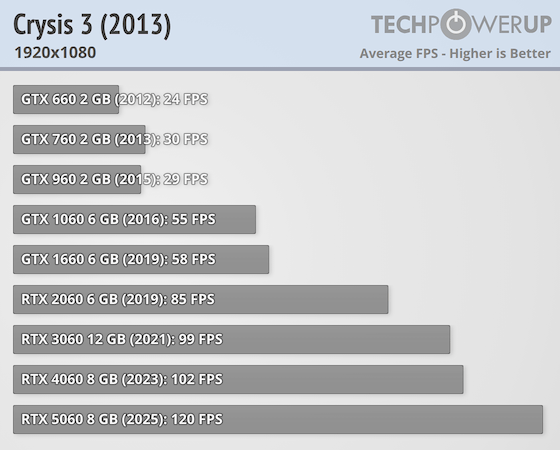
No historic game testing can be complete without Crysis. When Crysis 3 launched in 2013, achieving good FPS was nearly impossible on affordable GPUs. The GTX 760, for example, which came out in the same year, only managed to deliver 30 FPS.
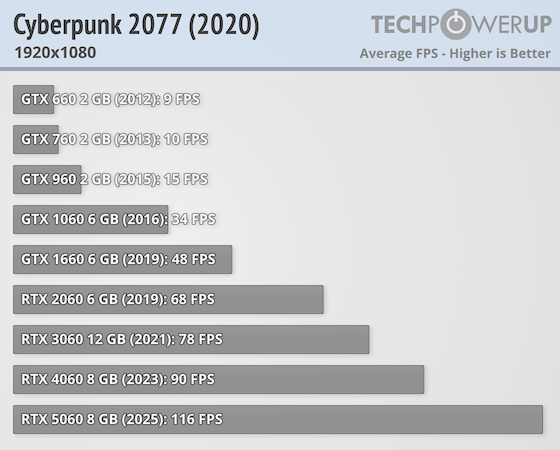
Cyberpunk 2077 was one of the most anticipated games of its time, but it ran pretty well even on one-year-old cards—the RTX 2060 got a bit over 60 FPS at max settings. Older cards are seriously challenged though, partially because of the game demanding more VRAM.
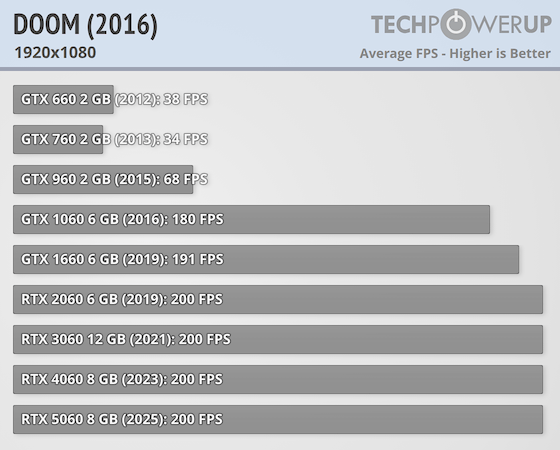
DOOM (2016) was a reboot and reimagining on the classic DOOM from 1992. Being based on id Tech 6 with the Vulkan API, it set the baseline for all future games using this engine, offering great quality visuals with very high frame rates. Do note that the game's engine is capped at 200 FPS, so scaling doesn't look as expected.
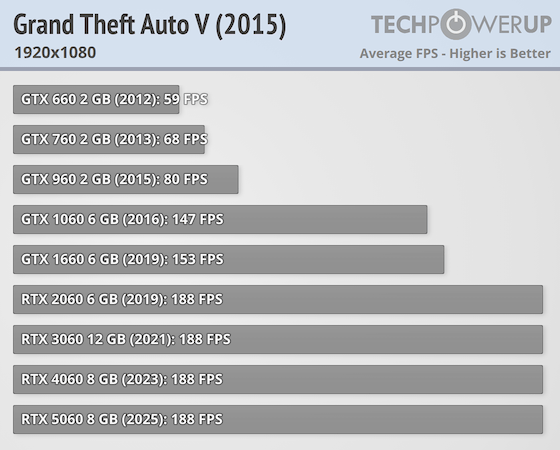
Grand Theft Auto V is one of the best-selling games of all times. When it came out it wasn't terribly demanding on GPU hardware, but older GPUs definitely had to run at lowered details. Modern cards can handle it easily, but at 188 FPS we're getting limited by the design of the audio engine, which has a sample buffer that's too small for higher FPS rates.
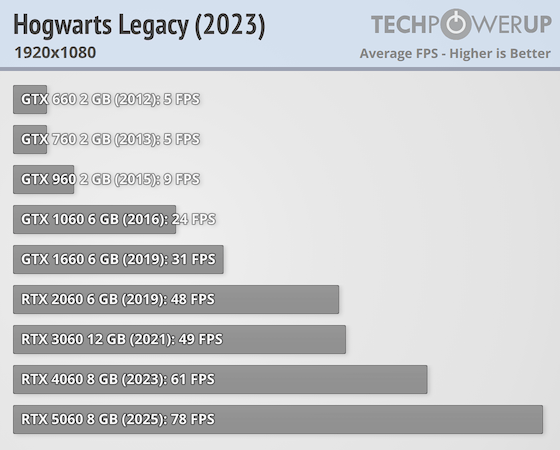
Hogwarts Legacy is the most successful game using Unreal Engine 4 with over 20 million copies sold. That's why it's something I like to include in my GPU testing. It also demonstrated to people that licensed single-player games can be successful in a market where everyone seems focused on making money by trying to develop the next big live-service game.
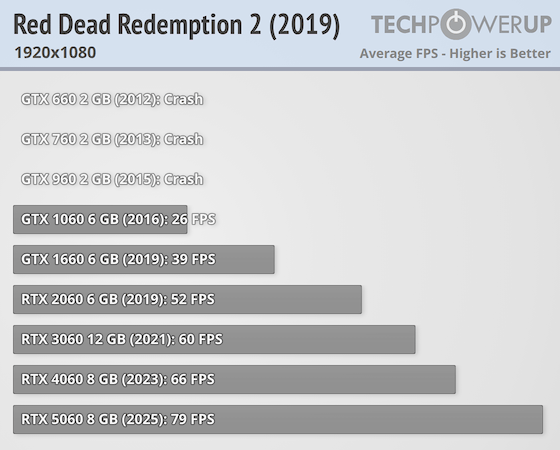
While GTA V has scaling issues on modern hardware, RDR2 runs really well on modern GPUs. At its time, the highest settings weren't playable at all with entry-level hardware, and even high-end GPUs had trouble delivering high FPS at increased resolutions. Note that older cards run out of VRAM and crash when loading into the game—the only solution was to greatly reduce details, so that the game never ran out of VRAM.
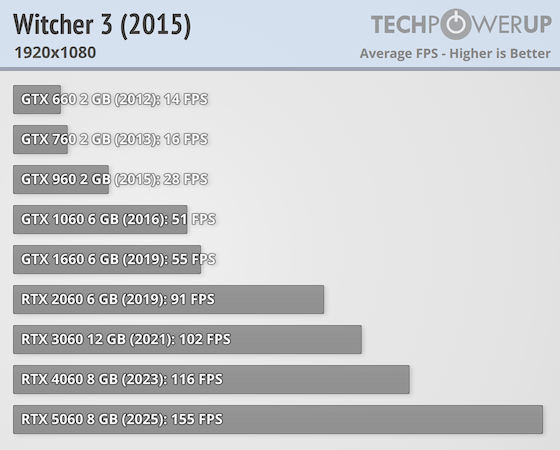
Witcher 3 is undoubtedly one of the best RPGs of all time, establishing CDPR as a legendary game developer and paving the way for Cyberpunk 2077. Even 10 years after its release we can see how well the engine scales—no hidden FPS caps—not getting CPU limited either. If you bought the newly released GTX 960 in 2015 and hoped to play Witcher 3 at high FPS, you were out of luck, as it only delivered 30 FPS. Achieving 1080p at max settings in 2015 required the powerful GTX Titan X.
Nov 24th, 2026 21:07 CST
change timezone
Latest GPU Drivers
New Forum Posts
- TPU's F@H Team (20570)
- Can you guess Which game it is? (352)
- The time has come to upgrade...my desktop (13)
- Ryzen Owners Zen Garden (8562)
- WarpCoreBench scores! (99)
- Asus Rog Maximus Z890 Extreme. (Various questions). (34)
- What are you playing? (26253)
- Which ryzen am5 cpu ? (210)
- Your PC ATM (36503)
- X79 and/or rampage IV OC'ing thread for those of us still left.... (2453)
Popular Reviews
- ASRock X870E Challenger Wi-Fi White Review
- Microsoft Surface Laptop Ultra Review - The Next-gen Arm Laptop
- Upcoming Hardware Launches 2027 (Updated Nov 2026)
- VZMORE AX9 Max Review
- AMD Ryzen 7 9800X3D Review - The Best Gaming Processor
- Corsair RM1200e (Second Generation) Review
- AMD Zen 6 Technical Deep Dive
- Phantom Blade Zero Performance Benchmark Review - 35 GPUs Tested
- Pulsar Office Tour & First Look at P1 Dual-Sensor Mouse
- Ocypus lota P1000 Review
TPU on YouTube
Controversial News Posts
- Jensen Huang Reinstated as CEO of NVIDIA (534)
- NVIDIA Co-Founder and CEO Jensen Huang Officially Resigns (492)
- Report: Jensen Huang Eyes NVIDIA Comeback (281)
- Open Letter Asking NVIDIA to Reinstate Jensen Huang Passes 115,000 Signatures (184)
- OpenAI CEO Argues Home PCs Waste the World's Limited DRAM Supply (152)
- NVIDIA Launches Investigation Into Jensen Huang's Relationship With Suspected Chinese Spy (136)
- Intel "Raptor Lake Next" 16-Core and 20-Core CPUs Surface (130)
- Intel Razor Lake Gets a 12 P-Core bLLC Chip With No E-Cores, Per Leak (94)