 102
GeForce x60: History, Benchmarks, Image Quality
DLSS, the Game Changer »Summary and Analysis
Now, let's move on to analyzing the recorded performance numbers.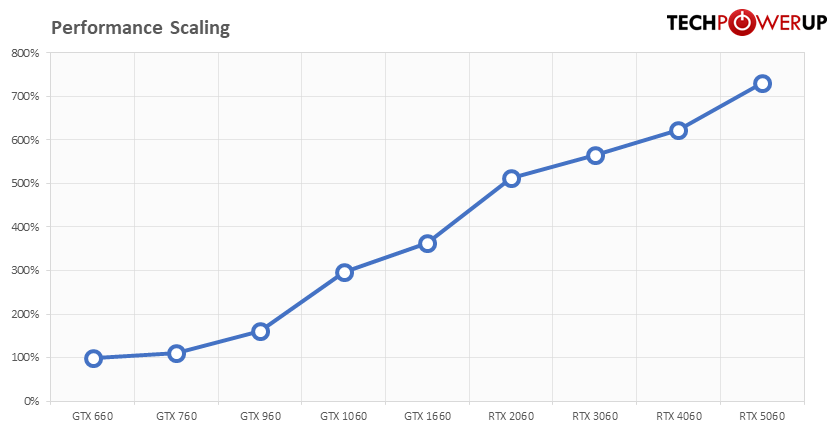
First, we'll start with how performance has developed over the years. On the horizontal axis I'm listing the GPU names, and performance goes up vertically. In the 13 years between GTX 660 and RTX 5060, performance has increased more than seven-fold.
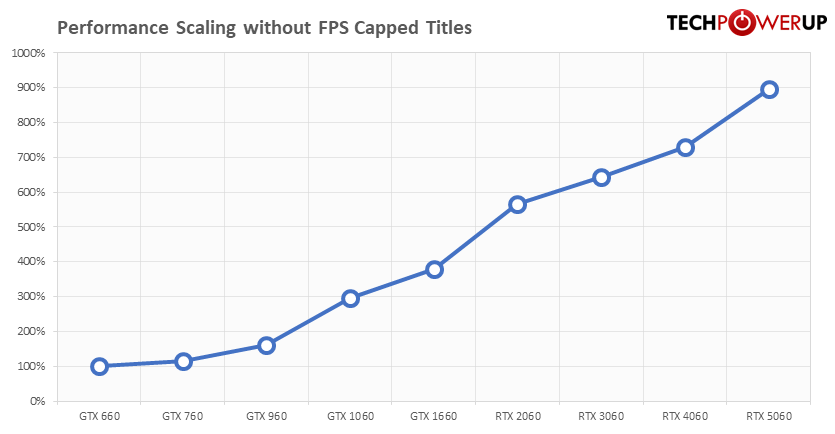
The numbers in the chart above are based on all games tested, which includes titles like DOOM (engine-capped at 200 FPS) and GTA V (CPU-limited at 188 FPS). So excluding those, the scaling looks even better, now performance has increased 9x over the years.
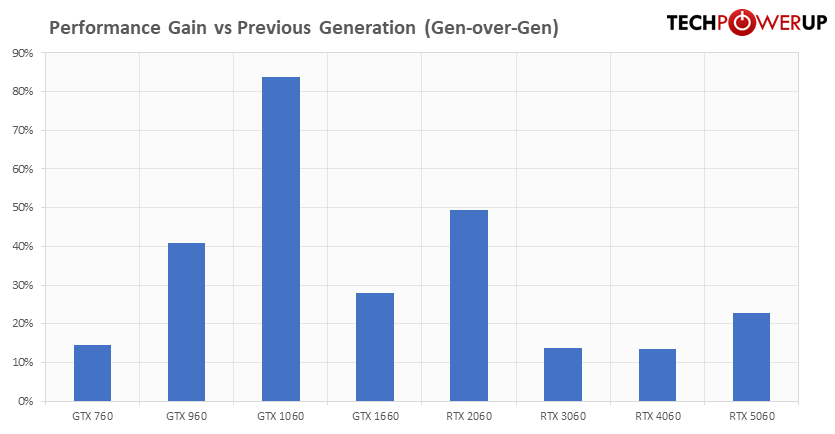
In this chart, we're looking the performance gains from one generation of GPU to the next. Specifically, we compare each GPU model to its predecessor and calculate the relative performance difference. For instance, the "GTX 1660" shows a value of +28%, which represents the performance increase from the GTX 1060 to the GTX 1660 across all games, excluding the two limited games (DOOM and GTA V). The weakest gens here are GTX 760, RTX 3060 and RTX 4060, the biggest gain is from the GTX 1060, which offered a monumental performance increase during its time.
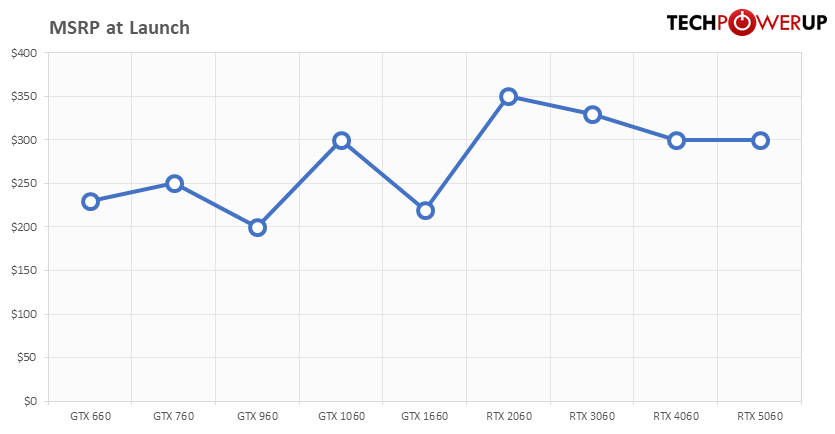
Next, we're looking at pricing for these cards. Just the MSRP alone, and we can clearly see that prices have definitely crept up, from around $230 to $300.
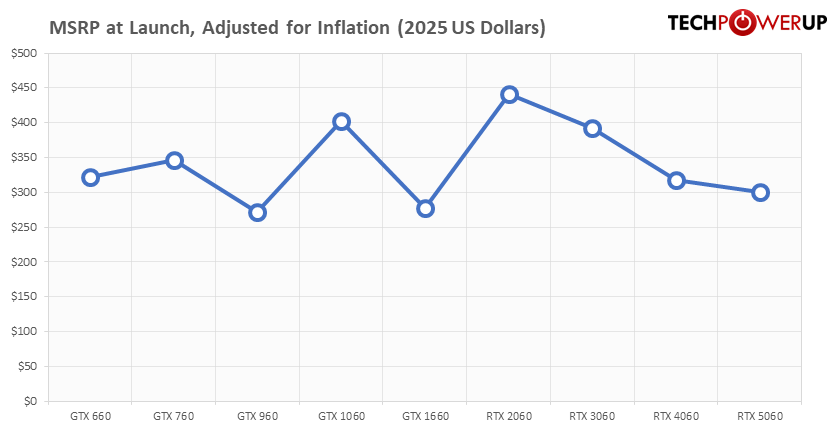
We keep hearing "but inflation," so I looked at that, too. Above you can see the MSRP prices adjusted for inflation, in 2025 US Dollars. For instance, the GTX 660 was priced at $230 in 2012. Today, you would need to spend $322 to match the buying power of that $230—wow, much more than I expected.
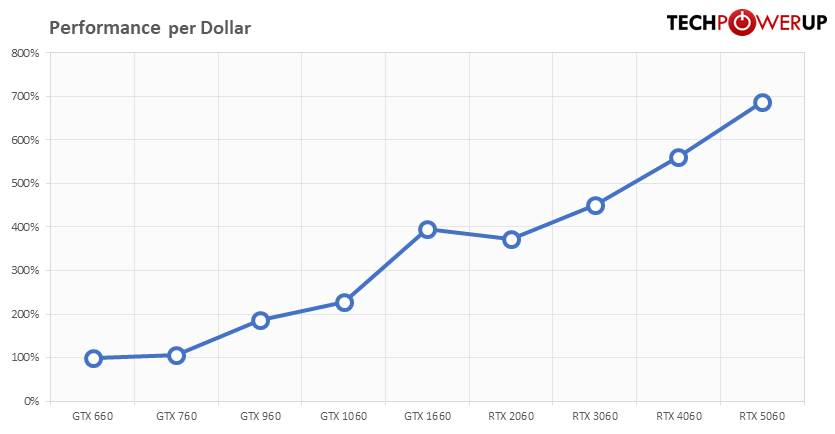
Here's our classic Performance-per-Dollar chart, taking into account the cost of the card and the performance offered.
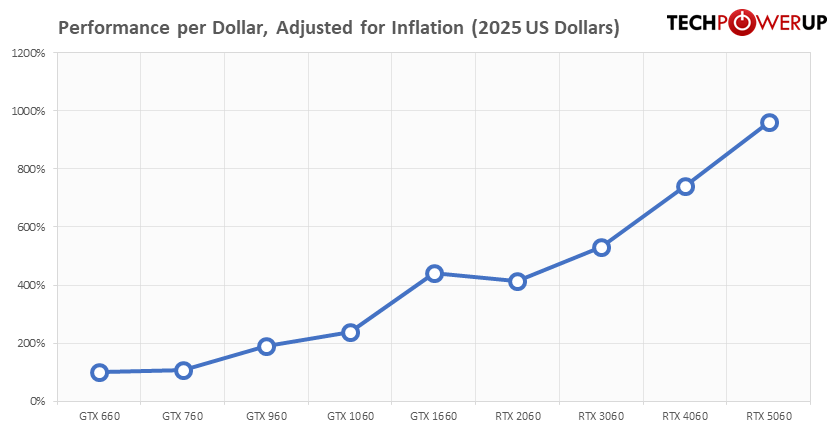
Using our inflation data from above, and plugging that into the perf-dollar values, we get this chart. Interestingly, the most standout card here is not the GTX 1060, despite its huge performance increases, but the GTX 1660, which was very affordable for its time and still offered a decent performance increase. Over the past 13 years covered in this article, performance per dollar has increased nearly tenfold. This means you're getting ten times(!) the frames per second for the same amount of money today compared to 2012.
Nov 24th, 2026 20:53 CST
change timezone
Latest GPU Drivers
New Forum Posts
- Ryzen Owners Zen Garden (8562)
- WarpCoreBench scores! (99)
- Can you guess Which game it is? (351)
- Asus Rog Maximus Z890 Extreme. (Various questions). (34)
- What are you playing? (26253)
- The time has come to upgrade...my desktop (12)
- Which ryzen am5 cpu ? (210)
- Your PC ATM (36503)
- X79 and/or rampage IV OC'ing thread for those of us still left.... (2453)
- {NA} 2026 Black November prices / deal (1)
Popular Reviews
- ASRock X870E Challenger Wi-Fi White Review
- Microsoft Surface Laptop Ultra Review - The Next-gen Arm Laptop
- Upcoming Hardware Launches 2027 (Updated Nov 2026)
- VZMORE AX9 Max Review
- AMD Ryzen 7 9800X3D Review - The Best Gaming Processor
- Corsair RM1200e (Second Generation) Review
- AMD Zen 6 Technical Deep Dive
- Phantom Blade Zero Performance Benchmark Review - 35 GPUs Tested
- Pulsar Office Tour & First Look at P1 Dual-Sensor Mouse
- Ocypus lota P1000 Review
TPU on YouTube
Controversial News Posts
- Jensen Huang Reinstated as CEO of NVIDIA (534)
- NVIDIA Co-Founder and CEO Jensen Huang Officially Resigns (492)
- Report: Jensen Huang Eyes NVIDIA Comeback (281)
- Open Letter Asking NVIDIA to Reinstate Jensen Huang Passes 115,000 Signatures (184)
- OpenAI CEO Argues Home PCs Waste the World's Limited DRAM Supply (152)
- NVIDIA Launches Investigation Into Jensen Huang's Relationship With Suspected Chinese Spy (136)
- Intel "Raptor Lake Next" 16-Core and 20-Core CPUs Surface (130)
- Intel Razor Lake Gets a 12 P-Core bLLC Chip With No E-Cores, Per Leak (94)