 12
Gigabyte MO32U24 Review - Penta Tandem Hits Its Stride
Value & Conclusion »Gaming Performance
The MO32U24 runs its QD-OLED panel at 240 Hz with adaptive synchronization across a 48 to 240 Hz range, carrying both FreeSync Premium Pro and G-Sync Compatible certification. VESA has also certified it under ClearMR 13000, placing it among the higher performance tiers of the standard.Response Time and Overdrive
I tested the response time with the Open Source Response Time Tool Pro (OSRTT Pro), developed by Andrew McDonald of TechTeamGB. It's a nifty tool that, combined with the OSRTT Launcher app, measures panel response times and presents them through detailed graphs and easy-to-read heatmaps. You can find everything you might want to know about the OSRTT in its technical documentation and on the official website, where you can order your unit, too. The OSRTT Launcher gives us three interesting heat maps to observe.Perceived Response Time tells us how much time the panel took to transition from one color to another. This measurement is expressed in milliseconds and includes overshoot. In other words, if the panel exceeded the target value, the perceived response time also includes the time it took for the transition to recover from overshoot and stabilize on the target value. I'm running my tests with recommended settings, so with a fixed RGB 5 tolerance level and with gamma-corrected RGB values.
RGB Overshoot tells us how much a specific transition missed the target value. For example, if the panel was transitioning from RGB 51 to RGB 204, and it initially landed on RGB 212, the overshoot RGB value is 8. Overshoot can be both positive and negative, and it commonly occurs at extreme overdrive settings when pixels are driven by high voltage. In practice, an overshoot manifests as an afterimage or a halo around a moving object. It can be easily spotted even when doing something as basic as scrolling through a webpage.
Visual Response Rating is the most abstract heatmap generated by the OSRTT Launcher; in essence, it's an ever-evolving scoring system. To quote OSRTT's technical documentation, it is a finite score rather than a direct measurement. The calculation is pretty simple; it's: "100 - (Initial Response Time + Perceived Response Time)". Since both metrics use the same tolerance level, if a display doesn't overshoot, both times will be identical. This essentially rewards displays that are fast with a small amount of overshoot over displays that aren't as fast even if they don't overshoot at all - while still overall preferring ultra-fast, accurate monitors.
Here's how the Gigabyte MO32U24 fares in the pixel response time test.
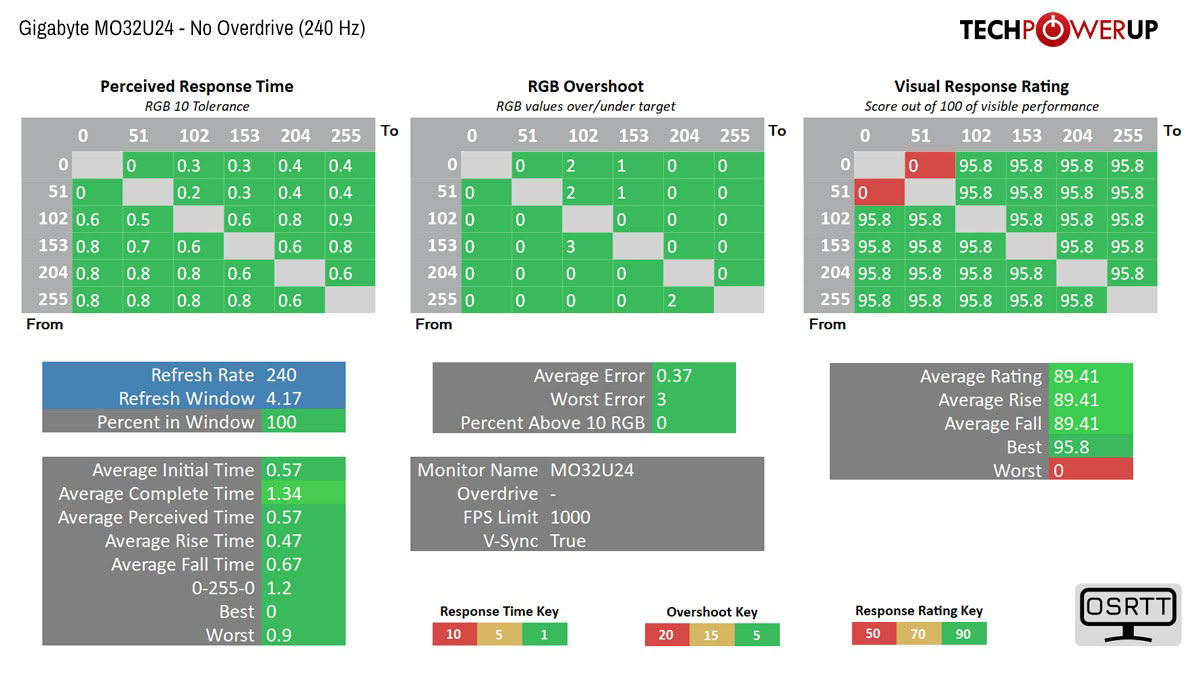
These are among the best response figures I have recorded. Average perceived response time is 0.57 ms and average complete time 1.34 ms. Rising transitions average 0.47 ms and falling transitions 0.67 ms, and the full 0 to 255 to 0 swing completes in 1.2 ms. The slowest single transition anywhere in the matrix is 0.9 ms. Against a 4.17 ms refresh window at 240 Hz, that puts 100% of transitions inside the frame time with a margin of more than four to one, which means the panel is nowhere near being the bottleneck at this refresh rate.
Overshoot is effectively absent. Average error across the matrix is 0.37 RGB levels and the worst single deviation is 3, with nothing approaching the 10 RGB threshold. There is no overdrive setting in the OSD and none is needed. OLED reaches these transition times through the physics of the emissive material rather than by driving pixels with excess voltage, which is why there is no inverse ghosting, no coronas and no tuning to get wrong.
The practical result is motion clarity that is limited by your eyes rather than by the display. Residual blur at 240 Hz comes from eye tracking across sample-and-hold frames, not from pixels failing to keep up. Fast pans stay legible, scrolling text stays readable, and there are no trails behind moving objects.
Input Lag
To measure the input lag of a monitor, I switched from using the LDAT V2 (Latency Display Analysis Tool), which I've covered extensively in my NVIDIA Reflex review, and started using the OSRTT Pro Tool. The OSRTT Pro Tool and the accompanying software include DirectX code developed by Andrew McDonald of TechTeamGB, which allows the OSRTT Launcher to track the events and capture the frame time, making it possible to isolate the monitor latency from other factors that come into play when using the click-to-photon testing methodology, namely the USB polling rate and game render time. For a deeper insight, I suggest you watch an excellent overview video made by Andy himself.Here's how the Gigabyte MO32U24 holds up in terms of input lag after doing 100 iterations of the input lag test.
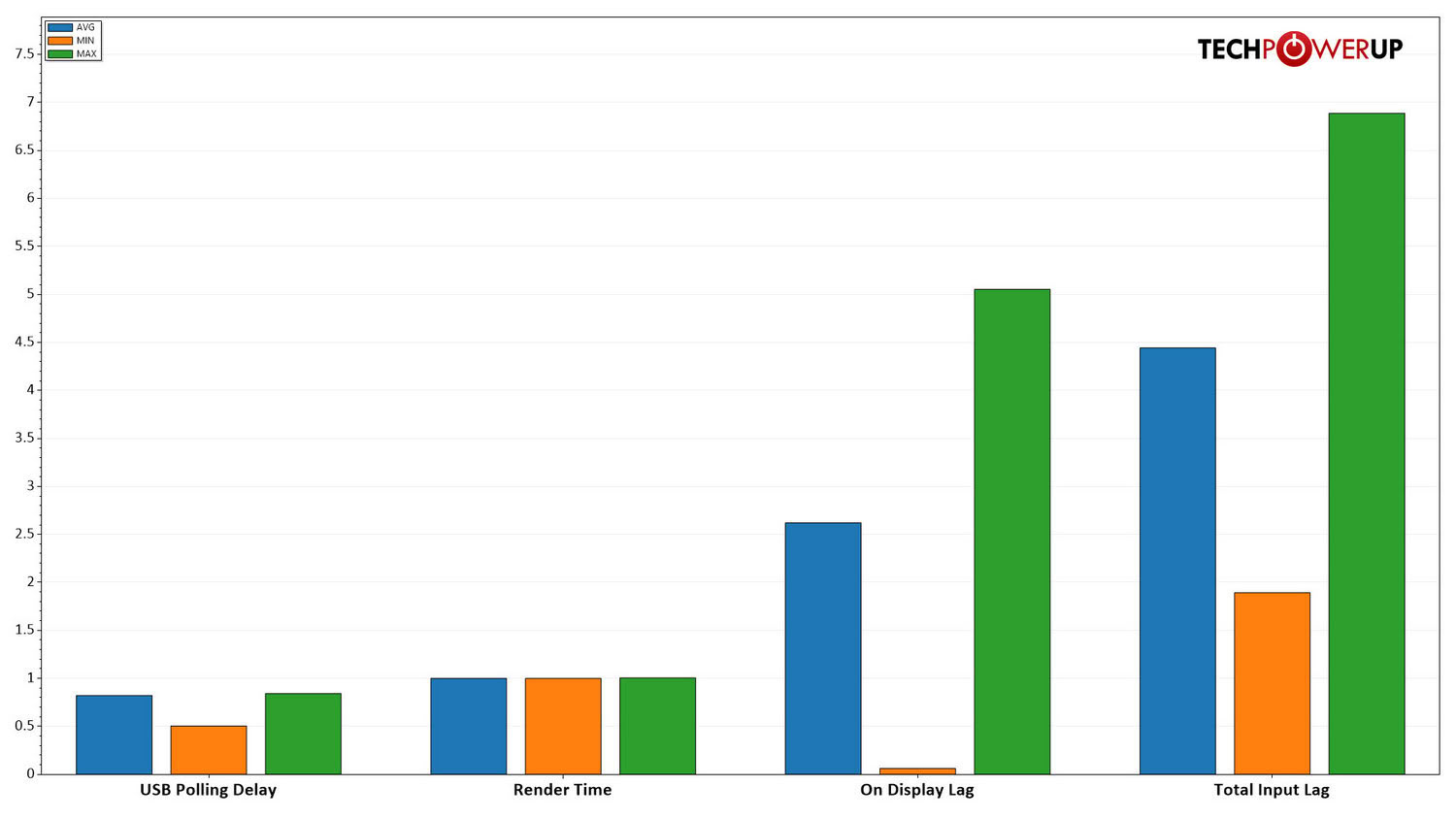
On-display lag averages 2.61 ms, with the fastest sample effectively immeasurable at under 0.1 ms and the slowest at 5.05 ms. At 240 Hz, a single frame interval is 4.17 ms, so the monitor is adding around 0.63 of a frame of processing delay on average. This is the figure that describes the display itself, the time it needs to actually show a frame it has already been handed, with USB polling and render time excluded because those belong to the rest of the system rather than to the monitor.
For context, the MSI MPG 322URX I tested previously averaged 5.9 ms of on-display lag on a comparable 32-inch 4K 240 Hz QD-OLED. The MO32U24 more than halves that. There is no scenario in which this display is the limiting factor in your reaction time.
Other Notable Gaming Features
OLED VRR Anti-Flicker addresses the brightness and gamma fluctuation that OLED panels can exhibit during variable refresh operation, particularly at low frame rates in dark scenes. Gigabyte exposes it as a user setting rather than burying it in firmware, which is unusual and welcome, since the mitigation involves constraining the effective VRR range and different users will weigh that trade-off differently.Tactical Switch 2.0 is a physical button on the underside of the bezel that triggers instant resolution and display size switching without entering the OSD. It is aimed at competitive shooter players who prefer lower and stretched resolutions, since distorting the aspect ratio makes enemy models visually wider and easier to hit.
AI Black Equalizer lifts shadow detail, but instead of applying a fixed amount of black level elevation the way conventional implementations do, it adapts to what is onscreen. Night Vision goes considerably further and tints the entire image green, literally as though you had put on a pair of night vision goggles, which makes dark spaces readable and anyone hiding in them easier to spot. AI Picture Mode watches what you are doing and selects an appropriate SDR preset on its own. All three compromise image fidelity, Night Vision drastically so, and none belongs anywhere near work where color accuracy matters. In a competitive match they do the job they were built for. Game Assist rounds things out with the familiar overlays, a crosshair, a timer and a zoom function for a selected part of the screen, while PiP and PbP handle two sources at once.
Nov 18th, 2026 12:28 CST
change timezone
Latest GPU Drivers
New Forum Posts
- WarpCoreBench scores! (62)
- Very unusual two gaming-pc scenarios. (4)
- Honestly, do you care about GTA VI? (141)
- Wireless Internet sharing between PC and router both-ways, is it possible? (17)
- My Final Barrier to Exclusively Using Linux has Fallen (Azure Virtual Desktops) (9)
- Ghetto Mods (4883)
- [Intel AX1xx/AX2xx/AX4xx/AX16xx/BE2xx/BE17xx] Intel Modded Wi-Fi Driver with Intel® Killer™ Features (633)
- RX 580 2048SP 8GB Samsung – Black Screens in Games, Looking for a Compatible BIOS (2)
- DTS DCH Driver for Realtek HDA [DTS:X APO4 + DTS Interactive] (2812)
- Time to upgrade CPU and MOBO (31)
Popular Reviews
- Acemagic Retro X3 Review
- Upcoming Hardware Launches 2027 (Updated Nov 2026)
- AMD Zen 6 Technical Deep Dive
- ASUS ROG Strix B850-I Gaming Wi-Fi7 W Review
- Corsair HX1000i Shift Crystal Review
- Biwin Black Opal NV7400 2 TB Review
- Chieftec Iceberg PRO 360 DARK Review
- AMD Ryzen 7 9800X3D Review - The Best Gaming Processor
- Phantom Blade Zero Performance Benchmark Review - 35 GPUs Tested
- Montech King 95 3D PRO Review
TPU on YouTube
Controversial News Posts
- NVIDIA Co-Founder and CEO Jensen Huang Officially Resigns (477)
- Open Letter Asking NVIDIA to Reinstate Jensen Huang Passes 115,000 Signatures (184)
- Report: Jensen Huang Eyes NVIDIA Comeback (184)
- OpenAI CEO Argues Home PCs Waste the World's Limited DRAM Supply (152)
- NVIDIA Launches Investigation Into Jensen Huang's Relationship With Suspected Chinese Spy (136)
- Intel "Raptor Lake Next" 16-Core and 20-Core CPUs Surface (130)
- Legendary Game Studio BioWare Shuts Down Following EA Layoffs (104)
- Dell CEO Says the Memory Shortage Will Get Worse in 2027 (95)