 152
Intel Arc A380 Review - Runs Fine on AMD Ryzen
(152 Comments) »Introduction

At long last, here's our first graphics card review in 14 years that covers a non-NVIDIA, non-AMD discrete GPU, with the last one being 2008's S3 Chrome 440 GTX. The new Intel Arc A380 may be an entry-level graphics card, but carries the weight of the world on its shoulders for Intel Graphics. The new Arc "Alchemist" graphics card family is part of Intel's first attempt to return to the gaming graphics space in over two decades. The company's last swing was "Larrabee" GPU, which missed the bus with performance/price positioning, and was re-purposed as an HPC accelerator. With the new Xe-HPG graphics architecture, Intel is pulling out all stops at developing a modern GPU that gamers would actually want. The entire lineup meets DirectX 12 Ultimate requirements, including real-time ray tracing.

The Intel Arc A380 in today's review is an entry-mainstream discrete graphics card that has the complete software feature-set of Xe-HPG. It's positioned as a mainstream gaming product that has some serious creator chops in the form of accelerated AV1 video encoding. Intel has a feature rivaling the DLSS and FSR, which it calls XeSS (Xe Super Sampling), letting you dial resolutions a notch above what this card is capable of playing at. Several popular e-sports titles should be playable at resolutions as high as Full HD.
The Arc "Alchemist" product development project, which Intel correctly calls an "Odyssey," bore fruit in Q2-2022, with a debut in the notebook space, followed shortly by a desktop debut with the A380—the card we're reviewing today. Intel decided to sell their card to the Chinese local market first. You can't yet buy the A380 in the US or Europe, but can probably import one from China, like we did. Intel has a selection of board partners such as ASRock, MSI and ASUS developing their custom-design A380 graphics cards, but the one we have with us today, is the GUNNIR Photon Arc A380, a brand that's been first to market with these cards in China.
A word on the nomenclature. "Intel Graphics" is the company's division tasked with development all of the company's GPU IP, including the iGPUs found in the company's processors. The "Xe" architecture, which debuted toward the end of the last decade, is a bottoms-up graphics IP initiative designed to double graphics performance with each generation. When it debuted with the 11th Gen Core Tiger Lake mobile processors, it was internally referred to by the processor SoC team as "Gen 12." Xe has several derivatives based on the target application and scale involved (whether it's low-power integrated graphics, or high-performance discrete graphics, or HPC compute). Xe-HPG is the derivative powering the Arc "Alchemist" series. "Arc" is a discrete GPU brand, just like "GeForce" or "Radeon"; while "Alchemist" is codename for the first generation of discrete GPUs by Intel (which happen to be based on Xe-HPG). The "A" in A380 denotes "Alchemist," and "3" denotes product segment, while "80" denotes a sub-variant within the product segment. The Arc 3-series are entry-mainstream, Arc 5-series are mid-range, and Arc 7-series are performance-segment.
The Arc A380 is based on the ACM-G11 / DG2-128 silicon that's fabricated using the 6 nm process at TSMC. It maxes out this chip, in featuring all 128 execution units (EUs) physically present, spread across 8 Xe Cores, which work out to 1,024 unified shaders. The card comes with 6 GB of GDDR6 memory across a 96-bit wide memory interface that ticks at 15.5 Gbps, working out to 186 GB/s of memory bandwidth. The card features a PCI-Express 4.0 x8 system bus, and Intel made it abundantly clear to everyone that Resizable BAR plays a big role in the card's performance. Although the GPU's typical power draw is rated by Intel at 75 W, GUNNIR gave the Photon A380 an overkill 8-pin PCIe power connector, for a total of 225 W of power capability.
The GUNNIR Photon Arc A380 is priced at the equivalent of $150, but not available at this price point, not even in China. Currently the card sells for the equivalent of $190. We take the card for a spin to tell you if Intel is off to a good start.
| Price | Cores | ROPs | Core Clock | Boost Clock | Memory Clock | GPU | Transistors | Memory | |
|---|---|---|---|---|---|---|---|---|---|
| GTX 1630 | $140 | 512 | 32 | 1740 MHz | 1785 MHz | 1500 MHz | TU117 | 4700M | 4 GB, GDDR6, 64-bit |
| GTX 1650 | $150 | 896 | 32 | 1485 MHz | 1665 MHz | 2000 MHz | TU117 | 4700M | 4 GB, GDDR5, 128-bit |
| RX 6400 | $150 | 1024 | 32 | 2039 MHz | 2321 MHz | 2000 MHz | Navi 24 | 5400M | 4 GB, GDDR6, 64-bit |
| Arc A380 | $190 | 1024 | 32 | 2450 MHz | N/A | 1937 MHz | ACM-G11 | 7200M | 6 GB, GDDR6, 96-bit |
| GTX 1650 Super | $180 | 1280 | 32 | 1530 MHz | 1725 MHz | 1500 MHz | TU116 | 6600M | 4 GB, GDDR6, 128-bit |
| RX 5500 XT | $190 | 1408 | 32 | 1717 MHz | 1845 MHz | 1750 MHz | Navi 14 | 6400M | 4 GB, GDDR6, 128-bit |
| GTX 1660 Super | $200 | 1408 | 48 | 1530 MHz | 1785 MHz | 1750 MHz | TU116 | 6600M | 6 GB, GDDR6, 192-bit |
| RX 5600 XT | $210 | 2304 | 64 | 1375 MHz | 1560 MHz | 1500 MHz | Navi 10 | 10300M | 6 GB, GDDR6, 192-bit |
| RX 6500 XT | $170 | 1024 | 32 | 2685 MHz | 2825 MHz | 2248 MHz | Navi 24 | 5400M | 4 GB, GDDR6, 64-bit |
| RTX 2060 | $250 | 1920 | 48 | 1365 MHz | 1680 MHz | 1750 MHz | TU106 | 10800M | 6 GB, GDDR6, 192-bit |
| RTX 2060 Super | $360 | 2176 | 64 | 1470 MHz | 1650 MHz | 1750 MHz | TU106 | 10800M | 8 GB, GDDR6, 256-bit |
| RX Vega 64 | $320 | 4096 | 64 | 1247 MHz | 1546 MHz | 953 MHz | Vega 10 | 12500M | 8 GB, HBM2, 2048-bit |
| RX 5700 XT | $300 | 2560 | 64 | 1605 MHz | 1755 MHz | 1750 MHz | Navi 10 | 10300M | 8 GB, GDDR6, 256-bit |
| RTX 3050 | $320 | 2560 | 32 | 1552 MHz | 1777 MHz | 1750 MHz | GA106 | 12000M | 8 GB, GDDR6, 128-bit |
| RTX 2070 | $310 | 2304 | 64 | 1410 MHz | 1620 MHz | 1750 MHz | TU106 | 10800M | 8 GB, GDDR6, 256-bit |
| RX 6600 | $280 | 1792 | 64 | 2044 MHz | 2491 MHz | 1750 MHz | Navi 23 | 11060M | 8 GB, GDDR6, 128-bit |
| RTX 3060 | $370 | 3584 | 48 | 1320 MHz | 1777 MHz | 1875 MHz | GA106 | 12000M | 12 GB, GDDR6, 192-bit |
Architecture
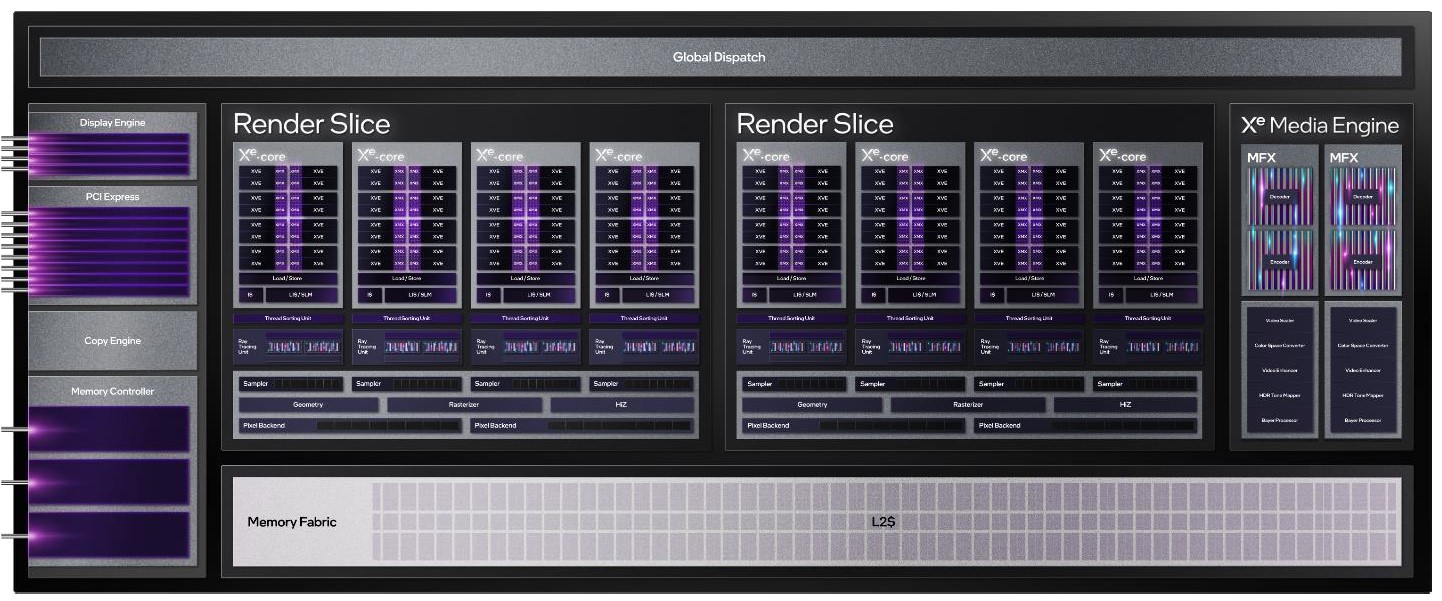
At the heart of the Intel Arc A380 is the ACM-G11 silicon, also known as the DG2-128, for its 128 execution units. Built on the TSMC 6 nm silicon fabrication process, this chip is based on the Intel Xe-HPG graphics architecture. The silicon-level hierarchy sees the Global Dispatch crossbar move data among the five key IP blocks of the silicon. The I/O block, with the chip's PCI-Express 4.0 x8 bus interface, a 96-bit GDDR6 memory interface, and the Display Engine supporting up to four displays. The Xe Media Engine provides hardware-acceleration for encoding and decoding of various video formats, including AV1, and H.265 HEVC. The Memory Fabric shares an L2 cache among the other components, and cushions data-transfers with the memory interface. The star attractions, however, are the Render Slices, where the actual graphics rendering happens. The DG2-128 has two of these.

Each Render Slice packs four Xe Cores—the indivisible SIMD muscle of the Xe-HPG architecture. There are also four Ray Tracing Units, one per Xe Core. These perform hardware-accelerated ray intersection calculations. Also shared among the four Xe Cores are four Samplers, a Geometry Engine, a Rasterizer, and two Pixel Backends.


The Xe Core is the main number crunching machinery of the GPU, featuring 16 XVE SIMD units, and an equal number of XMX matrix-multiplication engines; along with a load/store unit, and certain level-1 caches. Each XVE (or Execution Unit) amounts for 8 unified shaders. There are hence 16 EUs per Xe Core, 64 per Render Slice, and 128 on the DG2-128 silicon.

The Xe Display Engine is capable of up to two display outputs at 8K 60 Hz + HDR; up to four outputs at 4K 120 Hz + HDR, and up to four 1440p or 1080p with 360 Hz + HDR. VESA Adaptive Sync and Intel Smooth Sync features are supported. The latter is a feature that runs the GPU at its native frame-rate, while attempting to remove the screen-tearing from the display output. A typical A380 desktop graphics card has two each of DisplayPort 2.0 and HDMI 2.0b connections. The Xe Media Engine provides hardware-accelerated decoding and encoding of AV1, and accelerated decoding of H.265 HEVC, and H.264 AVC.
Packaging


Note the missing letter in "unknown". Surprising that nobody at Intel looked at the package design before release (or nobody noticed, or cared).
The Card


Visually the Gunnir Arc A380 looks nice; the cooler shroud has plenty of surface details and uses a clean black color theme. On the back you'll find a high-quality metal backplate with some "Intel blue" highlights.
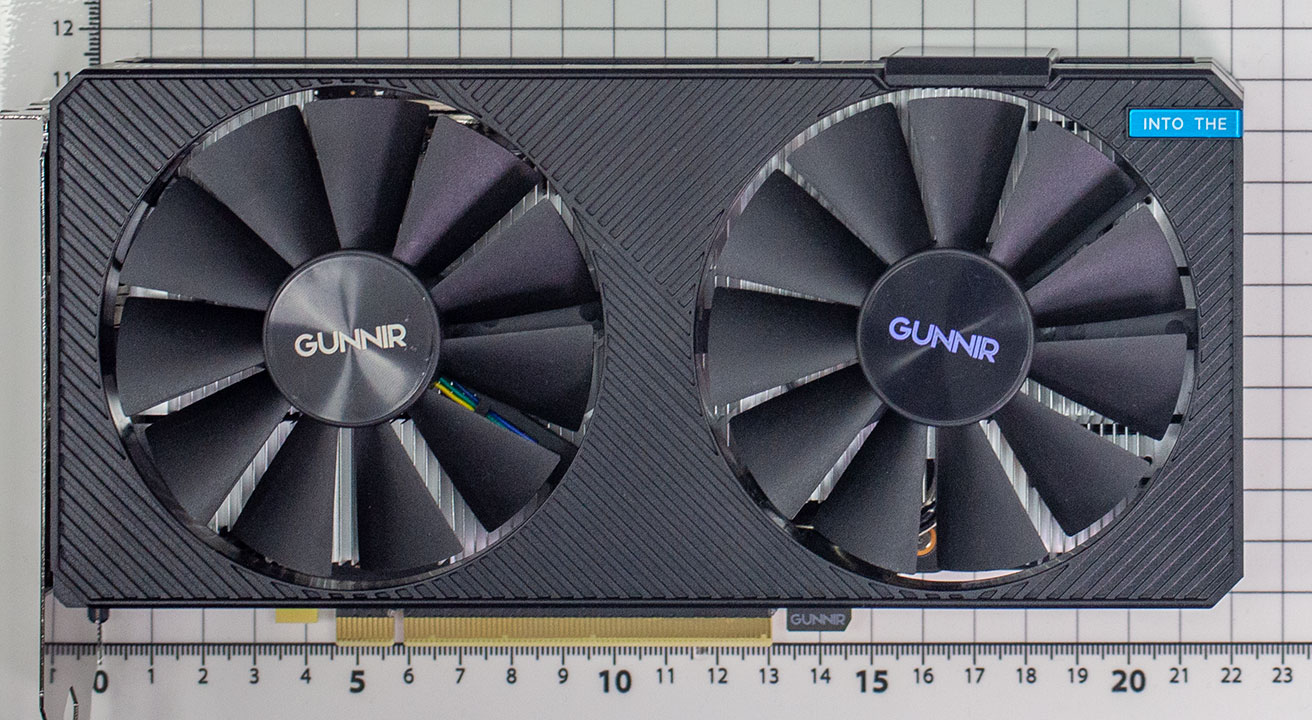

Dimensions of the card are 22.5 x 11.5 cm, and it weighs 694 g.


Installation requires two slots in your system.

Display connectivity includes three standard DisplayPort 2.0 ports and one HDMI 2.0b.

The card has one 8-pin power input. This configuration is rated for up to 225 W of power draw.
Teardown


The Gunnir thermal solution uses a single double-length heatpipe that makes direct contact with the GPU chip surface. The actual heatsink is aluminium and provides cooling not only for the GPU, but also the memory chips. The VRMs are uncooled and there is barely any airflow reaching them, but given the low power requirements this should be no problem.

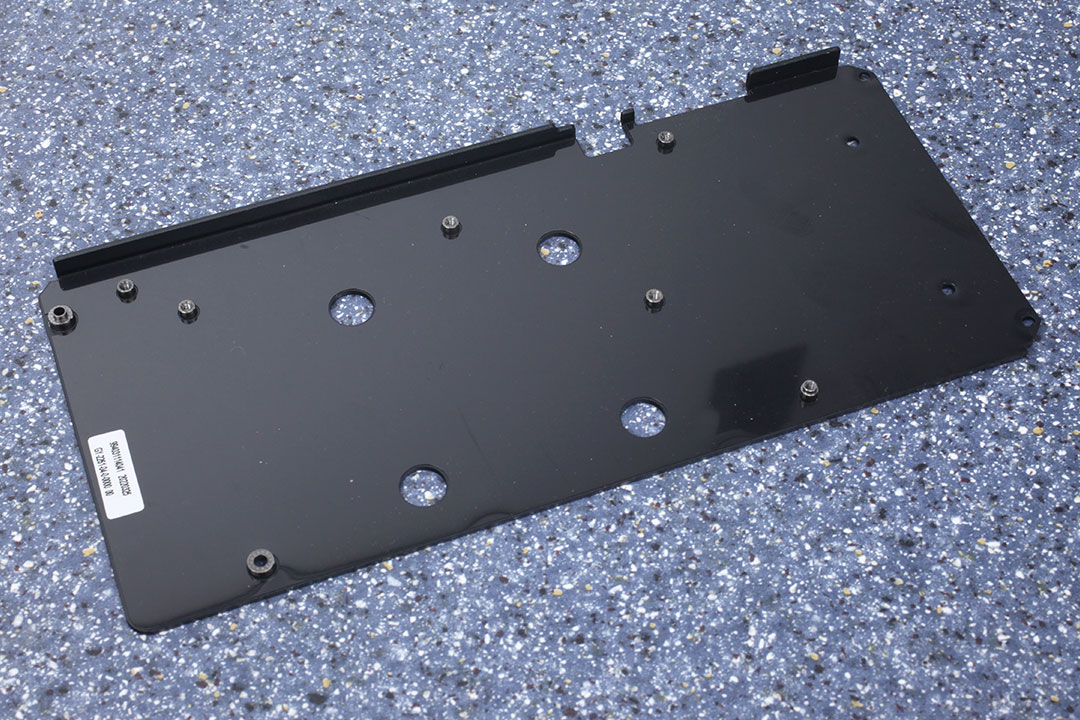
The metal backplate protects the card during installation and handling.
High-resolution PCB Pictures
These pictures are for the convenience of volt modders and people who would like to see all the finer details on the PCB. Feel free to link back to us and use these in your articles, videos or forum posts.

High-resolution versions are also available (front, back).
Our Patreon Silver Supporters can read articles in single-page format.
Nov 11th, 2026 03:09 CST
change timezone
New Forum Posts
- I cannot download games that are larger than 30–40 GB. (82)
- Meeting point of those who broke their GPUs. Please share what GPUs you've burned, shattered, ionized or melted accidentally. (33)
- Excessively high prices for RAM (88)
- Warning for Windows 10 and 11 users running newer AMD GPU drivers (42)
- budget home NAS – X79, X99 or another platform? (126)
- What are you playing? (26204)
- When you could finally run Crysis maxed out? (19)
- What Speakers Are You You Using For Your Computer (346)
- Lets talk PC Audio (388)
- Current Sales, Bundles, Giveaways (10445)
Popular Reviews
- AMD Zen 6 Technical Deep Dive
- Upcoming Hardware Launches 2027 (Updated Nov 2026)
- Gigabyte Z890I Aorus Ultra Review
- INNOCN 45C1R Review - Two QHD Screens, Zero Bezels
- XPG NIMBUS PLUS Review - Mid-range Chair With Strong Competitors
- Phantom Blade Zero Performance Benchmark Review - 35 GPUs Tested
- Gears of War: E-Day Performance Benchmark Review - 35 GPUs Tested
- NZXT H7 RGB+ Review
- be quiet! Light Mount TKL Keyboard Review
- NZXT H5 Review
TPU on YouTube
Controversial News Posts
- OpenAI CEO Argues Home PCs Waste the World's Limited DRAM Supply (152)
- NVIDIA Launches Investigation Into Jensen Huang's Relationship With Suspected Chinese Spy (136)
- Intel "Raptor Lake Next" 16-Core and 20-Core CPUs Surface (130)
- Legendary Game Studio BioWare Shuts Down Following EA Layoffs (104)
- Dell CEO Says the Memory Shortage Will Get Worse in 2027 (95)
- NVIDIA GeForce RTX 50-Series Scheduled for up to $500 Price Hike This Week (88)
- Modder Fits RTX 5090 With Four 8-Pin Connectors, Halving Current per Wire (80)
- AMD Radeon Owners Can Now Run Nearly Every DLSS Feature Through Fan-Made Mod (80)