 126
Intel Panther Lake Technical Deep Dive
Performance & Efficiency Claims »Integrating Dedicated Acceleration into a Unified Compute Framework


Panther Lake integrates several dedicated processing blocks for AI and media workloads, all connected through the same coherent memory fabric as the CPU and GPU. This lets the engines exchange data directly without round-tripping through system memory, reducing latency and power. Intel's goal with this generation is to make AI processing a standard capability rather than a specialized feature, so that software developers can begin to rely on it across mainstream devices.


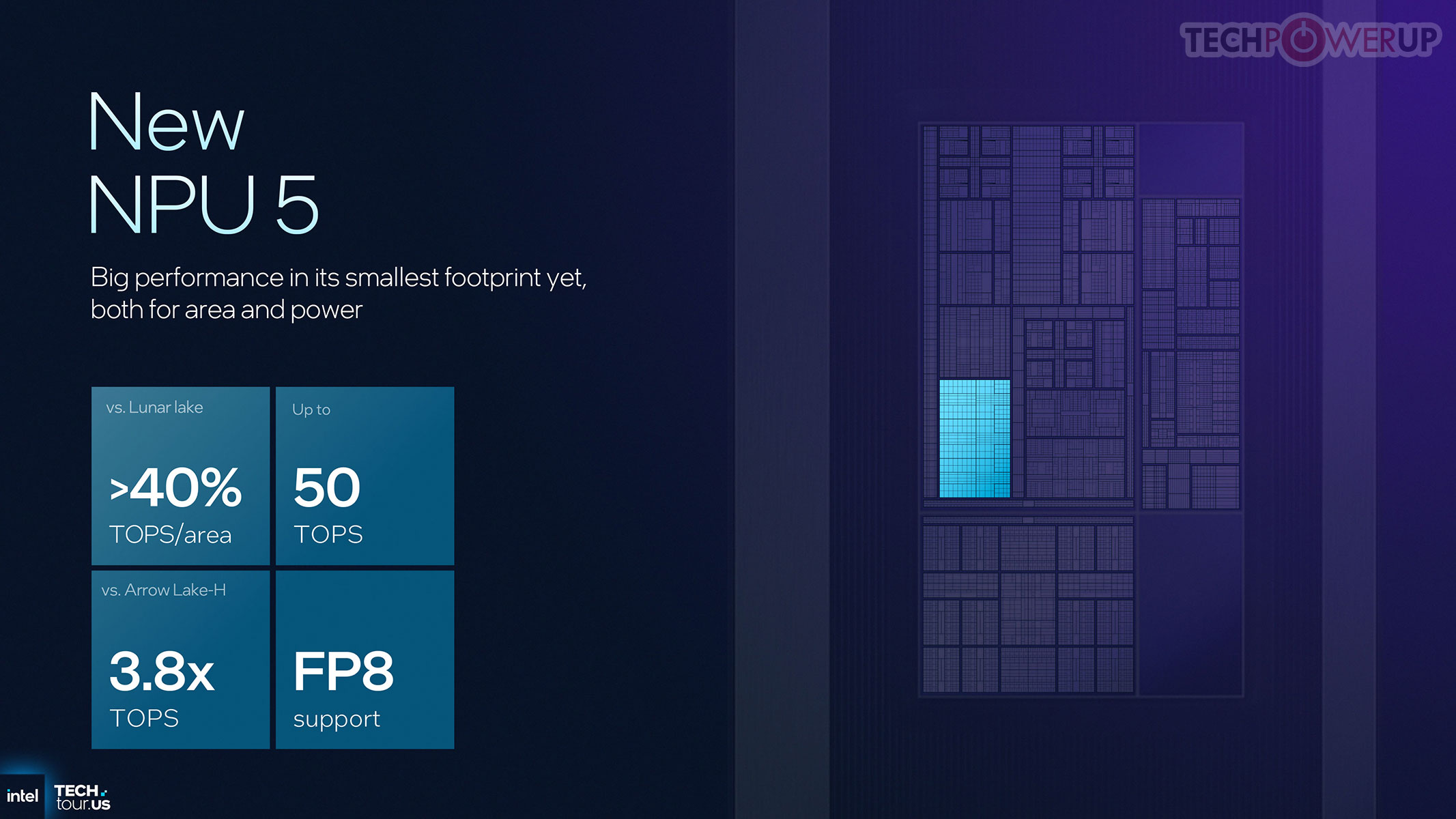
The neural processing unit (NPU5) in Panther Lake delivers 48 TOPS, which is roughly similar to Lunar Lake. The big difference is that Intel was able to reduce the area of the NPU, which helps lower its cost. Reducing the NPU's footprint was a key design goal, since it remains an area-expensive block at a time when relatively few consumer applications make heavy use of it. Intel's position is that the hardware needs to ship broadly now to encourage developers to adopt on-device AI frameworks. Without that availability, the ecosystem faces a chicken-and-egg problem where applications cannot depend on NPUs because too few systems include them.

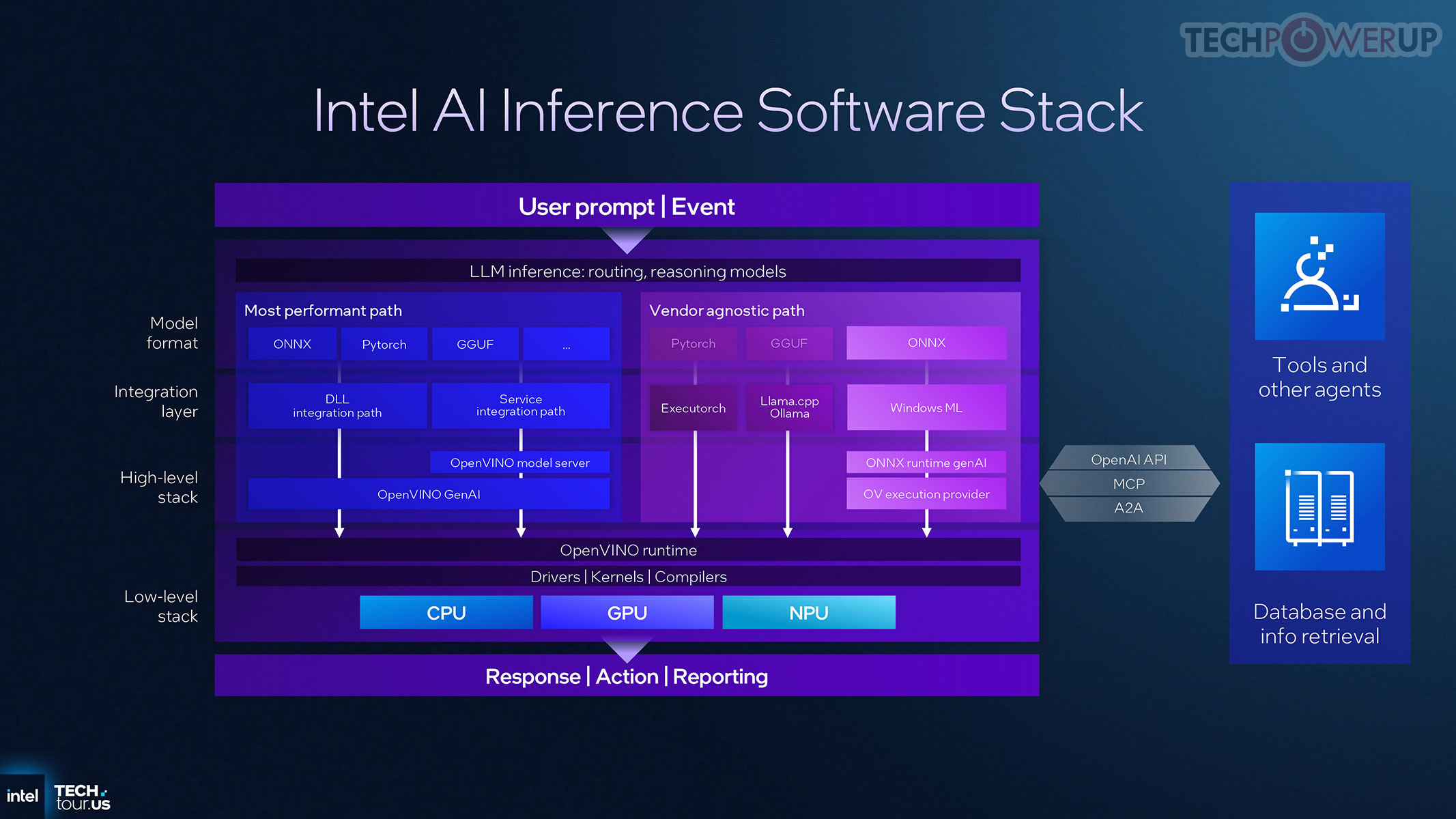

Panther Lake continues to rely on the OpenVINO runtime, providing a single software layer for dispatching AI workloads across the CPU, GPU, and NPU. The framework automatically determines which engine offers the best balance between latency and energy use, and it integrates with Windows ML, DirectML, and ONNX Runtime. This helps ensure that applications built for AI acceleration will scale across future Intel architectures without modification.


The image processing unit (IPU 7.5) handles camera and video input directly on the SoC, connecting to the shared fabric and using the memory-side cache within the compute tile for local buffering. This setup reduces latency in webcam and video capture workflows, while allowing the IPU to share frames with the GPU or NPU for further enhancement. Multi-camera input, HDR capture, and background segmentation can all be offloaded here, minimizing CPU involvement.

The IPU and NPU work together for AI-based video enhancement. The IPU performs early-stage processing such as noise reduction and white balance, then passes data through the fabric to the NPU or GPU for higher-level inference tasks. This direct exchange avoids full memory copies and allows real-time effects such as portrait blur or color tone adjustment to run continuously at low power. Many effects (e.g., tone mapping) can dynamically choose the GPU or NPU path depending on load and latency needs.

Examples of hybrid workloads include real-time noise suppression during video calls, automatic scene detection, or AI-assisted photo enhancement. These tasks combine the IPU for sensor input, the NPU for inference, and the GPU for display and composition, all coordinated through shared memory. Most of these operations run transparently under the OS's AI service layer, with applications calling standard frameworks rather than controlling the accelerators directly.
Nov 23rd, 2026 03:53 CST
change timezone
Latest GPU Drivers
New Forum Posts
- Your PC ATM (36461)
- repair an NVIDIA Quadro M4000 (3)
- GTA VI (23)
- Honestly, do you care about GTA VI? (272)
- Youtube channel video downloader, not playlist. (2)
- Can you guess Which game it is? (347)
- Increasing Power Limit? (10)
- Last game you purchased? (1416)
- Anker SOLIX C2000 Gen 2 + PS400 Solarpanel (1)
- What are you playing? (26241)
Popular Reviews
- Microsoft Surface Laptop Ultra Review - The Next-gen Arm Laptop
- Corsair RM1200e (Second Generation) Review
- Upcoming Hardware Launches 2027 (Updated Nov 2026)
- Pulsar Office Tour & First Look at P1 Dual-Sensor Mouse
- Ugreen NASync DXP4800 GT Review
- AMD Ryzen 7 9800X3D Review - The Best Gaming Processor
- AMD Zen 6 Technical Deep Dive
- Phantom Blade Zero Performance Benchmark Review - 35 GPUs Tested
- AMD Ryzen 7 5800X3D 10th Anniversary Review
- Biwin Black Opal NV7400 2 TB Review
TPU on YouTube
Controversial News Posts
- NVIDIA Co-Founder and CEO Jensen Huang Officially Resigns (492)
- Report: Jensen Huang Eyes NVIDIA Comeback (266)
- Open Letter Asking NVIDIA to Reinstate Jensen Huang Passes 115,000 Signatures (184)
- OpenAI CEO Argues Home PCs Waste the World's Limited DRAM Supply (152)
- NVIDIA Launches Investigation Into Jensen Huang's Relationship With Suspected Chinese Spy (136)
- Intel "Raptor Lake Next" 16-Core and 20-Core CPUs Surface (130)
- NVIDIA GeForce RTX 50-Series Scheduled for up to $500 Price Hike This Week (89)
- Intel Razor Lake Gets a 12 P-Core bLLC Chip With No E-Cores, Per Leak (86)